
Skip to content
  • Facebook
  • X
  • Linkedin
  • WhatsApp
  • YouTube
  • Associate Journalism
  • About Us
  • Privacy Policy
  • 033-46046046
  • editor@artifex.news
Artifex.News

Artifex.News

Stay Connected. Stay Informed.

  • Breaking News
  • World
  • Nation
  • Sports
  • Business
  • Science
  • Entertainment
  • Lifestyle
  • Toggle search form
  • Top Lawyer KK Venugopal On Judicial Independence
    Top Lawyer KK Venugopal On Judicial Independence Nation
  • “BJP B-Team Now Officially Part of NDA”: Congress On Kumaraswamy’s Party
    “BJP B-Team Now Officially Part of NDA”: Congress On Kumaraswamy’s Party Nation
  • The virtues of the tomato, a healthy vegetable
    The virtues of the tomato, a healthy vegetable Science
  • Access Denied Sports
  • Maharashtra Records 65% Voter Turnout In High-Stakes Assembly Elections
    Maharashtra Records 65% Voter Turnout In High-Stakes Assembly Elections Nation
  • Access Denied Sports
  • Delhi Civic Body To Install Mist Sprayers On Electric Poles To Fight Air Pollution
    Delhi Civic Body To Install Mist Sprayers On Electric Poles To Fight Air Pollution Nation
  • Travis Head Breaks Silence After Josh Hazelwood’s Comments Suggesting Divide In Australian Team
    Travis Head Breaks Silence After Josh Hazelwood’s Comments Suggesting Divide In Australian Team Sports
IISc team finds ancient proteins that hint at life’s leap in complexity

IISc team finds ancient proteins that hint at life’s leap in complexity

Posted on August 24, 2025 By admin


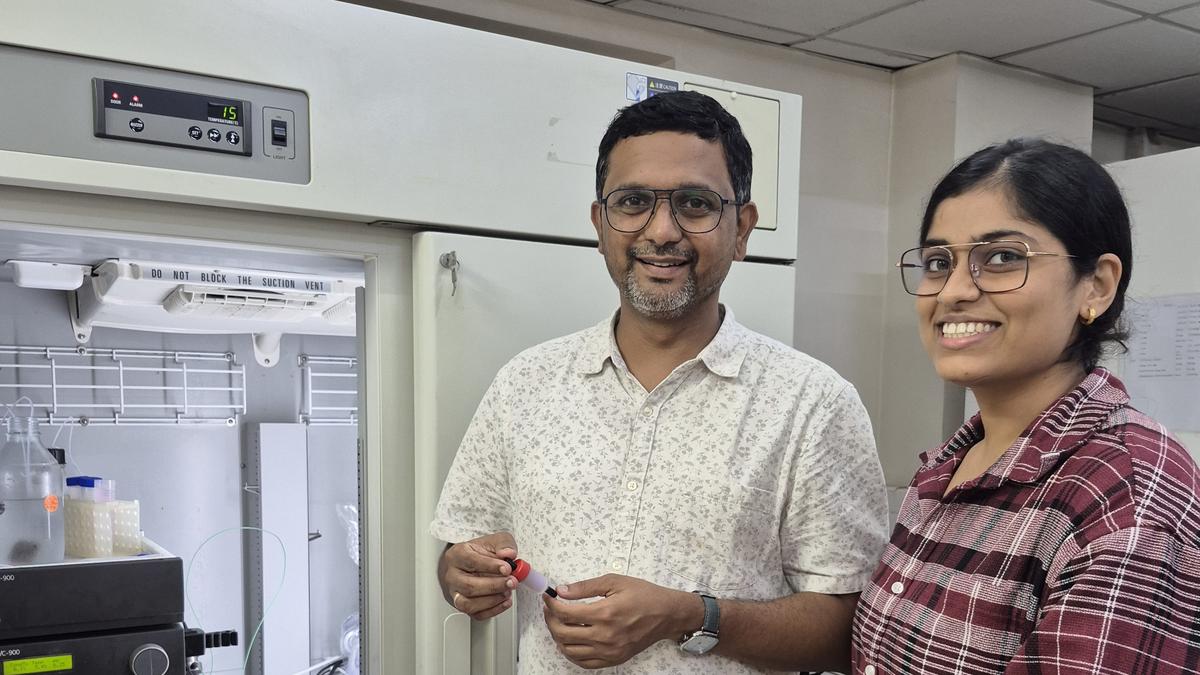
Project members Saravanan Palani and Jayanti Kumari.
| Photo Credit: Special arrangement

One of biology’s biggest mysteries is how simple cells evolved into the complex cells we see in animals, plants, and fungi. Simple cells like bacteria and archaea usually have fewer parts and simpler machinery. Eukaryotic cells, on the other hand, have elaborate internal structures and complicated systems for dividing and maintaining their shape.

To understand how this transition happened, scientists study a special group of archaea called the Asgard archaea. These microbes are considered the closest living relatives of eukaryotes and their genes provide important clues about how complexity first arose.

A key piece of this puzzle is the cytoskeleton, the network of proteins that gives cells their shape and helps them divide. In bacteria, the FtsZ protein is essential for cell division. Eukaryotes rely on related proteins such as tubulin, which perform more advanced functions.

In a new study published in The EMBO Journal, Indian Institute of Science researchers have reported that Odinarchaeota, a member of the Asgard group, has two versions of the FtsZ gene, along with a tubulin-like gene. This is unusual: most microbes only carry one.

The researchers analysed the two FtsZ proteins using phylogenetic studies, biochemical tests, and cryo-electron microscopy. They examined how each protein assembled in the presence of energy-carrying molecules like GTP, and tested whether they could bind to artificial membranes.

The two proteins showed distinct behaviours. OdinFtsZ1 formed straight protofilaments similar to bacterial FtsZ and could anchor directly to membranes. OdinFtsZ2 formed unusual spiral ring-like structures and needed the help of an adaptor protein to attach to membranes. When both proteins were tested together, they interacted, suggesting they may cooperate in actual cells.

The differences point to a division of labour between the two paralogs. This means cytoskeletal proteins in archaea can divide into specialised roles, a sign of growing cellular complexity. The combination of two FtsZ systems and a tubulin-like protein indicates Asgard archaea were experimenting with many structural strategies, possibly foreshadowing the diverse cytoskeletal machinery of eukaryotes.

“These proteins give us a rare snapshot of a turning point in evolution, where life began building the dynamic skeleton that supports all higher organisms today,” project lead Saravanan Palani told The Hindu. He added that next, the team will grow Asgard microbes in the lab to “observe these proteins in living cells, potentially offering a real-time view of one of evolution’s greatest leaps.”

Published – August 24, 2025 05:45 am IST



Source link

Science

Post navigation

Previous Post: Tobacco control laws are out of step with smokeless tobacco
Next Post: ‘There’s an appetite for newer products which is reflective of a younger India’, says Mallika Srinivasan

Related Posts

  • The power of choice: a case for life-saving modern contraception
    The power of choice: a case for life-saving modern contraception Science
  • Can ‘good sounds’ help coral islands recover from bleaching?
    Can ‘good sounds’ help coral islands recover from bleaching? Science
  • Why do medium-sized land animals like cheetahs tend to be fastest?
    Why do medium-sized land animals like cheetahs tend to be fastest? Science
  • Mitochondria keep your brain cells alive − helping them run smoothly may protect against Parkinson’s disease
    Mitochondria keep your brain cells alive − helping them run smoothly may protect against Parkinson’s disease Science
  • New genus of jumping spiders ‘Tenkana’ discovered in south India
    New genus of jumping spiders ‘Tenkana’ discovered in south India Science
  • The tech that keeps our vehicles from bumping into each other | Explained
    The tech that keeps our vehicles from bumping into each other | Explained Science

More Related Articles

Improving the compatibility of pig organs for transplantation into humans Improving the compatibility of pig organs for transplantation into humans Science
Rhino dehorning brings poaching in African reserves crashing down Rhino dehorning brings poaching in African reserves crashing down Science
Why are India’s communications satellites so heavy? | Explained Why are India’s communications satellites so heavy? | Explained Science
Flavour puzzle: physics doesn’t know why matter comes in ‘flavours’ Flavour puzzle: physics doesn’t know why matter comes in ‘flavours’ Science
After 180 years, clues reveal how general anaesthesia works in the brain After 180 years, clues reveal how general anaesthesia works in the brain Science
People with two copies of a risk gene have genetic form of Alzheimer’s, scientists say People with two copies of a risk gene have genetic form of Alzheimer’s, scientists say Science
SiteLock

Archives

  • May 2026
  • April 2026
  • March 2026
  • February 2026
  • January 2026
  • December 2025
  • November 2025
  • October 2025
  • September 2025
  • August 2025
  • July 2025
  • June 2025
  • May 2025
  • April 2025
  • March 2025
  • February 2025
  • January 2025
  • December 2024
  • November 2024
  • October 2024
  • September 2024
  • August 2024
  • July 2024
  • June 2024
  • May 2024
  • April 2024
  • March 2024
  • February 2024
  • January 2024
  • December 2023
  • November 2023
  • October 2023
  • September 2023
  • August 2023
  • July 2023
  • June 2023
  • May 2023
  • April 2023
  • March 2023
  • February 2023
  • January 2023
  • December 2022
  • November 2022
  • October 2022
  • September 2022
  • August 2022
  • July 2022
  • June 2022
  • May 2022

Categories

  • Business
  • Nation
  • Science
  • Sports
  • World

Recent Posts

  • Maruti Suzuki crosses 3 million vehicle dispatches through railways, eyes 35% share by rail
  • Delhi High Court rejects plea against tax exemption for agricultural income in Capital
  • Delhi High Court refuses to entertain PIL to prevent suicides
  • Gold ETF prices revive as investors flock on higher import duties on yellow metal
  • Kashmir MLA ‘boycotts’ L-G’s drug campaign after demolition drive in his constituency

Recent Comments

  1. Jeffreyroure on UP Teacher Who Asked Students To Slap Muslim Classmate
  2. Stevemonge on UP Teacher Who Asked Students To Slap Muslim Classmate
  3. RichardClage on UP Teacher Who Asked Students To Slap Muslim Classmate
  4. StevenLek on UP Teacher Who Asked Students To Slap Muslim Classmate
  5. Leonardren on UP Teacher Who Asked Students To Slap Muslim Classmate
  • AP Reporter Barred From Trump-Musk Event Over “Gulf Of America” Flap
    AP Reporter Barred From Trump-Musk Event Over “Gulf Of America” Flap World
  • Access Denied World
  • Enforcement Directorate searches Vuenow Infratech premises
    Enforcement Directorate searches Vuenow Infratech premises Business
  • Access Denied World
  • Viral Video: IndiGo Crew Member Ties Rakhi On Flight, To Her Brother
    Viral Video: IndiGo Crew Member Ties Rakhi On Flight, To Her Brother Nation
  • IPL 2024: 6,1,W,1,W,0 – Harshit Rana’s Final Over Heroics Clinch Win For KKR. Watch
    IPL 2024: 6,1,W,1,W,0 – Harshit Rana’s Final Over Heroics Clinch Win For KKR. Watch Sports
  • Insulin’s new upgrade: Can it truly prevent blood sugar lows?
    Insulin’s new upgrade: Can it truly prevent blood sugar lows? Science
  • Economic Survey flags growing challenges in global trade
    Economic Survey flags growing challenges in global trade Business

Editor-in-Chief:
Mohammad Ariff,
MSW, MAJMC, BSW, DTL, CTS, CNM, CCR, CAL, RSL, ASOC.
editor@artifex.news

Associate Editors:
1. Zenellis R. Tuba,
zenelis@artifex.news
2. Haris Daniyel
daniyel@artifex.news

Photograher:
Rohan Das
rohan@artifex.news

Artifex.News offers Online Paid Internships to college students from India and Abroad. Interns will get a PRESS CARD and other online offers.
Send your CV (Subjectline: Paid Internship) to internship@artifex.news

Links:
Associate Journalism
About Us
Privacy Policy

News Links:
Breaking News
World
Nation
Sports
Business
Entertainment
Lifestyle

Registered Office:
72/A, Elliot Road, Kolkata - 700016
Tel: 033-22277777, 033-22172217
Email: office@artifex.news

Editorial Office / News Desk:
No. 13, Mezzanine Floor, Esplanade Metro Rail Station,
12 J. L. Nehru Road, Kolkata - 700069.
(Entry from Gate No. 5)
Tel: 033-46011099, 033-46046046
Email: editor@artifex.news

Copyright © 2023 Artifex.News Newsportal designed by Artifex Infotech.