


Skip to content
  • Facebook
  • X
  • Linkedin
  • WhatsApp
  • YouTube
  • Associate Journalism
  • About Us
  • Privacy Policy
  • 033-46046046
  • editor@artifex.news
Artifex.News

Artifex.News

Stay Connected. Stay Informed.

  • Breaking News
  • World
  • Nation
  • Sports
  • Business
  • Science
  • Entertainment
  • Lifestyle
  • Toggle search form
  • ‘Unlucky Girona Better Than Their Results’, Warns Liverpool’s Arne Slot
    ‘Unlucky Girona Better Than Their Results’, Warns Liverpool’s Arne Slot Sports
  • Access Denied Business
  • 14 killed in plane crash in Brazil’s Amazon rainforest
    14 killed in plane crash in Brazil’s Amazon rainforest World
  • India Legend Sunil Gavaskar Turns 75: A Lookback At His Cricket Legacy
    India Legend Sunil Gavaskar Turns 75: A Lookback At His Cricket Legacy Sports
  • Farmers Protest, Manipur: “Don’t Allow Farmers To Face Manipur-Like Situation”: Congress’ Big Warning
    Farmers Protest, Manipur: “Don’t Allow Farmers To Face Manipur-Like Situation”: Congress’ Big Warning Nation
  • DMK Sends Message To Tamil Nadu Governor
    DMK Sends Message To Tamil Nadu Governor Nation
  • India tour of South Africa: South Africa vs India second T20 international
    India tour of South Africa: South Africa vs India second T20 international Sports
  • Budget 2024 | Key stock indices end in red
    Budget 2024 | Key stock indices end in red Business
Why are India’s communications satellites so heavy? | Explained

Why are India’s communications satellites so heavy? | Explained

Posted on November 3, 2025 By admin


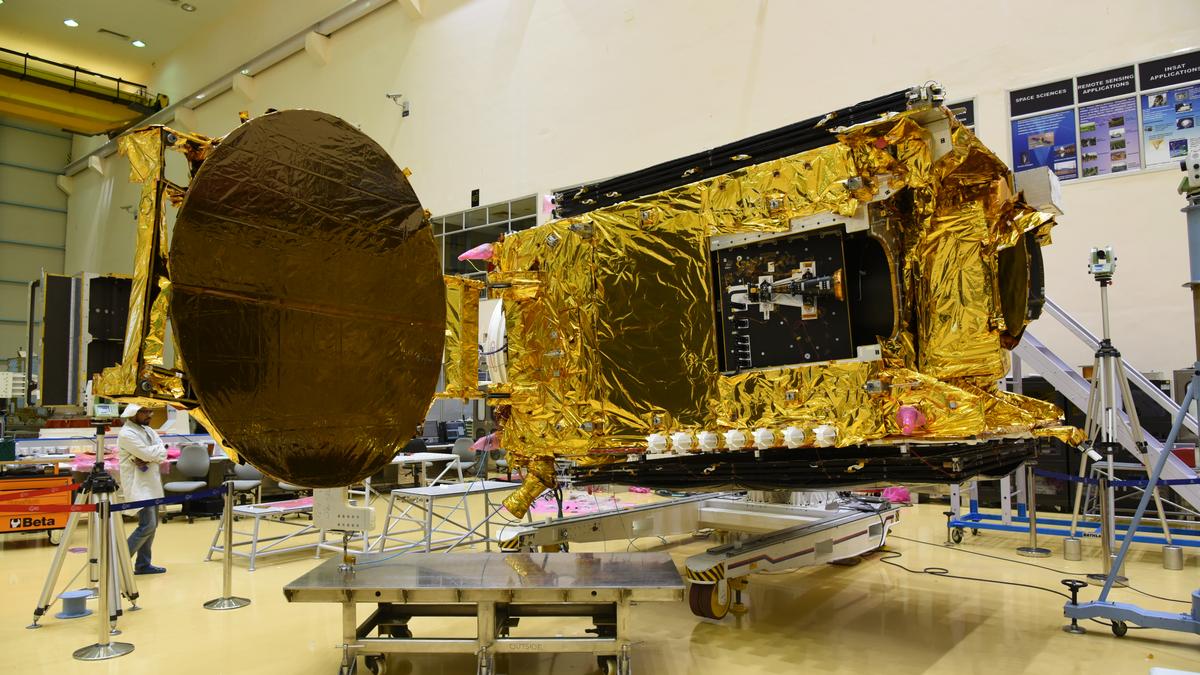
A photo of the GSAT-30 communications satellite.
| Photo Credit: ISRO

On November 2, the Indian Space Research Organisation (ISRO) launched the GSAT-7R satellite for the Indian Navy. The satellite’s launch mass was 4,410 kg — rendering the launch the heaviest of a communications satellite from Indian soil. For this mission, ISRO used its LVM-3 rocket, the most powerful yet in its stable of launch vehicles.

India’s communications satellites are heavy because they combine wide coverage, high power, and long service life in one spacecraft.

To serve the entire country and nearby seas, the communications payload needs to support many channels across multiple frequency bands. These are typically the C (4-8 GHz), the Ku (12-18 GHz), and sometimes the Ka (27-40 GHz) bands. This in turn requires several large deployable antennas, high-power amplifiers, waveguides, filters, switches, and either many analog transponders or flexible digital processors.

The antennas and pointing mechanisms also need to hold tight alignment in space, so the structure and thermal control systems are correspondingly robust and add more mass.

The satellites’ high throughput demands several kilowatt of electrical power. To supply this for 12–15 years, satellites carry large solar arrays, batteries large enough to account for daily eclipses, and power-conditioning units. These elements also increase mass, even as they must be built to withstand radiation and repeated heating and cooling cycles.

The spacecrafts’ long life demands redundancy, including in the form of duplicate computers, radios, and power units, so that they can continue working after failures. Redundancy improves reliability but increases weight.

Next, getting to the geostationary orbit (GTO) adds more mass in propellant. The GTO is a highly elliptical orbit that’s used to move satellites into the geostationary or geosynchronous orbits. A launch vehicle like ISRO’s LVM-3 will place the satellite into the GTO, and from there the satellite will use its own propulsion systems to move into the final intended orbit. In a GTO, the perigee, i.e. the point closest to the earth, can be a low-earth orbit (150-2,000 km above) while the apogee can be as high as the geostationary orbit (35,786 km).

When a communications satellite first enters the GTO, it must perform orbit-raising and station-keeping manoeuvres, as well as manage its momentum for more than a decade. The chemical propulsion systems that are still common on many Indian satellites need significant quantities of fuel for these tasks.

Finally, economic factors reinforce these choices. Launch opportunities are limited and operators prefer fewer, more capable satellites to cover specific national needs. As a result, it’s better for communications satellites to be designed to have high power, broad coverage, long lifetimes, and robust backups. In future electric propulsion systems can reduce the propellant mass, although the trade-off between satellite capability and satellite lifetime will still remain.

chart visualization

Published – November 03, 2025 12:32 pm IST



Source link

Science

Post navigation

Previous Post: PM Modi launches RDI Fund to spur private investment in research
Next Post: More than half of Indian enterprises faced ransomware attacks: survey

Related Posts

  • Anaemia prevalence in eight States found to be overestimated
    Anaemia prevalence in eight States found to be overestimated Science
  • Loggerhead turtles face four-pronged threats due to climate change
    Loggerhead turtles face four-pronged threats due to climate change Science
  • Large genetic study finds overlaps between schizophrenia, bone health
    Large genetic study finds overlaps between schizophrenia, bone health Science
  • ‘Underwhelming Indian genomics research, and gatekeeping’
    ‘Underwhelming Indian genomics research, and gatekeeping’ Science
  • Where does dust come from?
    Where does dust come from? Science
  • Geoengineering isn’t a snappy situation cure, however a expensive gamble
    Geoengineering isn’t a snappy situation cure, however a expensive gamble Science

More Related Articles

ISRO dispatches crew module for first uncrewed mission of Gaganyaan ISRO dispatches crew module for first uncrewed mission of Gaganyaan Science
What explains SpaceX, Blue Origin stepping up their moon plans? | Explained What explains SpaceX, Blue Origin stepping up their moon plans? | Explained Science
India to submit updated carbon-reduction targets by the beginning of COP30 on November 10 India to submit updated carbon-reduction targets by the beginning of COP30 on November 10 Science
No Indian industry in Board of revamped National Research Foundation No Indian industry in Board of revamped National Research Foundation Science
How do scientists determine the temperature of planets or stars? How do scientists determine the temperature of planets or stars? Science
Aditya-L1: IIA-NASA collaborate to record spectroscopic observations of a CME in visible wavelength range for very first time Aditya-L1: IIA-NASA collaborate to record spectroscopic observations of a CME in visible wavelength range for very first time Science
SiteLock

Archives

  • May 2026
  • April 2026
  • March 2026
  • February 2026
  • January 2026
  • December 2025
  • November 2025
  • October 2025
  • September 2025
  • August 2025
  • July 2025
  • June 2025
  • May 2025
  • April 2025
  • March 2025
  • February 2025
  • January 2025
  • December 2024
  • November 2024
  • October 2024
  • September 2024
  • August 2024
  • July 2024
  • June 2024
  • May 2024
  • April 2024
  • March 2024
  • February 2024
  • January 2024
  • December 2023
  • November 2023
  • October 2023
  • September 2023
  • August 2023
  • July 2023
  • June 2023
  • May 2023
  • April 2023
  • March 2023
  • February 2023
  • January 2023
  • December 2022
  • November 2022
  • October 2022
  • September 2022
  • August 2022
  • July 2022
  • June 2022
  • May 2022

Categories

  • Business
  • Nation
  • Science
  • Sports
  • World

Recent Posts

  • Israel-Iran war LIVE: Iran working on Hormuz ‘protocol’ to cover ‘costs’, says Dy FM Gharibabadi
  • Russia to fulfil all agreements on energy supply to India: FM Lavrov
  • Maruti Suzuki crosses 3 million vehicle dispatches through railways, eyes 35% share by rail
  • Delhi High Court rejects plea against tax exemption for agricultural income in Capital
  • Delhi High Court refuses to entertain PIL to prevent suicides

Recent Comments

  1. Jeffreyroure on UP Teacher Who Asked Students To Slap Muslim Classmate
  2. Stevemonge on UP Teacher Who Asked Students To Slap Muslim Classmate
  3. RichardClage on UP Teacher Who Asked Students To Slap Muslim Classmate
  4. StevenLek on UP Teacher Who Asked Students To Slap Muslim Classmate
  5. Leonardren on UP Teacher Who Asked Students To Slap Muslim Classmate
  • India’s macroeconomic management ‘stellar’; paves way for sustained recovery: Finance Ministry report
    India’s macroeconomic management ‘stellar’; paves way for sustained recovery: Finance Ministry report Business
  • Daily Quiz: International Day of Human Space Flight
    Daily Quiz: International Day of Human Space Flight Science
  • Virat Kohli Takes One-Handed Stunner, Team India In Jovial Spirits Ahead Of Champions Trophy Opener
    Virat Kohli Takes One-Handed Stunner, Team India In Jovial Spirits Ahead Of Champions Trophy Opener Sports
  • Baltimore bridge collapse | Crews carefully start removing first piece of twisted steel
    Baltimore bridge collapse | Crews carefully start removing first piece of twisted steel World
  • Access Denied World
  • UK PM Rishi Sunak “Hurt” After Far-Right Party Campaigner’s Racist Slurs For Him
    UK PM Rishi Sunak “Hurt” After Far-Right Party Campaigner’s Racist Slurs For Him World
  • Access Denied
    Access Denied Nation
  • Iran-Israel war LIVE: Fire at Kuwait airport after drones hit fuel tank
    Iran-Israel war LIVE: Fire at Kuwait airport after drones hit fuel tank World

Editor-in-Chief:
Mohammad Ariff,
MSW, MAJMC, BSW, DTL, CTS, CNM, CCR, CAL, RSL, ASOC.
editor@artifex.news

Associate Editors:
1. Zenellis R. Tuba,
zenelis@artifex.news
2. Haris Daniyel
daniyel@artifex.news

Photograher:
Rohan Das
rohan@artifex.news

Artifex.News offers Online Paid Internships to college students from India and Abroad. Interns will get a PRESS CARD and other online offers.
Send your CV (Subjectline: Paid Internship) to internship@artifex.news

Links:
Associate Journalism
About Us
Privacy Policy

News Links:
Breaking News
World
Nation
Sports
Business
Entertainment
Lifestyle

Registered Office:
72/A, Elliot Road, Kolkata - 700016
Tel: 033-22277777, 033-22172217
Email: office@artifex.news

Editorial Office / News Desk:
No. 13, Mezzanine Floor, Esplanade Metro Rail Station,
12 J. L. Nehru Road, Kolkata - 700069.
(Entry from Gate No. 5)
Tel: 033-46011099, 033-46046046
Email: editor@artifex.news

Copyright © 2023 Artifex.News Newsportal designed by Artifex Infotech.