


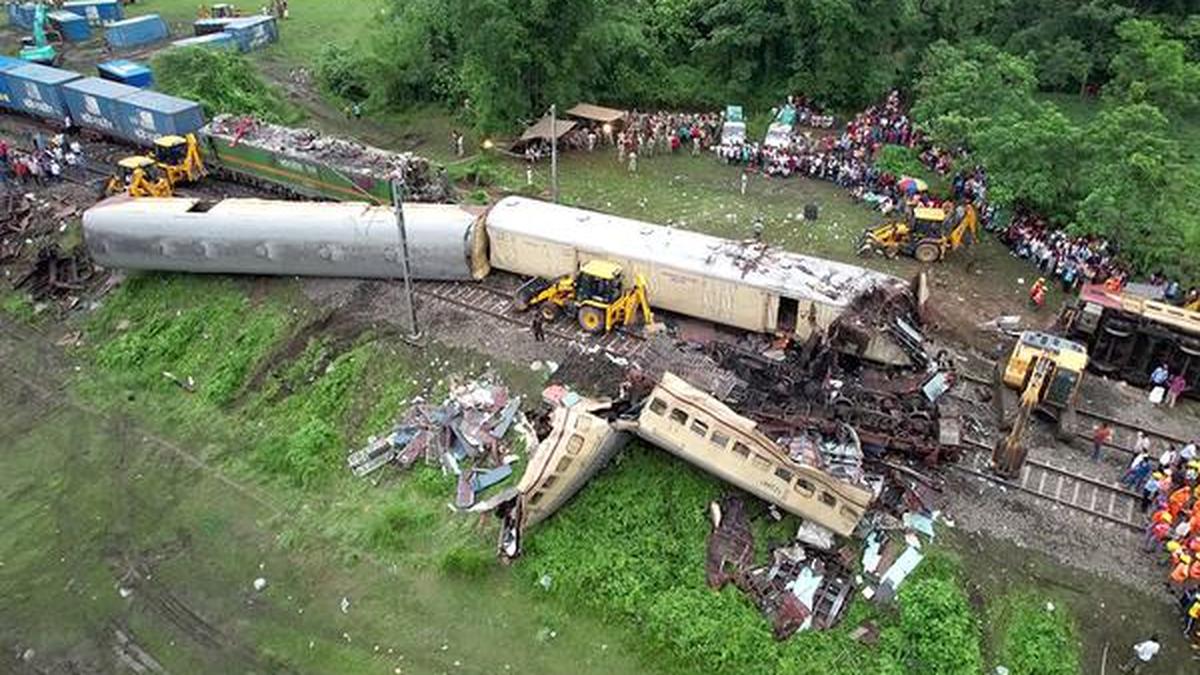
Vehicular traffic is a mainstay of modern life. Either people want to get from one place to the next or they want to send things. As the demand for such transport has increased, so have the number of transport options people have invented and the number of places to deploy them in. Today, thus, we have traffic on the road, in the air, across various water bodies, and – in a dubitable sign of progress – in space. For better or for worse, we can’t roll this traffic back very much, so we have collision avoidance systems instead.
What is a collision avoidance system?
In broad terms, a collision avoidance system (CAS) is a collection of technologies to help a vehicle steer clear of another vehicle or obstacles. For example, a CAS device fit on a train will be designed to help that train avoid colliding with another train.
Most CAS devices require two pieces of information, preferably in real-time: the locations of all the other vehicles and the location of this vehicle relative to those vehicles. Over the years scientists and engineers have developed instruments that collect this information and transmit it and other instruments that receive this information and aid in the navigation of the vehicle.
Such a vehicle can be driven by a human, in which case CAS’s purpose would be to assist the driver, or be autonomous.
How does CAS help land-based vehicles?
Say two cars, called the Front Car and the Back Car, are moving in sequence and both are fit with CAS devices. Typically, the Back Car will be tracking the speed of the Front Car, the distance between the two cars, and the speed of the Back Car. If the separation between the two cars is expected to drop within a certain value within a stipulated time frame, the CAS may be empowered to deploy an automatic emergency brake – as required of cars in the European Union, for example – without the driver’s intervention.
In order to achieve this, the CAS will have to be connected to the Back Car’s braking system and be able to override the driver’s instructions. It will also be connected to the Back Car’s speed metre as well as equipped with a sensing technology to track the Front Car, like radar, lidar, and/or cameras with object recognition.
What is ‘Kavach’?
Another important land-based mode of transport is the railway. A spate of train accidents in India recently brought the spotlight on its sluggish implementation of ‘Kavach’, the homegrown CAS for the Indian Railways. In their fundamentals Kavach’s components perform the same functions that CAS does in cars, but the railway system is also more complicated.
Kavach has three main components: onboard, trackside, and communications. For the purpose of explanation, let’s regroup them as computers, communications, and control.
Computers: There is a computer onboard the train plus two other computers for station masters. Of the latter, one is the master computer: it collates and processes information from signals and interlocking points and sends its output to the locomotive computer. The other is the remote interface unit, which also collates and processes information from various points on the railway network, and eventually transmits its data to the master computer; it doesn’t communicate directly with the locomotive computer.
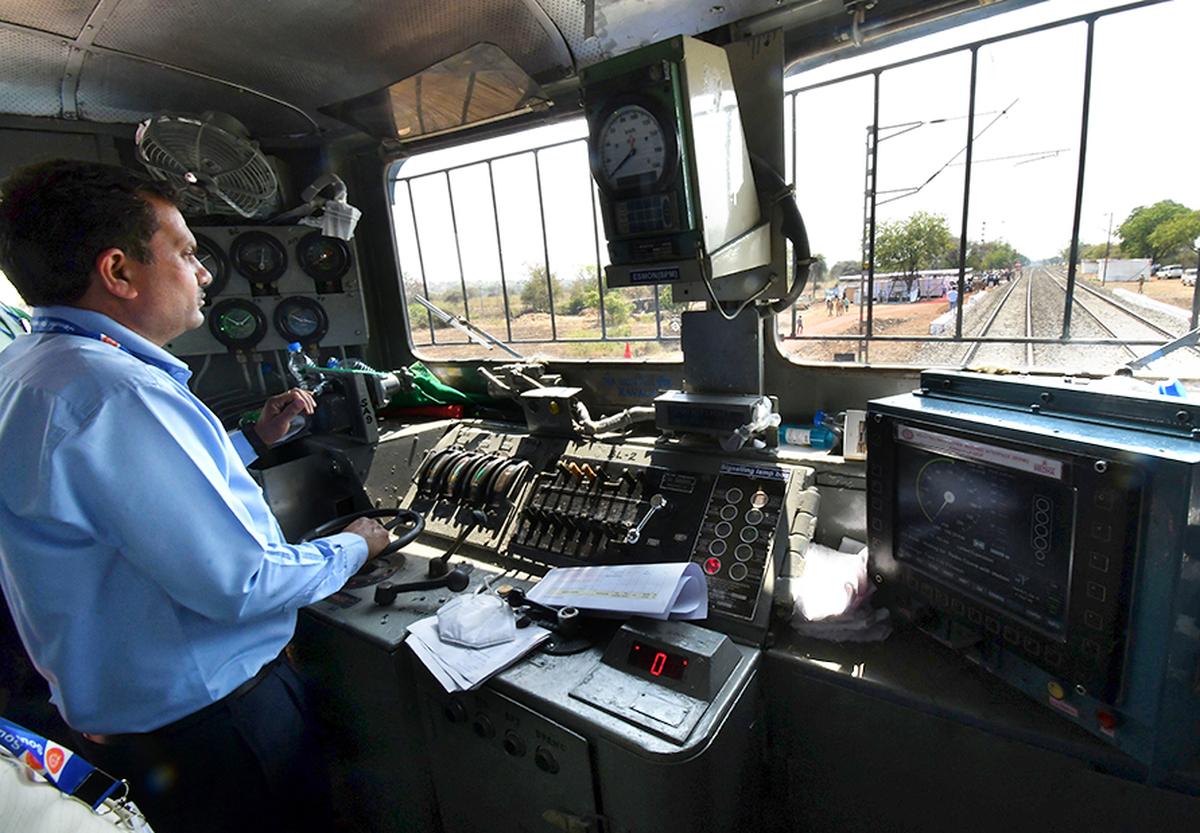
A locomotive pilot is seen operating a ‘Kavach’ installation. The system applied brakes automatically in a locomotive at Pulimamida in Vikarabad district on March 4, 2022, during a test conducted by the South Central Railway.
| Photo Credit:
Nagara Gopal/The Hindu
The locomotive computer receives information from two other sources:
(i) The locomotive will have two radio-frequency identification (RFID) readers mounted on its underside. The tracks will be fit with RFID cards at fixed intervals. When the locomotive passes over the cards, the readers will scan the cards and retrieve the train’s location and a track ID number, and send them to the onboard computer.
(ii) Onboard computers can communicate with each other if their respective locomotives are nearby.
Taken together, the system facilitates communications between stations and locomotive pilots, facilitates pilots’ decision-making (with or without having to visually spot another train), maintains speed, issues sounds and alarms when passing through areas with low visibility, and applies emergency brakes when a collision is expected.
Communication: The remote interface unit transmits data to the master computer via fibre-optic cables. The master computer communicates with the locomotive computer via ultra-high frequency radio. The onboard computer uses GSM-Railway to communicate with the overall network management system (the software system that animates the Kavach CAS), including to authenticate its communications with nearby master computers and locomotive computers.
Control: As with cars, the onboard computer is connected to various other parts of the locomotive, including its braking system and an alarm to alert pilots. While operating the locomotive, pilots will use a bespoke interface – like a digital screen – that relays information from the computer and receives inputs from the pilots. The station master will have a similar interface, with the ability to send SOS messages as well.
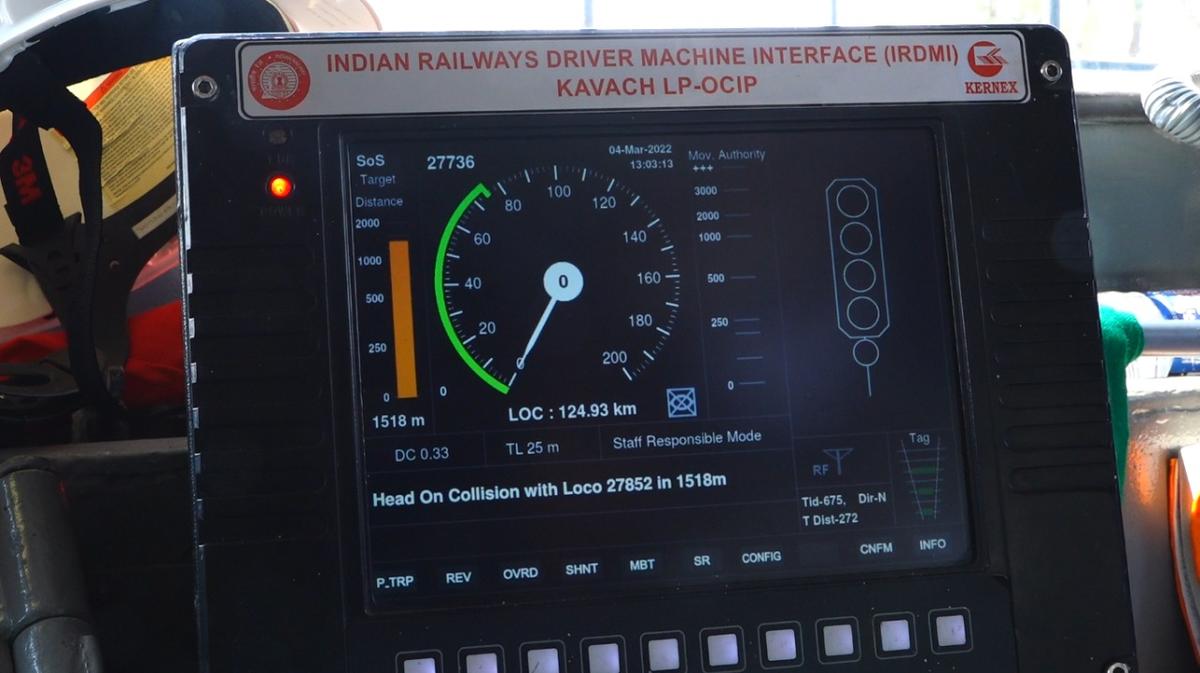
A prototype ‘Kavach’ interface terminal.
| Photo Credit:
Special arrangement
How does CAS work in ships and aircraft?
The Traffic Collision Avoidance System for aircraft also has a computer-communication-control setup as for trains. An important component is the transponder – a device that, when it receives a radio-frequency ping, produces a response. Using the transponders of various other aircraft, the host aircraft can build up a 3D view of the air traffic around itself.
Another salient component of aircraft CAS is the alerts. If another aircraft is within 48 seconds away on a potential collision course, the computer sounds a traffic advisory that requires the pilots to visually identify the other aircraft. If the aircraft is less than 30 seconds away, the computer requires the pilots to make a resolution: report the alert as soon as possible to air traffic control and manoeuvre the aircraft to a safer course, if required contrary to air traffic control’s instructions; and revert to the original course once the resolution is complete.
Finally, aircraft may also have radar altimeters to sense the distance to the ground and another system to alert pilots to ‘tall’ features like towers and ground antennae.
Ships – akin to cars and aircraft – use a combination of visual sighting and radar to steer clear of each other, while these operations are similarly assisted with the use of additional systems. Two important ones are AIS and LRIT. In the AIS, or Automatic Identification System, base stations on land track and coordinate data received from transceivers onboard ships to infer their location, speed, and bearing, and transmit the details to each vessel.
LRIT is short for ‘Long Range Identification and Tracking’. According to the International Maritime Organisation, a ship on an international voyage is required to report its location, local time, and onboard equipment once every six hours to the authorities in the country under whose flag the ship is sailing. This data is distributed to contracting governments and to operators of search-and-rescue missions via the International LRIT Data Exchange.

How have satellites changed CAS?
An important alternative to the transponder-based system for aircraft is the Automatic Dependent Surveillance-Broadcast (ADS-B) system, which collects and processes information shared actively by each aircraft via satellites to understand the relative location, bearing, and speed of a group of aircraft. Similarly, the AIS for ships can be facilitated by satellites as well: such S-AIS systems are particularly useful to track ships that are too far from AIS stations on land.
The advent of the U.S. Global Positioning System (GPS) had a transformative effect on navigation and collision avoidance worldwide, and which some countries have augmented with systems of their own to cater to specific national needs. For example, India already envisages the use of its NavIC constellation of navigational satellites to assist road and railway traffic in the country.
Recall also the Front Car + Back Car scenario: if the country these cars are moving through also has a GPS-tagged database of its various traffic elements (stop signs, turns, signals, intersections, etc.), the CAS onboard the cars can also be assisted by GPS data. The spatial frequency of GPS for civilian applications is restricted to 10 metres, which is not good enough for CAS. But systems can overcome this limitation using differential GPS capabilities, which can improve the resolution to less than a metre.