


Skip to content
  • Facebook
  • X
  • Linkedin
  • WhatsApp
  • YouTube
  • Associate Journalism
  • About Us
  • Privacy Policy
  • 033-46046046
  • editor@artifex.news
Artifex.News

Artifex.News

Stay Connected. Stay Informed.

  • Breaking News
  • World
  • Nation
  • Sports
  • Business
  • Science
  • Entertainment
  • Lifestyle
  • Toggle search form
  • How Vivek Ramaswamy’s H-1B Reform Plan Will Impact Indians
    How Vivek Ramaswamy’s H-1B Reform Plan Will Impact Indians Nation
  • Access Denied
    Access Denied Nation
  • Access Denied Sports
  • FC Goa Beat Punjab FC 2-1 To Climb To Top-Three In ISL Standings
    FC Goa Beat Punjab FC 2-1 To Climb To Top-Three In ISL Standings Sports
  • Unsafe landings increase as IndiGo seeks to trim soaring fuel costs using ‘unsanctioned methods’
    Unsafe landings increase as IndiGo seeks to trim soaring fuel costs using ‘unsanctioned methods’ Business
  • States Shifting To Old Pension Scheme Major Step Backwards: RBI Article
    States Shifting To Old Pension Scheme Major Step Backwards: RBI Article Business
  • Access Denied
    Access Denied Nation
  • Suryakumar Yadav, Rinku Singh And Abhishek Sharma Amongst 5 Key Players For India In T20I Series vs Bangladesh
    Suryakumar Yadav, Rinku Singh And Abhishek Sharma Amongst 5 Key Players For India In T20I Series vs Bangladesh Sports
75 years since Assam quake, Himalayas prep for large hydro projects

75 years since Assam quake, Himalayas prep for large hydro projects

Posted on August 14, 2025 By admin


On August 15, 1950, India was celebrating its Independence Day. The mood was upbeat throughout the country. Just as celebrations were winding down for the day, a great disaster struck. At around 7:30 pm, an earthquake of magnitude 8.6 — the strongest ever recorded on land — jolted the country’s Northeast and some neighbouring areas beyond the border.

According to some reports, the earth shook for about four to eight minutes. Mountains stumbled and buildings fell, causing widespread death and destruction. An English botanist and explorer named Frank Kingdon-Ward was camping at Rima (Zayu) on the day. He reported later: “I was seated writing my diary near the entrance to our tent. Suddenly, after the faintest tremor, there came an appalling noise, and the earth began to shake violently. … We were immediately thrown to the ground. The lantern too was knocked over and went out instantly.”

The earthquake was felt over an area of 3 million sq. km across India, Myanmar, and Bangladesh, Tibet, and South China. It wrecked homes, farms, and railway tracks, bridges, and other utilities. A field investigation report described how “rail tracks were torn up and twisted into snake-like patterns”, in a vivid demonstration of how the land and structures deform in response to shear waves. On the Indian side alone, more than 1,500 people lost their lives, and 50,000 to 1,00,000 cattle were killed. The quake was felt as far afield as Lhasa and Sichuan, and in Yunnan province in China. In the Medog area of Eastern Tibet, Yedong village slid into the Yarlung Zangbo river, and more than 4,000 casualties were reported from Tibet. Severe damage was wrought in the Sibsagar-Sadiya area of Assam as well.

More destruction was to follow in the days after the earthquake. Many hills had been sheared by the earthquake. Rocky debris falling into the valleys below blocked rivers — before giving way days later, producing flash floods downstream that killed hundreds of people living on the rivers’ banks. On September 9, two weeks after the earthquake, the then Prime Minister Jawaharlal Nehru said in a nationwide broadcast on All India Radio: “The Brahmaputra was blocked up for a while, and then broke through, they came down with a rush and a roar, a high wall of water sweeping down and flooding large areas and washing away villages and fields and gardens. … The remains of villages, animals, including cattle and elephants, and large quantities of timber floated down these raging waters…”.

Revisiting the earthquake

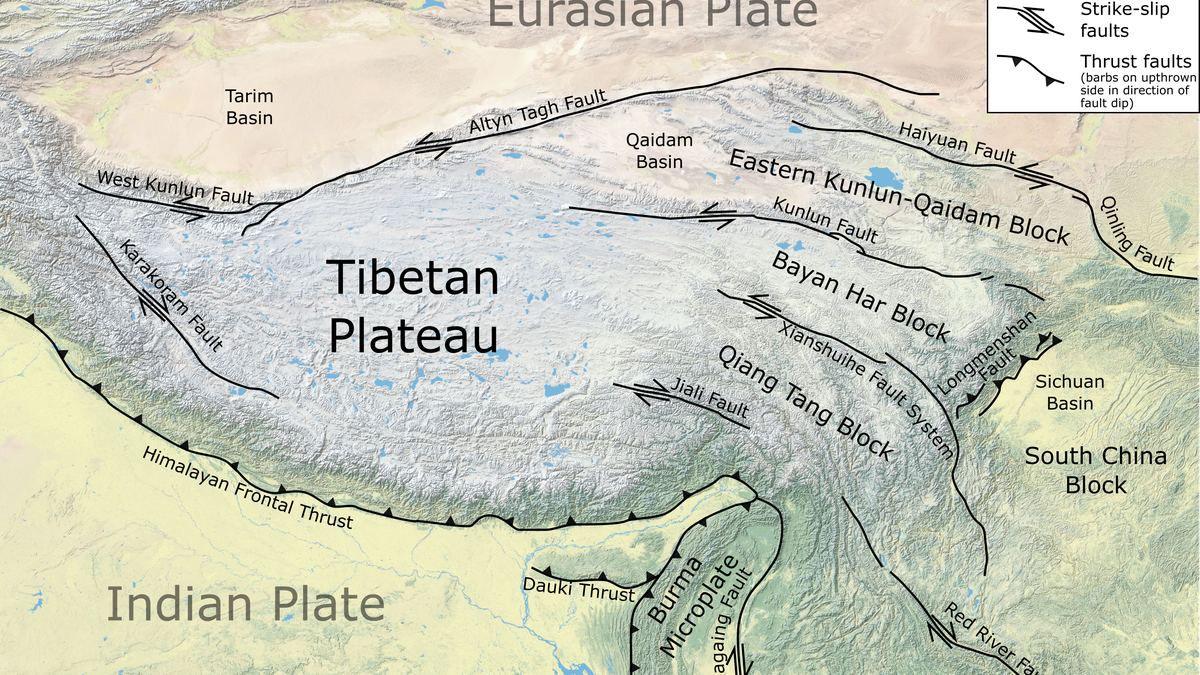
The source of the Great Assam Earthquake lay 40 km west of Rima (Zayu), the village near the India-Tibet border in the Mishmi hills where Kingdon-Ward was camped. The quake occurred along the boundary where the Indian and Eurasian Plates collided, near the eastern terminus of the Himalayas, at a depth of 15 km. The rupture extended from the Mishmi thrust of the Eastern Himalayas to the Himalayan Frontal Thrust of Arunachal Pradesh, completing a curvilinear motion around the mountainous bend (see image above).

As it happened, the shaking also occurred at a time when seismographic networks were expanding worldwide, providing great impetus to earthquake monitoring and the subsequent development of the theory of plate tectonics. It was also the time instrumental monitoring of earthquakes had started in India, with the India Meteorological Department (IMD) setting up its first seismological observatory at Alipore in Kolkata district in 1898.

Today, we understand the Great Assam Earthquake happened on a plate boundary formed by the collision of continental plates, like those along other parts of the Himalayan plate boundary. However, it is differentiated by the fact that its source was in the Eastern Himalaya, which is tectonically very complex. GPS data indicate that while Indian and Eurasian continental plates are converging at about 20 mm/year on average across the Himalayas, in the Eastern Himalayas it ranges from 10 mm to 38 mm/year.

This variation could very well be due to difficulties in capturing tectonic complexity and differences in data quality. While the main arcuate Himalaya plate boundary resulted from the collision of the Indian and Eurasian plates, the Sunda plate is also involved in the northeastern Himalaya, creating a complex structure.

Due to plate rotation, major structural elements also take sharp turns and the regional strike shifts from the general NE-SW direction to the NW-SE direction post-collision, forming what geologists call the Eastern Himalayan Syntaxis (EHS). This is where the Great Assam Earthquake likely occurred.

Unlike other Himalayan earthquakes, which have exhibited a thrusting mechanism — where one block of the fault thrusts over the other — the Assam earthquake displayed a component of strike-slip motion, with both blocks sliding past each other along the fault. This suggested it was connected with the EHS trending in the NW-SE direction.

Models also indicate a thrusting component, likely resulting from the propagation of earthquake faulting towards the west, where thrust tectonics are predominant. The possibility of multiple faults being linked to the Assam earthquake is also supported by the distribution of revised aftershock locations, spread over a wide zone east of the main shock epicentre.

Indeed, most researchers believe the earthquake may have started off on the Syntaxial bend while also activating Himalayan thrust faults to the west. Historical documents from the Ahom period (1228-1826) reveal the Northeast India region experienced earthquakes in 1548, 1596, and 1697 AD, all of uncertain magnitudes. Geological studies have also revealed a major medieval earthquake between 1262 and 1635 AD.

Quakes of the future

Looking back, the Great Assam Earthquake delivered to scientists a significant lesson on the destructive potential of major earthquakes in the Himalayas. Can a similar earthquake strike Northeast India again? As the Indian plate continues to move forward, earthquakes are an integral part of its future. Yet our current knowledge doesn’t allow us to predict when, where or how strong the next quake will be. For now, we only know the Central Himalayas are the most potentially active segment and could generate a 1950-type earthquake in future.

The seismic event also highlighted that we are more vulnerable today, primarily due to the exponential growth of the built environment and urban areas, leaving the landscape to look very different from the way it did 75 years ago. As we plan for more developmental activities and undertake heavy infrastructural projects, including large dams, in this tectonically fragile area, we must reflect on the images from the 1950 quake.

Finally, the event also proved the Himalayan tectonic segments along the 2500-km-long stretch are fully capable of producing earthquakes of magnitude 8.6 or higher. As both China and India prepare to build large hydroelectric projects in the Eastern Himalayan bend, one of the most seismically vulnerable parts of the majestic range, it’s clear the road ahead will be long and challenging.

Kusala Rajendran is a former professor at the Centre for Earth Sciences, Indian Institute of Science, Bengaluru. C.P. Rajendran is an adjunct professor at the National Institute of Advanced Sciences, Bengaluru.

Published – August 14, 2025 05:30 am IST



Source link

Science

Post navigation

Previous Post: Access Denied
Next Post: Russia-Ukraine conflict: Donald Trump eyes three-way meeting with Putin, Zelensky

Related Posts

  • Smart Irrigation Plan can save 10-30% of irrigation water in drought-prone regions: IIT Bombay research
    Smart Irrigation Plan can save 10-30% of irrigation water in drought-prone regions: IIT Bombay research Science
  • NASA astronaut Sunita Williams to attend Kerala Literature Festival in Kozhikode, say organisers
    NASA astronaut Sunita Williams to attend Kerala Literature Festival in Kozhikode, say organisers Science
  • Saurashtra fossils say early humans didn’t stick to coast as they moved
    Saurashtra fossils say early humans didn’t stick to coast as they moved Science
  • Gene that helps race horses manage BP could help human athletes, too
    Gene that helps race horses manage BP could help human athletes, too Science
  • Science Quiz | What computers need to compute: Logic gates
    Science Quiz | What computers need to compute: Logic gates Science
  • Watch: How are Coimbatore’s automotive firms gearing up for EV transition?
    Watch: How are Coimbatore’s automotive firms gearing up for EV transition? Science

More Related Articles

India aims to achieve debris free space missions by 2030 India aims to achieve debris free space missions by 2030 Science
Indian scientists find new way to measure distances in deep space Indian scientists find new way to measure distances in deep space Science
Searching for LUCA, the first life-form from which all other life descended Searching for LUCA, the first life-form from which all other life descended Science
DRDO conducts key test in scramjet technology development DRDO conducts key test in scramjet technology development Science
Antibiotics can leave a long-term footprint on our gut microbiome: study Antibiotics can leave a long-term footprint on our gut microbiome: study Science
The power of choice: a case for life-saving modern contraception The power of choice: a case for life-saving modern contraception Science
SiteLock

Archives

  • May 2026
  • April 2026
  • March 2026
  • February 2026
  • January 2026
  • December 2025
  • November 2025
  • October 2025
  • September 2025
  • August 2025
  • July 2025
  • June 2025
  • May 2025
  • April 2025
  • March 2025
  • February 2025
  • January 2025
  • December 2024
  • November 2024
  • October 2024
  • September 2024
  • August 2024
  • July 2024
  • June 2024
  • May 2024
  • April 2024
  • March 2024
  • February 2024
  • January 2024
  • December 2023
  • November 2023
  • October 2023
  • September 2023
  • August 2023
  • July 2023
  • June 2023
  • May 2023
  • April 2023
  • March 2023
  • February 2023
  • January 2023
  • December 2022
  • November 2022
  • October 2022
  • September 2022
  • August 2022
  • July 2022
  • June 2022
  • May 2022

Categories

  • Business
  • Nation
  • Science
  • Sports
  • World

Recent Posts

  • West Bengal government mandates singing Vande Mataram in all State-run schools during morning assembly
  • Delhi court orders OpIndia to remove articles on Swati Chaturvedi
  • U.S. to drop graft charges against Gautam Adani: NY Times
  • ED arrests Kolkata Police DC Shantanu Sinha Biswas in money laundering case
  • One dead, several injured in landslide in Jamuria coal mines in West Bengal; many feared missing

Recent Comments

  1. BrianWhape on UP Teacher Who Asked Students To Slap Muslim Classmate
  2. MartinbaW on UP Teacher Who Asked Students To Slap Muslim Classmate
  3. AlfredgeK on UP Teacher Who Asked Students To Slap Muslim Classmate
  4. WilliamTOP on UP Teacher Who Asked Students To Slap Muslim Classmate
  5. KevinPrics on UP Teacher Who Asked Students To Slap Muslim Classmate
  • Rishabh Pant Finds Unexpected Fan In WWE Hall Of Famer. Internet Left Stunned
    Rishabh Pant Finds Unexpected Fan In WWE Hall Of Famer. Internet Left Stunned Sports
  • Access Denied Business
  • Man Stabs Bengaluru Bus Conductor After Being Told To Stand Away From Doors
    Man Stabs Bengaluru Bus Conductor After Being Told To Stand Away From Doors Nation
  • Air India Flight From Paris Diverted To Jaipur, Fliers Sent To Delhi On Bus
    Air India Flight From Paris Diverted To Jaipur, Fliers Sent To Delhi On Bus Nation
  • “If I Were In Your Place…”: Shakib Al Hasan Breaks Silence On Civil Unrest In Bangladesh
    “If I Were In Your Place…”: Shakib Al Hasan Breaks Silence On Civil Unrest In Bangladesh Sports
  • “Mera Hukum Hai Room Aao Jaldi”: Ravindra Jadeja’s Insta Banter With Wife Rivaba Goes Viral
    “Mera Hukum Hai Room Aao Jaldi”: Ravindra Jadeja’s Insta Banter With Wife Rivaba Goes Viral Sports
  • Budget 2026 Expectations LIVE Updates: What To Expect For Defence, MSMEs And India's Growth Business
  • Fans Take Selfies With Dolly Chaiwala, Ignore India’s Hockey Stars At Airport
    Fans Take Selfies With Dolly Chaiwala, Ignore India’s Hockey Stars At Airport Sports

Editor-in-Chief:
Mohammad Ariff,
MSW, MAJMC, BSW, DTL, CTS, CNM, CCR, CAL, RSL, ASOC.
editor@artifex.news

Associate Editors:
1. Zenellis R. Tuba,
zenelis@artifex.news
2. Haris Daniyel
daniyel@artifex.news

Photograher:
Rohan Das
rohan@artifex.news

Artifex.News offers Online Paid Internships to college students from India and Abroad. Interns will get a PRESS CARD and other online offers.
Send your CV (Subjectline: Paid Internship) to internship@artifex.news

Links:
Associate Journalism
About Us
Privacy Policy

News Links:
Breaking News
World
Nation
Sports
Business
Entertainment
Lifestyle

Registered Office:
72/A, Elliot Road, Kolkata - 700016
Tel: 033-22277777, 033-22172217
Email: office@artifex.news

Editorial Office / News Desk:
No. 13, Mezzanine Floor, Esplanade Metro Rail Station,
12 J. L. Nehru Road, Kolkata - 700069.
(Entry from Gate No. 5)
Tel: 033-46011099, 033-46046046
Email: editor@artifex.news

Copyright © 2023 Artifex.News Newsportal designed by Artifex Infotech.