


Skip to content
  • Facebook
  • X
  • Linkedin
  • WhatsApp
  • YouTube
  • Associate Journalism
  • About Us
  • Privacy Policy
  • 033-46046046
  • editor@artifex.news
Artifex.News

Artifex.News

Stay Connected. Stay Informed.

  • Breaking News
  • World
  • Nation
  • Sports
  • Business
  • Science
  • Entertainment
  • Lifestyle
  • Toggle search form
  • Access Denied
    Access Denied Nation
  • Activists allege regulatory lapses in approving GM mustard
    Activists allege regulatory lapses in approving GM mustard Business
  • Sci-Five | The Hindu Science Quiz: On Elephants
    Sci-Five | The Hindu Science Quiz: On Elephants Science
  • David Warner bows out with Australia World Cup exit
    David Warner bows out with Australia World Cup exit Sports
  • Udhayanidhi Stalin unfit to enter Assembly, be in public life: Minister Nirmalkumar
    Udhayanidhi Stalin unfit to enter Assembly, be in public life: Minister Nirmalkumar Nation
  • Hobby groups decry Nageswara Rao Park’s makeover
    Hobby groups decry Nageswara Rao Park’s makeover Nation
  • Access Denied
    Access Denied Nation
  • How Can I Play For India?” Virat Kohli Asked By Boy At Ranji Trophy Training. Star Replies: “Tell Papa…
    How Can I Play For India?” Virat Kohli Asked By Boy At Ranji Trophy Training. Star Replies: “Tell Papa… Sports
India among four nations driving most global pesticide toxicity: study

India among four nations driving most global pesticide toxicity: study

Posted on February 21, 2026 By admin


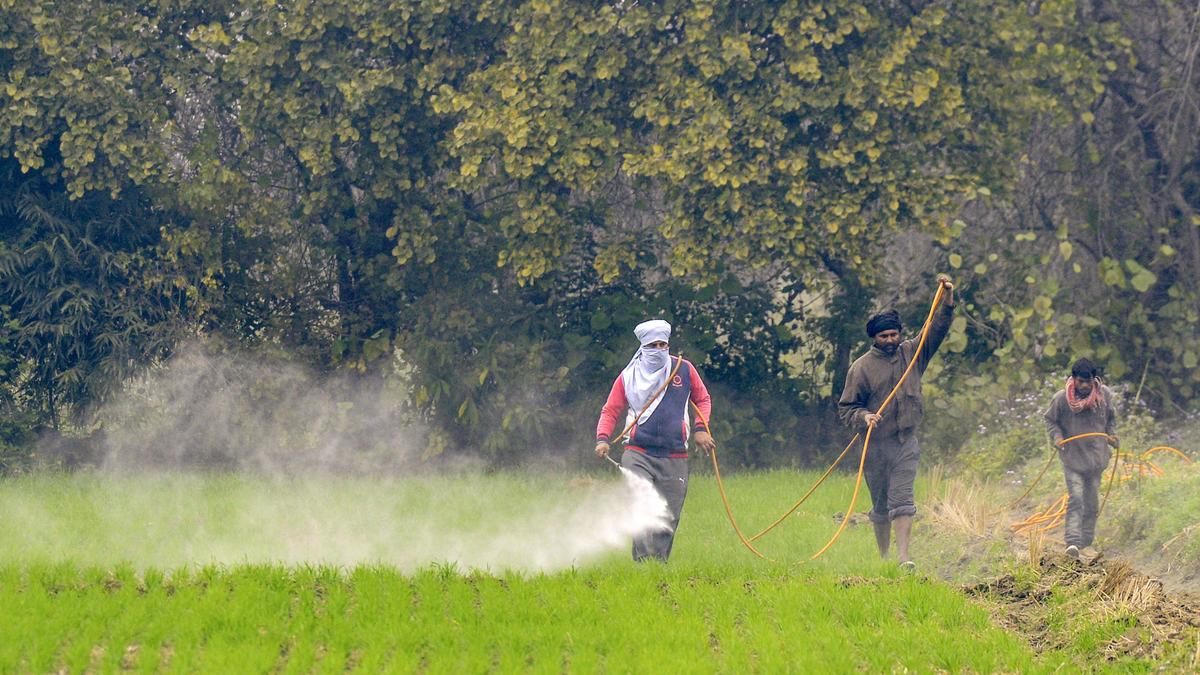
India is among just four countries that contribute almost 70% to the world’s total applied toxicity (TAT) in the form of pesticide, which is directed at agricultural pests, but in affect unleashes huge collateral damage among “non-target” species (that is, species that pesticides claimed as collateral).

In 2022, at the United Nations Biodiversity Conference, countries committed to reducing pesticide risk by 50% by 2030. Is the UN pact, intrinsically linked to biodiversity and human health, on track?

According to new paper in Science the answer is a resounding “no.” Researchers, for the very first time, calculated the total applied toxicity (TAT) from 2013-2019 across more than 600 pesticides, in 65 countries, and found that the applied toxicity had increased, especially for 20 pesticides used in agriculture.

Threatening a target

China, Brazil, the U.S., and India are the biggest contributors of global TAT, accounting for nearly 70%. Pesticides, the researchers found, were used copiously on fruits, vegetables, maize, soybean, rice, and other cereals. While the study found that toxicity increased in India, the U.S., Brazil and several countries in Africa, Chile was the solitary country on track to meet the UN’s 2030 target. The increased TAT could be due to countries using larger volumes of pesticides, as well as more toxic ones, says the paper.

To estimate TAT at a national level, the scientists looked at the annual amount of pesticide used in agriculture in the study countries and also the toxicity and lethality of these pesticides for different non-target species, such as pollinators, aquatic plants, invertebrates, fish, terrestrial arthropods (invertebrates with segmented bodies), soil organisms, terrestrial vertebrates ,and plants. The researchers found that during the study period, terrestrial arthropods were most affected, followed by soil organisms and fish.

“The importance of all of these species’ groups is recognised in the biodiversity debate, in agroecology, and from an economic perspective,” says the paper. The increasing global TAT trends pose a challenge to achieving the U.N. pesticide risk reduction target and demonstrate the presence of threats to biodiversity globally, it added.

Toxicity from pesticides increased in the study period, especially among invertebrate species, terrestrial plants, terrestrial arthropods, soil organisms and fish. Notably, sub-Saharan Africa and parts of the Indian subcontinent, and southern Australia showed particularly high TAT increases.

India’s antiquated laws

It is not only biodiversity that is plagued by pesticide: it has begun to affect people too. In 2014, two children died in their Chennai apartment after a pest control treatment in November 2024, media reports say.

“These chemicals now permeate daily life in ways that are often invisible: in wall paints, incense sticks, furniture, aircraft cabins, stored grains, and even temple prasad,” the author, Narasimha Reddy Donthi, an independent public policy expert, wrote. The Insecticides Act, 1968, focuses on agricultural use, with few provisions for “ordinary use” in homes, hotels, construction sites and transport systems, he added.

India’s Insecticides Act, 1968 is obsolete, Mr. Donthi told The Hindu. “The use, misuse, and overuse have changed since 1968. Pesticides have become more toxic. They have are persistent across food, water and soil.” India uses at least 66 pesticides that are banned elsewhere, he added. For instance, paraquat, which is banned in Europe, is used in India.

The new Pesticides Management Bill 2025 is expected to be passed in March this year. It aims to reduce the risk to people and the environment, and push for pesticides that are “biological and based on traditional knowledge”. But without taking expert suggestions, it could be worse-off than the 1968 Act, Mr. Donthi said. “India needs a long-term transformation policy in agriculture, shifting away from ‘green revolution’ packages, which includes pesticides, in view of the farmers’ crisis, climate change, chemical-residue laden environment. Liability has to be inbuilt into law, as a policy.”

To ensure continuous and comprehensive monitoring, it is essential that all countries regularly report updated annual data on agricultural pesticide use, broken down by active ingredient, said coauthor Jakob Wolfram of the Institute for Environmental Sciences, University Kaiserslautern-Landau, Germany, said in a release. “This would enable real-time tracking of progress toward the targets set at the UN Biodiversity Conference,” he added.

Not so rosy

In January this year, The Guardian reported that environmentalists had raised concerns over toxic “pesticide cocktails” in apples sold across Europe. Of a sample of 60 apples bought in 13 European countries, 64% of the samples contained “forever chemicals”, which do not breakdown easily as they contain a very strong carbon-fluorine bond. On Valentines Day, on February 14, laboratories in the Netherlands found that imported roses had toxins at much larger levels than other flowers. And EU recently rejected consignments of Indian basmati rice because residues of a fungicide (banned in Europe, but not in India) were found.

The researchers called for greater adoption of organic agriculture and a shift to less toxic pesticides in order to meet global commitments: “Substantial actions, combining shifts to less-toxic pesticides, increased adoption of organic agriculture, and also provision of national pesticide use data, will be required globally to approach the United Nations’ target.”

If action is not taken immediately, only Chile is projected to meet the UN’s 2030 target. China, Japan, and Venezuela showed a declining trend in applied toxicity.

As the pioneering environmental activist Rachel Carson presciently wrote in her 1962 book, Silent Spring: “If we are going to live so intimately with these chemicals eating and drinking them, taking them into the very marrow of our bones,” we had better know something about the power of the “who’s who of pesticides.”

divya.gandhi@thehindu.co.in



Source link

Science

Post navigation

Previous Post: Access Denied
Next Post: Access Denied

Related Posts

  • IIT-Delhi, Germany team makes device to sort current by ‘handedness’
    IIT-Delhi, Germany team makes device to sort current by ‘handedness’ Science
  • The first breath, at scale: on Nationwide Neonatal Resuscitation Program Day 2026
    The first breath, at scale: on Nationwide Neonatal Resuscitation Program Day 2026 Science
  • Watch | 50 years ago, India conducted its first ever nuclear test
    Watch | 50 years ago, India conducted its first ever nuclear test Science
  • Artemis astronauts gird for re-entry and splashdown
    Artemis astronauts gird for re-entry and splashdown Science
  • Skyroot expects to double rocket launches amid Chandrayaan-3’s success
    Skyroot expects to double rocket launches amid Chandrayaan-3’s success Science
  • Scientists urged to rethink ‘smoking gun’ signals in topological physics
    Scientists urged to rethink ‘smoking gun’ signals in topological physics Science

More Related Articles

How is the earth’s outer core changing? How is the earth’s outer core changing? Science
India-made typhoid vaccine efficacy lasts for four years: study India-made typhoid vaccine efficacy lasts for four years: study Science
BlueBird Block-2 mission: ISRO successfully launches LVM3-M6 rocket BlueBird Block-2 mission: ISRO successfully launches LVM3-M6 rocket Science
Astronomers unravel the mystery of the ‘Dragon’s Egg’ nebula Astronomers unravel the mystery of the ‘Dragon’s Egg’ nebula Science
Constant mechanical force may be why heart cancer is so rare Constant mechanical force may be why heart cancer is so rare Science
Hurricane Melissa a ‘beast’ among a string of monster Atlantic storms Hurricane Melissa a ‘beast’ among a string of monster Atlantic storms Science
SiteLock

Archives

  • September 2026
  • August 2026
  • July 2026
  • June 2026
  • May 2026
  • April 2026
  • March 2026
  • February 2026
  • January 2026
  • December 2025
  • November 2025
  • October 2025
  • September 2025
  • August 2025
  • July 2025
  • June 2025
  • May 2025
  • April 2025
  • March 2025
  • February 2025
  • January 2025
  • December 2024
  • November 2024
  • October 2024
  • September 2024
  • August 2024
  • July 2024
  • June 2024
  • May 2024
  • April 2024
  • March 2024
  • February 2024
  • January 2024
  • December 2023
  • November 2023
  • October 2023
  • September 2023
  • August 2023
  • July 2023
  • June 2023
  • May 2023
  • April 2023
  • March 2023
  • February 2023
  • January 2023
  • December 2022
  • November 2022
  • October 2022
  • September 2022
  • August 2022
  • July 2022
  • June 2022
  • May 2022

Categories

  • Business
  • Nation
  • Science
  • Sports
  • World

Recent Posts

  • Handloom weavers block Tenkasi-Madurai road
  • Ecologists urge scientists and policymakers to study imminent ‘Super’ El Niño to prepare for the future
  • Greenland, Denmark say Trump deal won’t compromise sovereignty
  • Bengaluru passengers welcome government move against advance tipping, drivers seek fairer fares
  • NTPC terminates ₹413 crore BESS contract as contractor fails to meet obligations, achieve progress

Recent Comments

  1. AlvinNet on UP Teacher Who Asked Students To Slap Muslim Classmate
  2. AlvinNet on UP Teacher Who Asked Students To Slap Muslim Classmate
  3. Jamesslits on UP Teacher Who Asked Students To Slap Muslim Classmate
  4. MichaelClear on UP Teacher Who Asked Students To Slap Muslim Classmate
  5. Jamesslits on UP Teacher Who Asked Students To Slap Muslim Classmate
  • Access Denied Sports
  • Access Denied World
  • Access Denied Sports
  • Trump vows national emergency in Washington, D.C., over ICE dispute
    Trump vows national emergency in Washington, D.C., over ICE dispute World
  • IIT Mandi probes ‘Shudras serve higher classes’ poster; director blames some students’ interpretation
    IIT Mandi probes ‘Shudras serve higher classes’ poster; director blames some students’ interpretation Nation
  • Access Denied
    Access Denied Nation
  • After Chandrayaan-3, Space Physics Lab at Vikram Sarabhai Space Centre prepares to study solar wind
    After Chandrayaan-3, Space Physics Lab at Vikram Sarabhai Space Centre prepares to study solar wind Science
  • Iran After Yahya Sinwar’s Killing
    Iran After Yahya Sinwar’s Killing World

Editor-in-Chief:
Mohammad Ariff,
MSW, MAJMC, BSW, DTL, CTS, CNM, CCR, CAL, RSL, ASOC.
editor@artifex.news

Associate Editors:
1. Zenellis R. Tuba,
zenelis@artifex.news
2. Haris Daniyel
daniyel@artifex.news

Photograher:
Rohan Das
rohan@artifex.news

Artifex.News offers Online Paid Internships to college students from India and Abroad. Interns will get a PRESS CARD and other online offers.
Send your CV (Subjectline: Paid Internship) to internship@artifex.news

Links:
Associate Journalism
About Us
Privacy Policy

News Links:
Breaking News
World
Nation
Sports
Business
Entertainment
Lifestyle

Registered Office:
72/A, Elliot Road, Kolkata - 700016
Tel: 033-22277777, 033-22172217
Email: office@artifex.news

Editorial Office / News Desk:
No. 13, Mezzanine Floor, Esplanade Metro Rail Station,
12 J. L. Nehru Road, Kolkata - 700069.
(Entry from Gate No. 5)
Tel: 033-46011099, 033-46046046
Email: editor@artifex.news

Copyright © 2023 Artifex.News Newsportal designed by Artifex Infotech.