



Skip to content
  • Facebook
  • X
  • Linkedin
  • WhatsApp
  • YouTube
  • Associate Journalism
  • About Us
  • Privacy Policy
  • 033-46046046
  • editor@artifex.news
Artifex.News

Artifex.News

Stay Connected. Stay Informed.

  • Breaking News
  • World
  • Nation
  • Sports
  • Business
  • Science
  • Entertainment
  • Lifestyle
  • Toggle search form
  • Sophie Ecclestone Stars As England Crush South Africa By Seven Wickets
    Sophie Ecclestone Stars As England Crush South Africa By Seven Wickets Sports
  • Access Denied
    Access Denied Nation
  • Pak Citizen Arrested In Alleged Iran Plot To Kill US Official, Politician
    Pak Citizen Arrested In Alleged Iran Plot To Kill US Official, Politician World
  • Joe Biden Says He’d Still Be Able To “Deal” With Vladimir Putin, Xi Jinping In 3 Years
    Joe Biden Says He’d Still Be Able To “Deal” With Vladimir Putin, Xi Jinping In 3 Years World
  • Definitions depend on the format of the game
    Definitions depend on the format of the game Sports
  • ‘Formula 1’s Lionel Messi?’ Williams F1 Rookie Franco Colapinto Reacts To Comparison With Football Icon
    ‘Formula 1’s Lionel Messi?’ Williams F1 Rookie Franco Colapinto Reacts To Comparison With Football Icon Sports
  • Azerbaijan Launches Military Operation In Disputed Armenia Nagorno-Karabakh Region Withdrawal Of Forces
    Azerbaijan Launches Military Operation In Disputed Armenia Nagorno-Karabakh Region Withdrawal Of Forces World
  • Access Denied
    Access Denied Nation
Endemic dengue may have helped stem severity of early COVID wave in India: study

Endemic dengue may have helped stem severity of early COVID wave in India: study

Posted on June 29, 2024 By admin


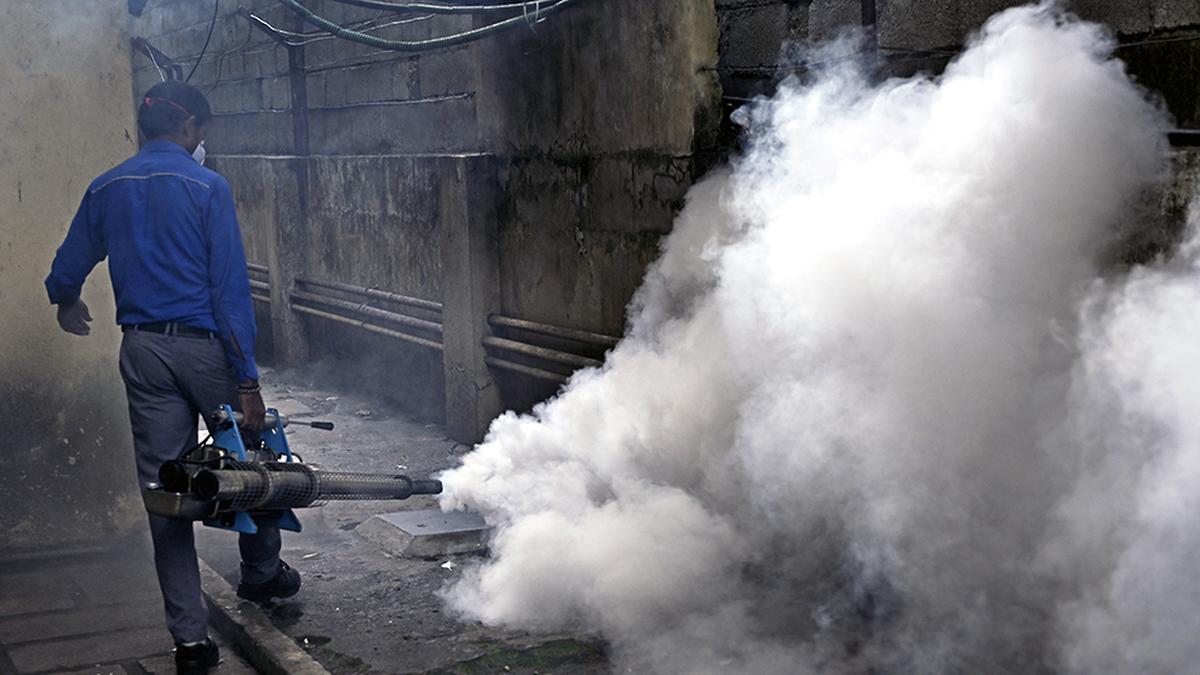
A worker fumigating a private building surroundings to control mosquitoes and to prevent spread of dengue. File
| Photo Credit: K. Bhagya Prakash

Can the dengue virus beat the coronavirus and is it why the early wave of the pandemic in 2020 resulted in fewer COVID deaths or severe infections compared to Europe or North America where dengue is not endemic? Research from the CSIR-Indian Institute of Chemical Biology, Kolkata hints at these intriguing possibilities following an analysis of antibodies from people infected with dengue and testing them against a kind of coronavirus called murine hepatitis virus (mouse coronavirus). In research settings, this virus — being part of the same family of human coronaviruses — is considered a good surrogate to study the behaviour of the coronavirus strains that infected people during the pandemic.

Their results, published in the peer-reviewed Journal of Medical Virology this week, suggest that the antibodies following a dengue infection were able to ‘neutralise’ these coronavirus. For their analysis, the scientists relied on a combination of computer-modelling studies as well as cell-culture studies, the latter demonstrating how antibodies from dengue were able to engulf and bind the coronavirus proteins.

However, this protective effect did not necessarily expand to all coronavirus variants.

These latest studies build on the lab’s work from 2020 that blood tests specific to check for dengue sometimes led to a positive SARS-CoV-2 test.

“We experimentally demonstrated that serum samples from dengue patients have the potential to bind to and “mask” the surface of several coronaviruses, including SARS-CoV-2. We performed “virus neutralization” tests in cell cultures and showed that such “masking” by dengue antibodies can indeed, block coronavirus entry into susceptible cells,” Dr. Subhajit Biswas, Principal Scientist and the main author of the study, told The Hindu.

The dengue family of viruses are different from the coronavirus family and hence infection from one, in normal circumstances, is not expected to protect against the other. What is known about dengue is that there are four major serotypes, or strains, that cause dengue infections. Strains Denv-1 and Denv-2 are the most common in India. However, being infected with one does not protect against the other and, in fact, a re-infection involving a different strain can be more dangerous — a phenomenon called antibody-dependent enhancement (ADE) in dengue. Whether the prevalence of dengue in dengue-endemic countries of Southeast Asia may be triggering newer mutations in the coronavirus is a factor that needs to be investigated more extensively, the authors suggest in their study.

That the early stages of the pandemic saw a decline in dengue in India has been independently reported. The National Vector Borne Disease Control Programme of India reported a sharp decline of 75% (39,419 versus 1,57,315) in dengue incidence during 2020 as compared with 2019. “The possible reasons for this reduction could be lower transmission of the vector, less exposure due to COVID-19 lockdown, and, potentially, a disparity in the reported data possibly due to underdiagnosis or underreporting because of increased attention to the COVID-19 pandemic,” said a 2021 study in the American Journal of Tropical Medicine and Hygeine.

“In this paper, we provided several pieces of experimentally obtained evidence that pre-existing dengue immunity might have played some protective role in reducing the COVID severity and mortality in dengue-prone regions like Southeast Asia compared to regions where dengue does not occur frequently, like Europe and North America. Perhaps this is why, historically, human coronaviruses have been rarely encountered as a causative agent of “severe acute respiratory infections, SARI” from India, highly endemic for dengue virus,” he added.

The dilemma was whether the cross-reactive antibodies would provide partial protection against severe dengue infection or lead to increased severity due to the well-known phenomenon of antibody-dependent enhancement seen in dengue.  We hypothesize that the presence of antibodies to SARS-CoV-2 might decrease the severity of dengue. Larger multicentric clinical studies or population data from dengue endemic regions might help in understanding the existence of the cross-reactive, cross-protective association between these two single-stranded, positively coiled +SS RNA viruses.



Source link

Science Tags:Coronavirus, dengue, early COVID wave, early COVID wave in India, endemic dengue, stem severity of early COVID wave

Post navigation

Previous Post: Tussle Between Governor, Mamata Banerjee Shameful Episode: Adhir Ranjan
Next Post: South Africa vs India Live Score Ball by Ball, T20 World Cup 2024 Live Cricket Score Of Today's Match on NDTV Sports

Related Posts

  • Space telescopes stumble on rule-breaking black hole in early universe
    Space telescopes stumble on rule-breaking black hole in early universe Science
  • How does my smartphone know which way is up?
    How does my smartphone know which way is up? Science
  • Bumrah’s ball to Rizwan shows energy conservation law in action
    Bumrah’s ball to Rizwan shows energy conservation law in action Science
  • A freak DNA change 25 million years ago is why humans lack tails
    A freak DNA change 25 million years ago is why humans lack tails Science
  • Photobiology: speeding up enzyme reactions in microbes using light
    Photobiology: speeding up enzyme reactions in microbes using light Science
  • New research finds abundant microplastics in personal care products available in India
    New research finds abundant microplastics in personal care products available in India Science

More Related Articles

How jumping genes and RNA bridges promise to shake up biomedicine How jumping genes and RNA bridges promise to shake up biomedicine Science
What is cheaper to cook with, LPG or induction? What is cheaper to cook with, LPG or induction? Science
South Africa petrochem unit world’s single largest greenhouse gas source South Africa petrochem unit world’s single largest greenhouse gas source Science
ADHD stimulants are being used recreationally, with consequences for users ADHD stimulants are being used recreationally, with consequences for users Science
Stubble burning in Punjab, Haryana contributes only 14% of PM2.5 in Delhi-NCR: study Stubble burning in Punjab, Haryana contributes only 14% of PM2.5 in Delhi-NCR: study Science
Prevalence of NCDs tripled, infectious diseases doubled since 1995 Prevalence of NCDs tripled, infectious diseases doubled since 1995 Science
SiteLock

Archives

  • May 2026
  • April 2026
  • March 2026
  • February 2026
  • January 2026
  • December 2025
  • November 2025
  • October 2025
  • September 2025
  • August 2025
  • July 2025
  • June 2025
  • May 2025
  • April 2025
  • March 2025
  • February 2025
  • January 2025
  • December 2024
  • November 2024
  • October 2024
  • September 2024
  • August 2024
  • July 2024
  • June 2024
  • May 2024
  • April 2024
  • March 2024
  • February 2024
  • January 2024
  • December 2023
  • November 2023
  • October 2023
  • September 2023
  • August 2023
  • July 2023
  • June 2023
  • May 2023
  • April 2023
  • March 2023
  • February 2023
  • January 2023
  • December 2022
  • November 2022
  • October 2022
  • September 2022
  • August 2022
  • July 2022
  • June 2022
  • May 2022

Categories

  • Business
  • Nation
  • Science
  • Sports
  • World

Recent Posts

  • China, U.S. should be ‘partners not rivals’, says Xi Jinping after meeting Donald Trump
  • Iran working on Hormuz ‘protocol’ to cover ‘costs’, says Deputy Foreign Minister Gharibabadi
  • Zydus Lifesciences arm to acquire U.S. oncology firm Assertio for $166 million
  • Israel-Iran war LIVE: Iran working on Hormuz ‘protocol’ to cover ‘costs’, says Dy FM Gharibabadi
  • Russia to fulfil all agreements on energy supply to India: FM Lavrov

Recent Comments

  1. Jeffreyroure on UP Teacher Who Asked Students To Slap Muslim Classmate
  2. Stevemonge on UP Teacher Who Asked Students To Slap Muslim Classmate
  3. RichardClage on UP Teacher Who Asked Students To Slap Muslim Classmate
  4. StevenLek on UP Teacher Who Asked Students To Slap Muslim Classmate
  5. Leonardren on UP Teacher Who Asked Students To Slap Muslim Classmate
  • Access Denied
    Access Denied Nation
  • Powerful 6.8 Magnitude Earthquake Hits Morocco
    Powerful 6.8 Magnitude Earthquake Hits Morocco World
  • Access Denied Sports
  • Access Denied Business
  • Access Denied
    Access Denied Nation
  • Honda’s GST rate cut benefit lowers two-wheeler prices up to 350cc by ₹18,800
    Honda’s GST rate cut benefit lowers two-wheeler prices up to 350cc by ₹18,800 Business
  • Access Denied
    Access Denied Nation
  • IND vs NZ | Was the Ahmedabad pitch worthy of a World Cup final?
    IND vs NZ | Was the Ahmedabad pitch worthy of a World Cup final? Sports

Editor-in-Chief:
Mohammad Ariff,
MSW, MAJMC, BSW, DTL, CTS, CNM, CCR, CAL, RSL, ASOC.
editor@artifex.news

Associate Editors:
1. Zenellis R. Tuba,
zenelis@artifex.news
2. Haris Daniyel
daniyel@artifex.news

Photograher:
Rohan Das
rohan@artifex.news

Artifex.News offers Online Paid Internships to college students from India and Abroad. Interns will get a PRESS CARD and other online offers.
Send your CV (Subjectline: Paid Internship) to internship@artifex.news

Links:
Associate Journalism
About Us
Privacy Policy

News Links:
Breaking News
World
Nation
Sports
Business
Entertainment
Lifestyle

Registered Office:
72/A, Elliot Road, Kolkata - 700016
Tel: 033-22277777, 033-22172217
Email: office@artifex.news

Editorial Office / News Desk:
No. 13, Mezzanine Floor, Esplanade Metro Rail Station,
12 J. L. Nehru Road, Kolkata - 700069.
(Entry from Gate No. 5)
Tel: 033-46011099, 033-46046046
Email: editor@artifex.news

Copyright © 2023 Artifex.News Newsportal designed by Artifex Infotech.