


Skip to content
  • Facebook
  • X
  • Linkedin
  • WhatsApp
  • YouTube
  • Associate Journalism
  • About Us
  • Privacy Policy
  • 033-46046046
  • editor@artifex.news
Artifex.News

Artifex.News

Stay Connected. Stay Informed.

  • Breaking News
  • World
  • Nation
  • Sports
  • Business
  • Science
  • Entertainment
  • Lifestyle
  • Toggle search form
  • Access Denied
    Access Denied Nation
  • CSK Pacer Makes History, Breaks 78-Year-Old Record With Ranji Trophy Ton
    CSK Pacer Makes History, Breaks 78-Year-Old Record With Ranji Trophy Ton Sports
  • Gautam Gambhir Told To “Make Right Choice” By Sanjay Manjrekar. Says “Fascination For KL Rahul…”
    Gautam Gambhir Told To “Make Right Choice” By Sanjay Manjrekar. Says “Fascination For KL Rahul…” Sports
  • New Japan PM Shigeru Ishiba sends offering to Yasukuni war shrine
    New Japan PM Shigeru Ishiba sends offering to Yasukuni war shrine World
  • Suzuki Motor’s Ex CEO, Sushil Modi, Pankaj Udhas Get Padma Awards
    Suzuki Motor’s Ex CEO, Sushil Modi, Pankaj Udhas Get Padma Awards Nation
  • 5 Points About Akoijam Bimol Angomcha, Congress’s Inner Manipur Candidate
    5 Points About Akoijam Bimol Angomcha, Congress’s Inner Manipur Candidate Nation
  • BJP Appoints Rajasthans Satish Poonia As Haryana In Charge
    BJP Appoints Rajasthans Satish Poonia As Haryana In Charge World
  • With Donald Trump’s Return, Will EU Go Easier On Ally Elon Musk?
    With Donald Trump’s Return, Will EU Go Easier On Ally Elon Musk? World
How jumping genes and RNA bridges promise to shake up biomedicine

How jumping genes and RNA bridges promise to shake up biomedicine

Posted on July 8, 2024 By admin


The year was 1948. It had only been about half a century since scientists had rediscovered Gregor Mendel’s work on inheritance in pea plants. This year, a scientist working on the genetics of the maize plant would challenge the then prevailing concept that genes are stable and arranged in an orderly manner on the chromosome. Barbara McClintock at the Carnegie Institution found that some genes were able to move around within the genome. These genes were called mobile elements or transposons.

Prof. McClintock also made another significant observation: depending on where the mobile elements were inserted, they had the ability to reversibly alter gene expression. She used corn kernels’ colours as a surrogate to understand hereditary characteristics, and this way figured out transposons moved about in the genome of the maize plant. She was awarded the Nobel Prize in Physiology or Medicine in 1983 for this work.

Between 1948 and 1983, researchers found transposons in an array of life-forms, including bacteriophages, bacteria, plants, worms, fruit flies, mosquitos, mice, and humans. They were nicknamed ‘jumping genes’.

‘Sleeping beauty’ transposon

The discovery of transposons revolutionised our understanding of genetics, in particular their role in enabling nature’s wondrous diversity. Transposons influence the effects of genes by turning ‘on’ or ‘off’ their expression using a variety of epigenetic mechanisms. They are thus rightly called the tools of evolution, for their ability to rearrange the genome and introduce changes.

More than 45% of the human genome consists of transposable elements. Just as they create diversity, they also create mutations in genes and lead to diseases. However, most of the transposons have themselves inherited mutations and have become inactive, and thus can’t move around within the gnome.

Over the years, researchers have attempted to resurrect inactive transposons from the genomes of the animal kingdom, hoping that the results will be useful in biomedical applications like genetic correction to cure a disease or for gene therapy.

For example, in 1997, researchers studied the genomes of fish and reconstructed a transposon called ‘sleeping beauty’ at the molecular level. This transposon became dormant in vertebrates millions of years ago. The researchers elegantly reprogrammed the synthetic avatar to work in human cells. In future, a similar synthetic transposon inspired by nature may be able to turn off a problem gene or over-express another to accentuate some desirable characteristic.

Researchers have already discovered several naturally occurring vertebrate transposons and continue to look for more.

RNA-guided transposons

On June 26, Naturepublished a paper by researchers at the University of California, Berkeley, and the Arc Institute in the U.S. describing a new RNA-guided gene editing system. This tool builds on an older discovery: that one of the genes in the IS110 family of bacterial transposons contains the instructions for cells to make an RNA molecule with two loops.

Scientists found this RNA could bind to two pieces of DNA, rather than the usual one piece, and form a bridge between them. This is a very useful ability.

In the new study, the researchers used the bridge RNA to edit the DNA. The two loops of the RNA can independently bind to two separate pieces of DNA. One of the loops identifies the target site in the genome that needs to be altered. The other loop specifies the DNA to be inserted in its place. Each loop is independently programmable, which means researchers can mix and match any target and donor DNA sequences of interest.

In their paper, they reported that in Escherichia coli bacteria, the bridge RNA had more than 60% insertion efficiency (i.e. ability to introduce a desired gene) and a 94% specificity (ability to target the intended location on the genome).

Boon for synthetic biology

In a separate paper published on the same day, researchers from the University of Tokyo described the structural and molecular mechanisms of genome modification guided by bridge RNA. The researchers used cryo-electron microscopy to study the IS110 transposons. They found that it works as a dimer — a complex compound formed by bonding two copies of a simpler compound. One copy binds to the target DNA and the other binds to the donor DNA, bridged by the bridge RNA.

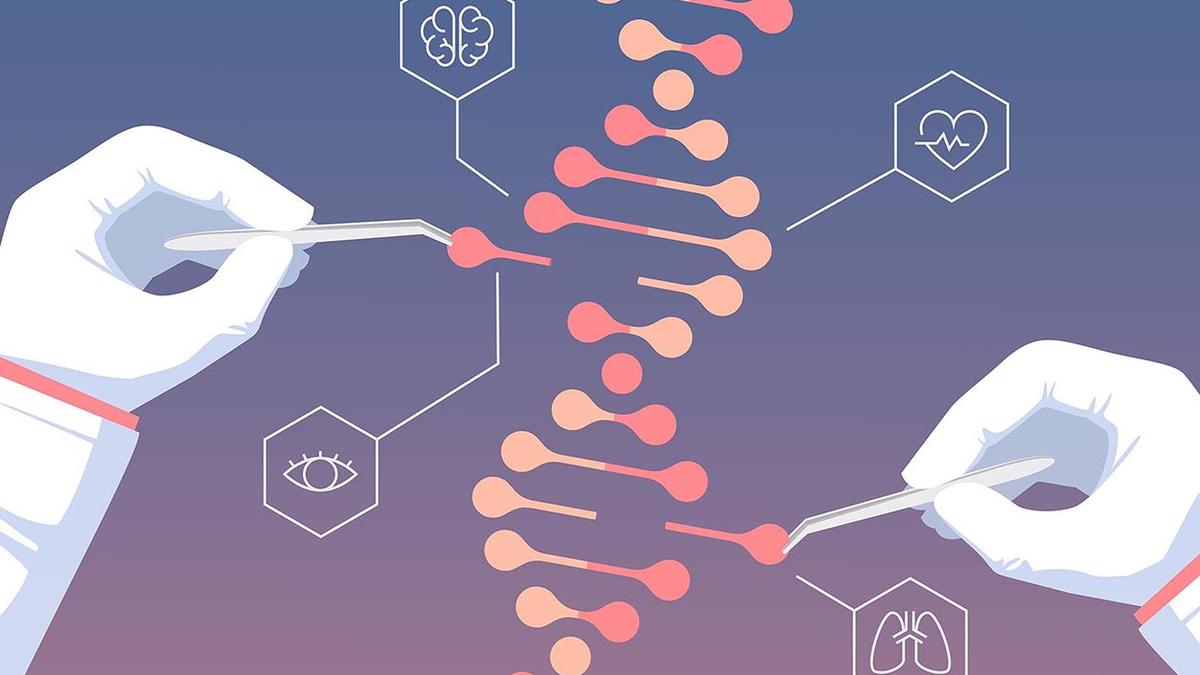
This alternative form of genome-editing has many advantages. CRISPR-mediated editing sometimes leaves small bits of nucleotides added/deleted during the repair process. DNA recombination mediated by bridge RNA on the other hand makes a clean cut, making the edit specific and tidy. Equally importantly, the latter can facilitate the addition, deletion or inversion of DNA sequences of virtually any length. Researchers can exploit this feature by inserting any desirable genetic cargo — such as a functional copy of a faulty, disease-causing gene — into any location on a genome.

Such an ability spells a big boon for synthetic biology, where entire sets of genes need to be inserted or removed from organisms. Similarly, the technique can be used to manage, or even treat, a wide variety of genetic diseases: a functional copy of a gene can be replaced in a given genomic location. Researchers may also be able to treat chromosomal inversions or deletions, which are currently beyond the reach of any of the editing tools we have.

As Prof. McClintock said in her Nobel Prize lecture in 1983: “Unquestionably we will emerge from this revolutionary period with modified views of components of cells and how they operate, but only, however, to await the emergence of the next revolutionary phase that again will bring startling changes in concepts.”

The authors are senior consultants at the Vishwanath Cancer Care Foundation and adjunct professors at IIT, Kanpur and the Dr. D.Y. Patil Medical College, Hospital and Research Center, Pune.



Source link

Science Tags:biomedicine, bridge RNA, bridge RNA mediatet genome editing, chromosome editing, mobile genetic elements, transposons

Post navigation

Previous Post: What is graphene? – The Hindu
Next Post: Curtains on Shiv Sena (UBT)-VBA alliance

Related Posts

  • ISRO’s Chandrayaan-3 moon lander separates from propulsion module
    ISRO’s Chandrayaan-3 moon lander separates from propulsion module Science
  • Andean glacier retreat unprecedented in human civilisation, study finds
    Andean glacier retreat unprecedented in human civilisation, study finds Science
  • Gopichand Thotakura, India’s first civilian space tourist, recieves warm welcome in Delhi
    Gopichand Thotakura, India’s first civilian space tourist, recieves warm welcome in Delhi Science
  • Is the bat’s brain wired for collective behaviour?
    Is the bat’s brain wired for collective behaviour? Science
  • President Murmu congratulates ISRO for successful deployment of Pragyan Rover
    President Murmu congratulates ISRO for successful deployment of Pragyan Rover Science
  • Sanofi gets approval for alternative inactivated polio vaccine
    Sanofi gets approval for alternative inactivated polio vaccine Science

More Related Articles

What is volcanic lightning? – The Hindu What is volcanic lightning? – The Hindu Science
How do some cancer cells survive chemotherapy? Scientists find one way How do some cancer cells survive chemotherapy? Scientists find one way Science
Undervaluing faculty fellowships is bad for scientists, and science Undervaluing faculty fellowships is bad for scientists, and science Science
Scientists map fruit fly brain in neurobiological milestone Scientists map fruit fly brain in neurobiological milestone Science
What is Theremin? What is Theremin? Science
Pragyan rover comes throughout 4-meter diameter crater on lunar floor: ISRO Pragyan rover comes throughout 4-meter diameter crater on lunar floor: ISRO Science
SiteLock

Archives

  • May 2026
  • April 2026
  • March 2026
  • February 2026
  • January 2026
  • December 2025
  • November 2025
  • October 2025
  • September 2025
  • August 2025
  • July 2025
  • June 2025
  • May 2025
  • April 2025
  • March 2025
  • February 2025
  • January 2025
  • December 2024
  • November 2024
  • October 2024
  • September 2024
  • August 2024
  • July 2024
  • June 2024
  • May 2024
  • April 2024
  • March 2024
  • February 2024
  • January 2024
  • December 2023
  • November 2023
  • October 2023
  • September 2023
  • August 2023
  • July 2023
  • June 2023
  • May 2023
  • April 2023
  • March 2023
  • February 2023
  • January 2023
  • December 2022
  • November 2022
  • October 2022
  • September 2022
  • August 2022
  • July 2022
  • June 2022
  • May 2022

Categories

  • Business
  • Nation
  • Science
  • Sports
  • World

Recent Posts

  • Visakhapatnam Collector calls for inter-departmental synergy to boost investments
  • Kohli’s masterful knock powers Royal Challengers to the top
  • Vijay Narayan earns rare distinction of being Advocate General under two different governments
  • Learn from Sri Lanka’s experience on impact of fertilizer supply chains: experts
  • Sewage pollution of Cooum, groundwater depletion raise alarm

Recent Comments

  1. Leonardren on UP Teacher Who Asked Students To Slap Muslim Classmate
  2. NathanQuins on UP Teacher Who Asked Students To Slap Muslim Classmate
  3. Davidgof on UP Teacher Who Asked Students To Slap Muslim Classmate
  4. NathanJobre on UP Teacher Who Asked Students To Slap Muslim Classmate
  5. Davidcag on UP Teacher Who Asked Students To Slap Muslim Classmate
  • Access Denied
    Access Denied Nation
  • Fed official Lisa Cook sues Trump over attempt to fire her, challenging his power over the independent agency
    Fed official Lisa Cook sues Trump over attempt to fire her, challenging his power over the independent agency World
  • Jharkhand Minister Alamgir Alam Arrested By Probe Agency In Money Laundering Case
    Jharkhand Minister Alamgir Alam Arrested By Probe Agency In Money Laundering Case Nation
  • Access Denied Business
  • Thai Zoo That Homes Viral Pygmy Hippo ‘Moo Deng’ Earns 4 Times More Now
    Thai Zoo That Homes Viral Pygmy Hippo ‘Moo Deng’ Earns 4 Times More Now World
  • Men's Doubles QFs Olympics Live: Nadal-Alcaraz Fight Back In 2nd Set
    Men's Doubles QFs Olympics Live: Nadal-Alcaraz Fight Back In 2nd Set Sports
  • Access Denied
    Access Denied Nation
  • Kerala Leader’s Hijab Remark Sparks Outrage
    Kerala Leader’s Hijab Remark Sparks Outrage Nation

Editor-in-Chief:
Mohammad Ariff,
MSW, MAJMC, BSW, DTL, CTS, CNM, CCR, CAL, RSL, ASOC.
editor@artifex.news

Associate Editors:
1. Zenellis R. Tuba,
zenelis@artifex.news
2. Haris Daniyel
daniyel@artifex.news

Photograher:
Rohan Das
rohan@artifex.news

Artifex.News offers Online Paid Internships to college students from India and Abroad. Interns will get a PRESS CARD and other online offers.
Send your CV (Subjectline: Paid Internship) to internship@artifex.news

Links:
Associate Journalism
About Us
Privacy Policy

News Links:
Breaking News
World
Nation
Sports
Business
Entertainment
Lifestyle

Registered Office:
72/A, Elliot Road, Kolkata - 700016
Tel: 033-22277777, 033-22172217
Email: office@artifex.news

Editorial Office / News Desk:
No. 13, Mezzanine Floor, Esplanade Metro Rail Station,
12 J. L. Nehru Road, Kolkata - 700069.
(Entry from Gate No. 5)
Tel: 033-46011099, 033-46046046
Email: editor@artifex.news

Copyright © 2023 Artifex.News Newsportal designed by Artifex Infotech.