
Skip to content
  • Facebook
  • X
  • Linkedin
  • WhatsApp
  • YouTube
  • Associate Journalism
  • About Us
  • Privacy Policy
  • 033-46046046
  • editor@artifex.news
Artifex.News

Artifex.News

Stay Connected. Stay Informed.

  • Breaking News
  • World
  • Nation
  • Sports
  • Business
  • Science
  • Entertainment
  • Lifestyle
  • Toggle search form
  • Vistara Cuts Flights To Deal With Pilot Shortage, Offers Refund To Passengers
    Vistara Cuts Flights To Deal With Pilot Shortage, Offers Refund To Passengers Nation
  • “We Will Go Into The Series With…”: R Ashwin Confident Of India’s Show In Upcoming Test Series vs Australia
    “We Will Go Into The Series With…”: R Ashwin Confident Of India’s Show In Upcoming Test Series vs Australia Sports
  • Mentally Challenged Woman Raped On Hospital Campus In Madhya Pradesh, 1 Arrested
    Mentally Challenged Woman Raped On Hospital Campus In Madhya Pradesh, 1 Arrested Nation
  • Decathlon to invest €100 million in India
    Decathlon to invest €100 million in India Business
  • Pooran punishes South Africa as West Indies win by seven wickets
    Pooran punishes South Africa as West Indies win by seven wickets Sports
  • SEBI allows Category I and II AIFs to borrow, extends tenure for LVFs
    SEBI allows Category I and II AIFs to borrow, extends tenure for LVFs Business
  • “Horrible, Disgusting”: Internet Blasts Lucknow Super Giants Owner Over Chat With KL Rahul
    “Horrible, Disgusting”: Internet Blasts Lucknow Super Giants Owner Over Chat With KL Rahul Sports
  • Poliovirus found in wastewater in Spain, Germany, and Poland
    Poliovirus found in wastewater in Spain, Germany, and Poland Science
How do some cancer cells survive chemotherapy? Scientists find one way

How do some cancer cells survive chemotherapy? Scientists find one way

Posted on October 12, 2023 By admin


Treating cancer is expensive, costing up to several lakh rupees depending on the type of cancer, the treatment options available, and the treatment setting (public or private). It can also take time, removing an individual from their work and family for extended periods, and be painful.

Sometimes, while an individual may have successfully forced a cancer into remission, there may be a risk of relapse. One way this happens is when a few cancer cells are able to resist the drugs used to destroy them: they lay in wait and produce a show of strength later. Understanding this resistance could eliminate the different ways in which it happens, and reduce the odds of a relapse.

In a new study, published in Cell Reports on September 20, researchers from the Netherlands Cancer Institute investigated the resistance of some cancer cells to a drug called Taxol. They have reported that the culprit could be the location of a particular gene inside the cancer cells’ nucleus.

The oncologist’s challenge

A characteristic feature of cancer cells is that they divide rapidly, in uncontrolled fashion. Anti-cancer drugs – i.e. chemotherapeutic agents – work by stalling or blocking this proliferation. When the division of a cancer cell is arrested, it generally responds by triggering a pathway of programmed cell death, called apoptosis. So in this way, chemotherapy eliminates the cancer cells without affecting other non-cancerous cells nearby that are not dividing.

But this is also why chemotherapy deals a lot of collateral damage. Any tissue with a significant number of normal cells that are also dividing – such as cells in the digestive tract, the bone marrow, and hair follicles – are also affected by chemotherapeutic agents and suffer apoptosis. This cell death underlies the unpleasant side-effects of chemotherapy, such as painful inflammation of the oral cavity and the gut, and nausea, diarrhoea, anaemia, and hair loss.

An oncologist’s challenge is to find the dose of a drug that effectively kills cancer cells but whose side-effects are not unbearable for the patient. One way researchers have tried to achieve this is by developing antibody-drug conjugates (ADCs) against some cancers. An ADC is a drug attached to an antibody that recognises a protein found only on, or at least preferentially on, the cancer cells. This way, the antibody guides the chemotherapeutic drug to the cancer cells, where the drug begins its work. And, of course, non-cancer cells are bypassed.

The toxin-remover protein

As it happens, a small subset of cancer cells can still escape confrontation with the anti-cancer drug. This happens when these cells express elevated levels of a protein called P-gp – short for permeability glycoprotein. For a cell to produce P-gp, it uses information encoded in a gene called ABCB1.

Inside the cell, P-gp works like a pump, moving toxic compounds out. And in cells that make too much P-gp, the protein removes toxins well enough to flush the chemotherapeutic agents out as well. So the latter can’t accumulate to levels that arrest cell division and trigger apoptosis, allowing the cancer cell to live another day.

In fact, these surviving cells can allow the cancer to return after a period of remission.

Finding the mechanism of resistance

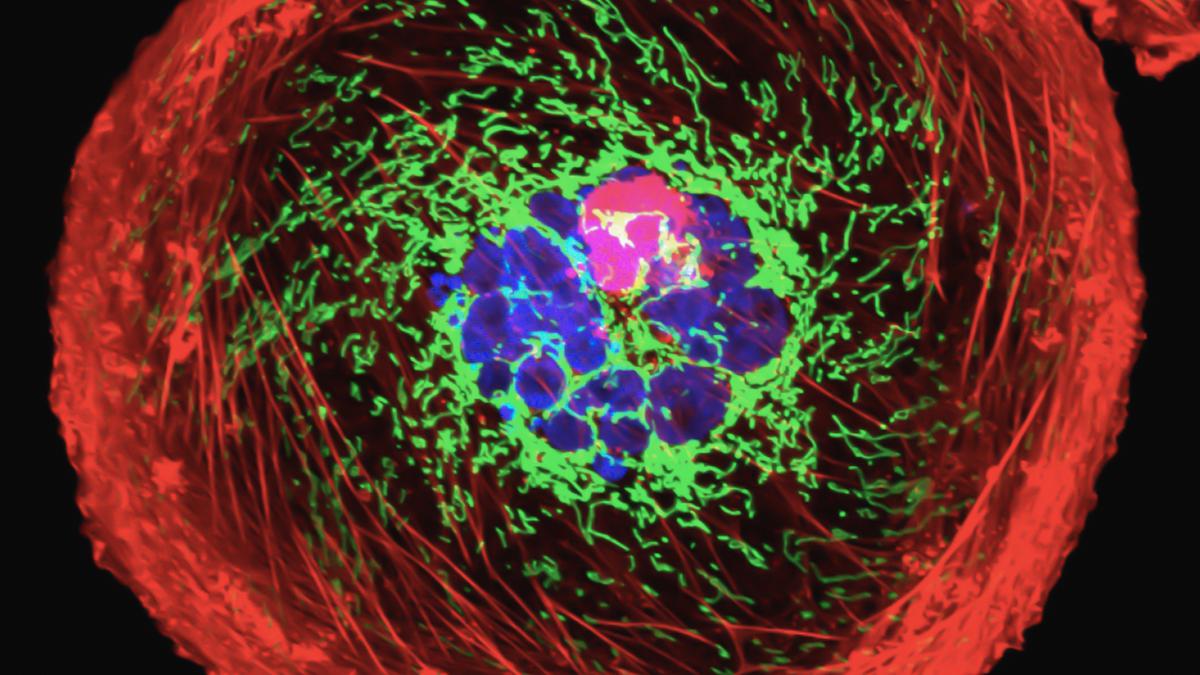
In the Cell Reports study, the researchers used cells from the human eye retinal pigment epithelium as a model to explore a small subset that expressed the P-gp protein and thus became resistant to the anti-cancer drug Taxol. They found that a cell’s sensitivity to Taxol, including its ability to resist Taxol’s anti-cancer effects, was related to the location of the ABCB1 gene inside the cell’s nucleus.

The nucleus is the part of the cell that houses the DNA and the associated proteins. A membrane called the nuclear envelope separates it from the rest of the cell. Genes are segments of a DNA molecule; when a gene is expressed, it means the cell can use it as a template to form molecules called RNA.

DNA and RNA share many chemical properties. The DNA contains the archival copy of a gene whereas the cell uses the RNA as the working copy. But only the RNA, and not the DNA, enters the cytoplasm – i.e. the rest of the cell – where it ‘instructs’ the cellular machinery on the way to link different amino acids to form the protein encoded by a gene.

In those retinal pigment epithelium cells that were sensitive to Taxol, the ABCB1 gene was found to be located close to the nuclear envelope. In cells that could resist the effects of Taxol, the gene had detached from the nuclear envelope and had moved further inside the nucleus. As a result, resistant cells exhibited a 100-fold increase in the amount of RNA corresponding to the ABCB1 gene compared to cells that remained sensitive to Taxol.

The P-gp efflux pump made from this RNA was responsible for Taxol-resistance.

Resisting the resistance

To identify what tethered the ABCB1 gene to the nuclear envelope in sensitive cells, the researchers turned different genes ‘off’ to see which one affected the proteins that the cell uses to make the envelope.

They zeroed in on a protein called lamin B receptor (LBR). According to the researchers, when the LBR protein was absent, a cell could activate the ABCB1 gene when it was exposed to Taxol. But when they deleted the gene used to make LBR, the cells didn’t increase ABCB1 expression right away; they had to be exposed to Taxol as well. So additional factors, instead of just LBR, help silence ABCB1 in the bulk population.

The researchers also studied the effect of depleting LBR from breast, head and neck, and lung cancer cells. Lung cancer cells expressed the RNA corresponding to ABCB1 to a high degree, and depleting LBR proteins didn’t further increase the fraction of Taxol-resistant cells. On the other hand, among breast cancer cells, depleting LBR increased the Taxol-resistant fraction – but not in the head and neck cancer cells.

Preferences among cells

Why do different cancers respond so differently to LBR depletion? An analogy from everyday life might help to understand. There are different ways to keep clothes dry in a bathroom: by hanging them on hooks, on towel rods or on a ledge. But not all bathrooms offer all options. In one with only a few hooks, there is a greater risk of clothes piled on a hook dropping to the floor.

We can rely less on hooks if there are rods and ledges as well. Similarly, the breast cancer cells may have depended more on LBR to tether genes to the nuclear envelope than the other cancer-cell types.

These findings highlight the need for more research to uncover the different ways in which cancer cells express or silence genes. By revealing how some cells develop Taxol-resistance, the study also opens the door for researchers to develop new ways to ensure anti-cancer drugs remain potent and patients recover faster.

The author is a retired scientist.


Source link

Science Tags:ABCB1 gene, antibody-drug conjugates, Cell Reports, chemotherapy, drug-resistant cancer, lamin B receptor, permeability glycoprotein, Taxol resistance

Post navigation

Previous Post: Chandrababu Naidu’s Son Meets Amit Shah To Discuss Father’s Safety In Jail
Next Post: ‘Masked’ Shubman Gill Reaches Ahmedabad Ahead Of India vs Pakistan World Cup Clash. Watch

Related Posts

  • Europe secures record space budget to boost independence
    Europe secures record space budget to boost independence Science
  • Can international patent law handle a permanent space presence?
    Can international patent law handle a permanent space presence? Science
  • Bacteria can talk to each other and are multilingual, says biologist
    Bacteria can talk to each other and are multilingual, says biologist Science
  • The evolving China-Pakistan space cooperation
    The evolving China-Pakistan space cooperation Science
  • GSLV-F14 Launch: GSLV-F14 carrying INSAT-3DS to lift off on Feb 17: ISRO
    GSLV-F14 Launch: GSLV-F14 carrying INSAT-3DS to lift off on Feb 17: ISRO Science
  • Chandrayaan 4 and 5 design complete; 70 satellites likely to be launched in 5 years: ISRO chief
    Chandrayaan 4 and 5 design complete; 70 satellites likely to be launched in 5 years: ISRO chief Science

More Related Articles

What caused Morocco’s earthquake? A geologist studying the Atlas mountains explains What caused Morocco’s earthquake? A geologist studying the Atlas mountains explains Science
Hotter Kalahari desert may stop hornbills breeding by 2027 Hotter Kalahari desert may stop hornbills breeding by 2027 Science
What do the Atlantic Ocean hurricane forecasts foretell for India? What do the Atlantic Ocean hurricane forecasts foretell for India? Science
What’s the status of the rare earth hypothesis? | Explained What’s the status of the rare earth hypothesis? | Explained Science
The Science Quiz | Indelible ink The Science Quiz | Indelible ink Science
Model by Chennai, Pune team predicts birth weight from routine scans Model by Chennai, Pune team predicts birth weight from routine scans Science
SiteLock

Archives

  • May 2026
  • April 2026
  • March 2026
  • February 2026
  • January 2026
  • December 2025
  • November 2025
  • October 2025
  • September 2025
  • August 2025
  • July 2025
  • June 2025
  • May 2025
  • April 2025
  • March 2025
  • February 2025
  • January 2025
  • December 2024
  • November 2024
  • October 2024
  • September 2024
  • August 2024
  • July 2024
  • June 2024
  • May 2024
  • April 2024
  • March 2024
  • February 2024
  • January 2024
  • December 2023
  • November 2023
  • October 2023
  • September 2023
  • August 2023
  • July 2023
  • June 2023
  • May 2023
  • April 2023
  • March 2023
  • February 2023
  • January 2023
  • December 2022
  • November 2022
  • October 2022
  • September 2022
  • August 2022
  • July 2022
  • June 2022
  • May 2022

Categories

  • Business
  • Nation
  • Science
  • Sports
  • World

Recent Posts

  • MP pulls up Adani Total Gas for delay in PNG supply line project for Udupi district
  • Heavy Russian strikes on Kyiv kill one, wound 31; Ukraine links attack to Trump-Xi summit
  • Vijay govt. says it needs time to ‘restructure’ Magalir Urimai Thogai programme; funds to be disbursed soon
  • Premier League title race: Manchester City keeps pressure on Arsenal with win over Crystal Palace
  • Wholesale price inflation rises to 8.3% in April on sharp spike in fuel, power, crude

Recent Comments

  1. JamesHeR on UP Teacher Who Asked Students To Slap Muslim Classmate
  2. RafaelNar on UP Teacher Who Asked Students To Slap Muslim Classmate
  3. CarlosExorb on UP Teacher Who Asked Students To Slap Muslim Classmate
  4. Robertfloup on UP Teacher Who Asked Students To Slap Muslim Classmate
  5. Davidcag on UP Teacher Who Asked Students To Slap Muslim Classmate
  • 750 Of 1,563 Students Skipped NEET-UG Retest: Exam Body NTA
    750 Of 1,563 Students Skipped NEET-UG Retest: Exam Body NTA Nation
  • No Imminent Threat From ISIS To US Homeland: White House
    No Imminent Threat From ISIS To US Homeland: White House World
  • India vs England 5th Test Day 1: Rohit Sharma, Yashasvi Jaiswal Pummel England After Kuldeep Yadav, Ravichandran Ashwin Spin Show
    India vs England 5th Test Day 1: Rohit Sharma, Yashasvi Jaiswal Pummel England After Kuldeep Yadav, Ravichandran Ashwin Spin Show Sports
  • Odisha Rapper Juggernaut, Caught Cheating On Wife Last Year, Dies By Suicide
    Odisha Rapper Juggernaut, Caught Cheating On Wife Last Year, Dies By Suicide Nation
  • Japan’s Kishida shuffles Cabinet and party posts to solidify power
    Japan’s Kishida shuffles Cabinet and party posts to solidify power World
  • Zelensky Says 2 Captured North Korean Soldiers Being Probed
    Zelensky Says 2 Captured North Korean Soldiers Being Probed World
  • Rob Reiner’s son to be arraigned in killing of his parents
    Rob Reiner’s son to be arraigned in killing of his parents World
  • Access Denied Sports

Editor-in-Chief:
Mohammad Ariff,
MSW, MAJMC, BSW, DTL, CTS, CNM, CCR, CAL, RSL, ASOC.
editor@artifex.news

Associate Editors:
1. Zenellis R. Tuba,
zenelis@artifex.news
2. Haris Daniyel
daniyel@artifex.news

Photograher:
Rohan Das
rohan@artifex.news

Artifex.News offers Online Paid Internships to college students from India and Abroad. Interns will get a PRESS CARD and other online offers.
Send your CV (Subjectline: Paid Internship) to internship@artifex.news

Links:
Associate Journalism
About Us
Privacy Policy

News Links:
Breaking News
World
Nation
Sports
Business
Entertainment
Lifestyle

Registered Office:
72/A, Elliot Road, Kolkata - 700016
Tel: 033-22277777, 033-22172217
Email: office@artifex.news

Editorial Office / News Desk:
No. 13, Mezzanine Floor, Esplanade Metro Rail Station,
12 J. L. Nehru Road, Kolkata - 700069.
(Entry from Gate No. 5)
Tel: 033-46011099, 033-46046046
Email: editor@artifex.news

Copyright © 2023 Artifex.News Newsportal designed by Artifex Infotech.