


Skip to content
  • Facebook
  • X
  • Linkedin
  • WhatsApp
  • YouTube
  • Associate Journalism
  • About Us
  • Privacy Policy
  • 033-46046046
  • editor@artifex.news
Artifex.News

Artifex.News

Stay Connected. Stay Informed.

  • Breaking News
  • World
  • Nation
  • Sports
  • Business
  • Science
  • Entertainment
  • Lifestyle
  • Toggle search form
  • From PoK to Asia Cup 2023, Zaman Khan Makes ODI Debut With Lasith Malinga-like Action
    From PoK to Asia Cup 2023, Zaman Khan Makes ODI Debut With Lasith Malinga-like Action Sports
  • Inside The NEET Paper Leak
    Inside The NEET Paper Leak Nation
  • Access Denied Sports
  • New Criminal Laws, Which Replace Penal Code, To Come Into Effect From July 1
    New Criminal Laws, Which Replace Penal Code, To Come Into Effect From July 1 Nation
  • Access Denied Sports
  • Access Denied Sports
  • In PM’s Mann Ki Baat, Praise For Meghalaya Man Who Discovered 1,700 Caves
    In PM’s Mann Ki Baat, Praise For Meghalaya Man Who Discovered 1,700 Caves Nation
  • Why Paytm CEO Vijay Shekhar Sharma Quit Payments Bank Board
    Why Paytm CEO Vijay Shekhar Sharma Quit Payments Bank Board Nation
Space telescopes stumble on rule-breaking black hole in early universe

Space telescopes stumble on rule-breaking black hole in early universe

Posted on January 23, 2025 By admin


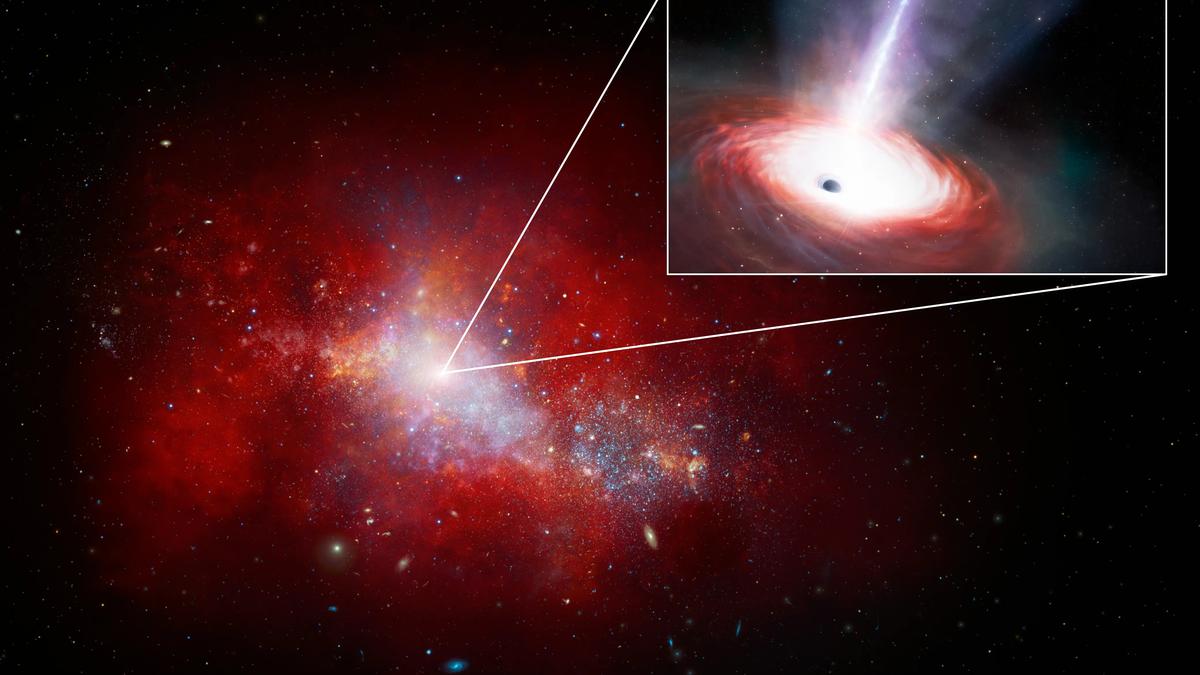
An international team of researchers using NASA’s James Webb Space Telescope (JWST) and the Chandra X-ray observatory has discovered a bizarre black hole that may provide insights into the genesis and growth of supermassive black holes.

Supermassive black holes are among the most common types of black holes in the universe. Most galaxies contain a supermassive black hole at their centres. These black holes have masses ranging from millions to billions of times that of the sun. The supermassive black hole Sagittarius A* located at the center of the Milky Way galaxy has a mass of approximately 4.3 million solar masses.

However, scientists are not yet fully certain how these giants grow to become so big.

Beyond the upper limit

The newfound black hole, designated LID-568, is a low-mass supermassive black hole that existed just 1.5 billion years after the Big Bang. If the universe were a human, it could be said to be around eight years old at this time.

A detailed analysis of its effects on its neighbourhood indicated that the black hole was feeding on a surrounding cloud of matter at an exceptional rate — almost 40-times greater than what astrophysicists thought was the upper limit.

The study was led by International Gemini Observatory/NSF NOIRLab astronomer Hyewon Suh and the results were published in the journal Nature Astronomy in November 2024.

“We first identified this unusual object through Chandra X-ray observations, as it was exceptionally bright in X-rays but completely invisible in the deepest optical and near-infrared observations, even with the Hubble Space Telescope,” Suh, the lead researcher, said.

“Because it was only detected in X-rays, we couldn’t determine its nature. With JWST’s unparalleled sensitivity in the infrared, we were finally able to uncover this exotic object, highlighting the complementary power of these observatories,” she added.

A class apart

The rate at which a black hole feeds on matter is governed by what astronomers call the Eddington limit. This limit — named after the English astronomer Arthur Stanley Eddington because he worked it out first — is also related to how brightly a black hole can shine.

Nothing can escape a black hole of course. But when a black hole pulls surrounding matter towards itself, the infalling material becomes compressed, heats up, and emits radiation, especially X-rays.

The concept behind the Eddington limit is straightforward: as matter collects around the black hole and gets packed into the disc, it heats up and emits radiation that generates an outward pressure capable of counteracting the gravitational pull of the black hole. When this radiation pressure balances the force of gravity, the black hole will stop accruing the matter. Ergo, there is a limit on how brightly the black hole can shine.

If this limit is crossed, the scenario is called a super-Eddington accretion. This is the category in which LID-568 lies.

Suh said that they measured the total light coming from the black hole and its mass using observations from Chandra and JWST’s Near-Infrared Spectrograph instrument, which revealed the exceptional accretion behavior of LID-568.

Experts have hypothesised that super-Eddington black holes can exist. They have even found a few. But LID-568 has defied their expectation in two ways. First, it’s much, much farther away. The most distant of these other black holes is ‘only’ around 2.3 billion light years from earth. Second, while the known rule-breakers exceeded the Eddington limit by a factor of two or three, LID-568 has done so by a factor of roughly 40, according to Suh.

Super-Eddington episodes in black holes are expected to be short-lived, so it is also remarkable that researchers captured LID-568 in action.

Making sense of the oddball

The existence of supermassive black holes that are millions or even billions of times more massive than our sun poses a challenge to current models of black hole formation and growth. Scientists have confirmed that such black holes reside at the centres of many galaxies that should have formed when the universe was less than a billion years old. However, they can’t explain how these objects came to be when the universe was so young, when there shouldn’t have been enough matter for them to form.

According to some traditional models, Suh said, “supermassive black holes are thought to form from the death of the first star, i.e. light seeds with 10-100 times the mass of the sun, and/or through the direct collapse of primordial gas clouds, such as heavy seeds with 1,000-100,000 times the mass of the sun.”

“However, these models lack direct observational confirmation and require sustained, continuous accretion of large amounts of matter over several hundred million years to account for the most extreme supermassive black holes observed in the early universe, which is likely difficult,” she added.

The discovery of LID-568 is crucial because it suggests that large black holes could have put on a significant fraction of their weight during short-lived episodes of rapid feeding. If true, this mechanism would do away with black holes having to feed on large quantities of matter for a very long time, and offer “a convincing explanation for how supermassive black holes could form so quickly, regardless of their initial seed mass,” whether heavy or light.

Chasing more black holes

Suh also said there are several theories to explain how black holes can exceed the Eddington limit, including geometrically thick accretion disks, powerful black hole jets, and black-hole mergers. However, she said that her team still doesn’t fully understand the exact mechanism that allowed LID-568 to feed so fast and that follow-up observations with JWST will be crucial to testing other hypotheses.

The researchers also found that the galaxy where LID-568 resided wasn’t producing many new stars — the result of the black supermassive hole driving powerful streams of material outward from the centre, called outflows. These outflows could be preventing matter from accumulating in enough quantities to form stars.

To confirm this idea as well as to inform it with more data, Suh said she and her team are planning to examine similar galaxies and examine their outflows, especially those driven by very large black fast-snacking holes.

The research team is also planning to find out how long a black hole can accrue matter at a super-Eddington rate as well as what percentage of all black holes do so.

Shreejaya Karantha is a freelance science writer and a content writer and research specialist at The Secrets of The Universe.

Published – January 23, 2025 05:30 am IST



Source link

Science

Post navigation

Previous Post: Trump Redesignates Iran-Backed Houthi Rebels As Foreign Terrorist Organization
Next Post: Maintaining steadfast support for Israel is top priority for Trump: U.S. State Department

Related Posts

  • ‘I’m really proud’: Victor Glover — first Black astronaut candidate reflects on historic Moon mission
    ‘I’m really proud’: Victor Glover — first Black astronaut candidate reflects on historic Moon mission Science
  • Gaganyaan test flight mission successful, crew escape module splashes down
    Gaganyaan test flight mission successful, crew escape module splashes down Science
  • The man behind the Mersenne primes
    The man behind the Mersenne primes Science
  • Open Day at Institute of Astrophysics in Bengaluru on February 25
    Open Day at Institute of Astrophysics in Bengaluru on February 25 Science
  • How humans came to inhabit every corner of the world
    How humans came to inhabit every corner of the world Science
  • Why forcing employees to use AI is producing the opposite of what companies want
    Why forcing employees to use AI is producing the opposite of what companies want Science

More Related Articles

SpaceX’s Falcon-9 deploys India’s GSAT-N2 satellite into orbit SpaceX’s Falcon-9 deploys India’s GSAT-N2 satellite into orbit Science
New research traces how Africa’s wildcats became today’s house cats New research traces how Africa’s wildcats became today’s house cats Science
New low-cost MRI machine can improve access to diagnostics in India New low-cost MRI machine can improve access to diagnostics in India Science
NASA astronaut Sunita Williams retires NASA astronaut Sunita Williams retires Science
Right against climate change a distinct fundamental and human right, SC judgment Right against climate change a distinct fundamental and human right, SC judgment Science
Why India’s Green Revolution isn’t a blueprint to feed a hungry planet Why India’s Green Revolution isn’t a blueprint to feed a hungry planet Science
SiteLock

Archives

  • May 2026
  • April 2026
  • March 2026
  • February 2026
  • January 2026
  • December 2025
  • November 2025
  • October 2025
  • September 2025
  • August 2025
  • July 2025
  • June 2025
  • May 2025
  • April 2025
  • March 2025
  • February 2025
  • January 2025
  • December 2024
  • November 2024
  • October 2024
  • September 2024
  • August 2024
  • July 2024
  • June 2024
  • May 2024
  • April 2024
  • March 2024
  • February 2024
  • January 2024
  • December 2023
  • November 2023
  • October 2023
  • September 2023
  • August 2023
  • July 2023
  • June 2023
  • May 2023
  • April 2023
  • March 2023
  • February 2023
  • January 2023
  • December 2022
  • November 2022
  • October 2022
  • September 2022
  • August 2022
  • July 2022
  • June 2022
  • May 2022

Categories

  • Business
  • Nation
  • Science
  • Sports
  • World

Recent Posts

  • Visakhapatnam Collector calls for inter-departmental synergy to boost investments
  • Kohli’s masterful knock powers Royal Challengers to the top
  • Vijay Narayan earns rare distinction of being Advocate General under two different governments
  • Learn from Sri Lanka’s experience on impact of fertilizer supply chains: experts
  • Sewage pollution of Cooum, groundwater depletion raise alarm

Recent Comments

  1. Leonardren on UP Teacher Who Asked Students To Slap Muslim Classmate
  2. NathanQuins on UP Teacher Who Asked Students To Slap Muslim Classmate
  3. Davidgof on UP Teacher Who Asked Students To Slap Muslim Classmate
  4. NathanJobre on UP Teacher Who Asked Students To Slap Muslim Classmate
  5. Davidcag on UP Teacher Who Asked Students To Slap Muslim Classmate
  • Economic Survey 2023-24: FDI inflows from China can help India increase global supply chain participation
    Economic Survey 2023-24: FDI inflows from China can help India increase global supply chain participation Business
  • Censor Board On Actor’s Corruption Charge
    Censor Board On Actor’s Corruption Charge Nation
  • Access Denied
    Access Denied Nation
  • Access Denied Sports
  • U.S. House approves resolution honouring Charlie Kirk amid opposition by dozens of Democrats
    U.S. House approves resolution honouring Charlie Kirk amid opposition by dozens of Democrats World
  • Press Bodies To Chief Justice After NewsClick Raids: Seizures On Whim
    Press Bodies To Chief Justice After NewsClick Raids: Seizures On Whim Nation
  • Access Denied Sports
  • England Coach In Splits As Fan Takes A Stunner While Holding A Beer In 1st Test vs Sri Lanka. Watch
    England Coach In Splits As Fan Takes A Stunner While Holding A Beer In 1st Test vs Sri Lanka. Watch Sports

Editor-in-Chief:
Mohammad Ariff,
MSW, MAJMC, BSW, DTL, CTS, CNM, CCR, CAL, RSL, ASOC.
editor@artifex.news

Associate Editors:
1. Zenellis R. Tuba,
zenelis@artifex.news
2. Haris Daniyel
daniyel@artifex.news

Photograher:
Rohan Das
rohan@artifex.news

Artifex.News offers Online Paid Internships to college students from India and Abroad. Interns will get a PRESS CARD and other online offers.
Send your CV (Subjectline: Paid Internship) to internship@artifex.news

Links:
Associate Journalism
About Us
Privacy Policy

News Links:
Breaking News
World
Nation
Sports
Business
Entertainment
Lifestyle

Registered Office:
72/A, Elliot Road, Kolkata - 700016
Tel: 033-22277777, 033-22172217
Email: office@artifex.news

Editorial Office / News Desk:
No. 13, Mezzanine Floor, Esplanade Metro Rail Station,
12 J. L. Nehru Road, Kolkata - 700069.
(Entry from Gate No. 5)
Tel: 033-46011099, 033-46046046
Email: editor@artifex.news

Copyright © 2023 Artifex.News Newsportal designed by Artifex Infotech.