


Skip to content
  • Facebook
  • X
  • Linkedin
  • WhatsApp
  • YouTube
  • Associate Journalism
  • About Us
  • Privacy Policy
  • 033-46046046
  • editor@artifex.news
Artifex.News

Artifex.News

Stay Connected. Stay Informed.

  • Breaking News
  • World
  • Nation
  • Sports
  • Business
  • Science
  • Entertainment
  • Lifestyle
  • Toggle search form
  • Birds read invisible maps – The Hindu
    Birds read invisible maps – The Hindu Nation
  • India series always attritional, says Australia captain Pat Cummins
    India series always attritional, says Australia captain Pat Cummins Sports
  • Access Denied Business
  • Hezbollah Fires Missile, Artillery At Israel After Killing Of Military Commander
    Hezbollah Fires Missile, Artillery At Israel After Killing Of Military Commander World
  • Access Denied
    Access Denied Nation
  • Access Denied
    Access Denied Nation
  • First time in its history, Bangladesh to try postal ballots in 2026 election
    First time in its history, Bangladesh to try postal ballots in 2026 election World
  • Access Denied Sports
Stubble burning in Punjab, Haryana contributes only 14% of PM2.5 in Delhi-NCR: study

Stubble burning in Punjab, Haryana contributes only 14% of PM2.5 in Delhi-NCR: study

Posted on February 15, 2025 By admin


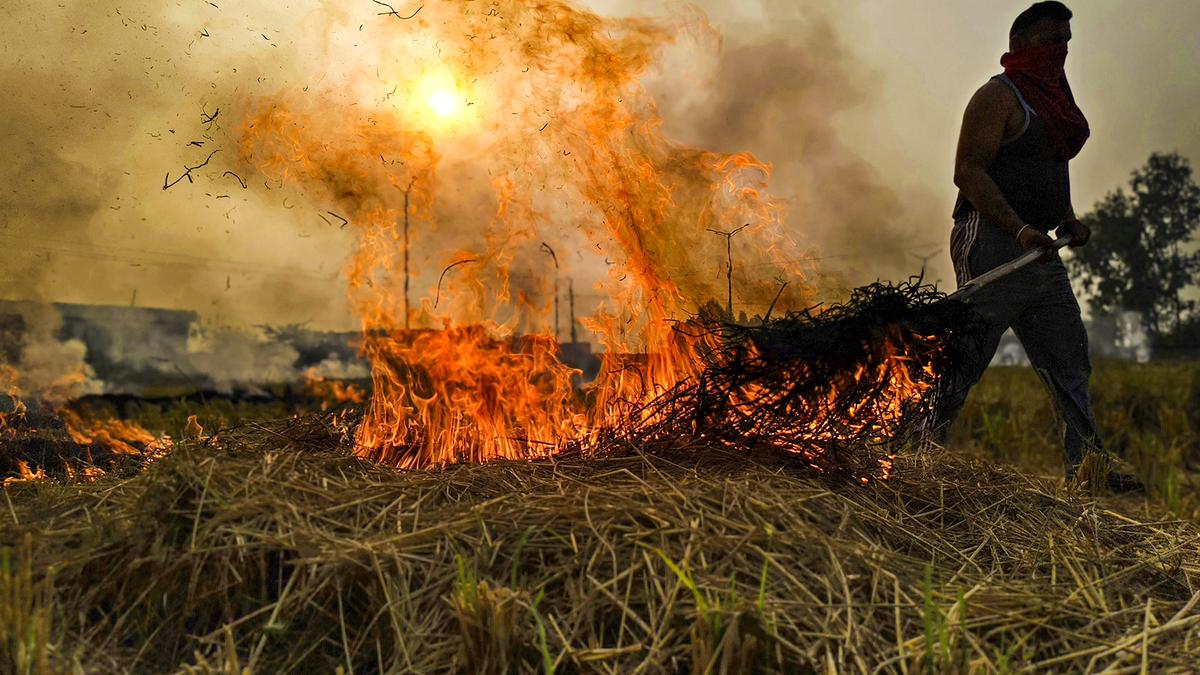
Based on field measurements, airmass trajectories, and particle dispersion and chemical transport model simulations, a study published in January 2025 has found that there is no linear correlation between stubble-burning events in Punjab and Haryana and fine particulate matter (PM2.5) concentration in Delhi-NCR. The study also underscores that crop residue burning in Punjab and Haryana contributes only about 14% of PM2.5 and is therefore not a primary source of particulate matter concentration in Delhi-NCR. The concentration of PM2.5 in Delhi-NCR remained fairly stable and constant despite the stubble-burning events in Punjab and Haryana declining by over 50% from 2015 to 2023, the study found. The results of the study were published in the journal Climate and Atmospheric Science.

As per a November 25, 2024 PTI report, the number of stubble-burning events measured by ISRO has witnessed a sharp decline on a year-to-year basis in Punjab and Haryana between September 15 and November 18 — from 48,489 in 2022 to 33,719 in 2023 and 9,655 in 2024 in Punjab, and in the case of Haryana it dropped from 3,380 in 2022 to 2,052 in 2023 and 1,118 in 2024.

High-quality measurements of fine particulate matter began at the U.S. Embassy in New Delhi in 2015. The number of stubble-burning events in Punjab and Haryana declined by 31% and 37%, respectively in 2023 compared with 2022. Yet, there was a 20% increase in PM2.5 at the U.S. Embassy in 2023, thus highlighting the absence of a linear correlation between stubble-burning events in the two States and PM2.5 concentration in Delhi-NCR. A network of 30 sensors was established in August 2022 in rural and urban regions in Punjab, Haryana, and Delhi. Data from the sensors located in Delhi-NCR are in close agreement with the instrument at the U.S. Embassy.

“There is no linearity between fire counts in Punjab/Haryana and PM2.5 variations [in Delhi-NCR],” Dr. Prabir K. Patra from the Research Institute for Humanity and Nature (RIHN), Kyoto, Japan, and one of the corresponding authors says in an email to The Hindu. Many institutions from India are part of the study.

Stubble burning almost ceases after November. However, the air quality index in the Delhi-NCR region has stubbornly remained in the “very poor” to “severe” category since 2016 during the winter months — December to February — due to stagnant winds, lower mixing heights, and inversion conditions, resulting in high pollution. This once again suggests that sources other than stubble burning significantly contribute to air pollution in Delhi-NCR.

The authors say that the amount of biomass burned in Punjab and Haryana “does not always determine the air quality of heavily urbanised Delhi-NCR even during the core rice-stubble burning period (October-November)”. Dr. Patra says: “Our data clearly shows that PM2.5 stays high (greater than 100 microgram per metre cube) well beyond November and through to the first week of February until the western disturbances arrive.”

There is a link between stubble burning and PM2.5 concentration in Delhi-NCR when there is strong wind. “While the wind patterns play a crucial role in pollutant transport, they are not the sole factor determining PM2.5 levels. Other meteorological factors and local emissions too influence the PM2.5 levels significantly,” Dr. Poonam Mangaraj from RIHN, Kyoto, Japan, and the first author of the paper says in an email to The Hindu. “When the dispersion conditions are unfavourable — low wind speeds, temperature inversions trapping pollutants near the surface, or stagnant air preventing movement — pollutants may not be effectively transported, leading to weaker or no observable correlation.”

Data of PM2.5 and carbon monoxide (CO) were recorded during the day and night by the network sensors. Data from selected sensor sites showed a persistent build-up of fine particulate matter and CO in Delhi during the night, which suggests emissions from localised sources. If stubble burning in Punjab and Haryana was the major source of air pollution in Delhi-NCR, the CO levels would have remained stable and not increased during the night, the authors say. “Carbon monoxide in Delhi-NCR is predominantly emitted from fossil fuel combustion or local biomass burning, independent of the diurnal cycle in PM2.5 emission sources,” they write.

As per the study, the day-night differences in PM2.5 are about 20% in Delhi-NCR, while the average CO concentration is about 67% greater in the night compared to the day in 2023, and about 48% in 2022. In contrast, in Punjab and Haryana, a clear day-night variation is observed only during the intense stubble-burning periods.

Since the day-night differences in fine particulate matter are greater than CO in the areas with predominant stubble burning, the higher CO emission at night in the Delhi-NCR region points to sources other than stubble burning.

“It is clear that even in the months of peak crop residue burning season (October-November), the contributions of local industrial and other anthropogenic sources to PM2.5 in the Delhi-NCR are much greater than crop residue burning in Punjab and Haryana,” says Dr. Mangaraj.

“During the Graded Response Action Plan (GRAP) implementation period at stage III and IV [when AQI is “severe” and “severe plus”, respectively], the PM2.5 levels dropped significantly when strict measures to control transport sector and construction activities were enforced. However, when GRAP-IV was lifted, PM2.5 levels surged back, underscoring how important these measures are in improving air quality.” This suggests that the local sources (e.g., small-scale unorganised industries, road transport, waste management, and construction facilities and supplies) [contribute significantly to fine particulate matter].”

Major contributor

According to Dr. Sachchida N. Tripathi from IIT Kanpur, who is not associated with the study, at 30%, the major contributor to fine particulate matter is the transport sector, followed by local biomass burning at 23%, 10% by the construction industry and road dust, while cooking and industry contribute 5-7%, and 10% is unaccounted. In contrast, stubble burning in Punjab and Haryana contributes only about 13%, and that too only during October and November.

Published – February 15, 2025 10:00 pm IST



Source link

Science

Post navigation

Previous Post: Travis Head, David Miller, Pat Cummins Not Retained Ahead Of Major League Cricket Season 3 Draft
Next Post: Sex work drives clade Ib mpox outbreak in DR Congo

Related Posts

  • ISRO releases two videos of the Moon on August 18
    ISRO releases two videos of the Moon on August 18 Science
  • On amplifiers: how do they work and what are the different kinds?
    On amplifiers: how do they work and what are the different kinds? Science
  • Brumation: Winter is coming for reptiles
    Brumation: Winter is coming for reptiles Science
  • ISRO’s high-resolution imaging satellite Cartosat-2 bids adieu
    ISRO’s high-resolution imaging satellite Cartosat-2 bids adieu Science
  • How does cutting onions make you cry?
    How does cutting onions make you cry? Science
  • The problem with the physics question in the NEET-UG paper
    The problem with the physics question in the NEET-UG paper Science

More Related Articles

Science for All | Quest to crack blues mystery in Pollock painting reveals colour-tuning technique Science for All | Quest to crack blues mystery in Pollock painting reveals colour-tuning technique Science
Failure of atomic clock cripples ISRO’s NavIC system Failure of atomic clock cripples ISRO’s NavIC system Science
Dinosaur-killing asteroid impact fouled Earth’s atmosphere with dust Dinosaur-killing asteroid impact fouled Earth’s atmosphere with dust Science
The Science Quiz | Computer viruses The Science Quiz | Computer viruses Science
How microbiomes and the smells they produce help shape behaviour in bugs, birds, beasts and humans How microbiomes and the smells they produce help shape behaviour in bugs, birds, beasts and humans Science
Private US moon lander still working after breaking leg and falling, but not for long Private US moon lander still working after breaking leg and falling, but not for long Science
SiteLock

Archives

  • May 2026
  • April 2026
  • March 2026
  • February 2026
  • January 2026
  • December 2025
  • November 2025
  • October 2025
  • September 2025
  • August 2025
  • July 2025
  • June 2025
  • May 2025
  • April 2025
  • March 2025
  • February 2025
  • January 2025
  • December 2024
  • November 2024
  • October 2024
  • September 2024
  • August 2024
  • July 2024
  • June 2024
  • May 2024
  • April 2024
  • March 2024
  • February 2024
  • January 2024
  • December 2023
  • November 2023
  • October 2023
  • September 2023
  • August 2023
  • July 2023
  • June 2023
  • May 2023
  • April 2023
  • March 2023
  • February 2023
  • January 2023
  • December 2022
  • November 2022
  • October 2022
  • September 2022
  • August 2022
  • July 2022
  • June 2022
  • May 2022

Categories

  • Business
  • Nation
  • Science
  • Sports
  • World

Recent Posts

  • Hanuman Jayanti: Muslim residents offer buttermilk to Hindu devotees in Kadapa days after clashes
  • Government raises gold and silver tariffs to 15% to curb imports, support rupee
  • Trump’s proposed ‘Golden Dome’ estimated to cost $1.2 trillion, far more than he initially said
  • Iran-Israel war LIVE: Trump says stopping Iran's nuclear program outweighs Americans' economic pain
  • 10 rescued after a small plane crashes off the Florida coast

Recent Comments

  1. Jesusetexy on UP Teacher Who Asked Students To Slap Muslim Classmate
  2. JeffryFok on UP Teacher Who Asked Students To Slap Muslim Classmate
  3. StanleyPeapy on UP Teacher Who Asked Students To Slap Muslim Classmate
  4. RonaldLam on UP Teacher Who Asked Students To Slap Muslim Classmate
  5. RaymondKiree on UP Teacher Who Asked Students To Slap Muslim Classmate
  • Access Denied
    Access Denied Nation
  • Russian Army Marches In ‘Made In Bihar’ Boots Manufactured In Hajipur
    Russian Army Marches In ‘Made In Bihar’ Boots Manufactured In Hajipur Nation
  • ‘Hit the streets’: Kejriwal to students on NEET-UG paper leak; protests
    ‘Hit the streets’: Kejriwal to students on NEET-UG paper leak; protests Nation
  • Exercise caution to check biases in AI models, says Dell’s Manakame
    Exercise caution to check biases in AI models, says Dell’s Manakame Business
  • What We Know So Far
    What We Know So Far World
  • Access Denied
    Access Denied Nation
  • “Acute Danger” To Arvind Kejriwal’s Health In Judicial Custody: AAP
    “Acute Danger” To Arvind Kejriwal’s Health In Judicial Custody: AAP Nation
  • Moon Mission’s Success Impacted Perception Of Indians Abroad: S Jaishankar
    Moon Mission’s Success Impacted Perception Of Indians Abroad: S Jaishankar Nation

Editor-in-Chief:
Mohammad Ariff,
MSW, MAJMC, BSW, DTL, CTS, CNM, CCR, CAL, RSL, ASOC.
editor@artifex.news

Associate Editors:
1. Zenellis R. Tuba,
zenelis@artifex.news
2. Haris Daniyel
daniyel@artifex.news

Photograher:
Rohan Das
rohan@artifex.news

Artifex.News offers Online Paid Internships to college students from India and Abroad. Interns will get a PRESS CARD and other online offers.
Send your CV (Subjectline: Paid Internship) to internship@artifex.news

Links:
Associate Journalism
About Us
Privacy Policy

News Links:
Breaking News
World
Nation
Sports
Business
Entertainment
Lifestyle

Registered Office:
72/A, Elliot Road, Kolkata - 700016
Tel: 033-22277777, 033-22172217
Email: office@artifex.news

Editorial Office / News Desk:
No. 13, Mezzanine Floor, Esplanade Metro Rail Station,
12 J. L. Nehru Road, Kolkata - 700069.
(Entry from Gate No. 5)
Tel: 033-46011099, 033-46046046
Email: editor@artifex.news

Copyright © 2023 Artifex.News Newsportal designed by Artifex Infotech.