
Skip to content
  • Facebook
  • X
  • Linkedin
  • WhatsApp
  • YouTube
  • Associate Journalism
  • About Us
  • Privacy Policy
  • 033-46046046
  • editor@artifex.news
Artifex.News

Artifex.News

Stay Connected. Stay Informed.

  • Breaking News
  • World
  • Nation
  • Sports
  • Business
  • Science
  • Entertainment
  • Lifestyle
  • Toggle search form
  • Access Denied World
  • Access Denied
    Access Denied Nation
  • Baba Siddique Shooters Were Given Flex Banner To Identify Target: Cops
    Baba Siddique Shooters Were Given Flex Banner To Identify Target: Cops Nation
  • Indira Gandhi First Changed The Preamble, BJP Would Never: Rajnath Singh To NDTV
    Indira Gandhi First Changed The Preamble, BJP Would Never: Rajnath Singh To NDTV Nation
  • Access Denied Sports
  • Maldives As India Sends “Crucial Budgetary Support”
    Maldives As India Sends “Crucial Budgetary Support” World
  • US’s Georgia School Shooter Was 14-Year-old Student: Police
    US’s Georgia School Shooter Was 14-Year-old Student: Police World
  • Access Denied
    Access Denied Nation
Indigenous clocks delay ISRO’s plans to replace defunct Navic satellites

Indigenous clocks delay ISRO’s plans to replace defunct Navic satellites

Posted on August 23, 2025 By admin


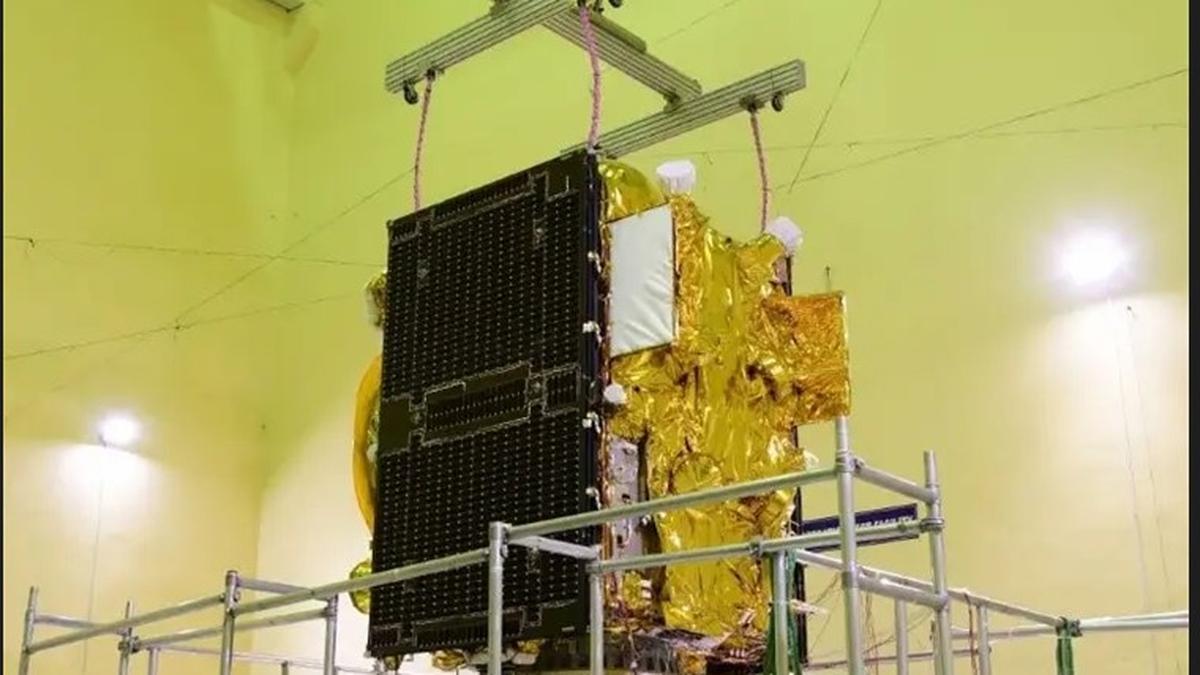
NVS-02 undergoing a vibration test. Photo: ISRO

Officials at the Indian Space Research Organisation (ISRO) say they are looking to launch at least three satellites before 2026-end, to replace defunct satellites that are part of the ‘Indian GPS’ or Navic (Navigation with Indian constellation) system. However, there seems to be a key element impeding the launch — the development of indigenous clocks.

These high-precision clocks — now proposed at five per satellite — are what provides accurate timing (and hence location) services to users on earth. The Navic satellites provide more accurate location services to the military and slightly less accurate ones for civilian purposes.

Nine satellites of the Indian Regional Navigation Satellite System (IRNSS), informally called Navic, have been launched since 2013. Eight of them reached their intended orbit. The last of this constellation of satellites (IRNSS-1I) was launched in 2018. These constellation of satellites are akin to the Russian GLONASS, the Chinese Beidou, the American GPS and European Galileo constellation of satellites to provide location services. However, the Navic, is expected to do so only within India and a radius of 1,500 km. This is however viewed more as a fall back system in the case of future global conflicts and India being denied access to these foreign constellations.

Last month, the ISRO revealed via a Right To Information request that five of the Navic satellites were completely defunct with all three of their clocks in each satellite not working. In one of the three satellites with functioning atomic clocks, two of the three clocks have failed. Only two satellites of the constellation, therefore, have functional atomic clocks. The atomic clocks in this constellation of satellites were imported by the ISRO from the firm SpectraTime.

For the next series of satellites to replace the impaired and ageing fleet of IRNSS satellites —two of the three being used have passed or are close to their rated shelf life of 10 years though it’s possible for these systems to function beyond — the ISRO has decided to install indigenously developed rubidium clocks.

“Each satellite will have five clocks though we are still in the process of developing them,” Nilesh Desai, Director, Space Applications Centre, a key part of the ISRO, told The Hindu on the sidelines of a conclave in Delhi to commemorate National Space Day on Saturday.

Another official familiar with the ISRO said that while the rubidium clocks are based on an indigenous design, there were key components that needed to be imported and this was contributing to procurement challenges and delays in commissioning.

So far, to replace its decrepit fleet of IRNSS satellites, ISRO has launched two satellites NVS-01 in May 2023 and NVS-02 in January 2025. Only NVS-01 successfully reached its designated orbit and is working as intended, with NVS-02 failing to reach the specific orbit required to function as a navigational satellite.

By 2040, India is aiming to launch at least a 100 satellites, several of them to provide earth imaging and communication services for both government and private sector applications.

Published – August 23, 2025 09:49 pm IST



Source link

Science Tags:ISRO, ISRO aims to launch three satellites by 2026, ISRO facing delays due to indigenous clock development, ISRO to replace defunct Navic satellites

Post navigation

Previous Post: Access Denied
Next Post: Access Denied

Related Posts

  • De-extinction company Colossal Biosciences announces 0 million series C financing
    De-extinction company Colossal Biosciences announces $200 million series C financing Science
  • Science and tech awards to get Padma-style makeover into Rashtriya Vigyan Puraskar
    Science and tech awards to get Padma-style makeover into Rashtriya Vigyan Puraskar Science
  • IIT Madras and ISRO develop indigenous aerospace chip for space applications
    IIT Madras and ISRO develop indigenous aerospace chip for space applications Science
  • CMFRI decodes genetic blueprint of Indian squid
    CMFRI decodes genetic blueprint of Indian squid Science
  • Models struggled to predict the 2026 monsoon’s rapid changes
    Models struggled to predict the 2026 monsoon’s rapid changes Science
  • The many roles of sugarcane in India and the world
    The many roles of sugarcane in India and the world Science

More Related Articles

Draft patent amendment rules undermine pre-grant opposition Draft patent amendment rules undermine pre-grant opposition Science
What Delhi’s wilderness says about the city’s politics What Delhi’s wilderness says about the city’s politics Science
What is ‘The Wow!’ signal? What is ‘The Wow!’ signal? Science
Physics of staying airborne – The Hindu Physics of staying airborne – The Hindu Science
Calorie, a year-long exhibit at the Science Gallery Bengaluru, questions our relationship with food Calorie, a year-long exhibit at the Science Gallery Bengaluru, questions our relationship with food Science
Low-cost flexible biosensor for early heart attack detection developed by BITS–RMIT Univ Low-cost flexible biosensor for early heart attack detection developed by BITS–RMIT Univ Science
SiteLock

Archives

  • September 2026
  • August 2026
  • July 2026
  • June 2026
  • May 2026
  • April 2026
  • March 2026
  • February 2026
  • January 2026
  • December 2025
  • November 2025
  • October 2025
  • September 2025
  • August 2025
  • July 2025
  • June 2025
  • May 2025
  • April 2025
  • March 2025
  • February 2025
  • January 2025
  • December 2024
  • November 2024
  • October 2024
  • September 2024
  • August 2024
  • July 2024
  • June 2024
  • May 2024
  • April 2024
  • March 2024
  • February 2024
  • January 2024
  • December 2023
  • November 2023
  • October 2023
  • September 2023
  • August 2023
  • July 2023
  • June 2023
  • May 2023
  • April 2023
  • March 2023
  • February 2023
  • January 2023
  • December 2022
  • November 2022
  • October 2022
  • September 2022
  • August 2022
  • July 2022
  • June 2022
  • May 2022

Categories

  • Business
  • Nation
  • Science
  • Sports
  • World

Recent Posts

  • 172 candidates receive appointment letters at Visakhapatnam Rozgar Mela
  • Flawed AI-linked intel almost led U.S. to board China ship: report
  • IIT Bombay faculty member booked for caste abuse, suicide abetment
  • Arjun finds form as India beats Spain; Savitha stars for women
  • CWC chief flags ‘malpractices’ in phytosanitary certification, pitches integrated logistics to boost agri-exports

Recent Comments

  1. AlvinNet on UP Teacher Who Asked Students To Slap Muslim Classmate
  2. AlvinNet on UP Teacher Who Asked Students To Slap Muslim Classmate
  3. Jamesslits on UP Teacher Who Asked Students To Slap Muslim Classmate
  4. MichaelClear on UP Teacher Who Asked Students To Slap Muslim Classmate
  5. Jamesslits on UP Teacher Who Asked Students To Slap Muslim Classmate
  • Humanoid robots race past humans in Beijing half-marathon, showing rapid advances
    Humanoid robots race past humans in Beijing half-marathon, showing rapid advances World
  • 25-Year-Old Man Fires At Teenage Girl, Kills Self In UP’s Sambhal
    25-Year-Old Man Fires At Teenage Girl, Kills Self In UP’s Sambhal Nation
  • Access Denied Sports
  • Vietnam boat disaster: Death toll rises to 48 after tourist vessel sinks in South China Sea
    Vietnam boat disaster: Death toll rises to 48 after tourist vessel sinks in South China Sea World
  • PM To Flag Off 2 New Vande Bharat Express Trains From Visakhapatnam Today
    PM To Flag Off 2 New Vande Bharat Express Trains From Visakhapatnam Today Nation
  • Access Denied World
  • Sri Lanka To Host West Indies For White-Ball Bilaterals In October
    Sri Lanka To Host West Indies For White-Ball Bilaterals In October Sports
  • NEET is a market conspiracy and a commercial gamble: SPCSS
    NEET is a market conspiracy and a commercial gamble: SPCSS Nation

Editor-in-Chief:
Mohammad Ariff,
MSW, MAJMC, BSW, DTL, CTS, CNM, CCR, CAL, RSL, ASOC.
editor@artifex.news

Associate Editors:
1. Zenellis R. Tuba,
zenelis@artifex.news
2. Haris Daniyel
daniyel@artifex.news

Photograher:
Rohan Das
rohan@artifex.news

Artifex.News offers Online Paid Internships to college students from India and Abroad. Interns will get a PRESS CARD and other online offers.
Send your CV (Subjectline: Paid Internship) to internship@artifex.news

Links:
Associate Journalism
About Us
Privacy Policy

News Links:
Breaking News
World
Nation
Sports
Business
Entertainment
Lifestyle

Registered Office:
72/A, Elliot Road, Kolkata - 700016
Tel: 033-22277777, 033-22172217
Email: office@artifex.news

Editorial Office / News Desk:
No. 13, Mezzanine Floor, Esplanade Metro Rail Station,
12 J. L. Nehru Road, Kolkata - 700069.
(Entry from Gate No. 5)
Tel: 033-46011099, 033-46046046
Email: editor@artifex.news

Copyright © 2023 Artifex.News Newsportal designed by Artifex Infotech.