
Skip to content
  • Facebook
  • X
  • Linkedin
  • WhatsApp
  • YouTube
  • Associate Journalism
  • About Us
  • Privacy Policy
  • 033-46046046
  • editor@artifex.news
Artifex.News

Artifex.News

Stay Connected. Stay Informed.

  • Breaking News
  • World
  • Nation
  • Sports
  • Business
  • Science
  • Entertainment
  • Lifestyle
  • Toggle search form
  • UP Woman Dies By Suicide, Family Sets In-Laws’ House On Fire, 2 Dead
    UP Woman Dies By Suicide, Family Sets In-Laws’ House On Fire, 2 Dead Nation
  • Rupee falls seven paise to settle at 83.35 against U.S. dollar
    Rupee falls seven paise to settle at 83.35 against U.S. dollar Business
  • Access Denied World
  • Daily Quiz | On FIFA – May 21, 2024
    Daily Quiz | On FIFA – May 21, 2024 Sports
  • Access Denied
    Access Denied Nation
  • Why are close to 1.08 crore voters staring at mass exclusion? | Decode Karnataka
    Why are close to 1.08 crore voters staring at mass exclusion? | Decode Karnataka Nation
  • Access Denied World
  • CSDS-Lokniti 2024 pre-poll survey: Issues that are likely to dominate the Lok Sabha election
    CSDS-Lokniti 2024 pre-poll survey: Issues that are likely to dominate the Lok Sabha election Business
New model finds hovering doesn’t need a complex brain

New model finds hovering doesn’t need a complex brain

Posted on October 26, 2025 By admin


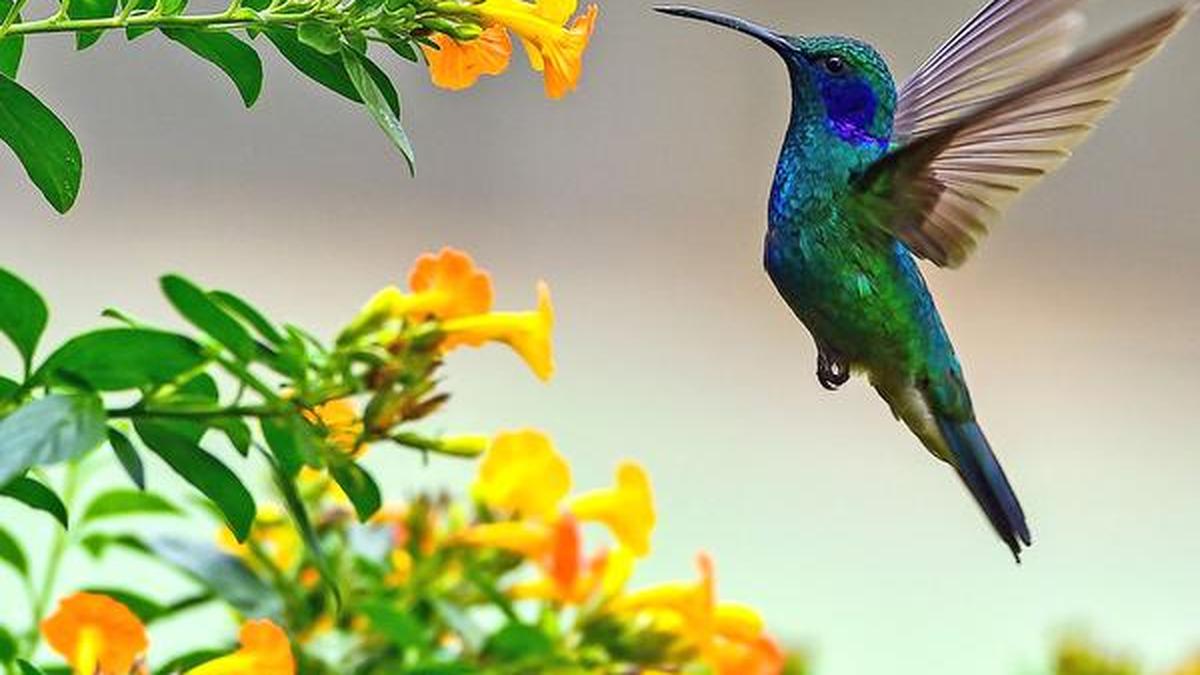
A hummingbird feeds on the nectar of a flower in Boquete, Chiriqui Province, Panama, 2020. Hummingbirds are known for their ability to hover mi-air by rapidly flapping their wings 15 to 80 times per second, depending on the bird’s size.
| Photo Credit: AFP

For decades, scientists and engineers have puzzled over how insects and hummingbirds can hover, i.e. stay nearly motionless in air, despite the limits of ordinary aerodynamics. Conventional theory long held that such flight should be unstable: the lifting forces needed to balance the being’s weight should be too great to sustain without active control.

Many studies have tried to model hovering mathematically, treating it as a complex system with flapping wings, nonlinear motions, and multiple interacting forces. Other researchers ran detailed simulations of fluid motion. They proved accurate — but they operated far too slowly to explain how real creatures stabilise themselves in milliseconds.

Meanwhile, experiments also showed that insects depend heavily on sensory feedback such as visual cues, airflow sensors, and balance organs to correct their motion, which added to the puzzle because insects have small brains with very limited computing power.

These conflicting lines of evidence have together left hovering an unsolved puzzle. But if a study published recently in Physical Review E is to be believed, science may have finally cracked the puzzle. The authors of this study, from the University of Cincinnati in the US, have revealed that there’s a way hovering can be governed by a simple, real-time feedback rule that needs no heavy computation at all.

They have proposed that hovering operates as an extremum-seeking (ES) feedback system. Imagine you’re trying to keep a drone perfectly hovering at one height but you don’t know the exact rules that tell you how to do it. You can’t write equations or predict the forces. Instead you use trial and error with feedback: you make small adjustments, watch what happens, and keep changing direction until the drone stays steady.

This is what an ES system does. It’s a feedback loop that helps a system find its sweet spot, a.k.a. the extremum, which could be a minimum or maximum of something you’re trying to adjust.

It starts by making small yet regular changes to some control input, e.g. an insect slightly changing the strength or angle of its wing flaps. The insect’s body or sensors detect whether it went up, down or stayed level. If the change improves its stability, it keeps moving that way; if it doesn’t, it reverses course. Through such small corrections, the insect eventually learns the right flapping pattern to stay balanced.

Their simulations showed that the ES-based control system reproduced stable hovering in hawkmoths, craneflies, bumblebees, dragonflies, hoverflies, and hummingbirds. Each model could maintain constant altitude without requiring detailed aerodynamic models. The same feedback rule also worked despite vast differences in size and wingbeat frequency as well. And the predicted flapping amplitudes closely matched values measured in natural experiments.

By showing that hovering can emerge from a simple law, the study suggested that stability in hovering flight needn’t demand complex neural abilities. For biologists, per the study, the findings can help clarify how small flyers remain steady with minimal processing power; in engineering, it could open a path towards bio-inspired drones that hover stably without complex control algorithms or heavy sensors.

Published – October 26, 2025 03:25 pm IST


Source link

Science

Post navigation

Previous Post: Access Denied
Next Post: Access Denied

Related Posts

  • India is world’s second largest emitter of nitrous oxide
    India is world’s second largest emitter of nitrous oxide Science
  • 18th International Olympiad on Astronomy and Astrophysics inaugurated in Mumbai 
    18th International Olympiad on Astronomy and Astrophysics inaugurated in Mumbai  Science
  • An energy transition driven by ethics
    An energy transition driven by ethics Science
  • mRNA research exemplifies the unpredictable value of basic research
    mRNA research exemplifies the unpredictable value of basic research Science
  • Fossil dung reveals clues to the rise of dinosaurs
    Fossil dung reveals clues to the rise of dinosaurs Science
  • China’s EAST fusion reactor beats density limit, widens path to power
    China’s EAST fusion reactor beats density limit, widens path to power Science

More Related Articles

Plant-based foods reduce the burden of cancer, diabetes Plant-based foods reduce the burden of cancer, diabetes Science
‘Datura’ lands e-commerce platforms in trouble in Karnataka: What is the plant? ‘Datura’ lands e-commerce platforms in trouble in Karnataka: What is the plant? Science
The Science Quiz | A quiz on science films at the Oscars through history The Science Quiz | A quiz on science films at the Oscars through history Science
How BioPharma SHAKTI can transform biologics with non-animal models How BioPharma SHAKTI can transform biologics with non-animal models Science
Mosquitoes suck — but should we simply get rid of them? Mosquitoes suck — but should we simply get rid of them? Science
The two vaccines that brought us to the brink of eradicating polio | Explained The two vaccines that brought us to the brink of eradicating polio | Explained Science
SiteLock

Archives

  • October 2026
  • September 2026
  • August 2026
  • July 2026
  • June 2026
  • May 2026
  • April 2026
  • March 2026
  • February 2026
  • January 2026
  • December 2025
  • November 2025
  • October 2025
  • September 2025
  • August 2025
  • July 2025
  • June 2025
  • May 2025
  • April 2025
  • March 2025
  • February 2025
  • January 2025
  • December 2024
  • November 2024
  • October 2024
  • September 2024
  • August 2024
  • July 2024
  • June 2024
  • May 2024
  • April 2024
  • March 2024
  • February 2024
  • January 2024
  • December 2023
  • November 2023
  • October 2023
  • September 2023
  • August 2023
  • July 2023
  • June 2023
  • May 2023
  • April 2023
  • March 2023
  • February 2023
  • January 2023
  • December 2022
  • November 2022
  • October 2022
  • September 2022
  • August 2022
  • July 2022
  • June 2022
  • May 2022

Categories

  • Business
  • Nation
  • Science
  • Sports
  • World

Recent Posts

  • HC grants bail to accused in Kavin caste killing case
  • State government reclaims 281 hectares of unused land from BHEL, plans industrial park
  • Israeli settlers set fire to mosque in occupied West Bank
  • Reliance’s Jio Platforms files final IPO prospectus; offer to open on October 21
  • Patient Mulani lives on hope

Recent Comments

  1. WalterBoumn on UP Teacher Who Asked Students To Slap Muslim Classmate
  2. HermanTwito on UP Teacher Who Asked Students To Slap Muslim Classmate
  3. JamesWhazy on UP Teacher Who Asked Students To Slap Muslim Classmate
  4. JamesWhazy on UP Teacher Who Asked Students To Slap Muslim Classmate
  5. ShawnFeach on UP Teacher Who Asked Students To Slap Muslim Classmate
  • ‘Bharat Taxi’ With Zero Commision, Surge- Free Pricing To Launch On Feb. 5 After Successful Pilot Operation Business
  • 1 Killed In Shooting In US’ Seattle: Cops
    1 Killed In Shooting In US’ Seattle: Cops World
  • Access Denied
    Access Denied Nation
  • Kolkata Doctor Rape Murder, RG Kar Medical College And Hospital: Kolkata Doctor’s Rape-Murder Probe To Be Transferred To CBI: High Court
    Kolkata Doctor Rape Murder, RG Kar Medical College And Hospital: Kolkata Doctor’s Rape-Murder Probe To Be Transferred To CBI: High Court Nation
  • Finance Commission Chief Arvind Panagariya Casts His 1st Vote
    Finance Commission Chief Arvind Panagariya Casts His 1st Vote Nation
  • So Many Unforgettable Memories: Bhuvneshwar Kumar Pens Emotional Farewell Note For SRH
    So Many Unforgettable Memories: Bhuvneshwar Kumar Pens Emotional Farewell Note For SRH Sports
  • Election result impact on market: How do markets look at election results?
    Election result impact on market: How do markets look at election results? Business
  • Ex CSK Star’s World Record Broken, New Zealand Batter Slams Fastest List A Double Ton
    Ex CSK Star’s World Record Broken, New Zealand Batter Slams Fastest List A Double Ton Sports

Editor-in-Chief:
Mohammad Ariff,
MSW, MAJMC, BSW, DTL, CTS, CNM, CCR, CAL, RSL, ASOC.
editor@artifex.news

Associate Editors:
1. Zenellis R. Tuba,
zenelis@artifex.news
2. Haris Daniyel
daniyel@artifex.news

Photograher:
Rohan Das
rohan@artifex.news

Associate Journalists
1. Subrata Paul - AN/2020/01
2. Quamruz Zaman - AN/2021/22
3. Ahmed Sha - AN/2021/035
4. Ajay Kumar Shaw - AN/2021/39
5. Tahqiqul Hoda - AN/2021/21

Artifex.News offers Online Paid Internships to college students from India and Abroad. Interns will get a PRESS CARD and other online offers.
Send your CV (Subjectline: Paid Internship) to internship@artifex.news

Links:
Associate Journalism
About Us
Privacy Policy

News Links:
Breaking News
World
Nation
Sports
Business
Entertainment
Lifestyle

Registered Office:
72/A, Elliot Road, Kolkata - 700016
Tel: 033-22277777, 033-22172217
Email: office@artifex.news

Editorial Office / News Desk:
No. 13, Mezzanine Floor, Esplanade Metro Rail Station,
12 J. L. Nehru Road, Kolkata - 700069.
(Entry from Gate No. 5)
Tel: 033-46011099, 033-46046046
Email: editor@artifex.news

Copyright © 2023 Artifex.News Newsportal designed by Artifex Infotech.