



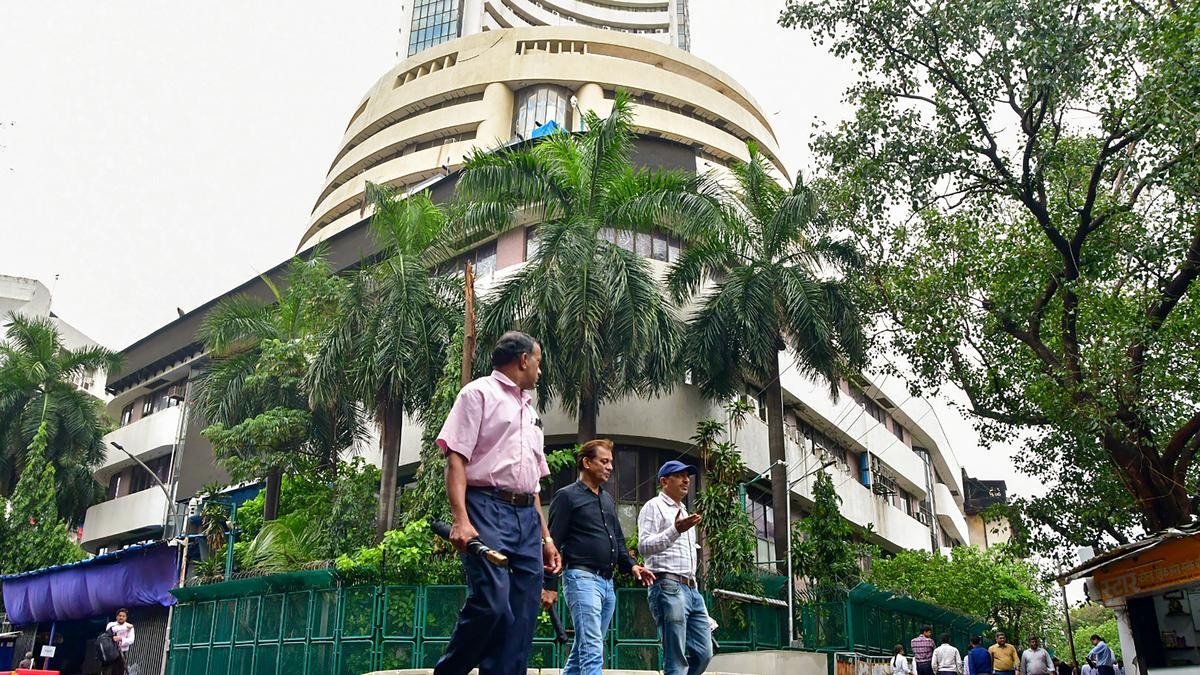
Markets turn particularly volatile during and in the run-up to the election season. Speculations, psephologists’ analyses, exit polls and rhetoric, among other things— all bear the potential to shroud equity markets in political uncertainty. Investors have ideally preferred a stable government which would focus on spurring economic activity, industrialisation, managing the fiscal deficit, taxation policies and taming inflation, among other things. It is largely based on these assessment metrics and the prevailing political currents, in combination and/or in isolation, that investors chalk their strategies. They are always on the lookout for a government that would be able to influence the economy and industry towards betterment.
Also Read: Exit poll 2024 highlights
Let us look at some of the currents that have determined the behaviour of markets in an election landscape.
Markets and political uncertainty: a case study from the 80s
In 1984, investors did not receive former Prime Rajiv Gandhi’s accession to the top administrative post in the country with great enthusiasm. His initial days occupying the country’s top administrative office contributed to greater volatility and economic fluctuations in November 1984. Bourses were still recovering from the shock that arrived with the assassination of his mother and late Prime Minister Indira Gandhi on October 31, 1984. The orgy of violence that followed was still subsiding in Northern India. Further, Mr. Gandhi was yet to prove his mettle in the general elections, which were expected to take place a year later. Important to note here, stability is also imperative for investors to determine the continuation of policies undertaken by the incumbent regime. It helps them plan suitably and make favourability assessments.
Trading in Dalal Street and other centres had resumed on November 5 on a rather subdued note. Amidst the uncertainty, investors, particularly bull investors, were unwilling to make fresh commitments. Trends were similar in Madras and Calcutta too. As reported by The Hindu back then, the volume of business was restricted, and a definite trend – avoiding the uncertainty – was expected to emerge only after a fortnight. It was further reported, “The capital market may not, of course, remain buoyant for several weeks as individual investors may not be keen to extend enthusiastic support to even worthwhile new issues in the absence of normal trading in the stock markets.”

Notwithstanding a rather sombre setting, expectations still existed about a revival. News reports suggested that provided there were no major upsets in the political situation, there could be a revival in economic activity after some uncertainties were out of the way. This was based on the inherent strength of the economy and the expectations of growth in the national income by 4.5% in 1984-85. This in turn was based on anticipation about a higher level of agricultural and industrial production.
The 90s, economic health and investor confidence
Rajiv Gandhi was assassinated in May 1991.
Succeeding the Congress stalwart was P.V. Narasimha Rao. His appointment as the Prime Minister in June 1991 greatly enthused investors. The Hindu had reported back then that the succession gave rise to a feeling in industry and stock markets that the incoming Prime Minister would adopt measures for reducing pressure on India’s balance of payments position. Further, there was confidence that he would ease the curbs on credit to avoid a “pronounced deceleration” of economic activity. The incoming Prime Minister had described elaborate steps to tackle economic issues as his highest priority. The major challenges awaiting the Rao government included taming inflation, and spurring incentives for saving and fresh investments.

The results of the election sent stock markets— Dalal Street, Lyons Range, Delhi and Madras— buzzing again. The BSE Sensex on June 21 gained 25 points, or about 1.8%, to scale 1,361.72 from its previous close of 1,336.75. This was the highest in recent weeks back then, especially after the times of turbulence which followed Mr Gandhi’s assassination.
P.V. Narasimha Rao’s tenure also witnessed the introduction of the liberalisation, privatisation and globalisation regime, with then Finance Minister Manmohan Singh spearheading the efforts. In his historical speech on July 24th, 1991, the finance minister indicated direct foreign investment would provide access to capital, technology and markets. “Cost, efficiency and quality willbegin to receive the attention they deserve,” he stated.
Markets, however, were not as enthused as may have been expected. The BSE index fluctuated in wide limits in the post-budget session – rising to 1,481.95 from 1,459.66 at the close of the pre-budget session. This was before it declined to 1,465.94. It eventually closed at its highest that year at 1,485.76, about 4.65% or 66.45 points higher. While the reforms were viewed favourably by a majority, apprehensions existed about the government being able to supply the required foreign exchange resources for importing plant and machinery. The other set of concerns were about whether the government would explore easing of curbs on the use of bank funds for reviving economic activity.
Congress in 2004 and 2009: Same party but two different reactions
As previously described, markets are particularly enthusiastic when a favourably-viewed party gets the most important seat in Delhi’s Rasina Hills. However, the Congress’ succession to power in 2004 and 2009 not only underlined how important this favourability was for markets, but also showed how currents – especially a lesser accompanying current, could reverse as well as expand a prevailing trend. On May 15, a week before the former Finance Minister Manmohan Singh would be sworn in as the next Prime Minister, the benchmark Sensex experienced its biggest-ever crash. It shed about 330 points amidst apprehension that a new coalition government, especially with Left partners to support, would move away from the disinvestment prerogative (especially in oil major PSUs). It closed about 3.26% lower at 5,123.23. Nifty 50 also lost 135.10 points to close at 1,582.40 that day.
What is also noteworthy is markets had expected the National Democratic Alliance (NDA) to return to power. The disinvestment apprehension further lowered investor sentiment. All of this was set against a backdrop of rising global oil prices and the U.S. undergoing a state of economic recovery – all leading to a reverse flow of capital out of India.

Things, however, were different when the UPA returned in 2009. Giving a thumbs-up to the incoming UPA-II, the Sensex on May 18 amassed a then record 2,110.79 points, or 1.75% greater than its previous close, three days before then Prime Minister Manmohan Singh took oath for the second time. The Hindu reported that Dalal Street lost fear for the first time since the global recession that started in August 2008 with the fall of the U.S.-based investment banker Lehman Brothers. In fact, markets hit the upper circuit twice that day. This was in stark contrast to how events unfolded nearly five years back (on May 17, 2004) when circuit breakers had to be placed because of volatile trading. The earlier event was also the first time when rules governing the implementation of circuit breakers were utilised since their introduction.
Back then, market observers felt that the gain was an affirmation from investors for an effective and smooth continuation of the current policies of the government. A. Balasubramaniam, CIO at Birla Sun Life Mutual Fund, told The Hindu back then, “With proactive monetary and fiscal policies combined with stable government, one can only expect that the economy will be back on track much faster than what one would have thought.”
All in all, investors welcomed the political and (potential) economic stability.
The Modi Wave and the boost in investor sentiment
The incumbent Prime Minister Narendra Modi’s rise to the top administrative job was good news for investors. Mr. Modi held a reputation of being pro-industry. This was primarily derived from having welcomed automobile players such as Ford India and Tata Motors (for the budget hatchback Nano) to set up their plants in Gujarat during his reign as the Chief Minister of the State. Financial Times had reported in April 2014 that the then visible pre-election rally was on the back of foreign investors gambling that a new business-friendly government would hack through the bureaucratic red tape which had hitherto hindered growth. Other than betting on higher economic growth, foreign investors also poured in money expecting an increase in infrastructure investment.

As the results became clear on May 16, markets scaled record highs, especially after there was clarity that the Bharatiya Janata Party (BJP) was attaining a majority on its own. This was good news for investors because this granted certainty about potential policies that the incoming government would undertake. Continuing the positive run since the exit polls affirmed the change in regime, on May 16, the BSE Sensex climbed 1,470.03 points to an all-time high of 25,375.63. Registering a sixth consecutive day of gain, it closed 0.5% higher at 24,121.74. The NSE’s 50-share Nifty was trading up by 288.45 points, or 4.05% higher, at 7,411.60. This was after it had breached the 7,500-mark intraday to touch 7,563.50.
The same course was repeated in 2019; investors were enthused about BJP having bettered its seat count from 2014. The continuing government’s pro-business stance, emphasis on self-sustainability, focus on infrastructure development and providing ease of doing business were viewed as positives by investors. Record highs were scaled again (on May 23) with the BSE seeping past the 40,000-mark and Nifty50 getting past 12,000-mark intraday. Eventually, S&P BSE Sensex settled at 38,811 after having attained a record high of 40,125, down 299 points or 0.77%. Nifty50 concluded the day at 11,657, down 81 points or 0.69%.
The story from here
On May 29, 2024, benchmark indices Sensex and Nifty declined about 1%. This marked an ongoing fall for the fifth consecutive day as investors turned cautious ahead of the Lok Sabha results. The 30-share BSE Sensex declined 667.55 points or 0.89% to settle at 74,502.90. The NSE Nifty dropped 183.45 points or 0.80% to 22,704.70. The volatility was initially experienced a fortnight back after speculations about a drop in seats for the BJP. Responding to the same, Home Minister Amit Shah stated that market would shoot up and attain newer records on June 4 – the results day.
Morgan Stanley Research has noted that government continuity could provide a backdrop for growth. The researchers added, “The market may have priced in election results already, but we see a number of reasons, such as growing domestic investment in equities, improving social equity and a fast-evolving tech sector, that support earnings cycle growth and a corresponding lift to share prices.” It held that these and other changes that could boost earnings 20% annually for the next five years “are not baked into the share prices.”