
Skip to content
  • Facebook
  • X
  • Linkedin
  • WhatsApp
  • YouTube
  • Associate Journalism
  • About Us
  • Privacy Policy
  • 033-46046046
  • editor@artifex.news
Artifex.News

Artifex.News

Stay Connected. Stay Informed.

  • Breaking News
  • World
  • Nation
  • Sports
  • Business
  • Science
  • Entertainment
  • Lifestyle
  • Toggle search form
  • US Open 2024: Yuki Bhambri And Rohan Bopanna Win With Respective Partners, N Sriram Balaji Exits
    US Open 2024: Yuki Bhambri And Rohan Bopanna Win With Respective Partners, N Sriram Balaji Exits Sports
  • India Star Reveals ‘Lie’ To Rahul Dravid That Led To IPL Selection – Old Video Viral
    India Star Reveals ‘Lie’ To Rahul Dravid That Led To IPL Selection – Old Video Viral Sports
  • Ranji Trophy | Delhi fails to make knockouts despite bonus-point win against Railways
    Ranji Trophy | Delhi fails to make knockouts despite bonus-point win against Railways Sports
  • Astronomers Detect Rocky Planet With Atmosphere
    Astronomers Detect Rocky Planet With Atmosphere World
  • Indian Navy Inducts Russia-Made Guided Missile Frigate INS Tushil
    Indian Navy Inducts Russia-Made Guided Missile Frigate INS Tushil World
  • Manu Bhaker Shakes A Leg On ‘Kala Chashma’ Song – Video Breaks Internet
    Manu Bhaker Shakes A Leg On ‘Kala Chashma’ Song – Video Breaks Internet Sports
  • Virat Kohli Found Guilty Of Showing Dissent During IPL Game. Punishment Is…
    Virat Kohli Found Guilty Of Showing Dissent During IPL Game. Punishment Is… Sports
  • Russian Cruise Missile, Fired At Ukraine, Breaches Polish Airspace
    Russian Cruise Missile, Fired At Ukraine, Breaches Polish Airspace World
New model finds hovering doesn’t need a complex brain

New model finds hovering doesn’t need a complex brain

Posted on October 26, 2025 By admin


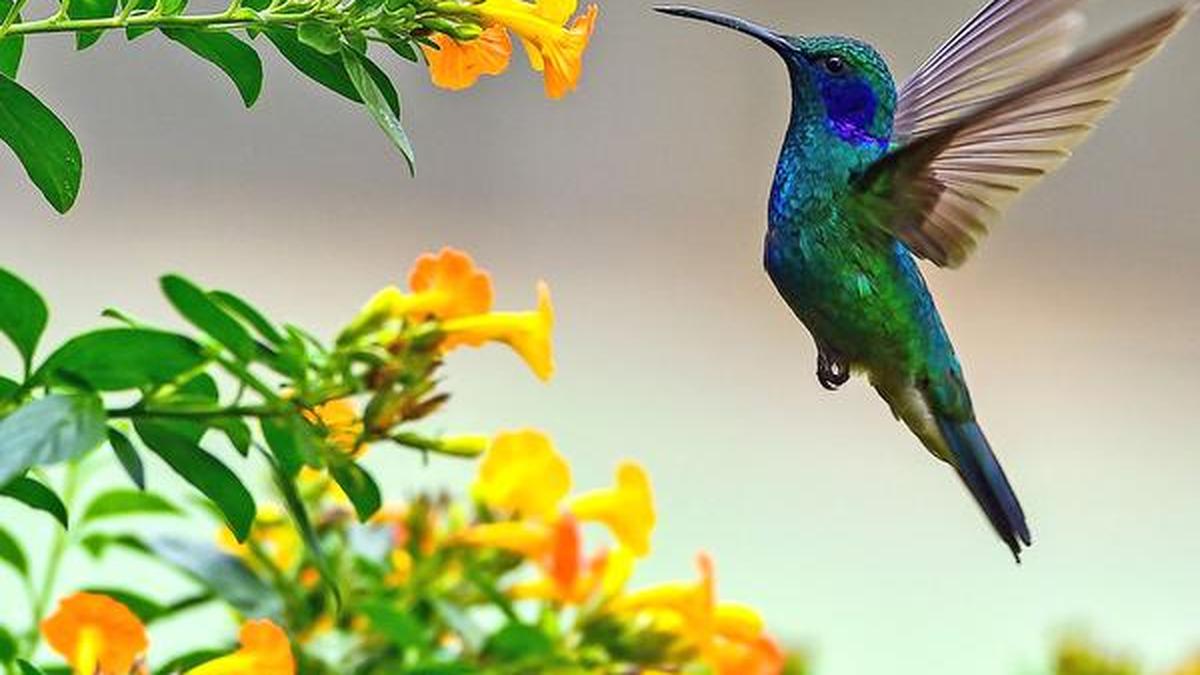
A hummingbird feeds on the nectar of a flower in Boquete, Chiriqui Province, Panama, 2020. Hummingbirds are known for their ability to hover mi-air by rapidly flapping their wings 15 to 80 times per second, depending on the bird’s size.
| Photo Credit: AFP

For decades, scientists and engineers have puzzled over how insects and hummingbirds can hover, i.e. stay nearly motionless in air, despite the limits of ordinary aerodynamics. Conventional theory long held that such flight should be unstable: the lifting forces needed to balance the being’s weight should be too great to sustain without active control.

Many studies have tried to model hovering mathematically, treating it as a complex system with flapping wings, nonlinear motions, and multiple interacting forces. Other researchers ran detailed simulations of fluid motion. They proved accurate — but they operated far too slowly to explain how real creatures stabilise themselves in milliseconds.

Meanwhile, experiments also showed that insects depend heavily on sensory feedback such as visual cues, airflow sensors, and balance organs to correct their motion, which added to the puzzle because insects have small brains with very limited computing power.

These conflicting lines of evidence have together left hovering an unsolved puzzle. But if a study published recently in Physical Review E is to be believed, science may have finally cracked the puzzle. The authors of this study, from the University of Cincinnati in the US, have revealed that there’s a way hovering can be governed by a simple, real-time feedback rule that needs no heavy computation at all.

They have proposed that hovering operates as an extremum-seeking (ES) feedback system. Imagine you’re trying to keep a drone perfectly hovering at one height but you don’t know the exact rules that tell you how to do it. You can’t write equations or predict the forces. Instead you use trial and error with feedback: you make small adjustments, watch what happens, and keep changing direction until the drone stays steady.

This is what an ES system does. It’s a feedback loop that helps a system find its sweet spot, a.k.a. the extremum, which could be a minimum or maximum of something you’re trying to adjust.

It starts by making small yet regular changes to some control input, e.g. an insect slightly changing the strength or angle of its wing flaps. The insect’s body or sensors detect whether it went up, down or stayed level. If the change improves its stability, it keeps moving that way; if it doesn’t, it reverses course. Through such small corrections, the insect eventually learns the right flapping pattern to stay balanced.

Their simulations showed that the ES-based control system reproduced stable hovering in hawkmoths, craneflies, bumblebees, dragonflies, hoverflies, and hummingbirds. Each model could maintain constant altitude without requiring detailed aerodynamic models. The same feedback rule also worked despite vast differences in size and wingbeat frequency as well. And the predicted flapping amplitudes closely matched values measured in natural experiments.

By showing that hovering can emerge from a simple law, the study suggested that stability in hovering flight needn’t demand complex neural abilities. For biologists, per the study, the findings can help clarify how small flyers remain steady with minimal processing power; in engineering, it could open a path towards bio-inspired drones that hover stably without complex control algorithms or heavy sensors.

Published – October 26, 2025 03:25 pm IST



Source link

Science

Post navigation

Previous Post: Access Denied
Next Post: Access Denied

Related Posts

  • The Nobel Prize 2024: an interactive guide
    The Nobel Prize 2024: an interactive guide Science
  • How do vapes work? A look inside
    How do vapes work? A look inside Science
  • Daily Quiz | On scales that measure hurricanes
    Daily Quiz | On scales that measure hurricanes Science
  • ISRO tests thrust chamber for LOX-Methane Engine
    ISRO tests thrust chamber for LOX-Methane Engine Science
  • Why does an elevator need three electrical phases to operate?
    Why does an elevator need three electrical phases to operate? Science
  • EU agencies track bird flu virus variants on increasing threat to humans
    EU agencies track bird flu virus variants on increasing threat to humans Science

More Related Articles

The Science Quiz | On Attosecond physics The Science Quiz | On Attosecond physics Science
Who gets to own the moon? India is uniquely positioned to answer Who gets to own the moon? India is uniquely positioned to answer Science
Beyond the stars – The Hindu Beyond the stars – The Hindu Science
H5N1 outbreak: route of mammalian transmission among cattle unclear H5N1 outbreak: route of mammalian transmission among cattle unclear Science
In breakthrough, scientists find pressure sensor in fat tissue In breakthrough, scientists find pressure sensor in fat tissue Science
ISRO wants to transfer 50% of PSLV development to industry consortium, says V. Narayanan ISRO wants to transfer 50% of PSLV development to industry consortium, says V. Narayanan Science
SiteLock

Archives

  • May 2026
  • April 2026
  • March 2026
  • February 2026
  • January 2026
  • December 2025
  • November 2025
  • October 2025
  • September 2025
  • August 2025
  • July 2025
  • June 2025
  • May 2025
  • April 2025
  • March 2025
  • February 2025
  • January 2025
  • December 2024
  • November 2024
  • October 2024
  • September 2024
  • August 2024
  • July 2024
  • June 2024
  • May 2024
  • April 2024
  • March 2024
  • February 2024
  • January 2024
  • December 2023
  • November 2023
  • October 2023
  • September 2023
  • August 2023
  • July 2023
  • June 2023
  • May 2023
  • April 2023
  • March 2023
  • February 2023
  • January 2023
  • December 2022
  • November 2022
  • October 2022
  • September 2022
  • August 2022
  • July 2022
  • June 2022
  • May 2022

Categories

  • Business
  • Nation
  • Science
  • Sports
  • World

Recent Posts

  • IPL 2026 | A win against LSG will do a world of good for CSK
  • Karnataka maps 86.37% electors with family linkage in draft voter roll exercise; Bengaluru continues to trail State average
  • Vessel seized off UAE’s Fujairah and heading toward Iranian waters, UKMTO says
  • New govt should implement existing welfare schemes, says Congress MP
  • NEET UG paper leak 2026: CBI produces five accused before Delhi court

Recent Comments

  1. CordellVoice on UP Teacher Who Asked Students To Slap Muslim Classmate
  2. Wesleyunfix on UP Teacher Who Asked Students To Slap Muslim Classmate
  3. JasonDag on UP Teacher Who Asked Students To Slap Muslim Classmate
  4. JamesHeR on UP Teacher Who Asked Students To Slap Muslim Classmate
  5. RafaelNar on UP Teacher Who Asked Students To Slap Muslim Classmate
  • After SBI, Bank of India tags Reliance Communications, Anil Ambani as ‘fraud’
    After SBI, Bank of India tags Reliance Communications, Anil Ambani as ‘fraud’ Business
  • Access Denied
    Access Denied Nation
  • Species in 17 mountains worldwide face extinction risk due to global warming: Study
    Species in 17 mountains worldwide face extinction risk due to global warming: Study World
  • “Gaganyaan Crew Module Recovered, All Data Looks Good,” Says ISRO chief
    “Gaganyaan Crew Module Recovered, All Data Looks Good,” Says ISRO chief Nation
  • Kylian Mbappe Denied Dream PSG Farewell After Champions League Exit
    Kylian Mbappe Denied Dream PSG Farewell After Champions League Exit Sports
  • Access Denied Sports
  • 29 Dead After Drinking Toxic Liquor 29 In Tamil Nadu, MK Stalin Cracks Down
    29 Dead After Drinking Toxic Liquor 29 In Tamil Nadu, MK Stalin Cracks Down Nation
  • The racial divide in South Africa’s economy since the end of apartheid
    The racial divide in South Africa’s economy since the end of apartheid Business

Editor-in-Chief:
Mohammad Ariff,
MSW, MAJMC, BSW, DTL, CTS, CNM, CCR, CAL, RSL, ASOC.
editor@artifex.news

Associate Editors:
1. Zenellis R. Tuba,
zenelis@artifex.news
2. Haris Daniyel
daniyel@artifex.news

Photograher:
Rohan Das
rohan@artifex.news

Artifex.News offers Online Paid Internships to college students from India and Abroad. Interns will get a PRESS CARD and other online offers.
Send your CV (Subjectline: Paid Internship) to internship@artifex.news

Links:
Associate Journalism
About Us
Privacy Policy

News Links:
Breaking News
World
Nation
Sports
Business
Entertainment
Lifestyle

Registered Office:
72/A, Elliot Road, Kolkata - 700016
Tel: 033-22277777, 033-22172217
Email: office@artifex.news

Editorial Office / News Desk:
No. 13, Mezzanine Floor, Esplanade Metro Rail Station,
12 J. L. Nehru Road, Kolkata - 700069.
(Entry from Gate No. 5)
Tel: 033-46011099, 033-46046046
Email: editor@artifex.news

Copyright © 2023 Artifex.News Newsportal designed by Artifex Infotech.