

Skip to content
  • Facebook
  • X
  • Linkedin
  • WhatsApp
  • YouTube
  • Associate Journalism
  • About Us
  • Privacy Policy
  • 033-46046046
  • editor@artifex.news
Artifex.News

Artifex.News

Stay Connected. Stay Informed.

  • Breaking News
  • World
  • Nation
  • Sports
  • Business
  • Science
  • Entertainment
  • Lifestyle
  • Toggle search form
  • Muhammad Yunus asks U.K. to investigate ‘graft scandal’ of British Minister Tulip Siddiq, Sheikh Hasina’s niece
    Muhammad Yunus asks U.K. to investigate ‘graft scandal’ of British Minister Tulip Siddiq, Sheikh Hasina’s niece World
  • Congress Announces Candidate For Akola, Warangal
    Congress Announces Candidate For Akola, Warangal Nation
  • AAP Releases 3rd List Of 11 Candidates For Haryana Assembly Elections
    AAP Releases 3rd List Of 11 Candidates For Haryana Assembly Elections Nation
  • Rameshwaram Cafe blast: Possible Link Between Mangaluru And Bengaluru Explosions: DK Shivakumar
    Rameshwaram Cafe blast: Possible Link Between Mangaluru And Bengaluru Explosions: DK Shivakumar Nation
  • Access Denied
    Access Denied Nation
  • Winter rain floods Gaza camps as Netanyahu heads for US meeting
    Winter rain floods Gaza camps as Netanyahu heads for US meeting World
  • Poland, Hungary, Slovakia to introduce own bans on Ukraine grains
    Poland, Hungary, Slovakia to introduce own bans on Ukraine grains World
  • Vinod Kambli Responds After Kapil Dev Offers To Help Him: “Have No Hesitation…”
    Vinod Kambli Responds After Kapil Dev Offers To Help Him: “Have No Hesitation…” Sports
China’s EAST fusion reactor beats density limit, widens path to power

China’s EAST fusion reactor beats density limit, widens path to power

Posted on January 13, 2026 By admin


Scientists at a nuclear fusion reactor in China recently surmounted an important obstacle in operating reactor vessels at high density. They pushed plasma density 65% beyond a special threshold, entering a stable state that overcomes a long-standing barrier to achieving burning plasma, the stage where a fusion reaction becomes self-sustaining.

Fusion power mimics what happens inside the sun. Hydrogen atoms slam together so hard that they fuse into helium, releasing copious amounts of energy. But this reaction only works when the atoms are packed into a small space at an extreme temperature, typically more than 100,000,000º C.

Greenwald limit

In the reactors designed to sustain these reactions, scientists measure success using the triple product: the density multiplied by the temperature multiplied by the confinement time. All three numbers need to be very high for engineers to reach ignition, a state in which a fusion reaction sustains itself. Density is the number of fuel particles that can be squeezed into the reactor. More density means more collisions and more fusion.

But there’s a catch. For decades, tokamaks, the donut-shaped magnetic vessels designed to hold the superhot plasma, ran into the Greenwald density limit. Beyond this limit, the plasma collapses in a disruption that could damage the reactor. The Greenwald formula links this limit to the plasma current and the reactor’s size.

The EAST fusion reactor in Hefei in China has typically operated between 80% and 100% of this limit.But in a January 1 paper in Science Advances, the EAST team reported it had achieved stable plasmas at densities 1.3x to 1.65x of the limit.

Temperature at divertor

The team achieved this by combining two techniques. First, they used electron cyclotron resonance heating (ECRH) during start-up. In ECRH, microwave beams are shot into the plasma, heating electrons to millions of degrees. This happens before ramping up the plasma current, a large electric current that flows through the plasma to heat it and help create the magnetic cage. Second, the team started with more deuterium gas in the chamber, then fed hydrogen fuel as the plasma heated up.

For the experiments, EAST’s tungsten surfaces were also coated with a thin layer of lithium to condition them and reduce impurities.

The overall combination changed how the plasma interacted with the reactor walls.When the plasma touches the walls, tungsten atoms from the walls are released into the plasma. Tungsten is an impurity that radiates a lot of heat away, potentially causing the plasma to collapse.

This creates a vicious cycle. Hot plasma strikes the walls, releases impurities, the impurities radiate heat, the plasma gets hotter in the spots that try to compensate, those hot spots hit the walls harder, releasing more impurities. Eventually the system may spiral into disruption.

In 2021, physicist Dominique Escande and colleagues at the Aix-Marseille University in France developed the plasma-wall self-organisation (PWSO) theory to predict this behaviour mathematically. The theory says two stable states exist: a density-limit regime near the Greenwald limit and a density-free regime where the density limit shoots past the limit.

The difference between the two states is the temperature at the divertor, the part of the reactor where plasma meets the walls. A cooler divertor means more gentle collisions between particles and the wall, fewer impurities, and thus cleaner plasma, which can pack hydrogen atoms more densely.

Less sputtering

The EAST team ran two sets of experiments. In the first, they held the ECRH power at 600 kW and varied the gas pressure. In the second, they fixed the gas pressure and varied the ECRH power.

This way, the team found that more gas in the chamber led to a cooler divertor and less tungsten contamination.

Varying the ECRH power had a smaller effect; in the paper, researchers wrote that that could be because they used relatively low gas pressure in tests.
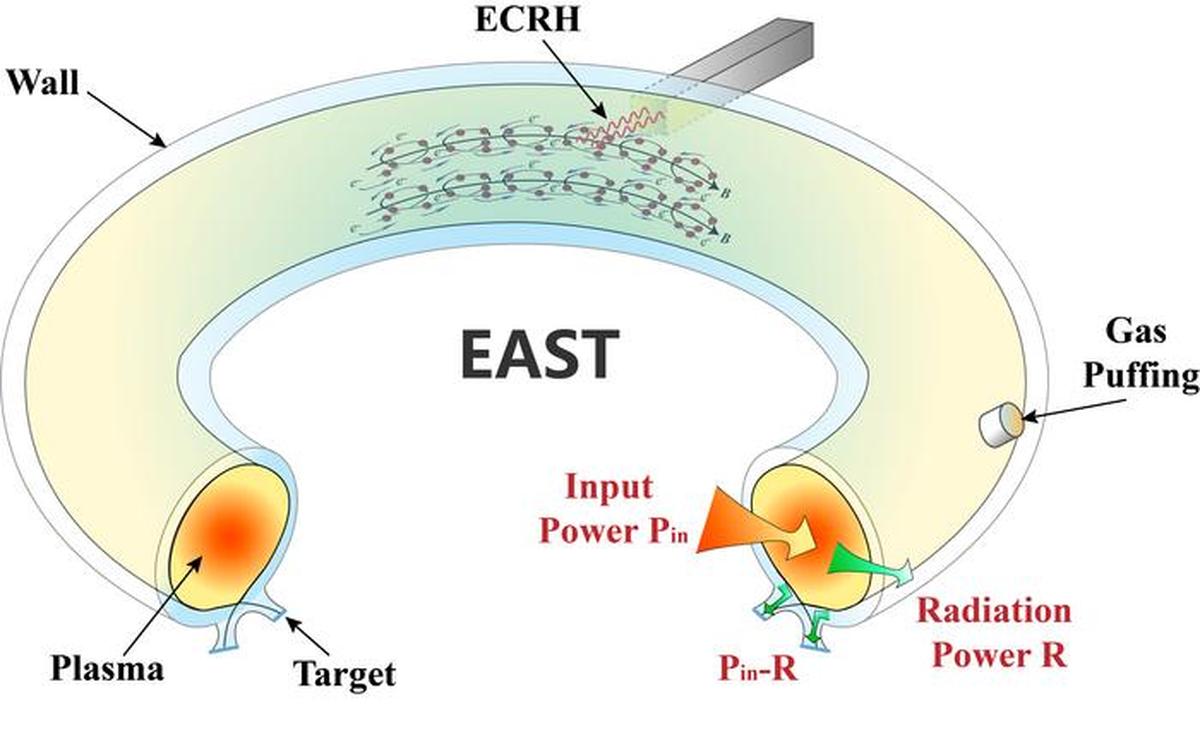
Schematic illustration of the EAST tokamak operation during ECRH-assisted start-up.

Schematic illustration of the EAST tokamak operation during ECRH-assisted start-up.
| Photo Credit:
Yan Ning

One unexpected finding emerged from repeated ECRH shots with identical settings. The later experiments reached higher densities than the first ones, even with the same power and gas inputs. The team found this was because the wall’s conditions improved over time as multiple high-density plasmas ‘conditioned’ its tungsten surface, making it less prone to sputtering.

The experiments were able to achieve densities of up to 5.6 × 10¹⁹ particles per cubic metre, around 65% higher than the EAST reactor’s normal 3.4 × 10¹⁹. The plasma temperature near the divertor target also dropped by roughly a third, from about 1.1 million to 0.7-0.8 million degrees C. The plasma also had fewer heavy atoms mixed in.

Beyond the limit

The measurements matched the predictions of the PWSO theory remarkably well. The team tested both a simplified zero-dimensional model and a more complex one-dimensional model to simulate the way temperature and density of impurities changed in the plasma. Both models placed EAST’s results squarely in the density-free regime, the stable state in which the plasma density exceeds the Greenwald limit.

Previous experiments in the J-TEXT tokamak in Wuhan stayed in the density-limit regime. The difference could be the J-TEXT reactor’s carbon walls. While tungsten sputters by bombarding the plasma, carbon undergoes additional chemical reactions and releases more impurities.

The new advance doesn’t ‘solve’ fusion energy. The EAST tests ran at relatively low power and plasma current, and lasted several seconds rather than the hours needed for a power plant.

The density-free regime also isn’t truly unlimited. At extreme density, different types of turbulence and instabilities can arise independent of the divertor. As density increases, engineers will also need more power to keep the plasma hot enough to fuse. But those constraints arise far beyond the Greenwald limit.

In future experiments, per the paper, engineers could further lower the divertor temperature by increasing both the ECRH power and the gas pressure, possibly reaching full detachment, a condition in which the plasma barely touches the walls. Detached plasmas could operate at densities several times the Greenwald limit.

Matters for ITER

“The findings suggest a practical and scalable pathway for extending density limits in tokamaks and next-generation burning plasma fusion devices,” Zhu Ping, of the Huazhong University of Science and Technology in Wuhan and a co-lead of the new study, said in a release.

Fusion researchers often focus on temperature and confinement time while treating density as constrained by the Greenwald limit. The new experiments challenge that assumption. The potential implication is that if a reactor can be run at twice the fuel density, it might achieve the conditions for ignition at lower temperatures or with shorter confinement times.

This matters for ITER, the large international fusion experiment under construction in France, and in which India has invested.

“Density limit is one of the critical issues in tokamak plasma for a fusion power plant. Plasma-wall self-organisation theory proposed in the … paper should be validated to overcome the density limit in ITER,” Ryoji Hiwatari of the Japan National Institutes for Quantum and Radiological Science and Technology wrote on X.com.

mukunth.v@thehindu.co.in

Published – January 13, 2026 06:00 am IST


Source link

Science

Post navigation

Previous Post: Access Denied
Next Post: Access Denied

Related Posts

  • As calculations catch up, muon anomaly nearly vanishes
    As calculations catch up, muon anomaly nearly vanishes Science
  • The Israel model, and Indian realities
    The Israel model, and Indian realities Science
  • Major study opens window to the brain when an emotion first appears
    Major study opens window to the brain when an emotion first appears Science
  • Chamarajanagar varsity to host Kannada Science Congress
    Chamarajanagar varsity to host Kannada Science Congress Science
  • Forest loss from SE Asia rubber is up to 3 times more than thought: study
    Forest loss from SE Asia rubber is up to 3 times more than thought: study Science
  • Science quiz: The discovery of Epimetheus
    Science quiz: The discovery of Epimetheus Science

More Related Articles

In pictures | Rare blue supermoon dazzles stargazers around the globe In pictures | Rare blue supermoon dazzles stargazers around the globe Science
Pragyan rover has done what it was expected to do: ISRO chief Pragyan rover has done what it was expected to do: ISRO chief Science
Big Swedish study hints at link between bowel disease, infant diet Big Swedish study hints at link between bowel disease, infant diet Science
‘Extremely exciting’: the ice cores that could help save glaciers ‘Extremely exciting’: the ice cores that could help save glaciers Science
The two vaccines that brought us to the brink of eradicating polio | Explained The two vaccines that brought us to the brink of eradicating polio | Explained Science
Rubies and emeralds get their colours from a common metal Rubies and emeralds get their colours from a common metal Science
SiteLock

Archives

  • May 2026
  • April 2026
  • March 2026
  • February 2026
  • January 2026
  • December 2025
  • November 2025
  • October 2025
  • September 2025
  • August 2025
  • July 2025
  • June 2025
  • May 2025
  • April 2025
  • March 2025
  • February 2025
  • January 2025
  • December 2024
  • November 2024
  • October 2024
  • September 2024
  • August 2024
  • July 2024
  • June 2024
  • May 2024
  • April 2024
  • March 2024
  • February 2024
  • January 2024
  • December 2023
  • November 2023
  • October 2023
  • September 2023
  • August 2023
  • July 2023
  • June 2023
  • May 2023
  • April 2023
  • March 2023
  • February 2023
  • January 2023
  • December 2022
  • November 2022
  • October 2022
  • September 2022
  • August 2022
  • July 2022
  • June 2022
  • May 2022

Categories

  • Business
  • Nation
  • Science
  • Sports
  • World

Recent Posts

  • Bandi Bhagirath’s case takes serious turn with Telangana CM ordering special team for comprehensive probe
  • Asian shares mixed, oil jumps 4% after Donald Trump rejects Iran’s response to ceasefire proposal
  • Velachery school kids steer road users towards safety
  • Eyeing migrant returns, EU pushes to revive Syria ties
  • Somnath Amrut Mahotsav: PM Modi performs ‘Maha Pooja’, witnesses air show

Recent Comments

  1. DonaldStype on UP Teacher Who Asked Students To Slap Muslim Classmate
  2. EnriqueExins on UP Teacher Who Asked Students To Slap Muslim Classmate
  3. EnriqueExins on UP Teacher Who Asked Students To Slap Muslim Classmate
  4. Robertnof on UP Teacher Who Asked Students To Slap Muslim Classmate
  5. GarlandLex on UP Teacher Who Asked Students To Slap Muslim Classmate
  • The Budget and the imperative of fiscal consolidation
    The Budget and the imperative of fiscal consolidation Business
  • Ex-Chelsea Footballer Tries ‘Spinning Kick’ As Fans Invade Pitch In Turkey – Watch
    Ex-Chelsea Footballer Tries ‘Spinning Kick’ As Fans Invade Pitch In Turkey – Watch Sports
  • Ind vs NZ 1st Test: India slips up after Sarfaraz-Pant show on day 4; Kiwis on the cusp of victory
    Ind vs NZ 1st Test: India slips up after Sarfaraz-Pant show on day 4; Kiwis on the cusp of victory Sports
  • Divided Israel marks two years since Oct 7 attack as Gaza war grinds on, hostages languish
    Divided Israel marks two years since Oct 7 attack as Gaza war grinds on, hostages languish World
  • Trudeau says Trump talk of annexing Canada is a distraction tactic
    Trudeau says Trump talk of annexing Canada is a distraction tactic World
  • Medical Aspirant Studying In Kota Found Dead On Tracks, Suicide Not Ruled Out
    Medical Aspirant Studying In Kota Found Dead On Tracks, Suicide Not Ruled Out Nation
  • Earthquake of magnitude 7.4 strikes north Chile near Argentine border; no reports of major damage
    Earthquake of magnitude 7.4 strikes north Chile near Argentine border; no reports of major damage World
  • Following backlash, ‘Jaffna’ restored in India-built Cultural Centre’s name in northern Sri Lanka
    Following backlash, ‘Jaffna’ restored in India-built Cultural Centre’s name in northern Sri Lanka World

Editor-in-Chief:
Mohammad Ariff,
MSW, MAJMC, BSW, DTL, CTS, CNM, CCR, CAL, RSL, ASOC.
editor@artifex.news

Associate Editors:
1. Zenellis R. Tuba,
zenelis@artifex.news
2. Haris Daniyel
daniyel@artifex.news

Photograher:
Rohan Das
rohan@artifex.news

Artifex.News offers Online Paid Internships to college students from India and Abroad. Interns will get a PRESS CARD and other online offers.
Send your CV (Subjectline: Paid Internship) to internship@artifex.news

Links:
Associate Journalism
About Us
Privacy Policy

News Links:
Breaking News
World
Nation
Sports
Business
Entertainment
Lifestyle

Registered Office:
72/A, Elliot Road, Kolkata - 700016
Tel: 033-22277777, 033-22172217
Email: office@artifex.news

Editorial Office / News Desk:
No. 13, Mezzanine Floor, Esplanade Metro Rail Station,
12 J. L. Nehru Road, Kolkata - 700069.
(Entry from Gate No. 5)
Tel: 033-46011099, 033-46046046
Email: editor@artifex.news

Copyright © 2023 Artifex.News Newsportal designed by Artifex Infotech.