

Skip to content
  • Facebook
  • X
  • Linkedin
  • WhatsApp
  • YouTube
  • Associate Journalism
  • About Us
  • Privacy Policy
  • 033-46046046
  • editor@artifex.news
Artifex.News

Artifex.News

Stay Connected. Stay Informed.

  • Breaking News
  • World
  • Nation
  • Sports
  • Business
  • Science
  • Entertainment
  • Lifestyle
  • Toggle search form
  • Access Denied Sports
  • Crompton bets on innovation and consumer research to become a tech-led home-solutions player
    Crompton bets on innovation and consumer research to become a tech-led home-solutions player Business
  • Yemen’s Houthi rebels release crew of commercial vessel seized in Red Sea in November 2023
    Yemen’s Houthi rebels release crew of commercial vessel seized in Red Sea in November 2023 World
  • PM asks Secretaries to focus on ease of doing business, ease of living, and self-reliance
    PM asks Secretaries to focus on ease of doing business, ease of living, and self-reliance Nation
  • Trump says would be ‘great to get a peace deal’ with Iran
    Trump says would be ‘great to get a peace deal’ with Iran World
  • Freedom doesn’t mean crossing limits: Mahesh Goud
    Freedom doesn’t mean crossing limits: Mahesh Goud Nation
  • West Bengal joins Ayushman Bharat scheme
    West Bengal joins Ayushman Bharat scheme Nation
  • Access Denied Sports
The Budget and the imperative of fiscal consolidation

The Budget and the imperative of fiscal consolidation

Posted on February 5, 2026 By admin


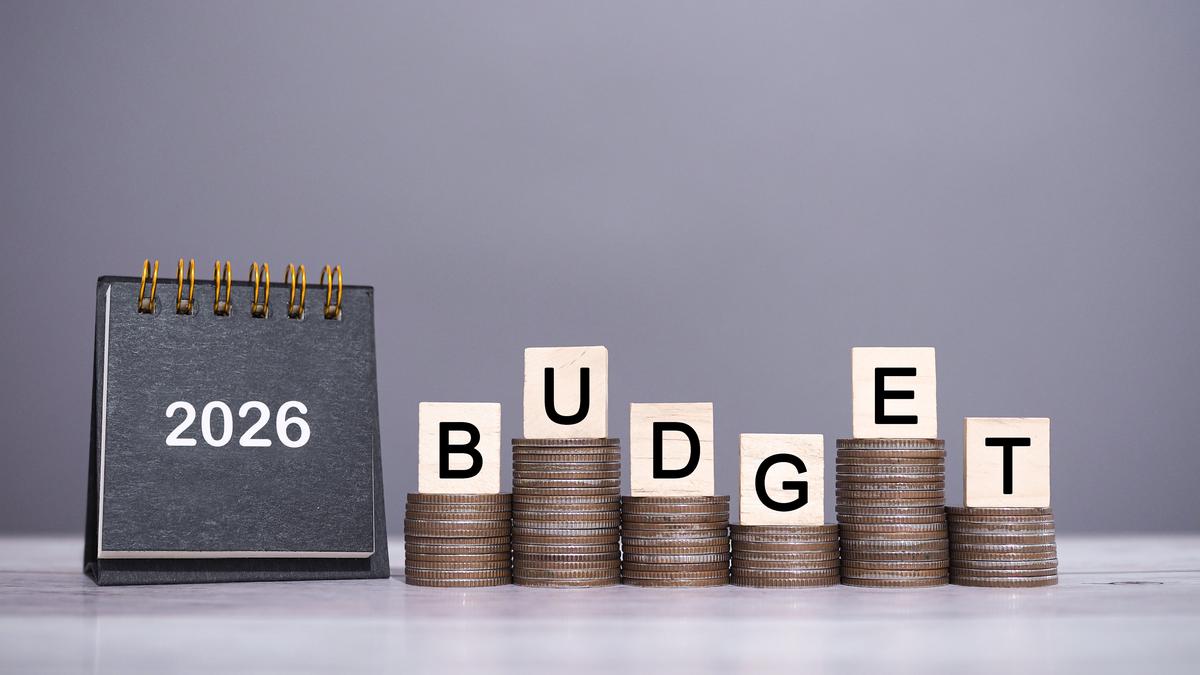
While presenting the Union Budget 2026-27, a considerable part of the Finance Minister’s Budget speech dealt with the expenditure programmes that will be launched to enable India to become developed by 2047. The emphasis on the advanced technology sectors such as Artificial Intelligence, biopharma, semiconductor and critical minerals among others, is well taken. The concern with these expenditure programmes is on how well they are going to be implemented and the pace at which they will enable the goal of Viksit Bharat to be achieved.

Expenditure priorities, revenue prospects

In order to provide fiscal space for these changing priorities, the Government of India has been successfully undertaking a restructuring, particularly of its revenue expenditures. For more than a decade, the share of revenue expenditure to total expenditure has been going down, from 88% in 2014-15 to about 77% in 2026-27 (BE), that is a fall of 11% points. Within this, the fall in central subsidies was 7% points of total expenditure. Correspondingly, the share of capital expenditure in total expenditure has increased.

The Centre’s emphasis on capital expenditure has played an important role in supporting GDP growth. As a percentage of GDP, the Centre’s capital expenditure, in the post-COVID-19 years, has been at a high level. However, its annual growth rate has fallen over time. Thus, from a recent peak growth of 28.3% in 2023-24, it fell to 10.8% in 2024-25 and to 4.2% in 2025-26 (RE). It is budgeted to increase now to 11.5% in 2026-27 (BE), which is only marginally higher than the assumed nominal GDP growth of 10.0%. Thus, it will almost remain static at 3.1% of GDP in 2025-26 (RE) and 2026-27 (BE). It may be noted that the budgeted capital expenditure growth in 2025-26 was 10.1%, but a growth of only 4.2% was achieved as already noted.


Editorial | Credible and creditable: On Union Budget 2026-27

The Government of India’s revenue receipts, particularly projections for 2026-27 (BE) of tax revenues are cautious and are likely to be achieved. But the concern is that the buoyancy of Centre’s gross tax revenues in 2026-27 (BE) has fallen to 0.8, well below the benchmark of 1. This consists of a buoyancy of 1.1 of direct taxes, which has a share of 61.2%, and a buoyancy of 0.3 of indirect taxes, which has a share of 38.8% in Centre’s gross tax revenues. The main reason for the lower overall buoyancy is linked to the Goods and Services Tax (GST) collections, which are not expected to keep pace with GDP growth in 2026-27 (BE). In view of the high pressure on increasing expenditure, both developmental and welfare, the government should take a good look at the indirect taxes structure and raise their buoyancy to 1.

The recommendations of the Sixteenth Finance Commission (FC16) have not provided for any change in the share of States in the divisible pool of central taxes, keeping it at 41%.

The assignment of taxes to the States, therefore, has remained the same at 3.9% of GDP in 2025-26 (RE) and 2026-27 (BE). Also, the FC16 did not recommend any revenue deficit grants or sector/State-specific grants. Because of discontinuation of revenue deficit grants, there would be a reduction in the overall transfers to the States as compared to FC15. In fact, there has also been a reduction in other components of FC grants — the reason why total FC grants to the States have fallen from 0.43% of GDP in 2025-26 (RE) — the last year under the recommendations of FC15 — to 0.33% in 2026-27 (BE), the first year under the recommendations of the FC16. Usually, in the first year of an FC award period, there is a step jump in the volume of grants.

Pace of fiscal consolidation

The slowdown in the pace of fiscal consolidation is also a major concern. The pace of reduction in the fiscal deficit to GDP ratio has progressively fallen in the post-COVID-19 years. Considering the period from 2023-24, the annual reduction in this ratio in successive years was 0.7% points in 2024-25, 0.4% points in 2025-26 (RE) and only 0.1% point in 2026-27 (BE). The change in the targeting strategy from fiscal deficit to targeting the debt-GDP ratio also does not give much confidence. In fact, the debt-GDP ratio and fiscal deficit to GDP ratio are interdependent and move in tandem depending on the nominal GDP growth.

A transparent strategy would be to give the glide path of debt-GDP ratio and fiscal deficit relative to GDP with an underlying assumption of nominal GDP growth for the next five years. It should also indicate as to when the respective targets committed to in the Fiscal Responsibility and Budget Management Act 2018, that is, of 40% for debt-GDP ratio and of 3% for fiscal deficit to GDP ratio are likely to be achieved.

It is also useful to note that maintaining an unduly high debt-GDP ratio leads to a high interest payment to revenue receipts ratio. The effective interest rate for central government debt is estimated at 7.12% in 2026-27 (BE). This rate has been rising progressively for the last three years. In fact, as per the 2026-27 (BE), the interest payment to revenue receipts ratio is close to 40%, thereby squeezing the space for the required primary expenditures.

It must be stressed that the limit of fiscal deficit at 3% of GDP has a strong logic behind it. If the Centre and States take 8%-9% of GDP, the investible resources available for the private sector will come down strongly. In this situation, it is difficult to expect private investment to pick up.

A good framework

Taken together, the Budget presents a good road map to achieve the status of a developed country by 2047. It has highlighted the critical areas where the government and country must focus on. Sustained growth needs monetary and fiscal stability. The path of fiscal consolidation requires a relook.

C. Rangarajan is Chairman, Madras School of Economics, and a former Governor of the Reserve Bank of India. D.K. Srivastava is Member, Advisory Council to the Sixteenth Finance Commission, and a former Director of the Madras School of Economics. The views expressed are personal

Published – February 05, 2026 12:16 am IST


Source link

Business Tags:advanced technology sectors, Artificial Intelligenc, biopharma, Centre’s emphasis on capital expenditure, expenditure programmes, fiscal space, Government of India’s revenue receipts, India and 2047 development target, recommendations of the Sixteenth Finance Commission, restructuring of revenue expenditures, semiconductor and critical minerals, supporting GDP growth, union budget 2026-27

Post navigation

Previous Post: Access Denied
Next Post: Trump, Xi discuss Iran in wide-ranging call as U.S. presses China, others to break from Tehran

Related Posts

  • Bombay High Court stays fraud notices to Anil Ambani; questions banks’ compliance
    Bombay High Court stays fraud notices to Anil Ambani; questions banks’ compliance Business
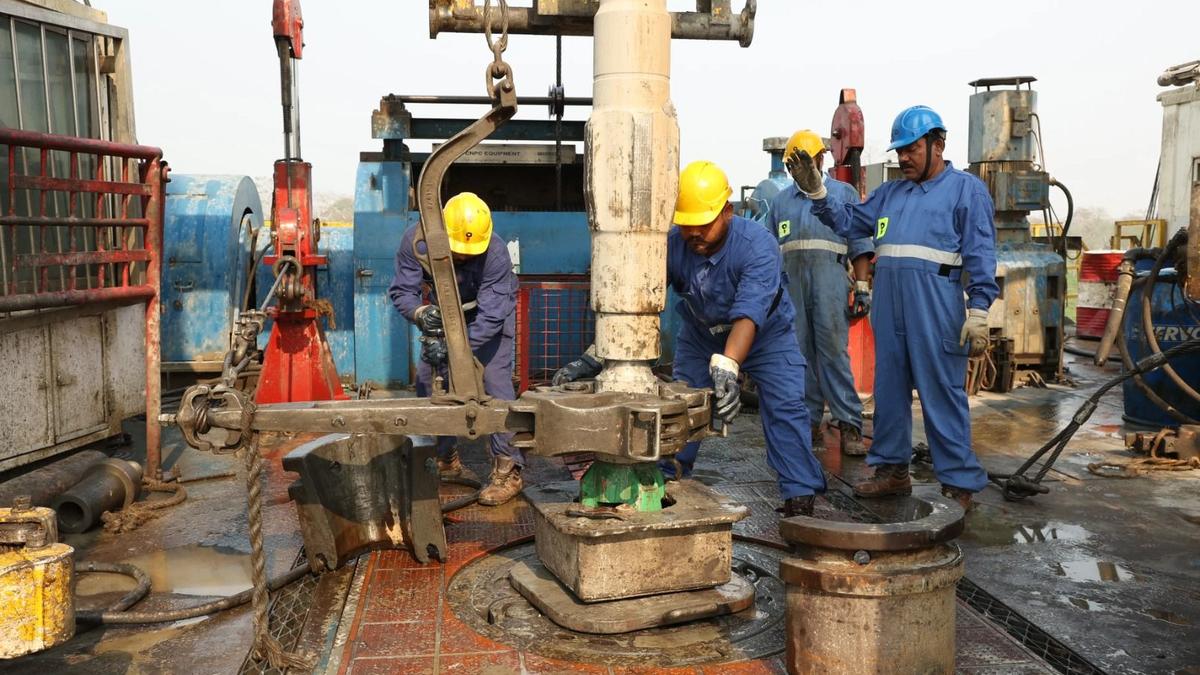
  • Oil India will change the narrative of its production in the next 18 months with ramped up infra, says Ranjit Rath
    Oil India will change the narrative of its production in the next 18 months with ramped up infra, says Ranjit Rath Business
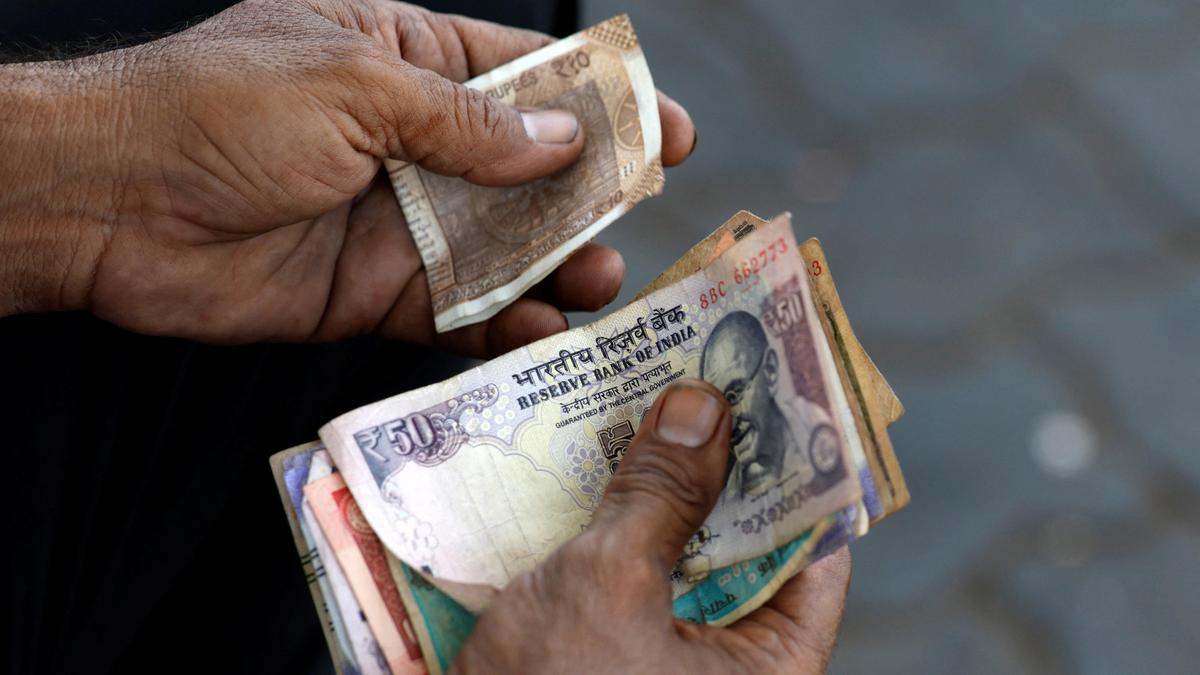
  • Rupee slips 13 paise to hit fresh lifetime low of 96.83 against U.S. dollar
    Rupee slips 13 paise to hit fresh lifetime low of 96.83 against U.S. dollar Business
  • Biocon, Zentiva get EU approval for generic diabetes, weight management drug
    Biocon, Zentiva get EU approval for generic diabetes, weight management drug Business
  • Access Denied Business
  • CCPA imposes ₹3 lakh fine on VLCC for misleading ads on slimming treatments
    CCPA imposes ₹3 lakh fine on VLCC for misleading ads on slimming treatments Business

More Related Articles

Gold plunges ₹350; silver declines ₹300 Gold plunges ₹350; silver declines ₹300 Business
‘We must act now’: IT Ministry fears losing out to China, Vietnam in smartphone exports race ‘We must act now’: IT Ministry fears losing out to China, Vietnam in smartphone exports race Business
Ishan Kishan’s Ton, Arshdeep Singh’s Fifer Help India Demolish New Zealand In 5th T20I Business
Access Denied Business
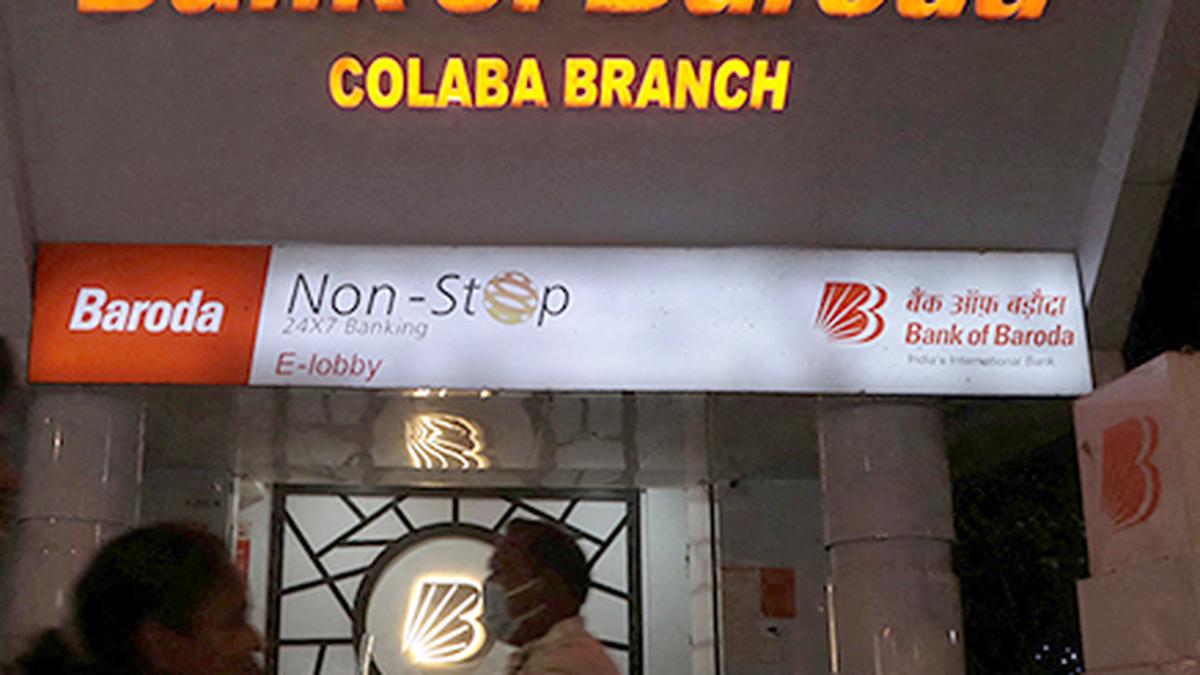
Bank of Baroda Q1 net profit grows 9.5% to ₹4,458 crore Bank of Baroda Q1 net profit grows 9.5% to ₹4,458 crore Business
Access Denied Business
SiteLock

Archives

  • October 2026
  • September 2026
  • August 2026
  • July 2026
  • June 2026
  • May 2026
  • April 2026
  • March 2026
  • February 2026
  • January 2026
  • December 2025
  • November 2025
  • October 2025
  • September 2025
  • August 2025
  • July 2025
  • June 2025
  • May 2025
  • April 2025
  • March 2025
  • February 2025
  • January 2025
  • December 2024
  • November 2024
  • October 2024
  • September 2024
  • August 2024
  • July 2024
  • June 2024
  • May 2024
  • April 2024
  • March 2024
  • February 2024
  • January 2024
  • December 2023
  • November 2023
  • October 2023
  • September 2023
  • August 2023
  • July 2023
  • June 2023
  • May 2023
  • April 2023
  • March 2023
  • February 2023
  • January 2023
  • December 2022
  • November 2022
  • October 2022
  • September 2022
  • August 2022
  • July 2022
  • June 2022
  • May 2022

Categories

  • Business
  • Nation
  • Science
  • Sports
  • World

Recent Posts

  • Is Wetland Authority accountable to government or construction companies, asks Anbumani
  • TCS looks to quantum computing to solve complex ‘what if’ problems
  • AIADMK, BJP leaders slam TVK-led Tamil Nadu government over electricity purchase at high rate
  • Two arrested for attacking security guard with knife in Besant Nagar
  • Women stage silent demonstration at Kathipara against police action on anti-CEC protesters in Delhi

Recent Comments

  1. RobertTes on UP Teacher Who Asked Students To Slap Muslim Classmate
  2. Manuelret on UP Teacher Who Asked Students To Slap Muslim Classmate
  3. RobertTes on UP Teacher Who Asked Students To Slap Muslim Classmate
  4. RobertTes on UP Teacher Who Asked Students To Slap Muslim Classmate
  5. BrentWes on UP Teacher Who Asked Students To Slap Muslim Classmate
  • A Month After Quitting AAP, Ex Delhi Minister Raaj Anand Joins Mayawati’s Party
    A Month After Quitting AAP, Ex Delhi Minister Raaj Anand Joins Mayawati’s Party Nation
  • BAN vs SL first Test | Kasun Rajitha’s five-wicket haul helps Sri Lanka to a 328-run win over Bangladesh
    BAN vs SL first Test | Kasun Rajitha’s five-wicket haul helps Sri Lanka to a 328-run win over Bangladesh Sports
  • 13 Indians Lured Into Illegal Work In Laos Rescued
    13 Indians Lured Into Illegal Work In Laos Rescued Nation
  • Havoc, Vortex and Sicyon impress
    Havoc, Vortex and Sicyon impress Sports
  • Access Denied Business
  • Access Denied
    Access Denied Nation
  • Access Denied
    Access Denied Nation
  • Access Denied
    Access Denied Nation

Editor-in-Chief:
Mohammad Ariff,
MSW, MAJMC, BSW, DTL, CTS, CNM, CCR, CAL, RSL, ASOC.
editor@artifex.news

Associate Editors:
1. Zenellis R. Tuba,
zenelis@artifex.news
2. Haris Daniyel
daniyel@artifex.news

Photograher:
Rohan Das
rohan@artifex.news

Associate Journalists
1. Subrata Paul - AN/2020/01
2. Quamruz Zaman - AN/2021/22
3. Ahmed Sha - AN/2021/035
4. Ajay Kumar Shaw - AN/2021/39
5. Tahqiqul Hoda - AN/2021/21

Artifex.News offers Online Paid Internships to college students from India and Abroad. Interns will get a PRESS CARD and other online offers.
Send your CV (Subjectline: Paid Internship) to internship@artifex.news

Links:
Associate Journalism
About Us
Privacy Policy

News Links:
Breaking News
World
Nation
Sports
Business
Entertainment
Lifestyle

Registered Office:
72/A, Elliot Road, Kolkata - 700016
Tel: 033-22277777, 033-22172217
Email: office@artifex.news

Editorial Office / News Desk:
No. 13, Mezzanine Floor, Esplanade Metro Rail Station,
12 J. L. Nehru Road, Kolkata - 700069.
(Entry from Gate No. 5)
Tel: 033-46011099, 033-46046046
Email: editor@artifex.news

Copyright © 2023 Artifex.News Newsportal designed by Artifex Infotech.