


Skip to content
  • Facebook
  • X
  • Linkedin
  • WhatsApp
  • YouTube
  • Associate Journalism
  • About Us
  • Privacy Policy
  • 033-46046046
  • editor@artifex.news
Artifex.News

Artifex.News

Stay Connected. Stay Informed.

  • Breaking News
  • World
  • Nation
  • Sports
  • Business
  • Science
  • Entertainment
  • Lifestyle
  • Toggle search form
  • Access Denied World
  • France Bars Israeli Exhibition At Defense Show Amid Dispute Over Gaza, Lebanon
    France Bars Israeli Exhibition At Defense Show Amid Dispute Over Gaza, Lebanon World
  • Serie A: Napoli Held By Torino Ahead Of Barcelona Decider
    Serie A: Napoli Held By Torino Ahead Of Barcelona Decider Sports
  • Vinesh Phogat’s First Statement After Returning To India Post Paris Olympics Heartbreak
    Vinesh Phogat’s First Statement After Returning To India Post Paris Olympics Heartbreak Sports
  • “Money Can’t Win Medals”: Asked About India’s Failure In Olympics, Abhinav Bindra’s Honest Reply
    “Money Can’t Win Medals”: Asked About India’s Failure In Olympics, Abhinav Bindra’s Honest Reply Sports
  • Union Budget 2026: 16th Finance Commission recommends 41% tax devolution to States, increased share to South India
    Union Budget 2026: 16th Finance Commission recommends 41% tax devolution to States, increased share to South India Business
  • Israel says troops fighting Hezbollah surrounded key Lebanon town
    Israel says troops fighting Hezbollah surrounded key Lebanon town World
  • Trump, along with Elon Musk, addresses thousands where he was shot at in failed assassination bid
    Trump, along with Elon Musk, addresses thousands where he was shot at in failed assassination bid World
Rubies and emeralds get their colours from a common metal

Rubies and emeralds get their colours from a common metal

Posted on February 5, 2025 By admin


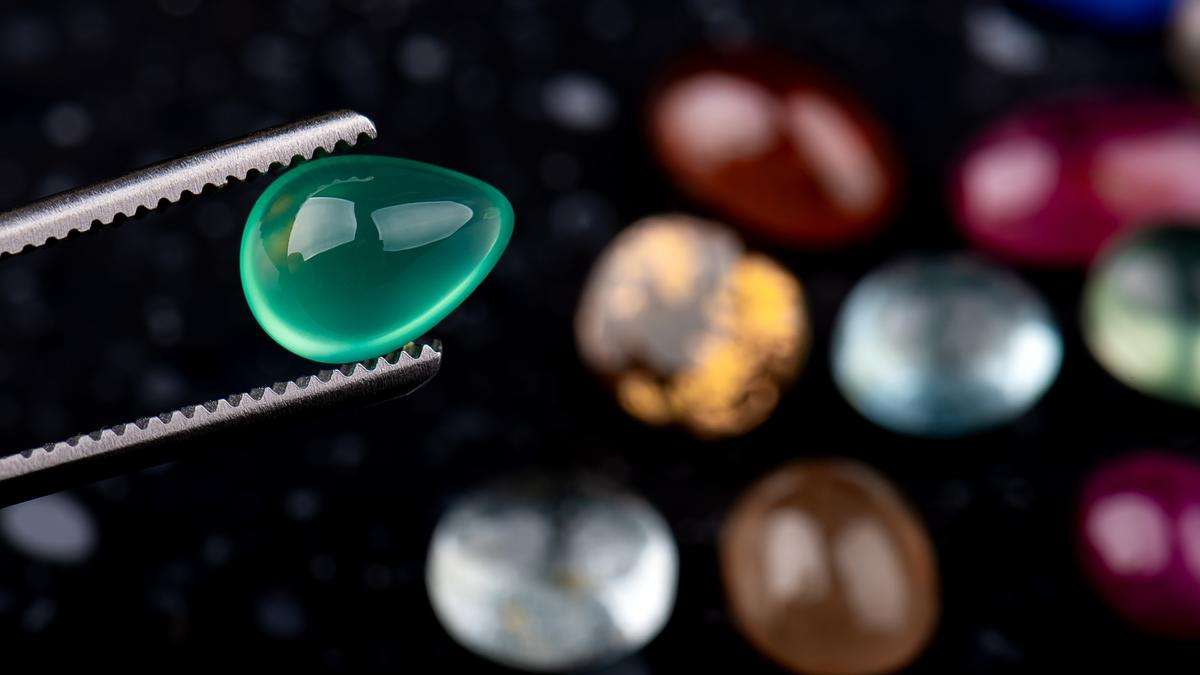
The colours of rubies and emeralds are so striking that they define shades of red and green – ruby red and emerald green. But have you ever wondered how they get those colours?

I am an inorganic chemist. Researchers in my field work to understand the chemistry of all the elements that make up the periodic table. Many inorganic chemists focus on the transition metals – the elements in the middle of the periodic table. The transition metals include most of the metals you are familiar with, like iron (Fe) and gold (Au).

One feature of compounds made with transition metals is their intense colour. There are many examples in nature, including gemstones and paint pigments. Even the colour of blood comes from the protein haemoglobin, which contains iron.

Investigating the colours of compounds containing transition metals leads you into some really amazing science – that’s part of what drew me to study this field.

Rubies and emeralds are great examples of how a small amount of a transition metal – in this case, chromium – can create a beautiful colour in what would otherwise be a fairly boring-looking mineral.

Minerals and crystals

Rubies appear red because they absorb blue and green light. 

Both rubies and emeralds are minerals, which is a type of rock with a consistent chemical composition and a highly ordered structure at the atomic level.

When this highly ordered structure extends in all three dimensions, the mineral becomes a crystal.

With a theory developed by physicists in the 1920s called crystal field theory, scientists can explain why rubies and emeralds have the colours they do. Crystal field theory makes predictions about how a transition metal ion’s structure is affected by the other atoms surrounding it.

Rubies are mainly made up of the mineral corundum, which is composed of the elements aluminium and oxygen in a regular, repeating array. Each aluminium ion is surrounded by six oxygen ions.

Emeralds are mainly made up of the mineral beryl, which is made from the elements beryllium, aluminium, silicon and oxygen. Beryl’s crystal structure is more complicated than corundum’s because of the additional elements in the formula, but each aluminium ion is again surrounded by six oxygen ions.

Pure corundum and beryl are colourless. The brilliant colours of rubies and emeralds come from the presence of very small amounts of chromium. The chromium replaces about 1% of the aluminium in the corundum or beryl crystal when a ruby or emerald forms underground at a high temperature and pressure.

But how can one element – chromium – create the red colour of a ruby and green colour of an emerald?

Colour science

Rubies and emeralds have the colours they do because, like many substances, they absorb some colours of light. Most visible light, like sunlight, is composed of all the colours of the rainbow: red, orange, yellow, green, blue, indigo and violet. These colours make up the visible light spectrum, which is easy to remember as ROY G BIV.

One of the main reasons why objects have a colour is because they absorb one or more of these visible colours of light. If a substance absorbs, for instance, red light, it means that the red light gets trapped in the substance and the other colours reflect back to your eyes. The colour you see is the sum of the remaining light, which will be in the green-to-blue range. If a substance absorbs blue, it will look red or orange to you.

Unlike the colourless aluminium ion, the chromium ion absorbs blue and green light when surrounded by the oxygen ions. The red light is reflected back, so that’s what you see in rubies.

In an emerald, even though the chromium is surrounded by six oxygen ions, there is a weaker interaction between the chromium and the surrounding oxygen ions. That’s due to the presence of silicon and beryllium in the beryl crystal. They cause the emerald to absorb blue and red light, leaving the green for you to see.

The ability to tune the properties of transition metals like chromium through changing what is surrounding it is a core strategy in my field of inorganic chemistry. Doing so can help scientists understand the basic science of metal-containing compounds and the design of chemical compounds for specific purposes.

You can take delight in the amazing colours of the gemstones, but through chemistry, you can also see how nature creates those colours using an endless variety of complex structures made with the elements in the periodic table.

Daniel Freedman is the Dean of the College of Science, Technology, Engineering, Mathematics & Management, University of Wisconsin-Stout.This article is republished from The Conversation.

Published – February 05, 2025 02:36 pm IST



Source link

Science Tags:chromium, emeralds, minerals that give colour to common metal, Rubies, science news

Post navigation

Previous Post: Zomato CEO Deepinder Goyal’s hiring update on Chief of Staff post, says ‘Nobody paid anything to work with us’
Next Post: Astronomers spot asteroid that may be heading for the earth

Related Posts

  • James Watson, Nobel prize-winning DNA pioneer, dies at 97
    James Watson, Nobel prize-winning DNA pioneer, dies at 97 Science
  • Boeing’s uncrewed Starliner spaceship lands successfully: webcast
    Boeing’s uncrewed Starliner spaceship lands successfully: webcast Science
  • Chandrayaan-3 | Vikram generated halo on landing on moon
    Chandrayaan-3 | Vikram generated halo on landing on moon Science
  • The cosmological constant problem is one of the biggest crises in physics
    The cosmological constant problem is one of the biggest crises in physics Science
  • Hidden pandemic of AMR poses challenge for modern medicine
    Hidden pandemic of AMR poses challenge for modern medicine Science
  • UNESCO Ambassador Vishal Sharma visits INCOIS, backs dedicated ocean observation satellite
    UNESCO Ambassador Vishal Sharma visits INCOIS, backs dedicated ocean observation satellite Science

More Related Articles

Why NASA’s Mars Sample Return mission has a shaky future Why NASA’s Mars Sample Return mission has a shaky future Science
Loud noise and your ears Loud noise and your ears Science
Centre amends surrogacy rules, allows couples with medical conditions to use donor gametes Centre amends surrogacy rules, allows couples with medical conditions to use donor gametes Science
Quantum test shows cause, effect need not follow a set order Quantum test shows cause, effect need not follow a set order Science
NASA astronaut Sunita Williams retires NASA astronaut Sunita Williams retires Science
Blood bank study reveals true incidence of Long COVID Blood bank study reveals true incidence of Long COVID Science
SiteLock

Archives

  • May 2026
  • April 2026
  • March 2026
  • February 2026
  • January 2026
  • December 2025
  • November 2025
  • October 2025
  • September 2025
  • August 2025
  • July 2025
  • June 2025
  • May 2025
  • April 2025
  • March 2025
  • February 2025
  • January 2025
  • December 2024
  • November 2024
  • October 2024
  • September 2024
  • August 2024
  • July 2024
  • June 2024
  • May 2024
  • April 2024
  • March 2024
  • February 2024
  • January 2024
  • December 2023
  • November 2023
  • October 2023
  • September 2023
  • August 2023
  • July 2023
  • June 2023
  • May 2023
  • April 2023
  • March 2023
  • February 2023
  • January 2023
  • December 2022
  • November 2022
  • October 2022
  • September 2022
  • August 2022
  • July 2022
  • June 2022
  • May 2022

Categories

  • Business
  • Nation
  • Science
  • Sports
  • World

Recent Posts

  • ATS questions 57 in Maharashtra over alleged gangster network links
  • Nicobarese oppose proposal for three wildlife sanctuaries
  • Visakhapatnam Collector calls for inter-departmental synergy to boost investments
  • Kohli’s masterful knock powers Royal Challengers to the top
  • Senior IPS officer Asra Garg posted IGP Intelligence

Recent Comments

  1. RichardClage on UP Teacher Who Asked Students To Slap Muslim Classmate
  2. StevenLek on UP Teacher Who Asked Students To Slap Muslim Classmate
  3. Leonardren on UP Teacher Who Asked Students To Slap Muslim Classmate
  4. NathanQuins on UP Teacher Who Asked Students To Slap Muslim Classmate
  5. Davidgof on UP Teacher Who Asked Students To Slap Muslim Classmate
  • Watch: Iran says no direct talks with U.S. in Islamabad planned
    Watch: Iran says no direct talks with U.S. in Islamabad planned World
  • Chirag Paswan On 2024 Polls
    Chirag Paswan On 2024 Polls Nation
  • UK Unveils Plans For “Fitting Tribute” To Queen Elizabeth II
    UK Unveils Plans For “Fitting Tribute” To Queen Elizabeth II World
  • Access Denied
    Access Denied Nation
  • U.S. approves updated COVID vaccines to rev up protection this fall
    U.S. approves updated COVID vaccines to rev up protection this fall World
  • Trump says U.S. Navy could escort tankers through the Strait of Hormuz
    Trump says U.S. Navy could escort tankers through the Strait of Hormuz World
  • Access Denied
    Access Denied Nation
  • Labourer convicted to five years imprisonment for sexual assault on three-year-old from neighbourhood outside Bengaluru
    Labourer convicted to five years imprisonment for sexual assault on three-year-old from neighbourhood outside Bengaluru Nation

Editor-in-Chief:
Mohammad Ariff,
MSW, MAJMC, BSW, DTL, CTS, CNM, CCR, CAL, RSL, ASOC.
editor@artifex.news

Associate Editors:
1. Zenellis R. Tuba,
zenelis@artifex.news
2. Haris Daniyel
daniyel@artifex.news

Photograher:
Rohan Das
rohan@artifex.news

Artifex.News offers Online Paid Internships to college students from India and Abroad. Interns will get a PRESS CARD and other online offers.
Send your CV (Subjectline: Paid Internship) to internship@artifex.news

Links:
Associate Journalism
About Us
Privacy Policy

News Links:
Breaking News
World
Nation
Sports
Business
Entertainment
Lifestyle

Registered Office:
72/A, Elliot Road, Kolkata - 700016
Tel: 033-22277777, 033-22172217
Email: office@artifex.news

Editorial Office / News Desk:
No. 13, Mezzanine Floor, Esplanade Metro Rail Station,
12 J. L. Nehru Road, Kolkata - 700069.
(Entry from Gate No. 5)
Tel: 033-46011099, 033-46046046
Email: editor@artifex.news

Copyright © 2023 Artifex.News Newsportal designed by Artifex Infotech.