


What are emotions, really? And why do we have them?
Simply put, emotions are intangible responses to what we see happening around us. They arise spontaneously, without conscious thought.
Emotions allowed early humans to efficiently dodge dangers as they explored the world around them. While the world and our lives in it are very different today than the way they were for our ancestors, our emotions haven’t changed.
Despite being so fundamental to our survival as a species, however, scientists are still piecing together how emotions arise in our brains. In a study recently published in Science, in fact, scientists have just reported mapping the brain-wide activity patterns that trigger emotions.
The team found that once an emotion was set off, it outlasted the trigger that sparked it in the first place. If this sounds familiar, it’s because this is what you feel when you accidentally stub your toe, burn your hand, and even when you enjoy your favourite flavour of ice cream.
In all these examples, there is incoming sensory information that prompts an emotional response while the good or bad feeling lasts even after the body part has been reflexively pulled back or after the ice cream is finished.
Stories hidden in blinks
In the new study, scientists led by Karl Deisseroth at Stanford University examined how emotions emerged in response to unpleasant (but not painful) sensory stimuli.
The participants were subjected to an eye puff assay: a machine called a tonometer blew light puffs of air into their left eye in specific sequences. Each puff lasted about 60 ms, the gap between puffs was 3-8 s long, and the entire session lasted 5 minutes. The scientists varied the gap between puffs so that participants didn’t reflexively tense up for the next puff they knew was coming.
During the entire duration, a high-speed camera recorded the way participants closed their eyes and their behavioral and subjective responses.
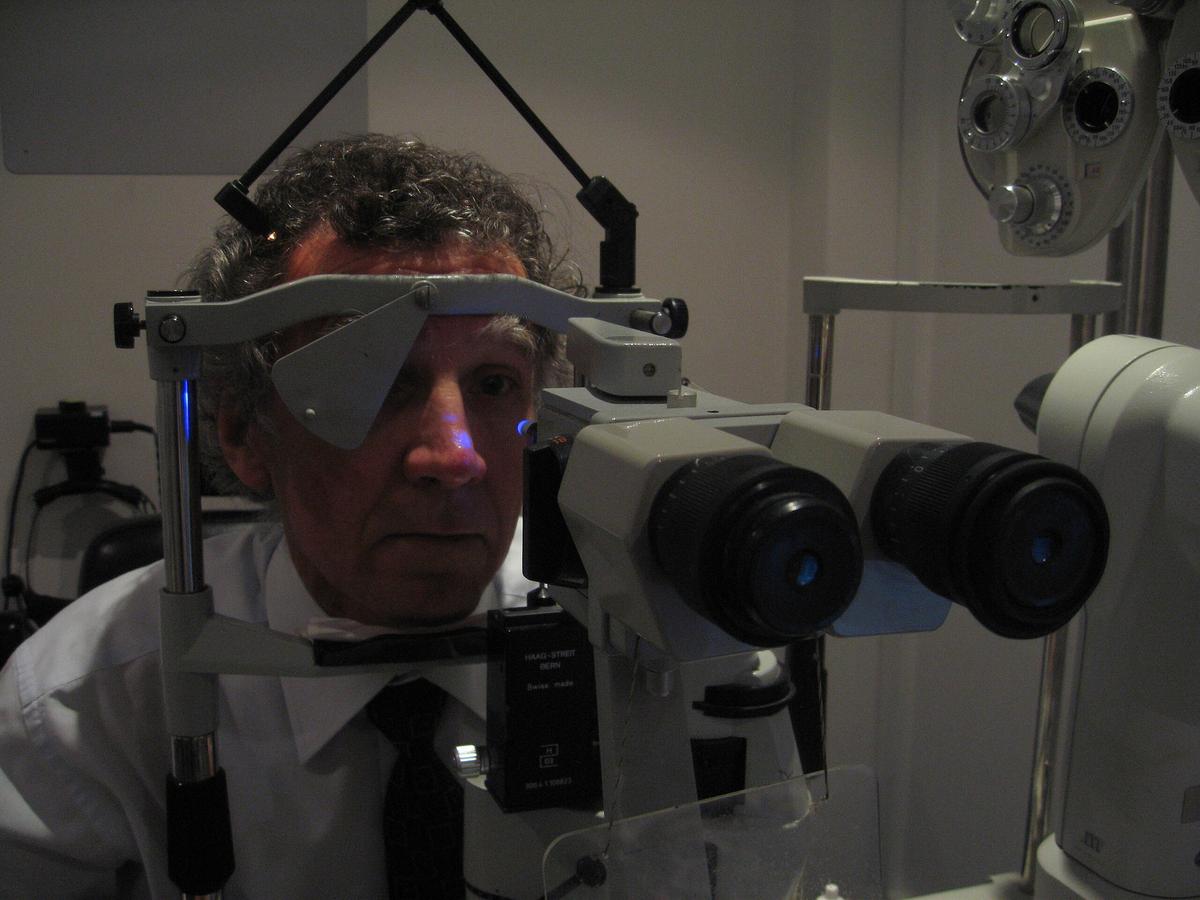
An individual in front of a tonometer.
| Photo Credit:
Jason7825 (CC BY-SA)
As expected, repeated puffs of air to the eye elicited reflexive blinking as participants instinctively pulled back from the tonometer. They also kept the eye closed for certain durations or squinted or blinked rapidly during the gaps. As part of their subjective reports, the participants said this experience was “unpleasant” and “annoying”.
The scientists recruited a separate group of participants who were, at the time of the study, inpatients at the Stanford university hospital and had electrodes planted in their brains to check for epileptic seizures. Members of this group who consented to participate underwent the same eyepuff assay. The scientists found that these participants’ behavioural responses were consistent with those of the previous group. They also blinked reflexively and kept their eyes closed for (relatively) long periods.
The real story emerged in the brain activity patterns.

Enter: ketamine
Each puff causes a signal to be broadcast throughout the brain, like a “breaking news” alert, followed by a slower, more persistent signal. In this second phase, based on data from the electrodes in the brains of participants, scientists found that specific circuits in the brain were activated, which were linked to the generation of an emotional response in the individual.
To confirm this possibility, the scientists administered ketamine to some of these participants and had them redo the eye puff assay. The U.S. Food and Drug Administration has approved ketamine’s use as an anaesthetic and at lower doses as an antidepressant. Ketamine also induces short-term dissociation: i.e. for a brief period, it alters subjective perceptions. By injecting it, the team could separate a person’s reflexive response from the emotional one.
The scientists found that being subjected to air puffs in the eye when a person was on ketamine changed neither the initial reflexive behaviour nor the initial burst of neural activity in the brain. However, it caused the subsequent slower brain response to dissipate much faster, so much so that the volunteers no longer described the experience as annoying but as a “tickling of the eyeball”.
Consistent with this ‘weaker’ subjective experience from ketamine, the participants’ behaviour also changed. They didn’t blink or close their eyes between consecutive air puffs. Instead, they held their eyes open even though they knew more puffs were in the offing.
Ketamine is known to block a sensor in the brain whose job it is to integrate signals coming from different corners. This means in the participants injected with ketamine, the brain may not have integrated the various signals into a coherent emotional response.
Of mice and men
Even though vertebrates have brains of vastly different sizes and complexity, the overall ‘brain plan’ is highly conserved. (The brain plan is akin to the building plan of a house or apartment.) To zero in on those systems responsible for emotions and which have survived evolution, Deisseroth’s team repeated their experiments with lab mice. The mice went through the eyepuff assay, had their brain activity measured with surgically planted electrodes, and had ketamine injected.

The team noticed the same patterns in mice as they had in humans. Injecting ketamine substantially changed the spiking activity in some neurons but not others. Only those neurons (or brain regions) coordinating the second phase — the slower response after the burst — were affected by ketamine. The initial burst didn’t change in any way, just as with the human participants.
The scientists could also study the neural activity following a puff in greater detail in the mouse model. They found that the fast/reflexive responses corresponded with a sharp rise in activity in some of the midbrain regions. This included the thalamus, where incoming sensory signals converge before being relayed onward, and the periaqueductal grey, which is involved in emotional behaviours.
They also found that the second phase of neural activity corresponded with activity in the brain’s emotional centres (described by the umbrella term ‘limbic regions’) and the frontal cortex. Again, as expected.
Then they dissected the brain activity patterns by stages, focusing on how quickly activity in brain regions shot up after the eyepuff and how long it took to fade away. They noticed that activity patterns in most of the pertinent regions increased at an explosive pace right after the eyepuff — but the rate of decrease was more interesting.
A pattern appears
The patterns in different regions slowed at different rates, fading first in the midbrain regions and last in the frontal cortex. The thalamus was active both in the first and the second phase. Considering the thalamus is the brain’s coordinating centre for all sensory signals, it makes sense that it would be active in the first phase. Incoming sensory signals go on to higher brain regions from the cortex. So it also served the role of handing off the baton, so to speak, and thus essayed a sort of bridging role across timescales.
The new study is the first to report this sort of differential pattern across different parts of the brain vis-à-vis emotions. At this point, it is not possible to say with any certainty what the implications are for the brain’s cortical and mid-brain areas.
With computational models of neuron firing activity in the mouse and the mouse’s behaviour following the eye puff assay, the team found that the timescale of neural activity was an important factor that shaped the emotional response.
Indeed, if the sensory signals dissipate before the brain has a chance to integrate the information, the person won’t be able to learn the lesson: “protect yourself from that obnoxious thing”. On the other hand, if brain activity is more strongly coupled to the fast and slow phases that Deisseroth & co. observed, such activity also lasts longer than normal, causing its own problems. Over-stabilised brain states have been correlated with depression, obsessive-compulsive disorder, and post-traumatic stress disorder, all of which cause people to experience uninterrupted or mistimed thoughts and emotions.
Beyond the binary of health and disease, the fast and slow phases of brain activity highlighted in the study could reveal the fundamentals of information processing in the brain. People differ in how their brains process information about their environment — in turn a product of their genetic makeup and their upbringing in their formative years.

First steps
Why do we have emotions? For now it may be more gainful to flip the question: what would happen if we didn’t have them?
In the absence of an instinctive reaction that our emotions afford us, the brain’s response would be based entirely on risk-benefit analyses, which can be very time consuming. Over time we’d struggle to make decisions both big and small. What should I wear today? What should I make for dinner tonight? What should I study? Whom should I marry? Purely rational thought would turn such questions into never-ending decision-making exercises with no final answer.
The new study has revealed what happens in the brain in the first seconds when an emotion takes root. One hopes future studies will reveal the specific information encoded by this primal circuitry, how they encode different emotions, and how they evolve with time.
Dr. Reeteka Sud is a neuroscientist by training and senior scientist at the Center for Brain and Mind, Department of Psychiatry, NIMHANS, Bengaluru.