



Skip to content
  • Facebook
  • X
  • Linkedin
  • WhatsApp
  • YouTube
  • Associate Journalism
  • About Us
  • Privacy Policy
  • 033-46046046
  • editor@artifex.news
Artifex.News

Artifex.News

Stay Connected. Stay Informed.

  • Breaking News
  • World
  • Nation
  • Sports
  • Business
  • Science
  • Entertainment
  • Lifestyle
  • Toggle search form
  • Access Denied Sports
  • Trump Says He Would Impose Tariffs On China If It Went Into Taiwan
    Trump Says He Would Impose Tariffs On China If It Went Into Taiwan World
  • India vs Nepal, Asia Cup 2023 Live Streaming: When And Where To Watch Live Telecast?
    India vs Nepal, Asia Cup 2023 Live Streaming: When And Where To Watch Live Telecast? Sports
  • US vs Apple Over iPhone Monopoly
    US vs Apple Over iPhone Monopoly World
  • Access Denied Sports
  • ‘Call of Duty’ co-creator Vince Zampella killed in car crash
    ‘Call of Duty’ co-creator Vince Zampella killed in car crash World
  • India vs Afghanistan live score over Match 9 ODI 21 25 updates
    India vs Afghanistan live score over Match 9 ODI 21 25 updates Sports
  • U.S.A. vs Bangladesh, 1st T20 | Harmeet’s power-hitting, Anderson’s finishing cameo take U.S. to upset win
    U.S.A. vs Bangladesh, 1st T20 | Harmeet’s power-hitting, Anderson’s finishing cameo take U.S. to upset win Sports
Scientists detect early brain response to rhythm in preterm babies

Scientists detect early brain response to rhythm in preterm babies

Posted on October 31, 2025 By admin


Scientists have long wondered when the sense of rhythm first takes shape in the developing brain.

It’s been a difficult question to answer not least because studying this in foetuses is almost impossible. But when instead scientists turned to premature newborns, whose brains are at roughly the same stage as foetuses in the final weeks of gestation, they found a surprise.

According to a new study in iScience, when these preterm infants hear rhythmic sounds, their brains light up not only in areas that process hearing but also in regions involved in movement — hinting that the connection between sound and motion begins earlier than anyone had confirmed before.

“Auditory rhythm processing begins very early in development,” the study’s corresponding author Sahar Moghimi, a researcher at the University of Picardy Jules Verne in France, said. “Even before the third trimester, the auditory system becomes functional and starts encoding external sounds.”

The results suggest that the sense of beat, long thought to emerge after birth, may already be shaping early connections between song and dance.

Beats before birth

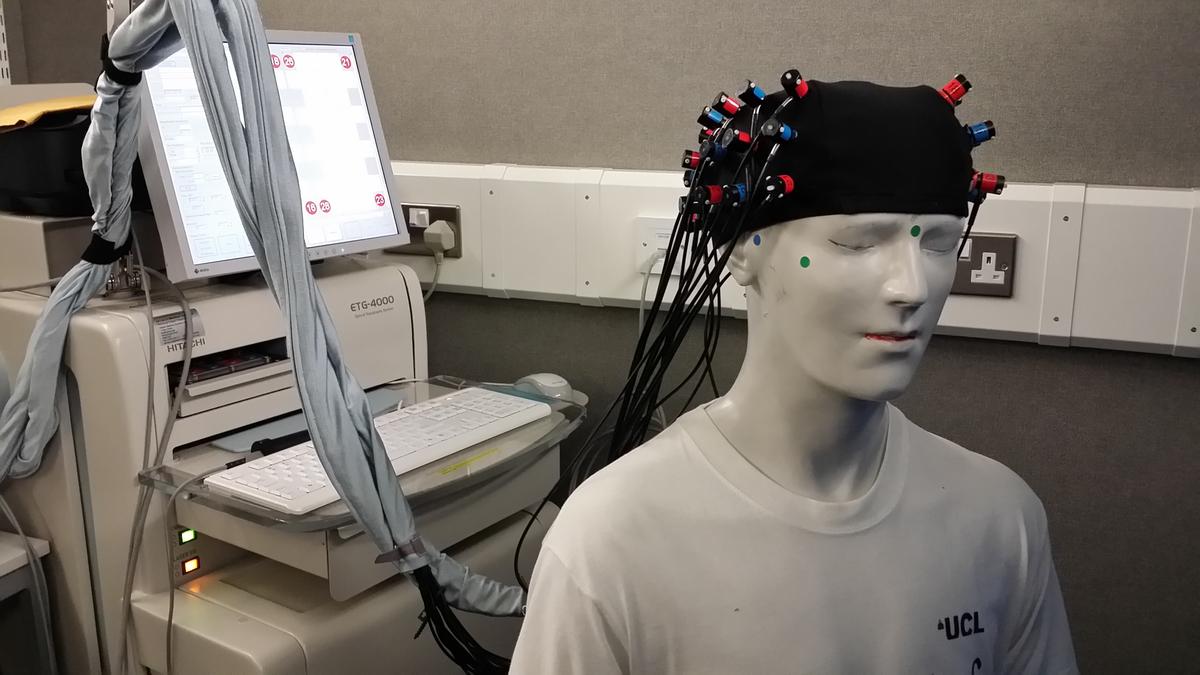
The researchers used a noninvasive imaging method called functional near-infrared spectroscopy (fNIRS) to record brain activity in premature infants while they slept. The babies were around 36 weeks of gestational age — still several weeks from their due date while already undergoing rapid brain development.

They were exposed to sequences of rhythmic and irregular sounds. The rhythmic patterns produced a steady beat while the irregular ones didn’t induce a predictable pulse. The team confirmed that rhythmic sounds activated not only the brain’s hearing area but also those areas that plan and control movement. The irregular patterns produced weaker, more limited activity, suggesting the developing brain could already organise  sounds into regular patterns in time, as if anticipating a beat.

“The brain is already responding to rhythm, much before birth — the same ability that later helps shape language and social communication,” Dr. Moghimi said.

Rhythmic sounds also activated more of the brain than expected. The areas that plan and control movement responded more strongly to regular beats, suggesting the brain had also started linking sound and movement internally and was preparing for the synchrony that researchers know emerges only months later.

Even without the beats, the foetus in a womb is already immersed in rhythm — from the steady pulse of the mother’s heartbeat to the cadence of her voice. The study’s authors reasoned that this exposure may be helping wire the foetus’s auditory system to detect a steady beat and build the brain’s sense of timing.

“Exposure to auditory rhythms may be important for the development of other brain regions beyond hearing areas,” Dr. Moghimi said.

Although a preterm infant’s motor cortex is still immature, its early responsiveness to rhythm suggests that links between hearing and movement begin forming early, laying the groundwork for later milestones in perception and coordination.

An early partnership

“The observation is truly exciting,” said Simone Dalla Bella, who studies audition and motor abilities at the University of Montreal in Canada.

He said research has already shown that newborns only weeks old can detect complex rhythmic patterns and that infants a few months later are able to sense the differences between beats such as a march or a waltz when gently moved to music.

What makes the new study distinctive, he continued, is that it captures this coordination before birth, when the motor system is only beginning to mature.

“This study confirms that rhythm plays a critical role very early in life,” Dr. Dalla Bella said. “It suggests that the brain’s ability to pick out steady patterns in sound and link them to movement may be at least partly hard-wired.”

He added that the work reinforces a key idea in rhythm research: that the motor system isn’t just something that moves after we learn to hear but an active partner in shaping perception from the ‘very beginning’.

While Dr. Dalla Bella also highlighted how early rhythm coordination could shape development, other researchers are asking what enables such synchronisation inside the brain.

Edward Large, who studies auditory neuroscience at the University of Connecticut in the USA, said the findings strengthen evidence that the brain’s rhythm circuits are active long before voluntary movement appears.

“Auditory responses alone cannot explain the brain activity seen here,” he said.

However, Dr. Large also said the imaging method used in the study, fNIRS, is too slow to track the rapid brain waves that underlie rhythm perception. The scans showed that motor regions are active but they can’t reveal whether those responses are themselves rhythmic.

“We may guess, based on earlier EEG studies, that they are,” he said.

Even so, he added, the results fit with a growing view that rhythm perception arises from self-organising neural oscillations linking hearing and movement areas — a kind of built-in resonance that may help the brain learn and coordinate from its earliest stages.

The brain’s first music

For neonatologists, the finding that rhythmic sound engages motor regions even before term offers a window into how early brain connections form.

“Rhythmic sounds may help stimulate both hearing and motor regions, supporting early synaptic growth in the developing brain,” Surendra Singh Bisht, who heads paediatrics and neonatology at the Swami Dayanand Hospital, New Delhi, said.

Dr. Bisht explained that in foetuses and newborns, smooth, symmetrical general movements — the spontaneous motions newborns make — are among the most reliable signs of healthy brain connections.

“These general movements are closely linked to how well brain cells connect and communicate,” he said.

Infants with smoother movements tend to have better neural coordination and are less likely to develop cerebral palsy later in life.

“It’s a direct clinical clue to how the brain’s motor networks are wiring themselves,” Dr. Bisht said.

To be sure, the findings don’t mean preterm infants can recognise a tune or pulse, only that their brains are already preparing to do so. Long before babies sway to a lullaby or match their mother’s speech rhythms, their brains appear to be linking sound and movement in preparation for both.

To Dr. Moghimi, this early sensitivity underlines rhythm’s role as a foundation for learning.

“The presence of elaborated neural capacities for processing rhythm so early in life highlights its importance as a building block for learning from regularities in the world,” she said.

In that sense, rhythm may be the brain’s first music — an internal pattern that helps the mind make sense of the world before life has even begun.

Anirban Mukhopadhyay is a geneticist by training and science communicator from New Delhi.



Source link

Science

Post navigation

Previous Post: Access Denied
Next Post: Access Denied

Related Posts

  • A decade among the stars: India’s first space observatory AstroSat completes 10 years
    A decade among the stars: India’s first space observatory AstroSat completes 10 years Science
  • Indigenous clocks delay ISRO’s plans to replace defunct Navic satellites
    Indigenous clocks delay ISRO’s plans to replace defunct Navic satellites Science
  • NISAR to be declared operational on November 7: ISRO chief
    NISAR to be declared operational on November 7: ISRO chief Science
  • Is global warming accelerating? – The Hindu
    Is global warming accelerating? – The Hindu Science
  • Has any particular gene responsible for longer lifespan been identified?
    Has any particular gene responsible for longer lifespan been identified? Science
  • Quiz: Lands kept apart, or together, by a sliver
    Quiz: Lands kept apart, or together, by a sliver Science

More Related Articles

What is it? IceCube: The big, chill neutrino-spotter What is it? IceCube: The big, chill neutrino-spotter Science
COP-30 to focus on known solutions, says its President COP-30 to focus on known solutions, says its President Science
What is xenobiology? – The Hindu What is xenobiology? – The Hindu Science
Research paper warns against nationwide switch to natural farming without proper studies Research paper warns against nationwide switch to natural farming without proper studies Science
Kerala researchers batting for better understanding of the flying mammal Kerala researchers batting for better understanding of the flying mammal Science
ISRO completes key test on main parachutes for Gaganyaan Crew Module ISRO completes key test on main parachutes for Gaganyaan Crew Module Science
SiteLock

Archives

  • May 2026
  • April 2026
  • March 2026
  • February 2026
  • January 2026
  • December 2025
  • November 2025
  • October 2025
  • September 2025
  • August 2025
  • July 2025
  • June 2025
  • May 2025
  • April 2025
  • March 2025
  • February 2025
  • January 2025
  • December 2024
  • November 2024
  • October 2024
  • September 2024
  • August 2024
  • July 2024
  • June 2024
  • May 2024
  • April 2024
  • March 2024
  • February 2024
  • January 2024
  • December 2023
  • November 2023
  • October 2023
  • September 2023
  • August 2023
  • July 2023
  • June 2023
  • May 2023
  • April 2023
  • March 2023
  • February 2023
  • January 2023
  • December 2022
  • November 2022
  • October 2022
  • September 2022
  • August 2022
  • July 2022
  • June 2022
  • May 2022

Categories

  • Business
  • Nation
  • Science
  • Sports
  • World

Recent Posts

  • Watch: Congress ends suspense: V. D. Satheesan to be next Kerala CM | Above the Fold | 14.05.2026
  • IPL 2026 | A win against LSG will do a world of good for CSK
  • Karnataka maps 86.37% electors with family linkage in draft voter roll exercise; Bengaluru continues to trail State average
  • Vessel seized off UAE’s Fujairah and heading toward Iranian waters, UKMTO says
  • New govt should implement existing welfare schemes, says Congress MP

Recent Comments

  1. CordellVoice on UP Teacher Who Asked Students To Slap Muslim Classmate
  2. Wesleyunfix on UP Teacher Who Asked Students To Slap Muslim Classmate
  3. JasonDag on UP Teacher Who Asked Students To Slap Muslim Classmate
  4. JamesHeR on UP Teacher Who Asked Students To Slap Muslim Classmate
  5. RafaelNar on UP Teacher Who Asked Students To Slap Muslim Classmate
  • Biden Condemns US School Shooting
    Biden Condemns US School Shooting World
  • Bajrang Punia, Ravi Dahiya Eliminated From Paris Olympics Qualification Race
    Bajrang Punia, Ravi Dahiya Eliminated From Paris Olympics Qualification Race Sports
  • New York-Dublin Portal Reopens With Tougher Rules, Limited Hours
    New York-Dublin Portal Reopens With Tougher Rules, Limited Hours World
  • Access Denied Sports
  • Novak Djokovic Ramps Up US Open Bid As Iga Swiatek, Coco Gauff Stroll
    Novak Djokovic Ramps Up US Open Bid As Iga Swiatek, Coco Gauff Stroll Sports
  • Access Denied World
  • Watch: ‘Natanz site hit again’ says Iran; IAEA reports no confirmation
    Watch: ‘Natanz site hit again’ says Iran; IAEA reports no confirmation World
  • Watch: What are the Epstein files and why has this triggered a political controversy in India?
    Watch: What are the Epstein files and why has this triggered a political controversy in India? World

Editor-in-Chief:
Mohammad Ariff,
MSW, MAJMC, BSW, DTL, CTS, CNM, CCR, CAL, RSL, ASOC.
editor@artifex.news

Associate Editors:
1. Zenellis R. Tuba,
zenelis@artifex.news
2. Haris Daniyel
daniyel@artifex.news

Photograher:
Rohan Das
rohan@artifex.news

Artifex.News offers Online Paid Internships to college students from India and Abroad. Interns will get a PRESS CARD and other online offers.
Send your CV (Subjectline: Paid Internship) to internship@artifex.news

Links:
Associate Journalism
About Us
Privacy Policy

News Links:
Breaking News
World
Nation
Sports
Business
Entertainment
Lifestyle

Registered Office:
72/A, Elliot Road, Kolkata - 700016
Tel: 033-22277777, 033-22172217
Email: office@artifex.news

Editorial Office / News Desk:
No. 13, Mezzanine Floor, Esplanade Metro Rail Station,
12 J. L. Nehru Road, Kolkata - 700069.
(Entry from Gate No. 5)
Tel: 033-46011099, 033-46046046
Email: editor@artifex.news

Copyright © 2023 Artifex.News Newsportal designed by Artifex Infotech.