






Skip to content
  • Facebook
  • X
  • Linkedin
  • WhatsApp
  • YouTube
  • Associate Journalism
  • About Us
  • Privacy Policy
  • 033-46046046
  • editor@artifex.news
Artifex.News

Artifex.News

Stay Connected. Stay Informed.

  • Breaking News
  • World
  • Nation
  • Sports
  • Business
  • Science
  • Entertainment
  • Lifestyle
  • Toggle search form
  • Access Denied Sports
  • India Outplayed By Spain In Men’s Pro League Hockey Campaign Opener
    India Outplayed By Spain In Men’s Pro League Hockey Campaign Opener Sports
  • Boy Held In Bomb Hoax Case Alleges Sexual Assault At Children’s Home In Mumbai: Cops
    Boy Held In Bomb Hoax Case Alleges Sexual Assault At Children’s Home In Mumbai: Cops Nation
  • Putin says Russia will take all of Ukraine’s Donbas region militarily or otherwise
    Putin says Russia will take all of Ukraine’s Donbas region militarily or otherwise World
  • Access Denied Sports
  • Access Denied
    Access Denied Nation
  • Pakistan Must Stop Blaming Others For Its Balochistan Problem
    Pakistan Must Stop Blaming Others For Its Balochistan Problem World
  • Jammu And Kashmir Poll Dates Going Past Top Court Deadline? Election Body Chief Responds
    Jammu And Kashmir Poll Dates Going Past Top Court Deadline? Election Body Chief Responds Nation
Just five DNA letters flip chromatin from fluid to solid-like state

Just five DNA letters flip chromatin from fluid to solid-like state

Posted on December 26, 2025 By admin


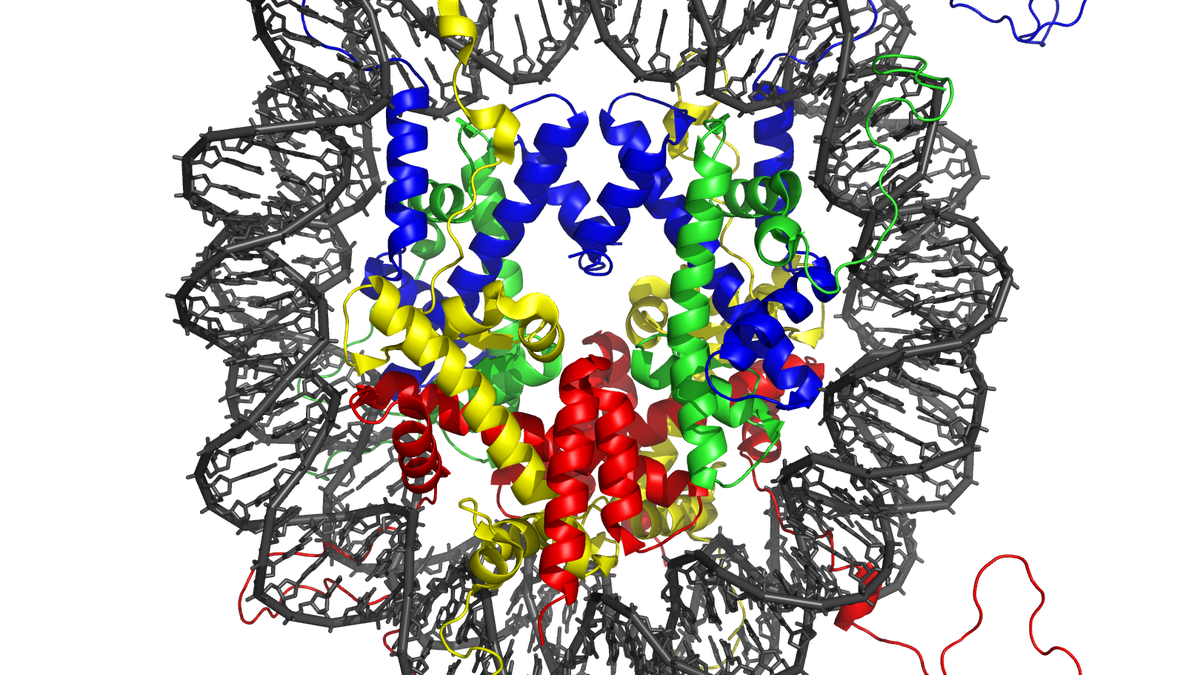
DNA inside human cells is not free-floating. Instead, it is tightly wrapped around small protein units forming a long chain, with DNA looping around each unit before moving on to the next. This DNA-protein complex is called chromatin and allows nearly 2 m of genetic material to fit inside a nucleus only a few micrometres wide.

However, chromatin does more than pack DNA efficiently: its arrangement influences which genes are accessible and which remain shut down. Some regions are loosely organised, allowing the cell to read genetic instructions, while others are dense and harder to access. How cells control these physical states has been a central question in molecular biology.

A new study in Science has now reported that a surprisingly small structural detail, the spacing between neighbouring DNA-protein units, can influence how chromatin behaves. That’s because DNA isn’t straight, UT Southwestern Medical Centre biochemistry professor and the study’s senior author Michael Rosen explained. It is twisted, so even small spacing changes can shift how protein beads sit along the DNA, reshaping the entire strand.

These bead-like proteins, called histones, are connected by short stretches of exposed DNA. In living cells, the length of this linker DNA varies naturally across the genome, differing by only a few DNA building blocks.

Because changes in orientation propagate along the chromatin fibre, Prof. Rosen added, they alter the shape of the entire molecule and how it interacts with nearby strands. These interaction differences, rather than changes in DNA sequence or protein composition, cause chromatin made from identical components to behave in very different ways.

To investigate this, the researchers built chromatin in the laboratory using identical DNA and proteins, altering only the length of the linker DNA. They compared chromatin with shorter linkers to chromatin with slightly longer ones (differing by just five DNA base pairs).

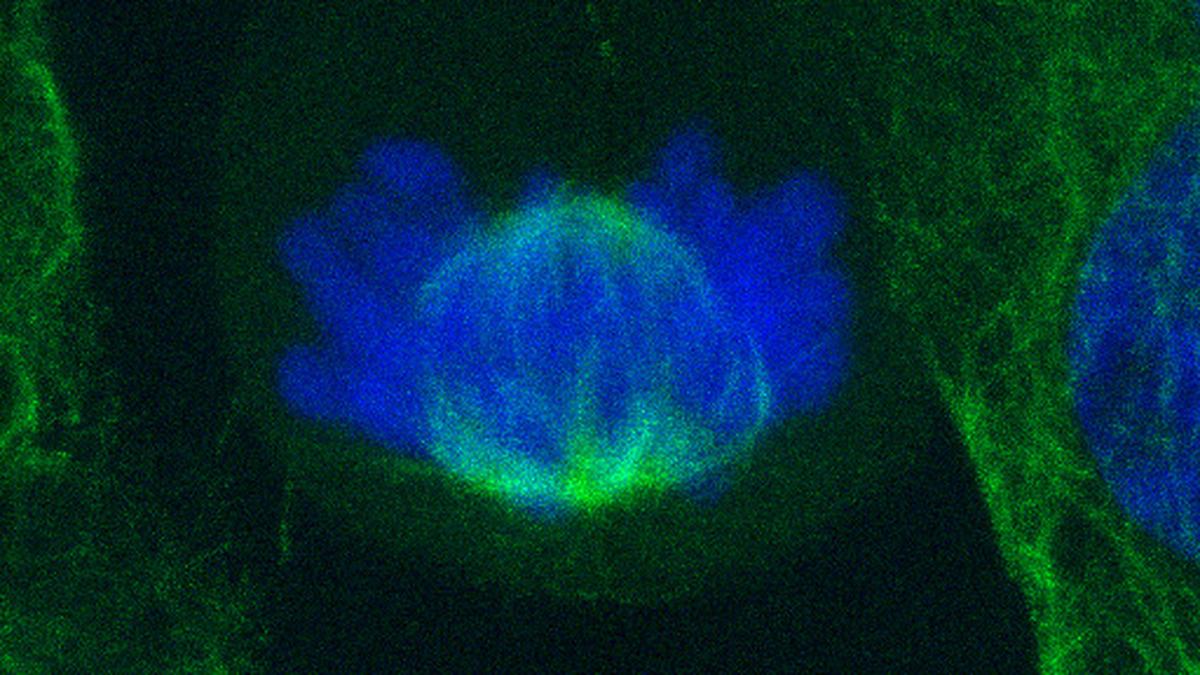
The team used rapid freezing and high-resolution imaging. Individual nucleosomes — the building blocks of chromatin — are large enough to be captured directly, allowing researchers to visualise most molecules inside the clusters. They tracked how the clusters formed, merged, moved, and broke apart.

The results revealed a clear divide. Chromatin with shorter DNA linkers remained more open along its length, positioning its units to reach outward and interact with neighbouring strands, like loosely laid yarn that easily tangles. These clusters were densely connected and mechanically resistant, fusing slowly and proving difficult to break apart.

Chromatin with longer linkers folded inward on the other hand, with units interacting more within the same strand. This reduced connections between neighbouring strands, producing clusters that were less stable, more fluid, and easier to dissolve.

“Those different interaction patterns are what make one system behave like a simple liquid and the other behave more like silly putty or toothpaste,” Prof. Rosen said.

National Institutes of Health biochemist Yamini Dalal said the study reinforces and unifies long-standing, disparate ideas using powerful interdisciplinary techniques. Chromatin has long been understood as a self-organising structure, she said, with nucleosome spacing strongly influencing how it folds.

“The genome’s organisation is encoded in the chromatin itself. You don’t need additional instructions to make structure emerge.”

When the researchers examined human and mouse cells, they found dense chromatin regions with packing patterns similar to those seen in laboratory experiments. Prof. Rosen suggested this shows that the same physical rules apply inside the nucleus as in the test tube, although whether cells actively use this feature to regulate chromatin function remains an open question.

Dr. Dalal agreed that the physics demonstrated is biologically realistic but cautioned against assuming that cells fine-tune this spacing everywhere. Maintaining exact five-base-pair differences across a dynamic chromatin would be difficult, she said. Such effects may matter most in highly ordered genomic regions, such as repetitive DNA, where even small disruptions could alter how easily regulatory molecules move through and access DNA.

Disorder in chromatin’s repetitive DNA stretches is already linked to genome instability in cancer and ageing. Dr. Dalal viewed the findings as a physical blueprint for understanding these fragilities.

From a gene function standpoint as well, the study is provocative. Sarah Teichmann, Cambridge University professor and co-founder of the international Human Cell Atlas project, said the results raise the possibility that chromatin’s physical state could influence how genes are regulated across different cell types. Large efforts such as the Human Cell Atlas, which map molecular differences between cells, could eventually test whether such physical chromatin states vary with cell identity, she said.

Anirban Mukhopadhyay is a geneticist by training and science communicator from New Delhi.

Published – December 26, 2025 06:00 am IST


Source link

Science

Post navigation

Previous Post: Access Denied
Next Post: Access Denied

Related Posts

  • India’s fossil fuel capacity grows 2.44% in FY24; non fossil-fuel rises 11%: Government data
    India’s fossil fuel capacity grows 2.44% in FY24; non fossil-fuel rises 11%: Government data Science
  • Does 2022 H5N1 bind, replicate better in the respiratory tract?
    Does 2022 H5N1 bind, replicate better in the respiratory tract? Science
  • Moon was formed around 4.51 billion years ago: study
    Moon was formed around 4.51 billion years ago: study Science
  • The Hindu daily Quiz: On earthquakes on September 29, 2025
    The Hindu daily Quiz: On earthquakes on September 29, 2025 Science
  • Study reveals how 3D environments affect bacterial growth and survival
    Study reveals how 3D environments affect bacterial growth and survival Science
  • Centre may raise retirement age of scientists from 60 to 65
    Centre may raise retirement age of scientists from 60 to 65 Science

More Related Articles

Science News: With lunar missions looming, scientists grow chickpeas in ‘moon dirt’ Science News: With lunar missions looming, scientists grow chickpeas in ‘moon dirt’ Science
Chinese startup to sell tickets for 2027 space tourism flights Chinese startup to sell tickets for 2027 space tourism flights Science
The brightest object in the universe is a black hole that eats a star a day The brightest object in the universe is a black hole that eats a star a day Science
What does a healthy breakfast do for you? What does a healthy breakfast do for you? Science
White-throated sparrows show sex in nature is not a simple binary White-throated sparrows show sex in nature is not a simple binary Science
Congress accuses PM Modi of ‘hogging’ the limelight after the success of Chandrayaan-3 mission Congress accuses PM Modi of ‘hogging’ the limelight after the success of Chandrayaan-3 mission Science
SiteLock

Archives

  • May 2026
  • April 2026
  • March 2026
  • February 2026
  • January 2026
  • December 2025
  • November 2025
  • October 2025
  • September 2025
  • August 2025
  • July 2025
  • June 2025
  • May 2025
  • April 2025
  • March 2025
  • February 2025
  • January 2025
  • December 2024
  • November 2024
  • October 2024
  • September 2024
  • August 2024
  • July 2024
  • June 2024
  • May 2024
  • April 2024
  • March 2024
  • February 2024
  • January 2024
  • December 2023
  • November 2023
  • October 2023
  • September 2023
  • August 2023
  • July 2023
  • June 2023
  • May 2023
  • April 2023
  • March 2023
  • February 2023
  • January 2023
  • December 2022
  • November 2022
  • October 2022
  • September 2022
  • August 2022
  • July 2022
  • June 2022
  • May 2022

Categories

  • Business
  • Nation
  • Science
  • Sports
  • World

Recent Posts

  • Gold ETF prices revive as investors flock on higher import duties on yellow metal
  • Kashmir MLA ‘boycotts’ L-G’s drug campaign after demolition drive in his constituency
  • Assam ships first legal agarwood chips to West Asia
  • How the anti-defection law is going to operate in the AIADMK case?
  • ATS questions 57 in Maharashtra over alleged gangster network links

Recent Comments

  1. Stevemonge on UP Teacher Who Asked Students To Slap Muslim Classmate
  2. RichardClage on UP Teacher Who Asked Students To Slap Muslim Classmate
  3. StevenLek on UP Teacher Who Asked Students To Slap Muslim Classmate
  4. Leonardren on UP Teacher Who Asked Students To Slap Muslim Classmate
  5. NathanQuins on UP Teacher Who Asked Students To Slap Muslim Classmate
  • BJP Announces 1st List Of Candidates For Jammu And Kashmir Assembly Polls
    BJP Announces 1st List Of Candidates For Jammu And Kashmir Assembly Polls Nation
  • Access Denied
    Access Denied Nation
  • Access Denied
    Access Denied Nation
  • iPhones Worth Rs 65 Lakh Stolen From Warehouse In Pune, 1 Arrested
    iPhones Worth Rs 65 Lakh Stolen From Warehouse In Pune, 1 Arrested Nation
  • “Going To Meet Very Quickly” With Vladimir Putin: Donald Trump
    “Going To Meet Very Quickly” With Vladimir Putin: Donald Trump World
  • Access Denied
    Access Denied Nation
  • Trump supporters turn U.S. flags upside down to protest guilty verdict
    Trump supporters turn U.S. flags upside down to protest guilty verdict World
  • Access Denied
    Access Denied Nation

Editor-in-Chief:
Mohammad Ariff,
MSW, MAJMC, BSW, DTL, CTS, CNM, CCR, CAL, RSL, ASOC.
editor@artifex.news

Associate Editors:
1. Zenellis R. Tuba,
zenelis@artifex.news
2. Haris Daniyel
daniyel@artifex.news

Photograher:
Rohan Das
rohan@artifex.news

Artifex.News offers Online Paid Internships to college students from India and Abroad. Interns will get a PRESS CARD and other online offers.
Send your CV (Subjectline: Paid Internship) to internship@artifex.news

Links:
Associate Journalism
About Us
Privacy Policy

News Links:
Breaking News
World
Nation
Sports
Business
Entertainment
Lifestyle

Registered Office:
72/A, Elliot Road, Kolkata - 700016
Tel: 033-22277777, 033-22172217
Email: office@artifex.news

Editorial Office / News Desk:
No. 13, Mezzanine Floor, Esplanade Metro Rail Station,
12 J. L. Nehru Road, Kolkata - 700069.
(Entry from Gate No. 5)
Tel: 033-46011099, 033-46046046
Email: editor@artifex.news

Copyright © 2023 Artifex.News Newsportal designed by Artifex Infotech.