



Skip to content
  • Facebook
  • X
  • Linkedin
  • WhatsApp
  • YouTube
  • Associate Journalism
  • About Us
  • Privacy Policy
  • 033-46046046
  • editor@artifex.news
Artifex.News

Artifex.News

Stay Connected. Stay Informed.

  • Breaking News
  • World
  • Nation
  • Sports
  • Business
  • Science
  • Entertainment
  • Lifestyle
  • Toggle search form
  • 400 IndiGo Passengers Stranded In Istanbul Without Food, Accommodation
    400 IndiGo Passengers Stranded In Istanbul Without Food, Accommodation World
  • Weight of history against WI as it seeks a turnaround in India
    Weight of history against WI as it seeks a turnaround in India Sports
  • Long-term study finds COVID-19 increases diabetes risk
    Long-term study finds COVID-19 increases diabetes risk Science
  • Rupee Tumbles 17 Paise, Closes At Record Low Of 92.68 Against US Dollar Business
  • Access Denied World
  • A Birthday Amid Age Controversy In US Polls 2024
    A Birthday Amid Age Controversy In US Polls 2024 World
  • Access Denied
    Access Denied Nation
  • Turkey ‘strongly condemns’ Israeli incursions in Syria
    Turkey ‘strongly condemns’ Israeli incursions in Syria World
In this Delhi studio, tintype brings chemistry into every portrait

In this Delhi studio, tintype brings chemistry into every portrait

Posted on October 5, 2026 By admin


In an age when a portrait can be made in a fraction of a second, Vibhav Kapoor, artist and assistant professor at O.P. Jindal Global University, Sonipat, spends several minutes making one photograph, much of the time spent negotiating with chemistry.

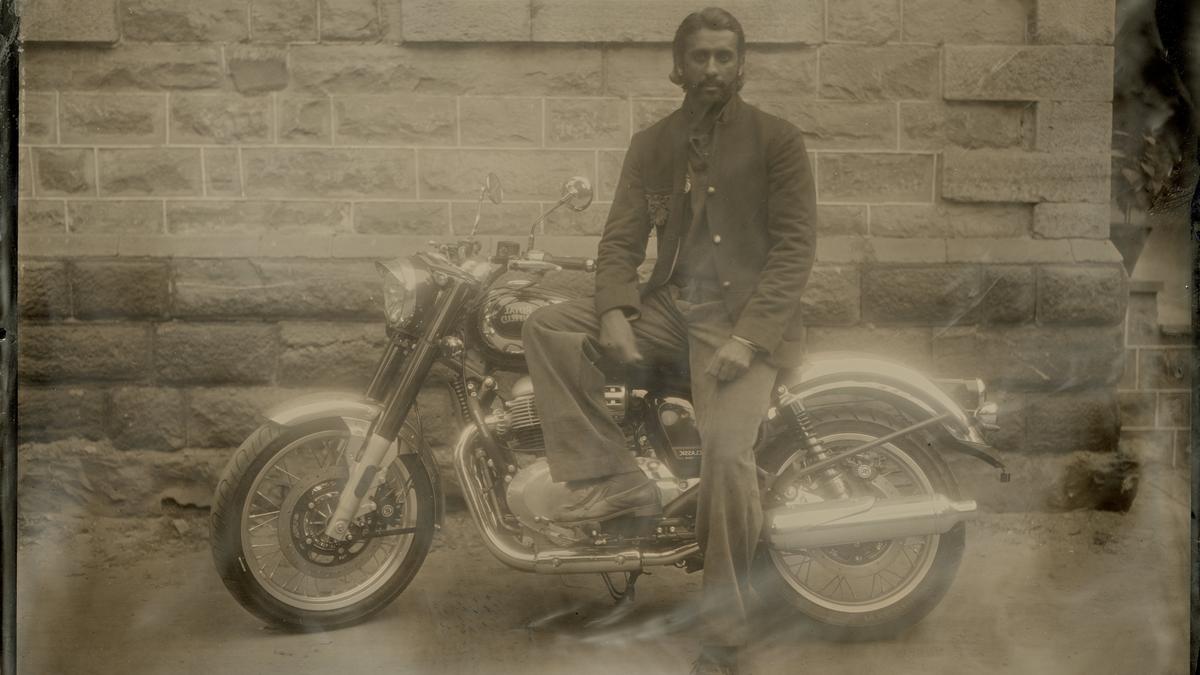
In his Delhi-NCR studio, Mr. Kapoor works with tintype, a 19th-century photographic process in which an image is created directly on a metal plate.

The French photographer Adolphe Alexandre Martin is credited with developing the technique in 1853, two years after Frederick Scott Archer invented the wet-plate collodion process.

Chemically demanding

Unlike processes that produced glass negatives or paper prints, tintypes created a positive image directly on a dark metal plate. 

Mr. Kapoor takes a plate with collodion, a syrupy solution of nitrocellulose dissolved in ether and alcohol. He pours it onto a metal plate to form a thin, sticky film, and sensitises it in a silver-nitrate bath in which the iodides and bromides react with silver nitrate to form light-sensitive silver iodide and silver bromide.

Finally, he exposes these light-sensitive compounds through a large-format camera, and develops the images in a dark room using a ferrous sulphate solution acidified with glacial acetic acid and thinned with alcohol; it amplifies the latent image by converting more exposed silver halides into visible metallic silver.

The entire sequence from coating to fixing must be completed while the plate remains wet. There is also no negative to reprint from, so duplicating tintypes is equally arduous.

19th century process

In the mid-19th century, the tintype process was valued for being relatively inexpensive and durable. The dominant photographic process of the era was the daguerreotype. It was costly because it required silver-plated copper sheets as the base material plus iodine and mercury vapour to develop images. Together with the labour-intensive crafting process, each daguerreotype was a luxury item.

Tintypes, however, afforded portraits outside the more formal, expensive photographic studios of the period. In India as well, the process formed part of the early history of photography.

In 1864, a British photographer named T. Murray introduced Sawai Ram Singh II of Jaipur to the tintype camera and documented his court, architecture, and lives of women in the royal zenana. Murray is also known to have helped the ruler develop a royal archive of visuals.

According to Mr. Kapoor, the Jaipur royal photographer Ram Singh also used the process.

“It is a very traditional, hand-made process,” Mr. Kapoor said. But its apparent simplicity conceals a process that demands scientific precision.

A portrait in tintype. Photography arrived in India in the 19th century, and the wet-collodion processes became ubiquitous as tintypes circulated in Indian towns in the late 19th and early 20th centuries. Today, however, ‘only a handful of photographers in India practice tintype’.

A portrait in tintype. Photography arrived in India in the 19th century, and the wet-collodion processes became ubiquitous as tintypes circulated in Indian towns in the late 19th and early 20th centuries. Today, however, ‘only a handful of photographers in India practice tintype’.
| Photo Credit:
Vibhav Kapoor/Special arrangement

Mr. Kapoor first learnt tintype photography during his master’s degree at the Rochester Institute of Technology, New York, which he spent coating plates, photographing, developing, drying, and finally varnishing the finished image.

The way tintype works also affects the photographer and the subject. The CMOS sensors in today’s digital cameras are so fast that a person needs to pose for just a second. On the other hand, the light-sensitive compounds in tintype photography ‘record’ the light over 8-10 seconds, so the subjects need to present themselves still for that period.

For a portrait, as Mr. Kapoor put it, “The person is performing …, presenting themselves.”

The image emerges in 10 to 15 minutes thereafter.

Weather and chemistry

That said, the photograph’s most unpredictable component is the weather.

“The chemistry is very volatile and humidity plays a crucial role,” Mr. Kapoor said.

“During the monsoon, the humidity causes the tintypes to develop spots,” Matthew Fossier, a U.S. tintype practitioner in Texas, said.

Dust is another serious problem. As dust particles settle on the wet collodion layer, they interrupt the formation of silver halide crystals. When the plate is developed, the affected area produces metallic silver differently from the surrounding film, and which appears as an opaque or transparent spot.

Temperature fluctuations can create other artefacts as well, per Mr. Fossier. The collodion contains volatile solvents and heat makes them evaporate faster, leaving the film to become sticky. The plate must be moved quickly to the silver-nitrate bath, where silver ions react with the halides in the collodion to form the light-sensitive silver-halide layer. If the collodion has begun to set unevenly by then, however, the resulting layer can be uneven as well.

He added that the effect is pronounced when pouring the collodion, which reduces the time available to get the plate into the silver bath.

According to Mr. Kapoor, the Delhi-NCR temperatures require him to adjust his solutions: “Heat acts as a catalyst [and] more heat means reactions are faster. The developer has to be managed.”

The developer is a chemical solution that reveals the image captured on a sensitised metal plate after exposure. But in warmer weather, the developer works faster, causing streaks or an uneven fog to appear in the picture.

To avoid this, Mr. Kapoor dilutes the developer to change its strength and how long it stays on the plate, slowing the reaction, and allowing the picture to develop clearly.

Unique images

Mr. Kapoor has worked with a fashion brand called rkive.city to photograph the Maharaja of Jaipur Sawai Padmanabh Singh.

He is now looking to make more tintypes, particularly portraits, from his new studio in Shahpur Jat in the national capital.

Photography arrived in India in the 19th century, and the wet-collodion processes became ubiquitous as tintypes circulated in Indian towns in the late 19th and early 20th centuries. Today, however, Mr. Kapoor said “only a handful of photographers in India practice tintype”.

Mr. Kapoor’s tintype camera is a large-format antique that uses a 5×7-inch plate. The camera is built of polished dark wood with metal parts, and a leather bellow that folds in and out like an accordion as the cover.

“When I am taking tintypes of people,” Mr. Kapoor said, “I think they are very fascinated, first of all by the camera, and by the spectacle of the process.”

Aditya Ansh is an independent media writer based in New Delhi.



Source link

Science

Post navigation

Previous Post: Why NHRC issued a notice on CJP’s Mumbai protesters | Explained
Next Post: Sanjay Dutt clarifies after his ‘no peace in India’ remark turns into a row

Related Posts

  • India’s capacity to scale next-generation biologics draws focus at BioAsia 2026
    India’s capacity to scale next-generation biologics draws focus at BioAsia 2026 Science
  • New molecular pathways contributing to cardiovascular disease in Indians found
    New molecular pathways contributing to cardiovascular disease in Indians found Science
  • Wikipedia inks AI deals with Microsoft, Meta and Perplexity as it marks 25th birthday
    Wikipedia inks AI deals with Microsoft, Meta and Perplexity as it marks 25th birthday Science
  • ‘Our world is built on basic science, and part of basic science is rationality’  
    ‘Our world is built on basic science, and part of basic science is rationality’   Science
  • How does a speed gun work?
    How does a speed gun work? Science
  • AIIMS Delhi researchers show exactly how particulate matter affects foetuses
    AIIMS Delhi researchers show exactly how particulate matter affects foetuses Science

More Related Articles

PM Modi congratulates ISRO scientists for successful docking experiment PM Modi congratulates ISRO scientists for successful docking experiment Science
Neural circuitry of mouse mothers to pups’ calls deciphered Neural circuitry of mouse mothers to pups’ calls deciphered Science
ISRO ties up with European Space Agency for Gaganyaan missions ISRO ties up with European Space Agency for Gaganyaan missions Science
Private US moon lander still working after breaking leg and falling, but not for long Private US moon lander still working after breaking leg and falling, but not for long Science
Why NASA’s Mars Sample Return mission has a shaky future Why NASA’s Mars Sample Return mission has a shaky future Science
Electrifying industrial heat as a path to India’s thermal independence Electrifying industrial heat as a path to India’s thermal independence Science
SiteLock

Archives

  • October 2026
  • September 2026
  • August 2026
  • July 2026
  • June 2026
  • May 2026
  • April 2026
  • March 2026
  • February 2026
  • January 2026
  • December 2025
  • November 2025
  • October 2025
  • September 2025
  • August 2025
  • July 2025
  • June 2025
  • May 2025
  • April 2025
  • March 2025
  • February 2025
  • January 2025
  • December 2024
  • November 2024
  • October 2024
  • September 2024
  • August 2024
  • July 2024
  • June 2024
  • May 2024
  • April 2024
  • March 2024
  • February 2024
  • January 2024
  • December 2023
  • November 2023
  • October 2023
  • September 2023
  • August 2023
  • July 2023
  • June 2023
  • May 2023
  • April 2023
  • March 2023
  • February 2023
  • January 2023
  • December 2022
  • November 2022
  • October 2022
  • September 2022
  • August 2022
  • July 2022
  • June 2022
  • May 2022

Categories

  • Business
  • Nation
  • Science
  • Sports
  • World

Recent Posts

  • Why have SLBCs/UTLBCs been asked to report SC beneficiary data for key government schemes for jobs and entrepreneurship?: Explained
  • Opposition to private project on agri research land in Kalaburagi
  • European soccer leaders meet aiming to shape strategy for ousting Infantino as FIFA president
  • Nana Patekar death updates: Leaders, film fraternity mourn Nana Patekar’s death
  • Strait of Hormuz transits at lowest in over two months after attacks, data shows

Recent Comments

  1. Joshuasoido on UP Teacher Who Asked Students To Slap Muslim Classmate
  2. EdmundJex on UP Teacher Who Asked Students To Slap Muslim Classmate
  3. Brandonweshy on UP Teacher Who Asked Students To Slap Muslim Classmate
  4. Brandonweshy on UP Teacher Who Asked Students To Slap Muslim Classmate
  5. FrankCes on UP Teacher Who Asked Students To Slap Muslim Classmate
  • ‘MACE’ Observatory Detects ‘Blast From The Past’ Way Before Earth Was Born
    ‘MACE’ Observatory Detects ‘Blast From The Past’ Way Before Earth Was Born Nation
  • Veg oil imports down 13% in February: SEA
    Veg oil imports down 13% in February: SEA Business
  • Israeli strikes kill nine in Gaza, Israeli Minister says no deal to halt attacks
    Israeli strikes kill nine in Gaza, Israeli Minister says no deal to halt attacks World
  • Pakistan police rescue French woman, 5 children after decade of alleged captivity
    Pakistan police rescue French woman, 5 children after decade of alleged captivity World
  • CBI files charge sheet against RCom, others in ₹3,750 crore LIC fraud case
    CBI files charge sheet against RCom, others in ₹3,750 crore LIC fraud case Business
  • Nepal monitoring two lakes, flood risk to remain until they’re fully drained: official
    Nepal monitoring two lakes, flood risk to remain until they’re fully drained: official World
  • On KL Rahul vs Sarfaraz Khan Debate, Rohit Sharma Drops “They Know Where They Stand” Bombshell
    On KL Rahul vs Sarfaraz Khan Debate, Rohit Sharma Drops “They Know Where They Stand” Bombshell Sports
  • Deepika Nets Hat-Trick As India Hammer Malaysia 5-0 In Womens Junior Asia Cup
    Deepika Nets Hat-Trick As India Hammer Malaysia 5-0 In Womens Junior Asia Cup Sports

Editor-in-Chief:
Mohammad Ariff,
MSW, MAJMC, BSW, DTL, CTS, CNM, CCR, CAL, RSL, ASOC.
editor@artifex.news

Associate Editors:
1. Zenellis R. Tuba,
zenelis@artifex.news
2. Haris Daniyel
daniyel@artifex.news

Photograher:
Rohan Das
rohan@artifex.news

Artifex.News offers Online Paid Internships to college students from India and Abroad. Interns will get a PRESS CARD and other online offers.
Send your CV (Subjectline: Paid Internship) to internship@artifex.news

Links:
Associate Journalism
About Us
Privacy Policy

News Links:
Breaking News
World
Nation
Sports
Business
Entertainment
Lifestyle

Registered Office:
72/A, Elliot Road, Kolkata - 700016
Tel: 033-22277777, 033-22172217
Email: office@artifex.news

Editorial Office / News Desk:
No. 13, Mezzanine Floor, Esplanade Metro Rail Station,
12 J. L. Nehru Road, Kolkata - 700069.
(Entry from Gate No. 5)
Tel: 033-46011099, 033-46046046
Email: editor@artifex.news

Copyright © 2023 Artifex.News Newsportal designed by Artifex Infotech.