Skip to content
  • Facebook
  • X
  • Linkedin
  • WhatsApp
  • YouTube
  • Associate Journalism
  • About Us
  • Privacy Policy
  • 033-46046046
  • editor@artifex.news
Artifex.News

Artifex.News

Stay Connected. Stay Informed.

  • Breaking News
  • World
  • Nation
  • Sports
  • Business
  • Science
  • Entertainment
  • Lifestyle
  • Toggle search form
  • Access Denied
    Access Denied Nation
  • Access Denied
    Access Denied Nation
  • Iran, Israel Relationship Or Absence Of It Source Of Concern: S Jaishankar
    Iran, Israel Relationship Or Absence Of It Source Of Concern: S Jaishankar Nation
  • Jasprit Bumrah May Not Play Champions Trophy 2025 Despite Selection. BCCI Says…
    Jasprit Bumrah May Not Play Champions Trophy 2025 Despite Selection. BCCI Says… Sports
  • Virat Kohli’s Celebration After 32-Ball-50 Says It All Amid Strike Rate Chatter
    Virat Kohli’s Celebration After 32-Ball-50 Says It All Amid Strike Rate Chatter Sports
  • U.S. military ships work to build pier for Gaza aid, could cost at least 0 million
    U.S. military ships work to build pier for Gaza aid, could cost at least $320 million World
  • Access Denied
    Access Denied Nation
  • Nguyen Thi Ngoc Phuong | The Vietnamese doctor honoured by the Magsaysay
    Nguyen Thi Ngoc Phuong | The Vietnamese doctor honoured by the Magsaysay World
Webb telescope captures weather on exoplanet 700 lightyears away

Webb telescope captures weather on exoplanet 700 lightyears away

Posted on May 25, 2026 By admin


“Cloudy with a chance of rain” — imagine astronomers turning into meteorologists and issuing weather reports like this, but for alien planets.

According to a new study published in Science on May 21, scientists were able to use the NASA James Webb Space Telescope (JWST) to peer closely at an exoplanet nearly 700 lightyears away, and deciphered the weather patterns on it.

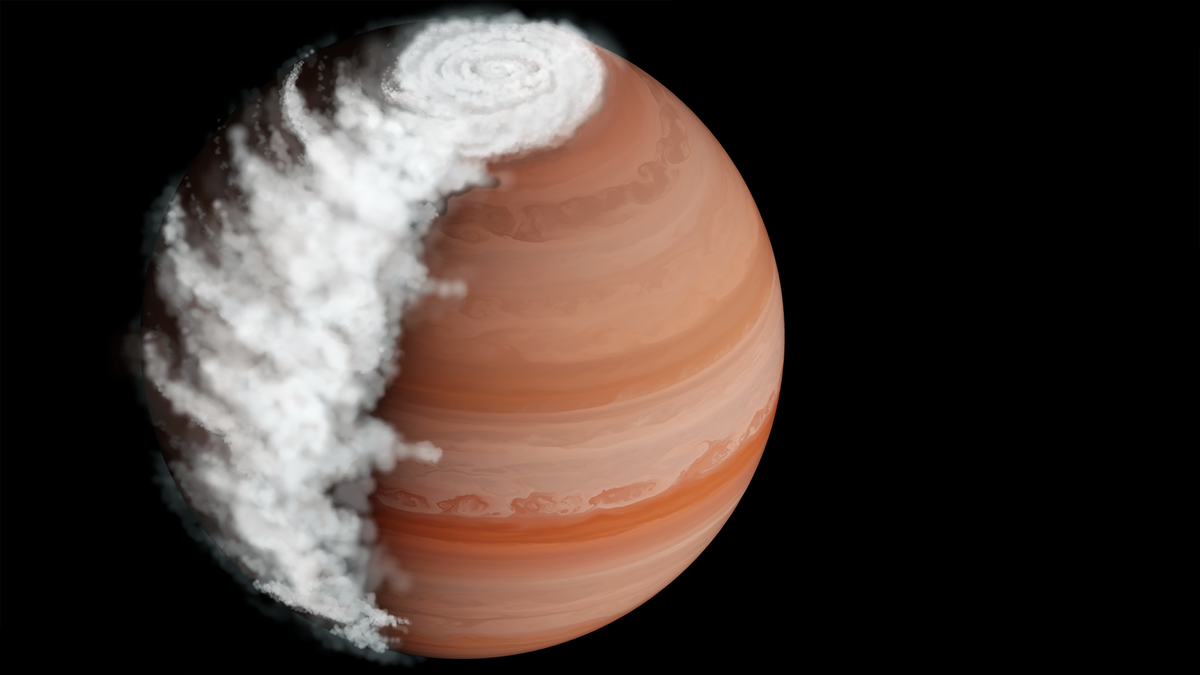
Named WASP-94A b, this exoplanet is almost twice as large as Jupiter but with only half the mass. It orbits very close to its parent star — so close that it takes just four days to complete a whole revolution.

Extreme worlds

Gas giants like WASP-94A b with scorching atmospheric temperatures are called ‘hot Jupiters’ and have their orbits tidally locked, meaning their rotation is synchronised with their revolution. As a result, the same side of the planet always faces the host star, much like the moon’s tidally locked orbit keeps one side always facing the earth.

WASP-94A b’s dayside is thus a sweltering desert with temperatures hot enough to melt rock while its nightside is perennially dark and frozen as temperatures dip to nearly absolute zero.

Astronomers have always been intrigued by the bizarre weather patterns on the 6,000 or so exoplanets they have found so far. But in the absence of a sufficiently powerful telescope, they have had no way to study these far-flung bodies.

NASA’s launch of the James Webb Space Telescope (JWST) in December 2021 was the gamechanger. The unprecedented sensitivity of its instruments — which allow the telescope to discern the details on a small coin from a distance of 50 km — has helped scientists study exoplanets’ atmospheres like never before.

Many of these worlds have turned out to be rocky; some are even almost earth-like. But on some other exoplanets, scientists have found extreme temperatures and pressures producing rain of molten metal and vaporised rock. Still others have downpours of molten glass pushed by supersonic winds. Some gaseous exoplanets even have crystallised carbon raining down as diamonds.

‘A world far beyond’

Hot Jupiters though are the most studied exoplanets. The latest JWST discovery has found that WASP-94A b in particular has a dynamic weather system: its mornings are blanketed in clouds of magnesium silicate, iron, and magnesium sulphide while the evenings sport clear skies.

“The clouds appear to form on the cooler night side of the planet, sweep across the globe with extremely fast winds, and then disappear as they reach the hotter dayside,” Sagnick Mukherjee, lead author of the study and a postdoctoral fellow at Arizona State University, said. “This is a direct measurement of an extreme weather cycle unfolding on a world far beyond our Solar System.”

Astronomers characterise the atmospheres of  distant exoplanets using spectroscopy: light is split up into its various wavelengths, followed by measuring the intensity of each one. If the planet has an atmosphere, it will absorb some of the light. This will create a gap in the set of wavelengths arriving at the spectrometer.

Since each molecule absorbs light of fixed wavelengths, it is easy to identify the compounds present in the atmosphere.

Slow transit

“To do that, we need some way to distinguish the planet’s light from the stars,” Bruce Macintosh, director of the University of California Observatories and professor of astronomy and astrophysics, said.

Prof. Macintosh, who was not part of the research team, said the astronomers used the transit method for their discovery.

“As the planet passes in front of the star, its atmosphere absorbs starlight. By studying exactly how that absorption changes with time, you can see the evidence that one side is cloudy and not the other. And by studying different wavelengths you can understand composition,” he explained.

According to University of Göttingen astrophysicist Lisa Nortmann, the researchers seemed to have studied the transit when the exoplanet passed slowly in front of its star.

“Therefore, at different times of observation, different parts of the planet are in front of the star. This effect was used in this study to ‘scan’ the planet’s atmosphere at different locations and this revealed that the atmospheric signal was different for morning and evening sides,” Dr. Nortmann, who was also not part of the study, said.

A major challenge in studying exoplanets, according to Dr. Mukherjee, is that clouds can obscure what their atmospheres are really made of.

“By separating the cloudy and clear sides of WASP-94A b, we show that earlier estimates of its composition can be strongly biased,” he said. “More broadly, the study demonstrates that understanding weather patterns on distant worlds is essential for learning how planets across a wide range of sizes (from earth-like rocky planets to Neptune-like gas worlds and gas giants) form, evolve, and differ from planets in our own solar system.”

History of formation

Research like this could help astronomers learn about the planetary architectures of 4.6 billion years ago when the protoplanetary disk of gas and dust around the Sun started evolving into this Solar System.

“The discs of material around a young star form planets. Different parts of that disc have different compositions — ice, gas, dust particles, etc.,” Prof. Macintosh said. By measuring the composition, you can tell something about the history of the formation (did it form out of solid material first or gas?) and even the location (did it form somewhere too hot for ice?). And then you can try and understand if the same process that made a big hot Jupiter like this could also make a smaller planet like the earth.”

As state-of-the-art instruments like the Extremely Large Telescope, which Europe is currently building in northern Chile, become operational, astronomers could discover many exoplanet nurseries around distant stars, increasing manifold the possibility of finding more extra-solar earth-like planets and, who knows, even a true earth twin.

Prakash Chandra is a science writer.

Published – May 26, 2026 08:00 am IST



Source link

Science

Post navigation

Previous Post: Last-minute IPL replacements eligible for retention
Next Post: Around 20 injured in spraying incident in Tokyo mall

Related Posts

  • The evolving China-Pakistan space cooperation
    The evolving China-Pakistan space cooperation Science
  • What scientists find when they find nothing
    What scientists find when they find nothing Science
  • Astronomers have spotted the biggest bangs since the Big Bang
    Astronomers have spotted the biggest bangs since the Big Bang Science
  • Science for All: Chocolate flavour is affected by microbes, scientists find
    Science for All: Chocolate flavour is affected by microbes, scientists find Science
  • Prevalence of NCDs tripled, infectious diseases doubled since 1995
    Prevalence of NCDs tripled, infectious diseases doubled since 1995 Science
  • How big fossil-fuel-producing countries export emissions abroad | Explained
    How big fossil-fuel-producing countries export emissions abroad | Explained Science

More Related Articles

Craig the elephant, and the promise and problem of wildlife icons Craig the elephant, and the promise and problem of wildlife icons Science
Southern Ocean carbon ‘anomaly’ reveals what models can still miss Southern Ocean carbon ‘anomaly’ reveals what models can still miss Science
Nobel Prize in Chemistry 2024 awarded to David Baker, along with Demis Hassabis and John M. Jumper Nobel Prize in Chemistry 2024 awarded to David Baker, along with Demis Hassabis and John M. Jumper Science
Indian researchers develop AI-based platform to identify age-defying molecules rapidly Indian researchers develop AI-based platform to identify age-defying molecules rapidly Science
What is coding, and when did it all begin? What is coding, and when did it all begin? Science
The birth and growth of music The birth and growth of music Science
SiteLock

Archives

  • October 2026
  • September 2026
  • August 2026
  • July 2026
  • June 2026
  • May 2026
  • April 2026
  • March 2026
  • February 2026
  • January 2026
  • December 2025
  • November 2025
  • October 2025
  • September 2025
  • August 2025
  • July 2025
  • June 2025
  • May 2025
  • April 2025
  • March 2025
  • February 2025
  • January 2025
  • December 2024
  • November 2024
  • October 2024
  • September 2024
  • August 2024
  • July 2024
  • June 2024
  • May 2024
  • April 2024
  • March 2024
  • February 2024
  • January 2024
  • December 2023
  • November 2023
  • October 2023
  • September 2023
  • August 2023
  • July 2023
  • June 2023
  • May 2023
  • April 2023
  • March 2023
  • February 2023
  • January 2023
  • December 2022
  • November 2022
  • October 2022
  • September 2022
  • August 2022
  • July 2022
  • June 2022
  • May 2022

Categories

  • Business
  • Nation
  • Science
  • Sports
  • World

Recent Posts

  • Private bus operators to begin indefinite hunger strike on October 27
  • Yemen’s Houthis vow more attacks on Saudi airports, oil facilities after Aramco HQ hit
  • Ranji Trophy | Assam weathers Punjab’s push for an outright win
  • BJP party worker killed in Bengaluru as high-end car rams gas tanker near Devanahalli; three injured
  • Rupee rises 19 paise to close at 95.17 against U.S. dollar

Recent Comments

  1. RobertTes on UP Teacher Who Asked Students To Slap Muslim Classmate
  2. Manuelret on UP Teacher Who Asked Students To Slap Muslim Classmate
  3. RobertTes on UP Teacher Who Asked Students To Slap Muslim Classmate
  4. RobertTes on UP Teacher Who Asked Students To Slap Muslim Classmate
  5. BrentWes on UP Teacher Who Asked Students To Slap Muslim Classmate
  • 5 Killed As Thousands Of Imran Khan’s Supporters Clash With Cops In Pakistan
    5 Killed As Thousands Of Imran Khan’s Supporters Clash With Cops In Pakistan World
  • Being top buy at TNPL auction high point of Ashwanth’s roller-coaster ride
    Being top buy at TNPL auction high point of Ashwanth’s roller-coaster ride Sports
  • Navarro renews attack on Delhi, asks why Americans ‘paying for AI in India’
    Navarro renews attack on Delhi, asks why Americans ‘paying for AI in India’ World
  • Heroin Worth Rs 210 Crore Seized In Assam’s Biggest Drug Haul, 1 Arrested
    Heroin Worth Rs 210 Crore Seized In Assam’s Biggest Drug Haul, 1 Arrested Nation
  • Anti-Terror Agency Seeks Info On ‘Khalistani’ Attack On Indian Consulate In US
    Anti-Terror Agency Seeks Info On ‘Khalistani’ Attack On Indian Consulate In US Nation
  • Access Denied
    Access Denied Nation
  • Trump Vice President Pick JD Vance Supports Big Tech Antitrust Crackdown
    Trump Vice President Pick JD Vance Supports Big Tech Antitrust Crackdown World
  • Access Denied World

Editor-in-Chief:
Mohammad Ariff,
MSW, MAJMC, BSW, DTL, CTS, CNM, CCR, CAL, RSL, ASOC.
editor@artifex.news

Associate Editors:
1. Zenellis R. Tuba,
zenelis@artifex.news
2. Haris Daniyel
daniyel@artifex.news

Photograher:
Rohan Das
rohan@artifex.news

Associate Journalists
1. Subrata Paul - AN/2020/01
2. Quamruz Zaman - AN/2021/22
3. Ahmed Sha - AN/2021/035
4. Ajay Kumar Shaw - AN/2021/39
5. Tahqiqul Hoda - AN/2021/21

Artifex.News offers Online Paid Internships to college students from India and Abroad. Interns will get a PRESS CARD and other online offers.
Send your CV (Subjectline: Paid Internship) to internship@artifex.news

Links:
Associate Journalism
About Us
Privacy Policy

News Links:
Breaking News
World
Nation
Sports
Business
Entertainment
Lifestyle

Registered Office:
72/A, Elliot Road, Kolkata - 700016
Tel: 033-22277777, 033-22172217
Email: office@artifex.news

Editorial Office / News Desk:
No. 13, Mezzanine Floor, Esplanade Metro Rail Station,
12 J. L. Nehru Road, Kolkata - 700069.
(Entry from Gate No. 5)
Tel: 033-46011099, 033-46046046
Email: editor@artifex.news

Copyright © 2023 Artifex.News Newsportal designed by Artifex Infotech.