


Skip to content
  • Facebook
  • X
  • Linkedin
  • WhatsApp
  • YouTube
  • Associate Journalism
  • About Us
  • Privacy Policy
  • 033-46046046
  • editor@artifex.news
Artifex.News

Artifex.News

Stay Connected. Stay Informed.

  • Breaking News
  • World
  • Nation
  • Sports
  • Business
  • Science
  • Entertainment
  • Lifestyle
  • Toggle search form
  • After Being Retained By IPL Teams, West Indies Stars Return To T20I Action vs England
    After Being Retained By IPL Teams, West Indies Stars Return To T20I Action vs England Sports
  • Explained: How Chennai Super Kings Can Miss Out On IPL 2024 Playoffs Spot
    Explained: How Chennai Super Kings Can Miss Out On IPL 2024 Playoffs Spot Sports
  • 2 Labourers From Bihar Shot Dead By Unidentified Gunmen In Manipur
    2 Labourers From Bihar Shot Dead By Unidentified Gunmen In Manipur Nation
  • Germany cracks down on Muslim groups viewed as threats to its constitutional order
    Germany cracks down on Muslim groups viewed as threats to its constitutional order World
  • Pakistan Legend Tells Shaheen Afridi To Copy Jasprit Bumrah Cricket World Cup 2023 Blueprint
    Pakistan Legend Tells Shaheen Afridi To Copy Jasprit Bumrah Cricket World Cup 2023 Blueprint Sports
  • Access Denied Sports
  • “Impossible To Beat Germany”: Hungary Coach Blasts Team After Switzerland Loss In Euro 2024
    “Impossible To Beat Germany”: Hungary Coach Blasts Team After Switzerland Loss In Euro 2024 Sports
  • Access Denied Sports
Astronomers have spotted the biggest bangs since the Big Bang

Astronomers have spotted the biggest bangs since the Big Bang

Posted on September 22, 2025 By admin


For all its apparent serenity, the universe is a very violent place teeming with cataclysmic events: from colliding galaxies and supernovae (the explosive deaths of massive stars), to immensely powerful geysers of X-rays and black holes that gobble up stars.

In this deafening cosmic din, astronomers have always considered gamma-ray bursts (GRBs), produced during the formation of black holes, to be the most powerful flare-ups in the universe. Incredibly energetic GRBs traverse vast distances, making them the most luminous electromagnetic events since the Big Bang, the accepted cosmological model to explain the origin and evolution of the universe.

But recently, astronomers from the University of Hawaii’s Institute for Astronomy (IfA) identified a new category of events that they found to be much more powerful than GRBs: extreme nuclear transients (ENTs). In astronomy, transients refer to celestial objects whose brightness changes significantly over a relatively short period.

Inscrutable creations

The IfA findings, published recently in Science Advances, described extraordinary phenomena that occurred when extremely big stars wandered too close to gargantuan black holes in galactic centres and literally got eaten up. Their fate was much like that of Icarus in Greek mythology, who flew too close to the sun on wings of wax and feathers only for the wings to melt, causing him to plummet to his death.

“ENTs are powered by accretion from the debris of a massive star at least three-times heavier than our sun that has been ripped apart by a supermassive black hole,” Jason Hinkle, the lead author of the IfA study, wrote to the author.

Black holes are one of nature’s most inscrutable creations and supermassive black holes that lurk near the centres of galaxies are the biggest of them all. There is one in the Milky Way galaxy, too: Sagittarius A*.

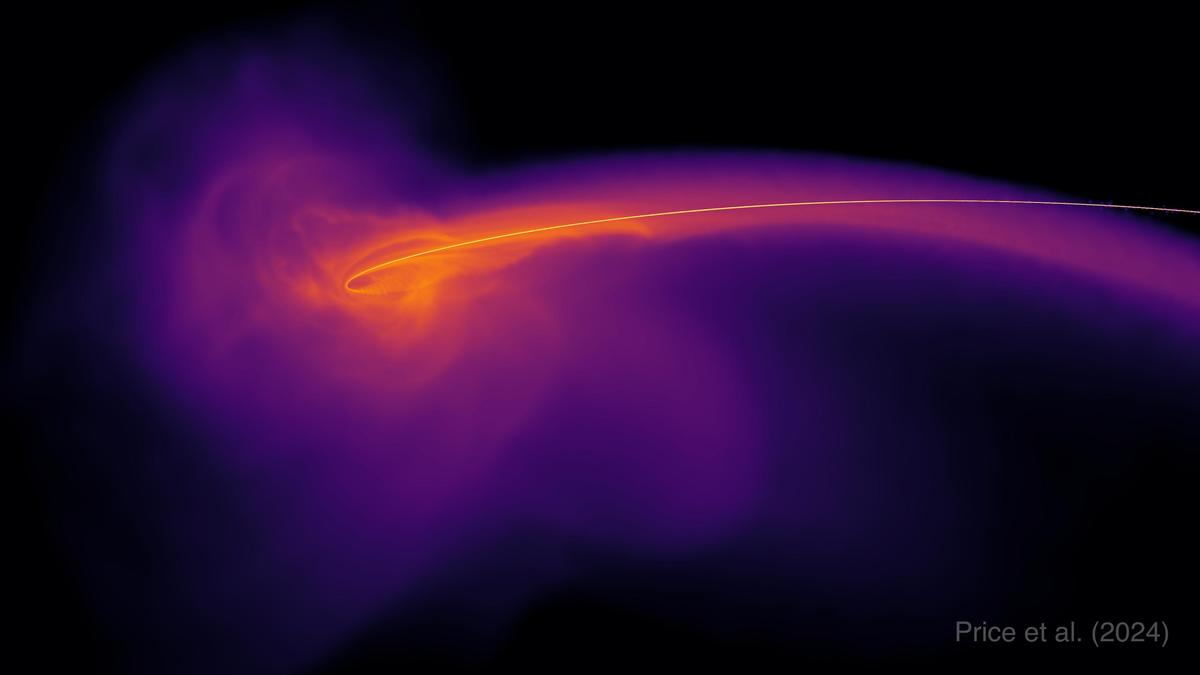
As a star nears a black hole’s event horizon — its outer edge that marks the point of no return for even light — extreme tidal forces stretch and compress the star into a long, thin spaghetti-like shape, releasing enormous amounts of electromagnetic energy. This emission is the ENT.

These brilliant space streamers traverse immense distances and remain luminous in radio wavelengths for years, making it possible for astronomers to study them. In fact, ENTs are so powerful that astronomers now believe they are the “biggest explosions” to have taken place since the Big Bang.

“ENTs are the most energetic class of transient events yet discovered,” Dr. Hinkle said. “They emit up to ten-times more energy than the previous record holders.”

Torn apart

Dr. Hinkle stumbled on to ENTs when sifting through data from the European Space Agency’s Gaia spacecraft, which mapped the Milky Way for more than a decade.

“We were looking for smooth, high-amplitude, and long-lived events,” he said. “In 2020, we began following two sources I had identified in 2016 and 2018 in the Gaia data with space-based UV/X-ray missions and ground-based spectroscopy to measure physical parameters, which gave the first indications that we were seeing something special.”

When the Zwicky Transient Facility [which scans the entire Northern sky every two days using an extremely wide field of view camera at the Palomar observatory in California] published data on a third similar event in 2023, it gave additional confidence that we had found a rare, new class of transient phenomena,” he added.

Astronomers have previously observed stars being torn apart in tidal disruption events (TDEs), which happens when a star is pulled apart by a black hole’s tidal forces, releasing the energy equivalent of more than a hundred supernovae in the process. In that sense, TDEs share many similarities with ENTs, including hot temperatures, brilliant emissions, and broad emission lines. But the two are actually quite different.

“The host galaxies of ENTs are much larger than that of a TDE and have a more massive central black hole,” Dr. Hinkle explained. “ENTs are also much rarer than the TDEs we observe in the local universe. However, we think that ENTs are TDEs of massive stars that are just too rare to observe in the nearby universe.”

ENTs also differ from the mysterious fast X-ray transients (FXTs), short-lived bursts of X-rays from distant galaxies that have puzzled astronomers since they were first found in the 1970s. The origins of FXTs remained elusive largely because their signals are less energetic and more fleeting than traditional X-ray driven GRBs.

In extreme light

Despite an exhaustive search, which even included candidate sources such as TDEs where a small black hole interacted with a white dwarf, astronomers couldn’t determine where FXTs originated. The mystery was finally solved in June when researchers from Northwestern University in the US and the University of Leicester in England discovered FXTs actually arose from high energy particles trapped inside a supernova.

It turned out that when high-energy particle jets break through a star’s outer layers, they produce GRBs. But if these jets are contained within the star, they release lower-energy X-ray signals that we observe as FXTs. In other words, unlike ENTs, FXTs are essentially an X-ray phenomenon that occurs on very short timescales.

Astronomers are excited about the prospect of observing the universe in the light of the extreme luminosity of ENTs.

As Dr. Hinkle said: “By building a sample of ENTs, we can study massive black holes in the early universe, especially the large majority of those that are not otherwise accreting, serving as an excellent complement to studies of accreting black holes in the early universe.”

This will be made easier by a new generation of telescopes and instruments with AI-powered data analysis, such as the Vera C. Rubin Observatory in Chile and the Nancy Grace Roman Space Telescope, scheduled to be launched in 2027. They promise to revolutionise our understanding of the extreme physics behind a universe filled with cosmic destruction on such immense scales.

Prakash Chandra is a science writer.

Published – September 22, 2025 05:30 am IST



Source link

Science

Post navigation

Previous Post: Passenger booked after revolver, cartridges recovered from his bag at Pune airport
Next Post: Open level crossing gate despite approaching train causes commotion near Katpadi

Related Posts

  • India successfully test-fires Agni-5 ballistic missile from Odisha
    India successfully test-fires Agni-5 ballistic missile from Odisha Science
  • Air pollution harms pollinators more than pests, study finds
    Air pollution harms pollinators more than pests, study finds Science
  • The tale of the tigers
    The tale of the tigers Science
  • IIT-Kanpur team develops new way to predict solar cycles
    IIT-Kanpur team develops new way to predict solar cycles Science
  • India’s open ecosystems face an unusual threat: trees
    India’s open ecosystems face an unusual threat: trees Science
  • IIT Bombay researchers develop GPS-free control scheme for autonomous drone swarms Science

More Related Articles

Losing the way: On ISRO and issues with its NavIC constellation Losing the way: On ISRO and issues with its NavIC constellation Science
Four new studies report progress towards long-awaited HIV vaccine Four new studies report progress towards long-awaited HIV vaccine Science
Song lyrics are getting simpler, more repetitive: study Song lyrics are getting simpler, more repetitive: study Science
Hong Kong blaze: Why buildings have disastrous fires and how they can be prevented Hong Kong blaze: Why buildings have disastrous fires and how they can be prevented Science
Why are India’s communications satellites so heavy? | Explained Why are India’s communications satellites so heavy? | Explained Science
The Science Quiz | The Skylab ‘incident’ The Science Quiz | The Skylab ‘incident’ Science
SiteLock

Archives

  • May 2026
  • April 2026
  • March 2026
  • February 2026
  • January 2026
  • December 2025
  • November 2025
  • October 2025
  • September 2025
  • August 2025
  • July 2025
  • June 2025
  • May 2025
  • April 2025
  • March 2025
  • February 2025
  • January 2025
  • December 2024
  • November 2024
  • October 2024
  • September 2024
  • August 2024
  • July 2024
  • June 2024
  • May 2024
  • April 2024
  • March 2024
  • February 2024
  • January 2024
  • December 2023
  • November 2023
  • October 2023
  • September 2023
  • August 2023
  • July 2023
  • June 2023
  • May 2023
  • April 2023
  • March 2023
  • February 2023
  • January 2023
  • December 2022
  • November 2022
  • October 2022
  • September 2022
  • August 2022
  • July 2022
  • June 2022
  • May 2022

Categories

  • Business
  • Nation
  • Science
  • Sports
  • World

Recent Posts

  • FIR against Tumakuru madrasa management after 24 runaway children allege abuse and forced labour
  • Six die in an accident in Tiruppur district
  • Stock markets pare early gains; trade lower
  • Watch: Trump: ‘Believe it or not, we’re going to get a settlement between Russia and Ukraine’
  • PM Modi reduces convoy size: Sources

Recent Comments

  1. DavidAnymn on UP Teacher Who Asked Students To Slap Muslim Classmate
  2. Jesusetexy on UP Teacher Who Asked Students To Slap Muslim Classmate
  3. JeffryFok on UP Teacher Who Asked Students To Slap Muslim Classmate
  4. StanleyPeapy on UP Teacher Who Asked Students To Slap Muslim Classmate
  5. RonaldLam on UP Teacher Who Asked Students To Slap Muslim Classmate
  • IPL 2026 | My focus is to help bowlers read situations: Bravo
    IPL 2026 | My focus is to help bowlers read situations: Bravo Sports
  • Priyanka Gandhi On ‘Palestine’ Bag Row
    Priyanka Gandhi On ‘Palestine’ Bag Row Nation
  • Access Denied Business
  • Access Denied Sports
  • Shami returns to India squad for England T20Is; Axar appointed as Suryakumar’s deputy
    Shami returns to India squad for England T20Is; Axar appointed as Suryakumar’s deputy Sports
  • Harvey Weinstein hospitalised after ‘alarming blood test’, attorney says
    Harvey Weinstein hospitalised after ‘alarming blood test’, attorney says World
  • Tottenham Hotspur vs Arsenal LIVE Streaming, Premier League 2024-25 LIVE Telecast: When And Where To Watch
    Tottenham Hotspur vs Arsenal LIVE Streaming, Premier League 2024-25 LIVE Telecast: When And Where To Watch Sports
  • Ind vs Aus 3rd Test: India’s balcony celebrations at Gabba after avoiding follow-on raise eyebrows
    Ind vs Aus 3rd Test: India’s balcony celebrations at Gabba after avoiding follow-on raise eyebrows Sports

Editor-in-Chief:
Mohammad Ariff,
MSW, MAJMC, BSW, DTL, CTS, CNM, CCR, CAL, RSL, ASOC.
editor@artifex.news

Associate Editors:
1. Zenellis R. Tuba,
zenelis@artifex.news
2. Haris Daniyel
daniyel@artifex.news

Photograher:
Rohan Das
rohan@artifex.news

Artifex.News offers Online Paid Internships to college students from India and Abroad. Interns will get a PRESS CARD and other online offers.
Send your CV (Subjectline: Paid Internship) to internship@artifex.news

Links:
Associate Journalism
About Us
Privacy Policy

News Links:
Breaking News
World
Nation
Sports
Business
Entertainment
Lifestyle

Registered Office:
72/A, Elliot Road, Kolkata - 700016
Tel: 033-22277777, 033-22172217
Email: office@artifex.news

Editorial Office / News Desk:
No. 13, Mezzanine Floor, Esplanade Metro Rail Station,
12 J. L. Nehru Road, Kolkata - 700069.
(Entry from Gate No. 5)
Tel: 033-46011099, 033-46046046
Email: editor@artifex.news

Copyright © 2023 Artifex.News Newsportal designed by Artifex Infotech.