


Skip to content
  • Facebook
  • X
  • Linkedin
  • WhatsApp
  • YouTube
  • Associate Journalism
  • About Us
  • Privacy Policy
  • 033-46046046
  • editor@artifex.news
Artifex.News

Artifex.News

Stay Connected. Stay Informed.

  • Breaking News
  • World
  • Nation
  • Sports
  • Business
  • Science
  • Entertainment
  • Lifestyle
  • Toggle search form
  • Access Denied
    Access Denied Nation
  • Pakistan vs South Africa, Cricket World Cup 2023: Fantasy XI Prediction, Top Captaincy And Vice-Captaincy Picks
    Pakistan vs South Africa, Cricket World Cup 2023: Fantasy XI Prediction, Top Captaincy And Vice-Captaincy Picks Sports
  • Access Denied World
  • National Mourning For 7 Days To Honour Manmohan Singh: Sources
    National Mourning For 7 Days To Honour Manmohan Singh: Sources Nation
  • Access Denied Sports
  • Delhi Capitals Head Coach Ricky Ponting Gives Update On David Warner’s Fitness Ahead Of IPL 2024 Match vs Gujrat Titans
    Delhi Capitals Head Coach Ricky Ponting Gives Update On David Warner’s Fitness Ahead Of IPL 2024 Match vs Gujrat Titans Sports
  • All four Moscow airports closed due to spate of Ukrainian drone attacks
    All four Moscow airports closed due to spate of Ukrainian drone attacks World
  • Amnesty says Israel ‘still committing genocide’ in Gaza, despite truce
    Amnesty says Israel ‘still committing genocide’ in Gaza, despite truce World
Four new studies report progress towards long-awaited HIV vaccine

Four new studies report progress towards long-awaited HIV vaccine

Posted on June 13, 2024 By admin


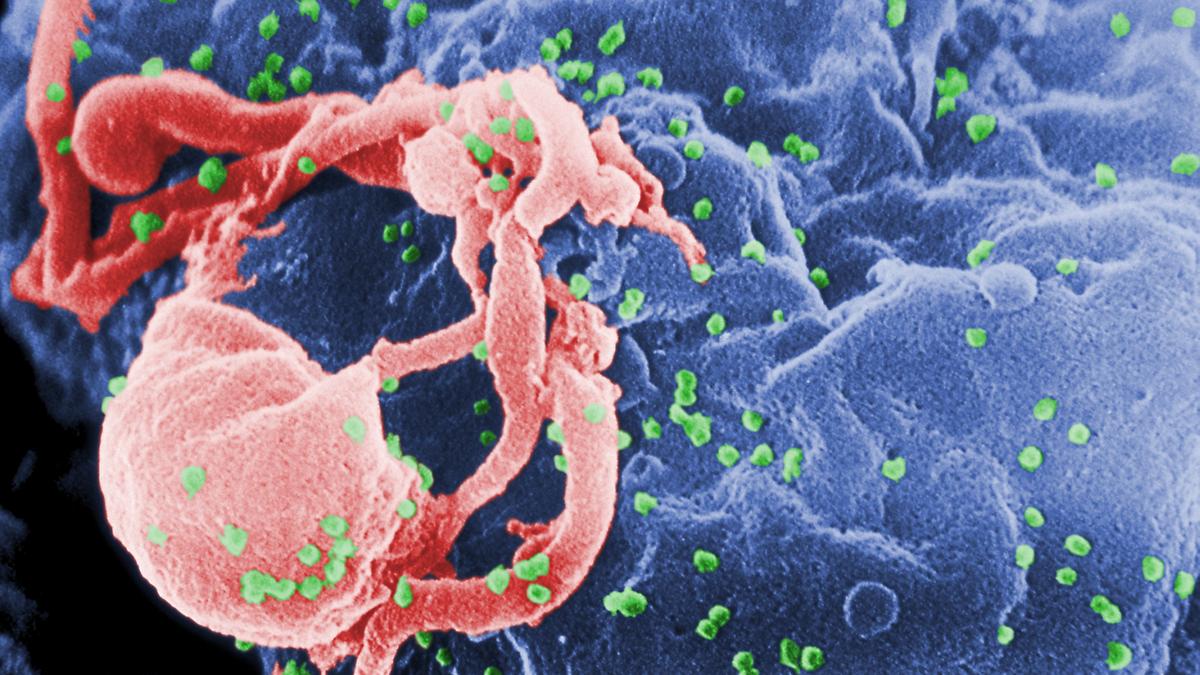
A false-coloured scanning electron micrograph of HIV-1 budding (in green) from cultured lymphocyte, 1984. HIV has more variants circulating in a single patient at any given point of time than influenza cumulatively generates in one year in all influenza patients around the world combined, creating a vaccine development nightmare.
| Photo Credit: U.S. CDC

In early 1981, Michael Gottlieb, an assistant professor at the University of California Los Angeles Medical Centre, wanted to teach some tenets of immunology to a post-doctoral fellow in his laboratory. Dr. Gottlieb asked the post-doc to select a patient from the hospital who displayed some immunological features that they might find interesting. The post-doc found a patient who had a relatively rare infection called pneumocystis pneumonia and had been admitted after sudden, unexplained weight loss.

During the course of their discussion, the hospital doctors referred four more patients with the same infection. Dr. Gottlieb published a paper detailing these five cases in a small American journal called Morbidity and Mortality Weekly. At the time, Dr. Gottlieb had no idea his paper was about to change the field of immunology forever.

That paper was the first report of acquired immunodeficiency syndrome (AIDS).

No vaccine for AIDS

Today, nearly half a century after Dr. Gottleib’s landmark publication, AIDS still has no vaccine or cure. This anomaly in humanity’s otherwise remarkable track record in tackling major infectious diseases is a result of several factors. Chief among them is that the replication of the human immunodeficiency virus (HIV), which causes AIDS, is an incredibly error-prone process that results in multiple variants of the virus circulating.

The sheer number of all the different strains circulating in the world is in fact the biggest challenge to an HIV vaccine today.

To put it in perspective, HIV has more variants circulating in a single patient at any given point of time than influenza cumulatively generates in one year in all influenza patients around the world combined. And influenza is the second-best virus in terms of genetic variation.

Starring role for B-cells

When the immune system encounters a virus, one of its responses is to produce antibodies highly specific to proteins on the virions’ surface. Each antibody is unique to a small piece of a given protein, and the immune system can generate antibodies against any given fragment of any protein.

The immune system does this by starting with a pool of specialised cells that produce antibodies, called B-cells. Each B-cell produces an antibody unique to one protein fragment. When a B-cell encounters a similar protein fragment on a foreign object — say, a virus or a bacteria — it begins to divide and refine the antibody until it binds perfectly to the target. These antibodies then bind to their corresponding pieces on the viral surface, rendering them incapable of further infection. The body then retains some of these specific antibody-producing cells in case of a future infection.

A vaccine aims to generate these antibodies prior to viral infection so that whenever a virus enters the body, the antibodies can neutralise the virus and prevent it from initiating an infection. The vaccine basically provides the immune system with a head-start by allowing the body to make antibodies without an infection with the real virus.

bNAb, a sliver of hope

However, when multiple variants of the same virus exist, generating antibodies against all the different variants simultaneously becomes very difficult. In the case of most viruses, the immune system ultimately does catch up. But against HIV, it doesn’t because of the sheer volume of different variants that are circulating, overwhelming the immune system’s ability to generate new antibodies. In fact, by the time the immune system makes antibodies against a few strains, the virus will have produced hundreds more.

In the early 1990s, scientists noticed that in a small subset of HIV-infected individuals, a new kind of antibody was being produced that could neutralise a large number of circulating viral strains. These broadly neutralising antibodies (bNAb) worked by targeting areas of the viral proteins that the virus couldn’t afford to change, since doing so would make it lose infectivity. Scientists have since discovered many bNAbs, and they are classified into different groups based on the region of HIV they target. Some of these bNAbs can effectively neutralise more than 90% of circulating strains.

But there is a catch: a body usually takes years to make bNAbs, and by then, the virus has already evolved to escape them. It takes years because the parental B-cell that makes the bNAbs is incredibly rare in the starting pool.

Light at the tunnel’s end?

The challenge, therefore, has been to make the immune system produce these bNAbs in large numbers in response to a vaccine. The route to doing this, called germline targeting, has three steps.

In the first step, those B-cells that can mature into cells that can produce bNAb are identified and engaged to increase their population and prepare them for the second-step, where a booster dose will guide these cells into generating stronger bNAbs against HIV. The third and final step is to refine these bNAbs such that they can neutralise a wide range of HIV strains.

After years of painstaking failures, researchers have established a possible roadmap for the first two steps of germline targeting for two groups of bNAbs. Four papers recently published in Science journals outlined two promising nanoparticle-based vaccine candidates: N332-GT5 and  eOD-GT8. The teams, based out of the Scripps Research Institute and the Massachusetts Institute of Technology, both in the U.S., showed that using these novel vaccines, it may be possible to engage B-cells to make two different classes of bNAbs.

HIV demands patience

The teams demonstrated the efficacy of their vaccine candidates in two forms, protein and mRNA. The latter is important because mRNA vaccines are easy to develop and produce. In both cases, the antibodies generated in response to the vaccine were shown by structural analysis to bind to the HIV proteins in a manner similar to that of established bNAbs. Further, the groups also demonstrated the efficacy of their vaccine candidates in two different animal models, mice and macaques. These animals can now be used as model systems for future studies. The candidate vaccines are currently being evaluated in a phase-1 clinical trial to assess their performance in humans.

The research groups have also reported a possible candidate for step II of germline targeting. A protein fragment called g28v2 appears to be able to guide the cells into making bNAbs. Further research in this direction to evaluate its properties is ongoing.

While these four papers do imply progress in developing a B-cell based vaccine for HIV after decades of frustrating wait, we must refrain from celebrating too early. Results from mouse and macaque models don’t always translate to positive results in the human system. The strategies reported by these publications do have enormous potential for vaccine development against other RNA viruses such as influenza, various coronaviruses, and hepatitis C — but our past failures have also taught us to remain sceptical with HIV until the very end.

Arun Panchapakesan is an assistant professor at the Y.R. Gaithonde Centre for AIDS Research and Education, Chennai.



Source link

Science Tags:acquired immunodeficiency syndrome, aids vaccine, germline targeting, hiv vaccine latest news, hiv variants, human immunodeficiency virus, nanoparticle based vaccine

Post navigation

Previous Post: Myanmar’s economy in crisis as civil strife disrupts trade and livelihoods
Next Post: U.S. Fed holds interest rates, now sees just one cut this year

Related Posts

  • Deep space exploration next, prepare for it: PM Modi tells scientists on National Space Day
    Deep space exploration next, prepare for it: PM Modi tells scientists on National Space Day Science
  • Nobel laureates sound alarm as Argentina cuts science funding
    Nobel laureates sound alarm as Argentina cuts science funding Science
  • Bird species exploded after dinos’ doom, largest yet bird genetics study says
    Bird species exploded after dinos’ doom, largest yet bird genetics study says Science
  • What is the HbA1C test and why is it used to check for diabetes? | Explained
    What is the HbA1C test and why is it used to check for diabetes? | Explained Science
  • New low-cost MRI machine can improve access to diagnostics in India
    New low-cost MRI machine can improve access to diagnostics in India Science
  • How agriPV can turn India’s farms into dual-purpose powerhouses
    How agriPV can turn India’s farms into dual-purpose powerhouses Science

More Related Articles

Patagonia cave paintings are earliest found in South America Patagonia cave paintings are earliest found in South America Science
The physics of friction, the ‘necessary evil’ that bedevils daily life The physics of friction, the ‘necessary evil’ that bedevils daily life Science
Sensing China threat, India joins race to mine new sea patch Sensing China threat, India joins race to mine new sea patch Science
Google’s new AI model offers new pathway in cancer drug research Google’s new AI model offers new pathway in cancer drug research Science
Science and technology key to raising India’s profile in the world, says CSIR chief Science and technology key to raising India’s profile in the world, says CSIR chief Science
How does U.K.’s OpenSAFELY ensure transparency? How does U.K.’s OpenSAFELY ensure transparency? Science
SiteLock

Archives

  • May 2026
  • April 2026
  • March 2026
  • February 2026
  • January 2026
  • December 2025
  • November 2025
  • October 2025
  • September 2025
  • August 2025
  • July 2025
  • June 2025
  • May 2025
  • April 2025
  • March 2025
  • February 2025
  • January 2025
  • December 2024
  • November 2024
  • October 2024
  • September 2024
  • August 2024
  • July 2024
  • June 2024
  • May 2024
  • April 2024
  • March 2024
  • February 2024
  • January 2024
  • December 2023
  • November 2023
  • October 2023
  • September 2023
  • August 2023
  • July 2023
  • June 2023
  • May 2023
  • April 2023
  • March 2023
  • February 2023
  • January 2023
  • December 2022
  • November 2022
  • October 2022
  • September 2022
  • August 2022
  • July 2022
  • June 2022
  • May 2022

Categories

  • Business
  • Nation
  • Science
  • Sports
  • World

Recent Posts

  • Oil Minister Puri dispels any fuel supply concerns; LPG production ramped up to 54,000 tonnes/day
  • Tamil Nadu CM Vijay gives maiden speech in Assembly after TVK win
  • India declines Russian LNG under sanctions, talks continue on permitted cargoes, sources say
  • Elon Musk, Apple’s Tim Cook to head to China with Trump, per White House
  • Jeffrey Epstein files go on display at New York pop-up exhibit featuring 3.5 million pages

Recent Comments

  1. JeffryFok on UP Teacher Who Asked Students To Slap Muslim Classmate
  2. MiguelWhato on UP Teacher Who Asked Students To Slap Muslim Classmate
  3. Richardsally on UP Teacher Who Asked Students To Slap Muslim Classmate
  4. MatthewUsalf on UP Teacher Who Asked Students To Slap Muslim Classmate
  5. Brucetrura on UP Teacher Who Asked Students To Slap Muslim Classmate
  • Himanta Sarma After Trump Shot At
    Himanta Sarma After Trump Shot At Nation
  • “Simple Funda Hai…”: Axar Patel Sums Up Rohit Sharma Captaincy Style
    “Simple Funda Hai…”: Axar Patel Sums Up Rohit Sharma Captaincy Style Sports
  • Israel-Hamas war, Day 21 LIVE updates | Israel to pay compensation for ships damaged in Gaza war
    Israel-Hamas war, Day 21 LIVE updates | Israel to pay compensation for ships damaged in Gaza war World
  • Gautam Gambhir’s Brutal ‘Domestic Cricket’ Message After India’s Series Loss Against Australia
    Gautam Gambhir’s Brutal ‘Domestic Cricket’ Message After India’s Series Loss Against Australia Sports
  • Beijing accuses Philippines of deliberate collision between coast guard ships in latest flareup
    Beijing accuses Philippines of deliberate collision between coast guard ships in latest flareup World
  • Science This Week | India becomes the first country to land on Moon’s south pole and more
    Science This Week | India becomes the first country to land on Moon’s south pole and more Science
  • ‘Brain Rot’ named Oxford Word of the Year 2024: What does it mean? 
    ‘Brain Rot’ named Oxford Word of the Year 2024: What does it mean?  World
  • Watch: Yashasvi Jaiswal In Heated Chat With Umpires Over Controversial DRS Decision
    Watch: Yashasvi Jaiswal In Heated Chat With Umpires Over Controversial DRS Decision Sports

Editor-in-Chief:
Mohammad Ariff,
MSW, MAJMC, BSW, DTL, CTS, CNM, CCR, CAL, RSL, ASOC.
editor@artifex.news

Associate Editors:
1. Zenellis R. Tuba,
zenelis@artifex.news
2. Haris Daniyel
daniyel@artifex.news

Photograher:
Rohan Das
rohan@artifex.news

Artifex.News offers Online Paid Internships to college students from India and Abroad. Interns will get a PRESS CARD and other online offers.
Send your CV (Subjectline: Paid Internship) to internship@artifex.news

Links:
Associate Journalism
About Us
Privacy Policy

News Links:
Breaking News
World
Nation
Sports
Business
Entertainment
Lifestyle

Registered Office:
72/A, Elliot Road, Kolkata - 700016
Tel: 033-22277777, 033-22172217
Email: office@artifex.news

Editorial Office / News Desk:
No. 13, Mezzanine Floor, Esplanade Metro Rail Station,
12 J. L. Nehru Road, Kolkata - 700069.
(Entry from Gate No. 5)
Tel: 033-46011099, 033-46046046
Email: editor@artifex.news

Copyright © 2023 Artifex.News Newsportal designed by Artifex Infotech.