





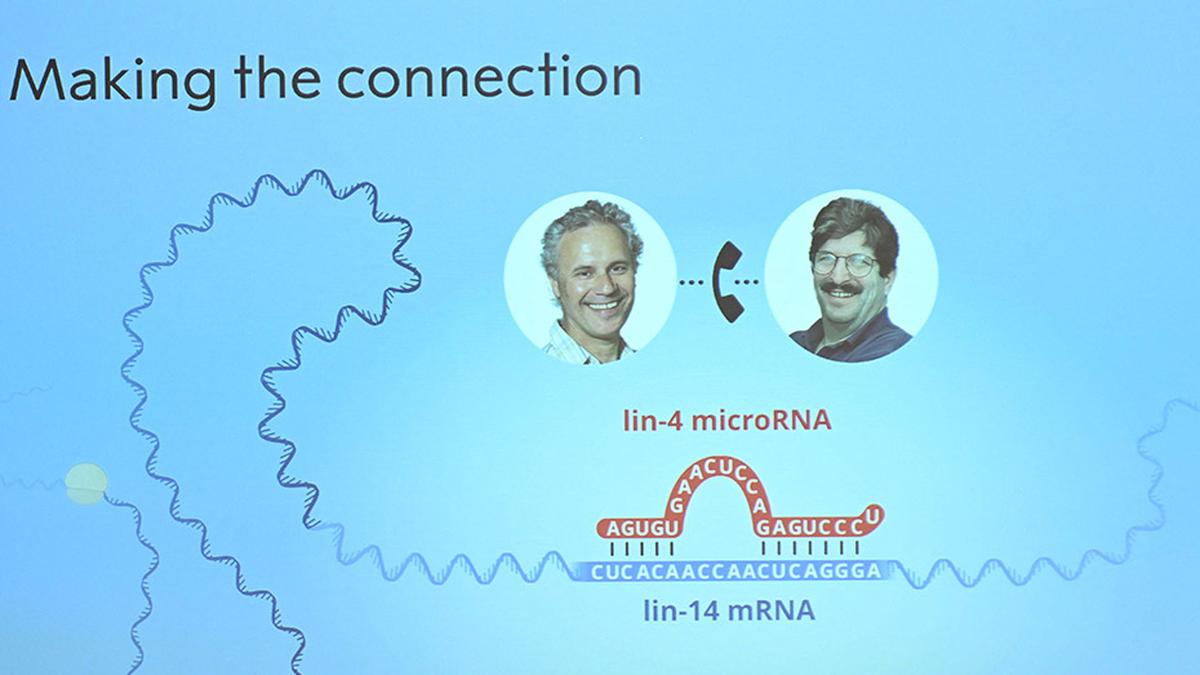
A screen displaying a picture of this year’s laureates Victor Ambros and Gary Ruvkum is seen during the announcement of the winners of the 2024 Nobel Prize in Physiology or Medicine at the Karolinska Institute in Stockholm on October 7, 2024. Victor Ambros and Gary Ruvkum won the Nobel medicine prize on October 7, 2024 for the discovery of microRNA and its role in how gene activity is regulated, the Nobel jury said.
| Photo Credit: AFP
The Nobel Committee announced on October 7 that the Nobel Prize for Medicine or Physiology would be shared by Victor Ambros and Gary Ruvkun “for the discovery of microRNA and its role in post-transcriptional gene regulation,” thereby unlocking a secret on how different types of cells develop.
What is microRNA?
The human body is probably the most complex puzzle that humans are still trying to make sense of. Every time there is a better understanding and a piece slides into place with a resounding click, then it is an occasion for celebration. For a Nobel Prize too perhaps. This year’s awardees of the Nobel Prize for Medicine — Ambros and Ruvkun — did slide in a couple of pieces into the right slots in the massive puzzle that suddenly opened our eyes to understanding how different cell types develop.
Editorial | Regulation role: On the 2024 Medicine Nobel
Consider this: Every cell in the body contains the same chromosome, so every cell contains exactly the same set of genes and presumably, the same instructions. But different cell types have different, unique characteristics. It confounded the imagination until Ambros and Ruvkun came along. Their discovery offered a plausible explanation for the conundrum. The piece of the puzzle was called microRNA, a new class of tiny RNA molecules that play a crucial role in gene regulation. As the Nobel announcement statement said, their groundbreaking discovery revealed a completely new principle of gene regulation essential for multicellular organisms, including humans.
It is now known that the human genome codes for over one thousand microRNAs. Genetic information flows from DNA to messenger RNA (mRNA), via a process called transcription, and then on to the cell for production of protein. There, mRNAs are translated so that proteins are made according to the genetic instructions stored in DNA.
The key is in the precise regulation of gene activity so that only the correct set of genes is active in each specific cell type. Additionally, gene activity must be continually fine-tuned to adapt cellular functions to changing conditions in our bodies and environment. If gene regulation goes awry, it can lead to serious diseases. Therefore, understanding the regulation of gene activity has been an important goal for many decades.
What is the work that led to the Nobel prize?
Ambros and Ruvkun, both American biologists, were together in their post-doctoral period at the H. Robert Horovitz lab in the 1980s, and their interest in cell development probably had its spark there. “It was the moment,” Ruvkun said later, “when recombinant DNA was just starting to take off and it was obvious that it was a revolution and I wanted to be part of that.” As they say, great achievements have humble beginnings, and this duo started appropriately enough with a humble 1 mm long roundworm. This creature was not an odd choice though: it possessed many specialised types of cells, such as nerve and muscle cells, making it a convenient model to study a complex genetic regulation process across species, one that was conserved throughout evolution.
After that, both scientists branched off on their own, though they remained focused on the same theme, obsessively, as great scientists are wont to, but exchanging data with each other, a task assigned great value in the modern scientific world.
The study of mutant strains that disrupt cellular processes offers great insights into gene function, and Ambros and Ruvkun took this path. They studied two mutant strains of worms, lin-4, and lin-14, that displayed defects in the timing of activation of genetic programmes during development.
After his post-doctoral research, Ambros analysed the lin-4 mutant in his laboratory. He managed to clone the gene which revealed that the lin-4 gene produced an unusually short RNA molecule that lacked a code for protein production. This suggested that the small RNA from lin-4 was responsible for inhibiting lin-14.
Concurrently, Ruvkun investigated the regulation of the lin-14 gene at Massachusetts General Hospital and Harvard Medical School. Ruvkun showed that the inhibition occurred at a later stage in the process of gene expression, through the shutdown of protein production. Experiments also revealed a segment in lin-14 mRNA necessary for its inhibition by lin-4. There were therefore complementary sequences in lin-4 and lin-14 mRNA, and the former binds to such sequences in the latter, blocking protein production in lin-14.
The two laureates compared their findings, which resulted in a breakthrough discovery. A new principle of gene regulation, mediated by a previously unknown type of RNA, microRNA, had been discovered. The results were published in 1993 in two articles in the journal Cell. Incidentally, Ambros’ wife Rosalind Lee was his colleague and the first author of the Cell paper cited by the Nobel Committee. As Iorio and Croce wrote in their paper Causes and consequences of microRNA dysregulation, in the Cancer Journal, “microRNAs represent indeed an entire novel level of gene regulation that forced scientists to revise and somehow reorganise their view of the molecular biology.”
While these results were met with initial silence from the scientific community, perception changed and euphoria took over, after Ruvkun’s research group published their discovery of another microRNA encoded by the let-7 gene, seven years later. This gene was highly conserved and present throughout the animal kingdom, unlike lin-4. Over the following years, different microRNAs were identified. As a result of this work, researchers are today aware of the presence of more than 1,000 genes for different microRNAs and that gene regulation for microRNA is present in all multicellular organisms.
What are the applications for the future?
As Iorio and Croce list, since the first discovery, there have been remarkable advances in the understanding of microRNA biology. These include the identification of hundreds of microRNA genes; the dissection of microRNA biogenesis pathways; the identification of numerous microRNA targets and the establishment of principles of target regulation; and more importantly, there have been vigorous studies of their biological functions in physiological and pathological conditions.
Researchers found that a single microRNA can regulate the expression of many different genes, and conversely, a single gene can be regulated by multiple microRNAs, thereby coordinating and fine-tuning entire networks of genes. Extensive research has also yielded knowledge that cells and tissues do not develop normally without microRNAs. Abnormal regulation by microRNA can contribute to cancer, and mutations in genes coding for microRNAs have been found in humans, causing conditions such as congenital hearing loss, eye and skeletal disorders. Mutations in one of the proteins required for microRNA production result in the DICER1 syndrome, a rare but severe syndrome linked to cancer in various organs and tissues.
The Nobel Prize 2024: An interactive guide
Published – October 13, 2024 03:14 am IST