






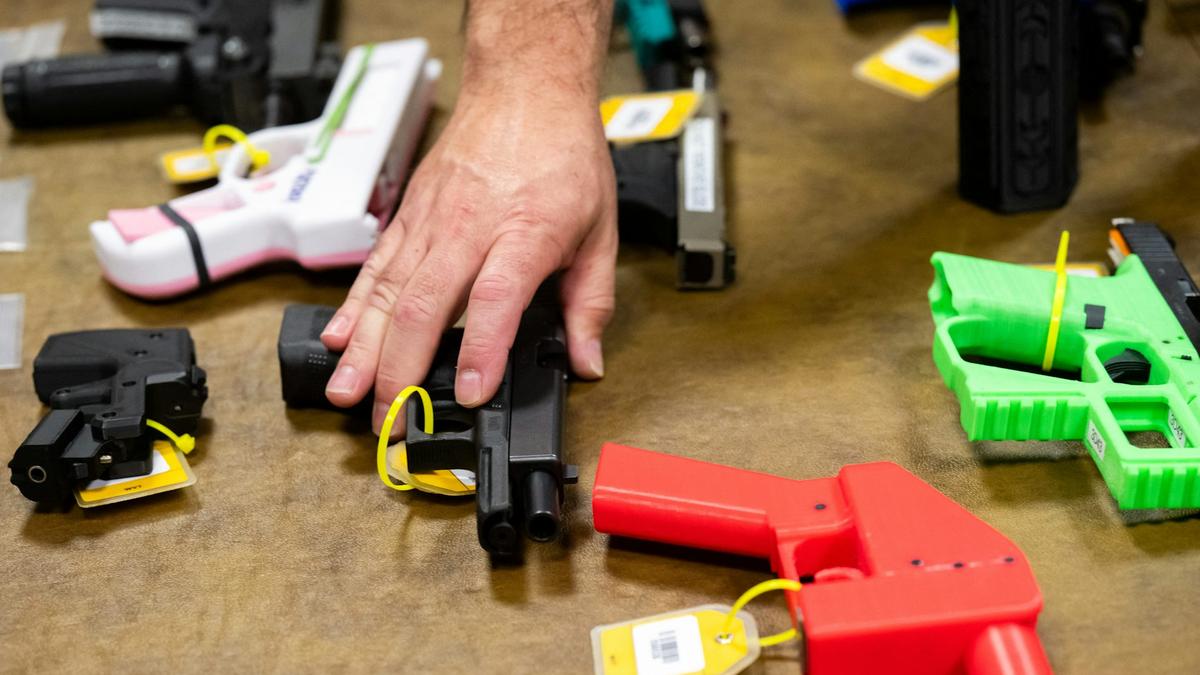
Police investigating the shooting of UnitedHealthcare CEO Brian Thompson on December 4, 2024, have announced that the suspected assailant had used a 3D-printed gun. Several high-profile crimes in recent years have involved this kind of homemade, or partially homemade, weapon.
Often called “ghost guns” because they can be hard to trace, these firearms can be either partially or completely made with components that have been produced in metal or plastic on commercially available 3D printers. The U.S. Supreme Court is considering the legality of current federal restrictions on these firearms.
The first known criminal case involving a 3D-printed gun resulted in the arrest of a U.K. man in 2013. But since then, police worldwide have reported finding increasing numbers of these weapons.
My research focuses on the economic and social effects of advanced digital technologies, including 3D printing. I see that the use of 3D-printed guns in criminal and violent activities is likely to continue to increase. And it will likely prove ever harder for governments and police to regulate these firearms.
Surge in arrests and seizures
Arrests and seizures connected to 3D-printed guns are escalating quickly. Between 2017 and 2021, U.S. law enforcement agencies seized and reported nearly 38,000 suspected ghost guns, according to a 2024 report from the U.S. Bureau of Alcohol, Tobacco, Firearms and Explosives. In 2021 alone, 19,273 suspected ghost guns were traced, a significant increase from 8,504 in 2020. The number of seized 3D-printed guns in New York state alone surged dramatically, from 100 in 2019 to 637 in 2022.
Arrests linked to 3D-printed guns are also rising. The world recorded 108 arrests in the first half of 2023, compared to 66 arrests in all 2022.
North America leads in 3D-printed gun-related arrests, with 166 cases from 2013 to June 2023. Europe followed with 48 arrests, while Oceania ranked third with 24 arrests.
The U.S. is a particular hot spot, with 36% of total global arrests related to 3D-printed firearms in 2023. But Canada is close behind, with 34%. The U.K. had 10%, and Australia had 8%.
Growing global security threat
Police and media reports indicate that many efforts to acquire or manufacture 3D-printed firearms were connected to plans for violent actions.
These guns have been used by diverse groups including far-right extremists, ethno-separatists, jihadists, left-wing anarchists, organized crime groups in Europe and pro-democracy rebels in Myanmar.
From 2019 to mid-2022, there were at least nine documented cases in Europe and Australia of extremists, terrorists or paramilitary groups either producing or attempting to produce firearms using 3D-printing technology. An analysis of 165 cases of 3D-printed firearms from 2013 to mid-2024 reveals that 15% were linked to terrorism. Far-right groups appear to be the most frequent users among terrorism-related cases.
A widely varied legal landscape
Often, 3D-printed guns are homemade firearms without serial numbers. This lack of identification makes them attractive to criminals because it is harder for law enforcement to link specific guns to particular crimes or suspects. Different countries take very different approaches to regulating these weapons.
Japan enforces stringent laws governing the manufacture, possession and sales of firearms. Its legal system strictly prohibits unauthorized firearm production, including 3D-printed guns. In 2014, a 28-year-old Japanese man was sentenced to two years in prison for producing plastic 3D-printed firearms.
In 2023, Canada effectively banned ghost guns. It is illegal to possess or manufacture them without a license from the government.
In Australia, making a 3D-printed firearm is illegal, and in some states, possessing a digital blueprint to create one is also an offense. In the state of New South Wales, a person convicted of possessing blueprints can face up to 14 years in prison. In Tasmania state, the punishment can be even more severe – up to 21 years in prison.
Across the European Union, making or owning homemade firearms, including 3D-printed ones, is broadly prohibited. However, laws and penalties vary, with some nations criminalizing even the possession of digital files or blueprints related to 3D-printing guns.
In the U.K., where firearms are very restricted, 3D-printed guns have been considered illegal. But in November 2022, the government updated the laws to specifically ban possessing, buying or producing parts for 3D-printed guns. The proposal aims to explicitly ban 3D-printed guns, addressing their unique challenges directly, rather than relying on existing laws designed for traditional firearms. The U.K. National Crime Agency has called for a ban on possessing blueprints as well, and Parliament is currently considering two bills proposing such a ban.
Federal rules in the US
The U.S. Constitution poses some unique challenges to regulating ghost guns, especially for the federal government, but also for states.
For regular firearms – that is, those not produced by 3D printing – U.S. federal law requires that a key component, called the lower receiver, bear a unique serial number. Purchasing a lower receiver requires a federal background check and conducting the transaction through a merchant who holds a Federal Firearms License.
The situation is more complicated when it comes to 3D printing weapons. The First Amendment to the Constitution protects freedom of expression, which includes sharing digital files that could contain firearm designs. And the Second Amendment protects citizens’ right to bear arms.
In the U.S., selling 3D-printed firearms requires a federal license. But producing or owning homemade firearms for personal use is allowed. That includes 3D-printing the lower receiver component, and assembling the rest of the weapon with unregulated parts.
Current federal law, under review by the Supreme Court, also requires 3D-printed guns meet specific guidelines, even if they do not contain any currently regulated firearms components. Under the rule, makers of ghost gun kits must obtain a federal license, conduct background checks, record information about their customers and add serial numbers to their products.
The type of weapon also matters when determining the legality of a 3D-printed firearm. Automatic weapons, or machine guns, can continue to fire ammunition as long as the user holds the trigger down. These weapons have been heavily regulated by federal law for almost 90 years.
Criminals have used 3D printers to produce “Glock switches” or auto-sears, which convert semi-automatic firearms into fully automatic machine guns. That turns those items into machine guns under federal law, making them illegal. Owning this kind of 3D-printed conversion device can lead to a maximum of 10 years in federal prison and a $250,000 fine.
In the states
The states can also regulate firearms, and many are trying to get control of 3D-printed guns.
By November 2024, 15 U.S. states had established regulations on ghost guns, though exact requirements vary. The rules typically require a serial number, background checks for firearm component purchases and reporting to authorities that a person is producing 3D-printed guns.
For instance, in New Jersey, a 2019 law mandates that all ghost guns have a serial number and be registered. Under current New York law, possession or distribution of a 3D-printed gun is classified as a misdemeanor. However, a proposed law seeks to elevate the manufacturing of firearms using 3D-printing technology to a felony offense.
As technology advances and rules evolve, criminals who use 3D-printed firearms will continue to pose threats to public safety and security, and governments will continue playing catch-up to effectively regulate these weapons.
This article is republished from The Conversation under a Creative Commons license. Read the original article here.
Published – December 24, 2024 04:48 pm IST