





The story so far: The Indian Space Research Organisation (ISRO) has said its PSLV-C58/XPoSat mission has practically left zero debris in earth’s orbit. The space agency explained that the last stage of the Polar Satellite Launch vehicle (PSLV) used in the mission was transformed into a kind of orbital station — called the PSLV Orbital Experimental Module-3 (POEM-3) — before it was left to re-enter the earth’s atmosphere instead of floating in orbit once its mission was completed.
ISRO said that after it completed the primary mission of injecting all satellites into their target orbits, the fourth stage of the PSLV was transformed into the POEM-3. It was subsequently de-orbited from 650 kilometres to 350 kilometres, rendering it more susceptible to being pulled towards the earth and burning up in the atmosphere. ISRO also said it “passivated the stage,” meaning dumped its fuel, to avoid an explosion that could have flung small pieces of debris into orbit.
What is POEM?
Developed by the Vikram Sarabhai Space Centre (VSSC) as an inexpensive space platform, POEM uses the spent fourth stage of a PSLV rocket as an orbital platform. Used for the first time in the PSLV-C53 mission in June 2022, ISRO had POEM orbit the earth as a stabilised platform to perform in-orbit scientific experiments with various payloads.
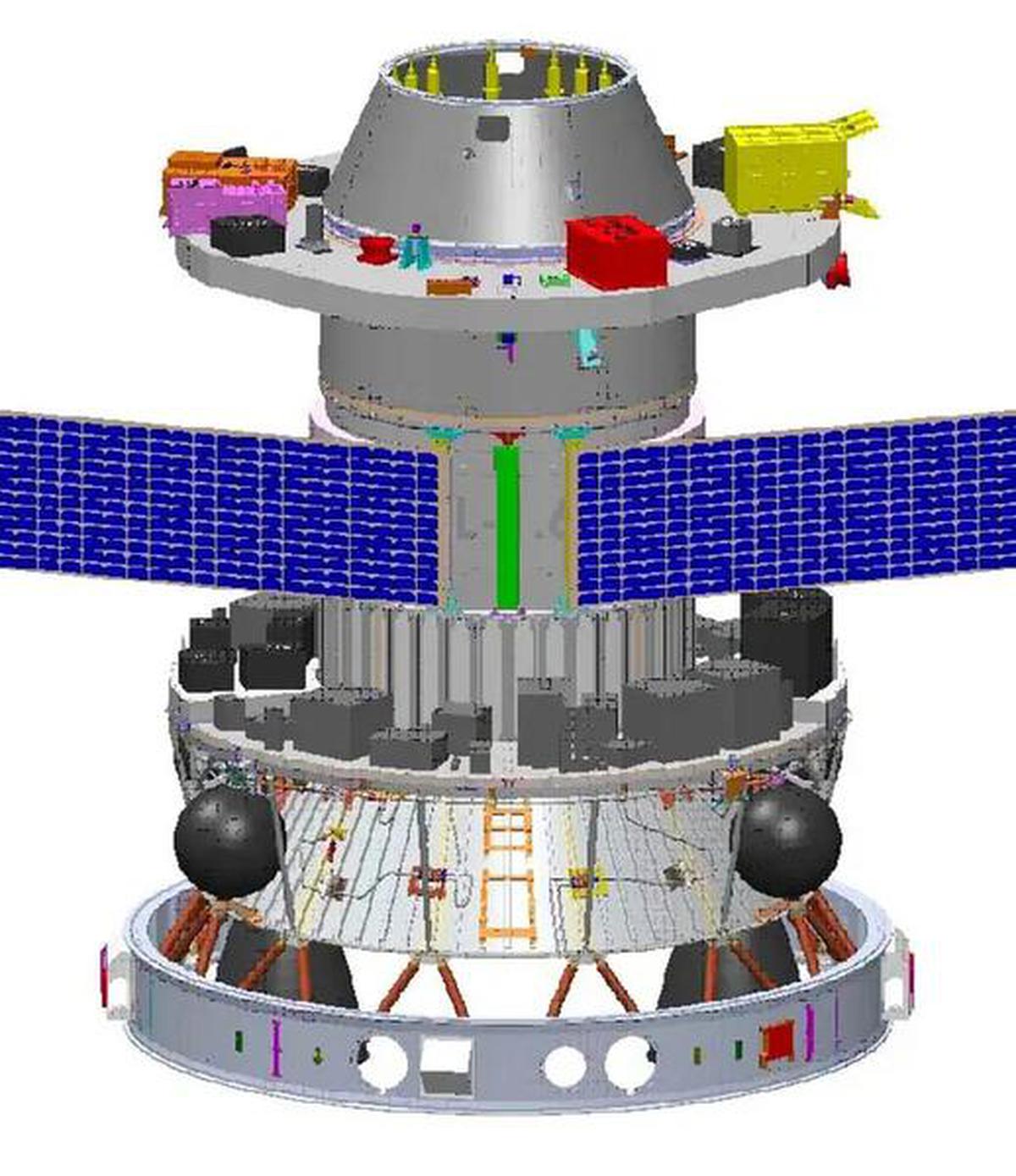
Image of PSLV Orbital Experimental Module (POEM)
POEM is powered by solar panels mounted on the fuel tank of the rocket’s fourth stage and a lithium-ion (Li-ion) battery. It has a dedicated navigation, guidance, and control (NGC) system to stabilise its altitude along with helium control thrusters. The NGC system has four Sun sensors, a magnetometer, and gyroscopes, and talks to ISRO’s NavIC satellite constellation for navigation. POEM also has a telecommand system to communicate with the ground station.
ISRO first demonstrated the reuse of the spent fourth stage of its rocket in its PSLV C-44 mission in 2019. After satellites were injected in the target orbits, the fourth stage, carrying a student payload called Kalamsat-V2, was moved to a higher circular orbit of 443 km and stayed there, allowing the payload to make observations.
What has POEM-3 achieved?
ISRO launched the PSLV C-58 mission from the Satish Dhawan Space Centre in Sriharikota on January 1, 2024. After deploying the XpoSat satellite in its desired orbit of 650 km, the fourth stage, now called POEM-3, was lowered to a 350-km high circular orbit. The lower a satellite is in orbit around the earth, the more drag it experiences and the more energy it needs to expend to stay in orbit.

POEM-3 featured nine payloads: two each from VSSC and Bellatrix Aerospace Pvt Ltd, one each from the start-ups TakeMe2Space, Inspecity Space Labs Pvt Ltd., Dhruva Space, and from LBS Institute of Technology, KJ Somaiya Institute of Technology, and ISRO’s Physics Research Laboratory, Ahmedabad.
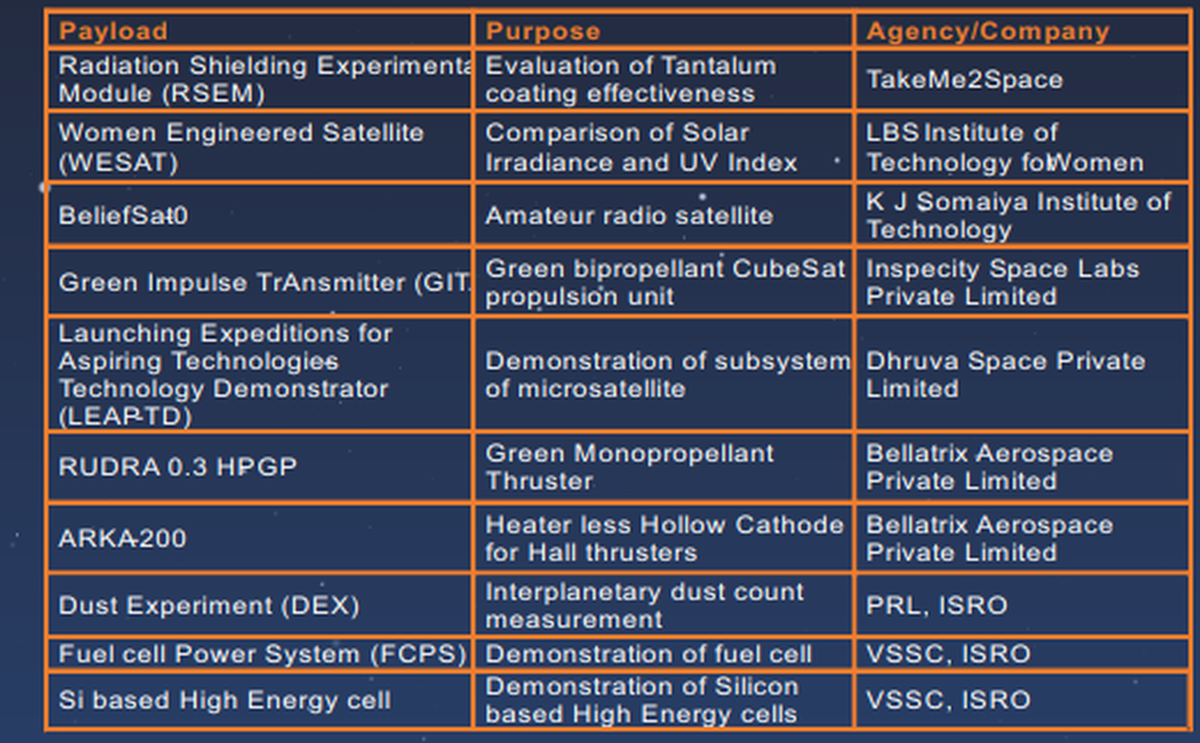
POEM-3’s payloads and their experiments
| Photo Credit:
ISRO
POEM-3 completed 400 orbits around the earth by its 25th day. The payloads were operationalised to perform their experiments during this time. ARKA200, RUDRA, and LEAP-TD completed their respective experiments while the data from WeSAT, RSEM, and DEX were collected after every orbit for further analysis on the ground. Two fuel cells from VSSC demonstrated their ability to generate power. By January 27, 2024, all of POEM-3’s payload objectives were completed.
For two months, POEM-3 prepared for its re-entry while ISRO tracked it with its Telemetry, Tracking and Command Network (ISTRAC) stations in Bengaluru, Lucknow, Mauritius, Sriharikota, Port Blair, Thiruvananthapuram, Brunei, and Biak (Indonesia) and the Multi-Object Tracking Radar (MOTR) at Sriharikota. On March 21, POEM-3 reentered the earth’s atmosphere, meeting its fiery end.
Why is this significant?
With the rise in the number of satellites in orbit around the earth, space debris has become a pressing issue. Space debris in the low earth orbit (LEO) mainly comprises pieces of spacecraft, rockets, and defunct satellites, and the fragments of objects that have deteriorated explosively as a result of anti-satellite missile tests. This debris often flies around at high speeds of up to 27,000 kilometres per hour. Due to their sheer volume and momentum, they pose a risk to several space assets.
Millions of man-made debris and naturally occurring micrometeoroids orbit in and around Earth’s space environment at hypervelocity speeds averaging 10 km/s (22,000 mph)
The LEO extends from 100 km above the earth’s surface up to 2000 km above. It includes satellites tracking intelligence data, encrypted communication, and navigation. According to ISRO’s Space Situational Assessment report 2022, the world placed 2,533 objects in space in 179 launches in 2022, up from 1860 objects in 135 launches in 2021.
Also Read | Sign of the future: On ISRO’s PSLV C58 mission
Debris also exists, but in smaller volumes, in the geosynchronous orbit (GEO), which is 36,000 km above the earth’s surface. Currently, there are 7,000 operational satellites orbiting the earth at different altitudes along with millions of pieces of space debris. The U.S. Space Command tracks and catalogues space debris larger than 10 centimetres in LEO and larger than 0.3-1 metres in GEO.
In 2022, four on-orbit break-up events occurred, contributing to most of the debris created that year:
- March 2022: Intentional destruction of Russia’s Cosmos 1048 in an anti-satellite test adding 1408 fragments of debris
- July 2022: Break-up of the upper stage of Japanese H-2A while deploying GOSAT-2 satellite adding 52 fragments of debris
- November 2022: Accidental explosion of the upper stage of China’s Yunhai-3 adding 533 pieces of debris
- November 2022: Break up of the Japanese H-2A upper stage for the deployment of GCOM satellite adding 30 pieces of debris
The latest incident of space debris causing havoc was recorded on March 8 when a chunk of metal believed to be a discarded battery pallet from the International Space Station ripped through the roof and two stories of a house in Florida. The cylindrical piece, weighing almost 1 kilogram, was recorded by the US Space Command while re-entering the Earth’s atmosphere over the Gulf of Mexico, on a path towards south-west Florida at 2.29 PM that day. Five minutes later, the security camera of the house caught the sound of the metal crashing into it. NASA is still investigating the incident.
A major contributor to the rising number of satellites is American launch-services provider company Space X, which is currently also building a large constellation of 12,000 satellites to provide internet services worldwide. The project, named Starlink, has deployed satellites in 550 km, 540-570 km, and 335-345 km orbits and is expected to be completed by 2027. SpaceX has also applied for a second generation of Starlink satellites comprising 30,000 LEO satellites.
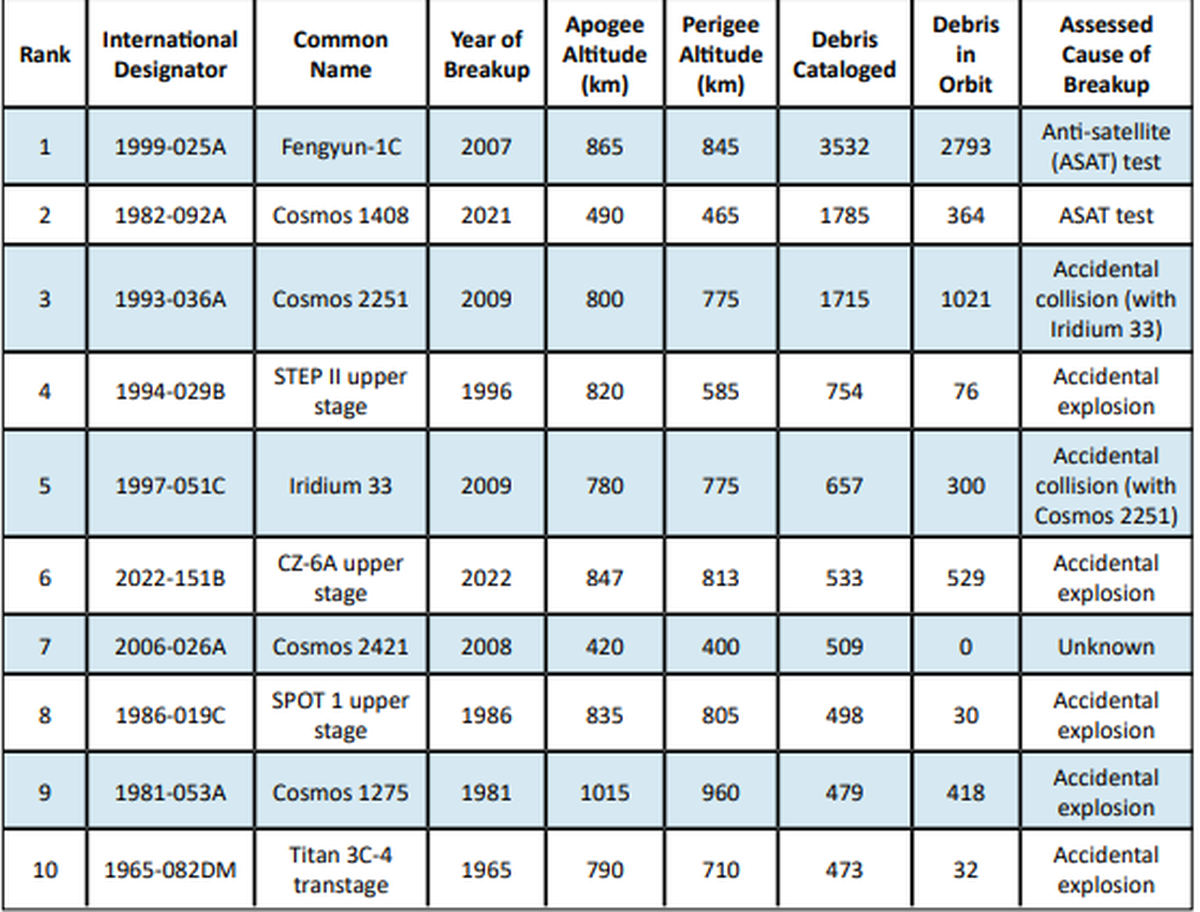
Ten of the most damaging events creating space debris in recent years
| Photo Credit:
NASA
As more communication satellites/constellations are launched and more anti-satellite tests are conducted, more on-orbit breakup and collisions occur, producing smaller and smaller fragments in orbit. The number of space objects (debris or functional equipment) greater than 10 cm in size in LEO is expected to be about 60,000 by 2030, per ISRO estimates. Space debris also leads to two major risks – it creates unusable regions of the orbit due to excessive debris, and leads to the ‘Kessler syndrome’ – creation of more debris due to cascading collisions resulting from one collision.
How are space agencies dealing with debris?
Currently, there are no international space laws pertaining to LEO debris. However, most space-exploring nations abide by the Space Debris Mitigation Guidelines 2002 specified by the Inter-Agency Space Debris Coordination Committee (IADC), which the U.N. endorsed in 2007.
The guidelines outline methods to limit accidental collisions in orbit, break-ups during operations, intentional destruction, and post-mission break-ups. They also advise against the long-term presence of spacecraft and launch vehicle orbital stages in LEO and limit their interference in the GEO region.
NASA had instituted its Orbital Debris Program in 1979 to find ways to create less orbital debris and design equipment to track and remove existing debris. Currently, the sixth U.S. Armed forces wing, called the Space Force, tracks space debris and collisions in LEO. However, the agency has not implemented any technology to clean such debris yet; most such ideas are in the conceptual stage.
Similarly, the European Space Agency (ESA) has adopted a ‘Zero Debris charter,’ which includes multiple ways to mitigate space debris. It has also called for zero space debris by 2030 and seeks that other agencies adopt it as well.
On November 5, 2022, China was widely criticised when its rocket Long March 5B plunged into the Pacific Ocean after it broke up upon re-entry. Ranking among one of history’s most damaging break-ups, one of the more than 500 pieces left of the core stage was about 30 metres long and weighed between 17 and 23 tonnes.
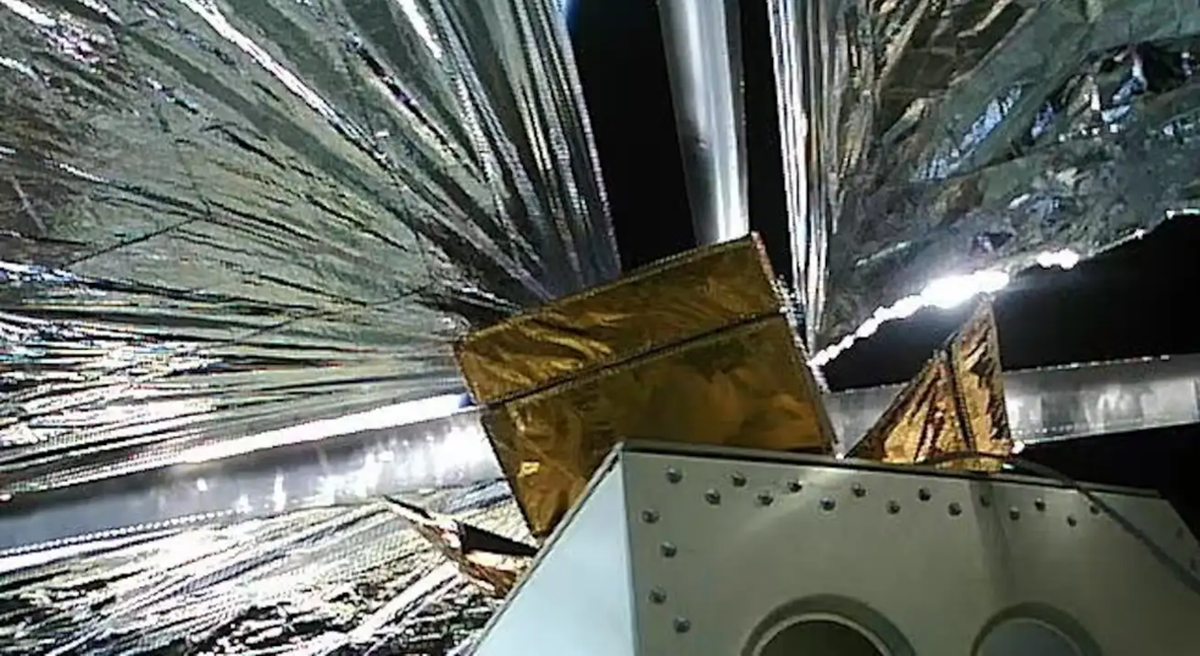
This kite-like space sail helps de-orbit spent rocket stages.
| Photo Credit:
Shanghai Academy of Spaceflight Technology
Days later, China deployed a large spacecraft designed to de-orbit its defunct spacecraft. The device had a very slim ‘solar sail’ attached to the payload adapter, which when unfolded expanded to a 269 square foot sheet that would push defunct rocket parts towards the earth for faster re-entry
Japan also has a project, called the Commercial Removal of Debris Demonstration (CRD2), to tackle space junk. The Japan Aerospace Exploration Agency (JAXA) has partnered with private space company Astroscale to assess debris in phase I of the programme. In the second phase, JAXA will launch a satellite to approach the debris and rendezvous with it before capturing and removing it from orbit. Currently, JAXA is conducting tests of this craft.
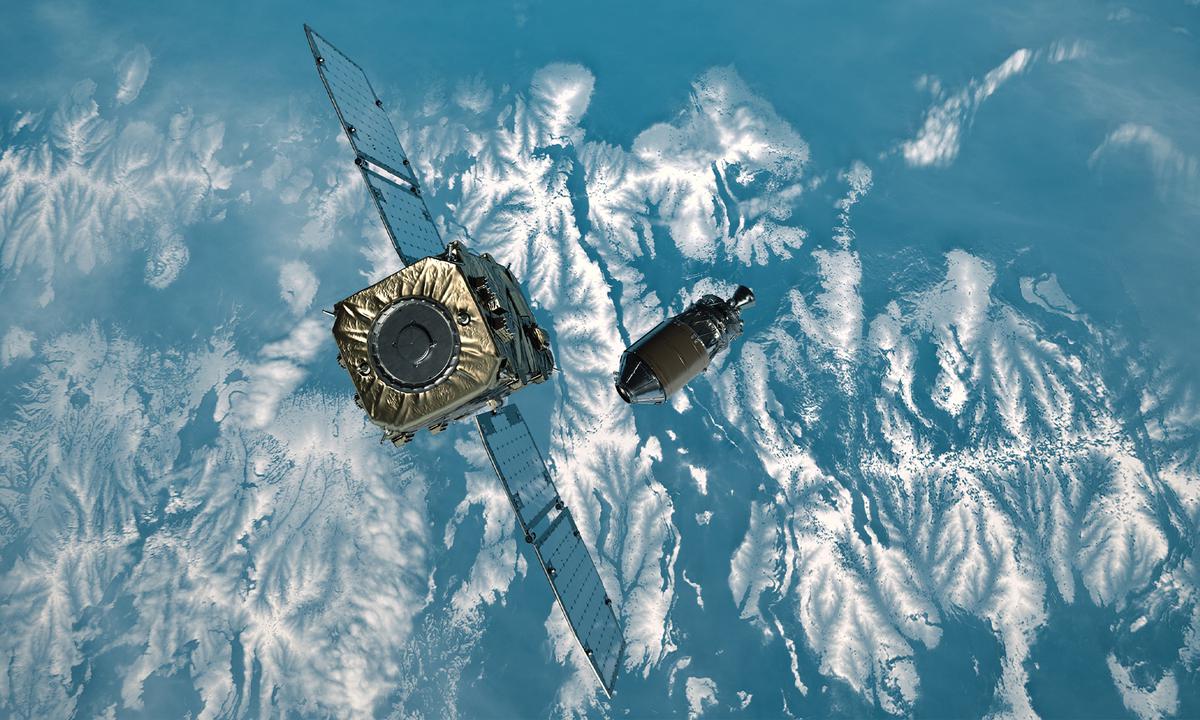
An artist’s image of a CRD2 phase-I mission.
| Photo Credit:
Astroscale
Private companies in both Japan and China are also competing for debris clean-up contracts. Japan’s Astroscale is developing a method to refuel and repair satellites in space, allowing each de-orbiting mission to operate for longer. China’s Origin Space has launched a prototype robot capable of capturing debris with a large net.
India is working to mitigate space debris. Apart from the POEM missions, ISRO has set up a Space Situational Awareness Control Centre to protect its high-value assets from close approaches and collisions with inactive satellites, pieces of orbiting objects, and even near-earth asteroids. An Indian start-up named Manastu Space is working on technologies like in-space refuelling, de-orbiting of old satellites, and satellite life extension.
- ISRO said that after it completed the primary mission of injecting all satellites into their target orbits, the fourth stage of the PSLV was transformed into the POEM-3.
- POEM is powered by by solar panels mounted on the fuel tank of the rocket’s fourth stage and a lithium-ion (Li-ion) battery.
- With the rise in the number of satellites in orbit around the earth, space debris has become a pressing issue.