


Skip to content
  • Facebook
  • X
  • Linkedin
  • WhatsApp
  • YouTube
  • Associate Journalism
  • About Us
  • Privacy Policy
  • 033-46046046
  • editor@artifex.news
Artifex.News

Artifex.News

Stay Connected. Stay Informed.

  • Breaking News
  • World
  • Nation
  • Sports
  • Business
  • Science
  • Entertainment
  • Lifestyle
  • Toggle search form
  • Economic Superpowers Like India Reshaping Global Economy: Rishi Sunak
    Economic Superpowers Like India Reshaping Global Economy: Rishi Sunak World
  • Access Denied Sports
  • Five drown in Cauvery river near Muthathi in Karnataka
    Five drown in Cauvery river near Muthathi in Karnataka Nation
  • Rahul Gandhi, Akhilesh Yadav Leave Rally Without Giving Speech. Here’s Why
    Rahul Gandhi, Akhilesh Yadav Leave Rally Without Giving Speech. Here’s Why Nation
  • Access Denied Sports
  • This Reason Could Shift Pakistan’s Home Test Series vs England To Sri Lanka Or UAE: Report
    This Reason Could Shift Pakistan’s Home Test Series vs England To Sri Lanka Or UAE: Report Sports
  • Access Denied Sports
  • FIFA World Cup Round of 32 LIVE: USA vs Bosnia-Herzegovina knockout clash under way
    FIFA World Cup Round of 32 LIVE: USA vs Bosnia-Herzegovina knockout clash under way Sports
Earliest-known galaxy, spotted by Webb telescope, is a beacon to cosmic dawn

Earliest-known galaxy, spotted by Webb telescope, is a beacon to cosmic dawn

Posted on June 1, 2024 By admin


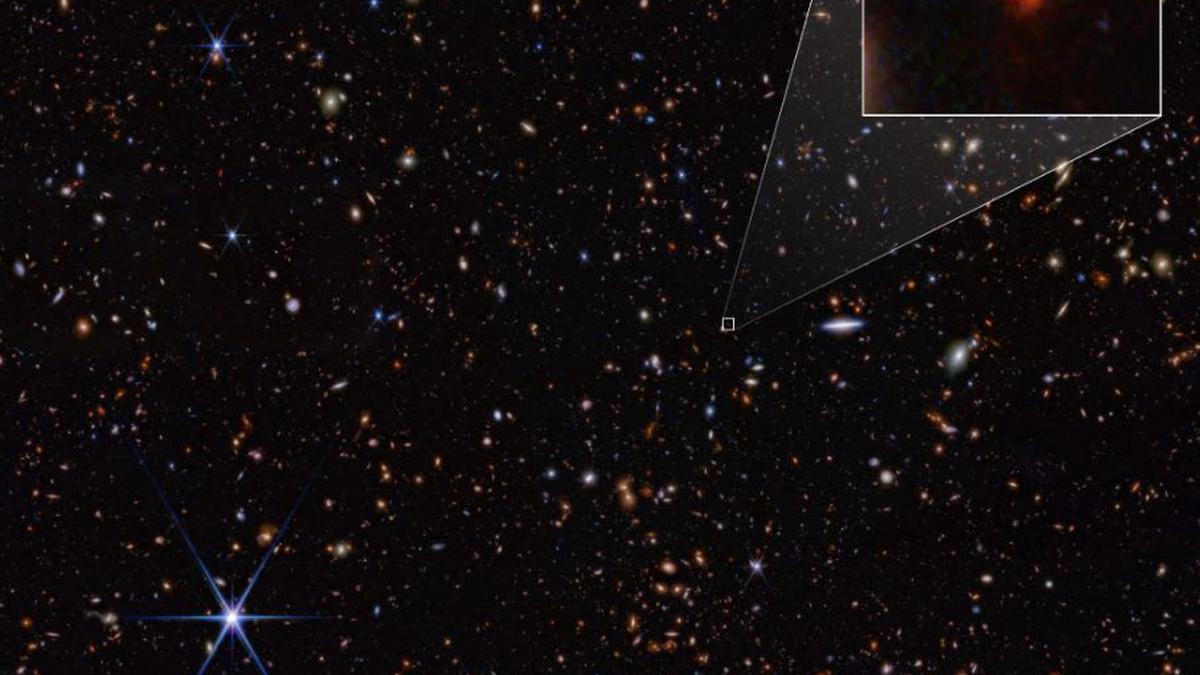
This handout image obtained on May 30, 2024 courtesy of NASA/ESA/CSA STScI shows an infrared image from NASA’s James Webb Space Telescope. A galaxy, JADES-GS-z14-0 (shown in the pullout), was determined to be at a redshift of 14.32 (+0.08/-0.20), making it the current record-holder for the earliest known galaxy.
| Photo Credit: AFP

NASA’s James Webb Space Telescope has spotted the earliest-known galaxy, one that is surprisingly bright and big considering it formed during the universe’s infancy— at only 2% its current age.

Webb, which by peering across vast cosmic distances is looking way back in time, observed the galaxy as it existed about 290 million years after the Big Bang event that initiated the universe roughly 13.8 billion years ago, the researchers said. This period spanning the universe’s first few hundred million years is called cosmic dawn.

The telescope, also called JWST, has revolutionized the understanding of the early universe since becoming operational in 2022. The new discovery was made by the JWST Advanced Deep Extragalactic Survey (JADES) research team.

This galaxy, called JADES-GS-z14-0, measures about 1,700-light years across. A light year is the distance light travels in a year, 5.9 trillion miles (9.5 trillion km). It has a mass equivalent to 500 million stars the size of our sun and was rapidly forming new stars, about 20 every year.

Before Webb’s observations, scientists did not know galaxies could exist so early, and certainly not luminous ones like this.

“The early universe has surprise after surprise for us,” said astrophysicist Kevin Hainline of Steward Observatory at the University of Arizona, one of the leaders of the study published online this week ahead of formal peer review.

“I think everyone’s jaws dropped,” added astrophysicist and study co-author Francesco D’Eugenio of the Kavli Institute for Cosmology at the University of Cambridge. “Webb is showing that galaxies in the early universe were much more luminous than we had anticipated.”

Until now, the earliest-known galaxy dated to about 320 million years after the Big Bang, as announced by the JADES team last year.

“It makes sense to call the galaxy big, because it’s significantly larger than other galaxies that the JADES team has measured at these distances, and it’s going to be challenging to understand just how something this large could form in only a few hundred million years,” Mr. Hainline said.

“The fact that it’s so bright is also fascinating, given that galaxies tend to grow larger as the universe evolves, implying that it would potentially get significantly brighter in the next many hundred million years,” Mr. Hainline said.

While it is quite big for such an early galaxy, it is dwarfed by some present-day galaxies. Our Milky Way is about 100,000 light years across, with the mass equivalent to about 10 billion sun-sized star.

The JADES team in the same study disclosed the discovery of the second oldest-known galaxy, from about 303 million years post-Big Bang. That one, JADES-GS-z14-1, is smaller – with a mass equal to about 100 million sun-sized stars, measuring roughly 1,000 light years across and forming about two new stars per year.

“These galaxies formed in an environment that was much more dense and gas-rich than today. In addition, the chemical composition of the gas was very different, much closer to the pristine composition inherited from the Big Bang – hydrogen, helium and traces of lithium,” Mr. D’Eugenio said.

Star formation in the early universe was much more violent than today, with massive hot stars forming and dying quickly, and releasing tremendous amount of energy through ultraviolet light, stellar winds and supernova explosions, Mr. D’Eugenio said.

Three main hypotheses have been advanced to explain the luminosity of early galaxies. The first attributed it to supermassive black holes in these galaxies gobbling up material. That appears to have been ruled out by the new findings because the light observed is spread over an area wider than would be expected from black hole gluttony.

It remains to be seen whether the other hypotheses – that these galaxies are populated by more stars than expected or by stars that are brighter than those around today – will hold up, Mr. D’Eugenio said.



Source link

Science Tags:cosmic dawn, James Webb Space Telescope, James Webb Space Telescope nasa, Milky Way, nasa James Webb Space Telescope

Post navigation

Previous Post: Borussia Dortmund Dream Of Shocking Real Madrid In Champions League Final
Next Post: Israel maintains a shadowy hospital in the desert for Gaza detainees. Critics allege mistreatment

Related Posts

  • IISc scientists find a way to break down ‘biofilm barriers’ by using cow’s gut enzyme to aid entry of drugs
    IISc scientists find a way to break down ‘biofilm barriers’ by using cow’s gut enzyme to aid entry of drugs Science
  • Researchers identify key genetic factors causing oral cancer early among Indian tobacco chewers
    Researchers identify key genetic factors causing oral cancer early among Indian tobacco chewers Science
  • Will chocolate’s future hinge on success of growing cocoa in the lab?
    Will chocolate’s future hinge on success of growing cocoa in the lab? Science
  • What is combustion?
    What is combustion? Science
  • In a first, RNA is recovered from extinct Tasmanian tiger
    In a first, RNA is recovered from extinct Tasmanian tiger Science
  • Boeing launches NASA astronauts for the first time after years of delays
    Boeing launches NASA astronauts for the first time after years of delays Science

More Related Articles

Cost concerns delay safer building codes despite Himalayan threats Cost concerns delay safer building codes despite Himalayan threats Science
Ancient DNA suggests women were at the heart of social networks in Celtic society in Britain Ancient DNA suggests women were at the heart of social networks in Celtic society in Britain Science
How does the human brain’s biological clock track a 24-hour day? How does the human brain’s biological clock track a 24-hour day? Science
The Science Quiz | Make way for the railway technologies express The Science Quiz | Make way for the railway technologies express Science
Dyson sphere: an energy devourer Dyson sphere: an energy devourer Science
What does World Thrift Day have to do with physics? What does World Thrift Day have to do with physics? Science
SiteLock

Archives

  • September 2026
  • August 2026
  • July 2026
  • June 2026
  • May 2026
  • April 2026
  • March 2026
  • February 2026
  • January 2026
  • December 2025
  • November 2025
  • October 2025
  • September 2025
  • August 2025
  • July 2025
  • June 2025
  • May 2025
  • April 2025
  • March 2025
  • February 2025
  • January 2025
  • December 2024
  • November 2024
  • October 2024
  • September 2024
  • August 2024
  • July 2024
  • June 2024
  • May 2024
  • April 2024
  • March 2024
  • February 2024
  • January 2024
  • December 2023
  • November 2023
  • October 2023
  • September 2023
  • August 2023
  • July 2023
  • June 2023
  • May 2023
  • April 2023
  • March 2023
  • February 2023
  • January 2023
  • December 2022
  • November 2022
  • October 2022
  • September 2022
  • August 2022
  • July 2022
  • June 2022
  • May 2022

Categories

  • Business
  • Nation
  • Science
  • Sports
  • World

Recent Posts

  • Higher education council holds talks with Indo-German centre official
  • 172 candidates receive appointment letters at Visakhapatnam Rozgar Mela
  • Flawed AI-linked intel almost led U.S. to board China ship: report
  • IIT Bombay faculty member booked for caste abuse, suicide abetment
  • Arjun finds form as India beats Spain; Savitha stars for women

Recent Comments

  1. AlvinNet on UP Teacher Who Asked Students To Slap Muslim Classmate
  2. AlvinNet on UP Teacher Who Asked Students To Slap Muslim Classmate
  3. Jamesslits on UP Teacher Who Asked Students To Slap Muslim Classmate
  4. MichaelClear on UP Teacher Who Asked Students To Slap Muslim Classmate
  5. Jamesslits on UP Teacher Who Asked Students To Slap Muslim Classmate
  • Ban vs WI 2nd Test: Rana’s five-for and Mehidy’s blitz lead Bangladesh to 211-run lead over West Indies
    Ban vs WI 2nd Test: Rana’s five-for and Mehidy’s blitz lead Bangladesh to 211-run lead over West Indies Sports
  • India’s LPG dependence on U.S. | Explained
    India’s LPG dependence on U.S. | Explained Business
  • India Reports Over 40,000 Suspected Heatstroke Cases This Summer
    India Reports Over 40,000 Suspected Heatstroke Cases This Summer Nation
  • Access Denied Sports
  • Delhi government plans digital upgrade of sub-registrar offices to curb delays, fraud
    Delhi government plans digital upgrade of sub-registrar offices to curb delays, fraud Nation
  • Thalloru LIS phase-2 launched in Kakinada
    Thalloru LIS phase-2 launched in Kakinada Nation
  • Former India Pacer Varun Aaron Retires From ‘Representative Cricket’
    Former India Pacer Varun Aaron Retires From ‘Representative Cricket’ Sports
  • “Like Mahabharat…”: Pakistan Great On Hype In World Cup Game vs India, Explains Why His Team Will Be ‘Lonely’
    “Like Mahabharat…”: Pakistan Great On Hype In World Cup Game vs India, Explains Why His Team Will Be ‘Lonely’ Sports

Editor-in-Chief:
Mohammad Ariff,
MSW, MAJMC, BSW, DTL, CTS, CNM, CCR, CAL, RSL, ASOC.
editor@artifex.news

Associate Editors:
1. Zenellis R. Tuba,
zenelis@artifex.news
2. Haris Daniyel
daniyel@artifex.news

Photograher:
Rohan Das
rohan@artifex.news

Artifex.News offers Online Paid Internships to college students from India and Abroad. Interns will get a PRESS CARD and other online offers.
Send your CV (Subjectline: Paid Internship) to internship@artifex.news

Links:
Associate Journalism
About Us
Privacy Policy

News Links:
Breaking News
World
Nation
Sports
Business
Entertainment
Lifestyle

Registered Office:
72/A, Elliot Road, Kolkata - 700016
Tel: 033-22277777, 033-22172217
Email: office@artifex.news

Editorial Office / News Desk:
No. 13, Mezzanine Floor, Esplanade Metro Rail Station,
12 J. L. Nehru Road, Kolkata - 700069.
(Entry from Gate No. 5)
Tel: 033-46011099, 033-46046046
Email: editor@artifex.news

Copyright © 2023 Artifex.News Newsportal designed by Artifex Infotech.