


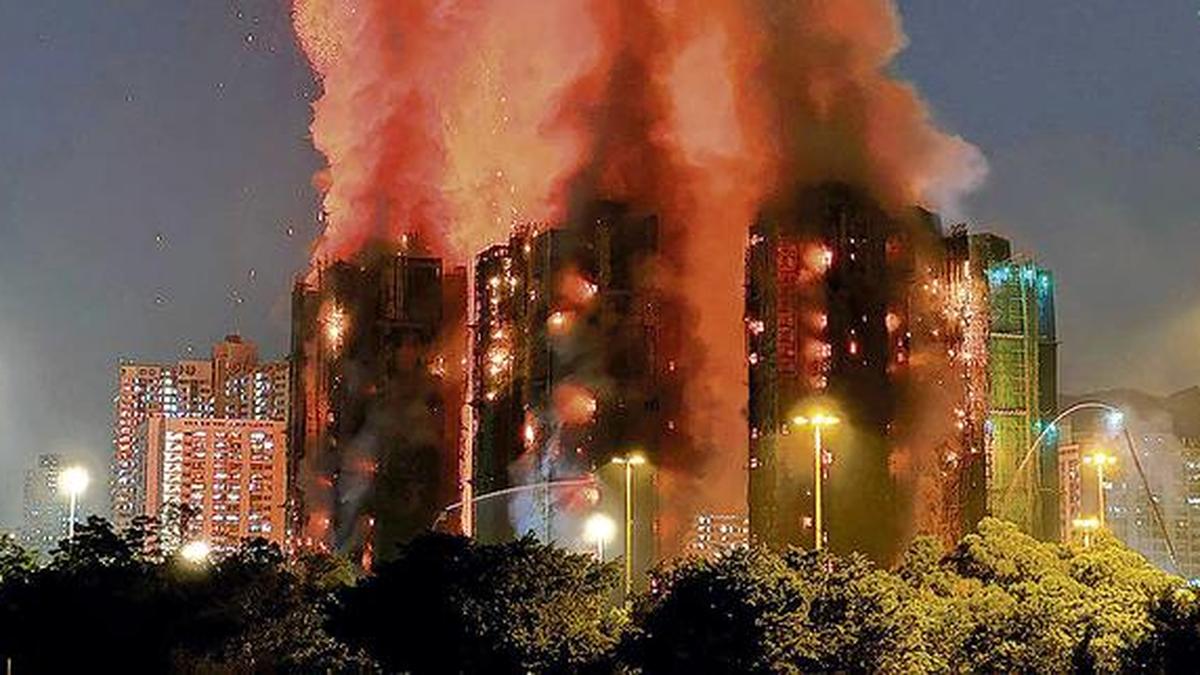
On November 26, a fire started on scaffolding at the Wang Fuk Court housing complex in Tai Po in Hong Kong and spread rapidly across multiple high-rise blocks wrapped in bamboo and other flammable external materials. At least 44 people had died as of 7 am IST (November 27) while hundreds were missing. The local police had reportedly arrested three construction executives even as investigators were looking into how renovation work on the structure had allowed the fire to spread vertically so fast.
Why do buildings burn?
Buildings burn when three things come together and keep feeding each other: heat, fuel, and oxygen. Potential ignition sources include short circuits, welding sparks or a kitchen flame but also any fireworks inside or nearby. The heat from these sources heats nearby material until it decomposes and releases flammable gases. Those gases can mix with air and burn, releasing even more heat, which then warms other materials.
In a building filled with plastics, fabrics, paper, and synthetic foams, this positive feedback loop can quickly avalanche into a big fire. Once a room’s surfaces all get hot enough, the space can reach a point called flashover, when almost everything ignites within seconds and the fire becomes very hard to control or survive.
Many large fires since 2000 have started off as localised blazes that the structures’ geometry and construction materials fanned into building-scale disasters. Architects and engineers have known that external scaffolding, cladding systems, and cavities on the façade can act like open chimneys that allow hot gases to race upwards, pulling in fresh air from below and warming up the higher levels.
How are occupants put at risk?
In Hong Kong, based on an early assessment by investigators, bamboo poles and plastic mesh that surrounded the towers gave the first fire a continuous and combustible path up the towers’ exterior. Similarly, in Shanghai in 2010, sparks from welding had ignited nylon netting and bamboo scaffolding, and the resulting fire spread into a 28-storey apartment building under renovation.
In London’s Grenfell Tower in 2017, an electrical fault in a fridge started a small flat fire, but flammable cladding and insulation on the façade plus a ventilated gap behind the panels created a powerful artificial chimney that carried flames rapidly up the tower, killing 72 people. A similar sort of external cladding contributed to repeated fires at Dubai’s Torch Tower in 2015 and 2017.
Inside buildings, the way a fire grows is shaped by the fire load (i.e. the quantity of materials that can burn), compartmentation, and escape routes. Hospitals, nightclubs, offices, and factories in particular are known to have a dense fire load, including beds, medical plastics, soundproofing foam, paper files, stored chemicals, and textiles.
When ignition occurs in a poorly compartmented space, flames and smoke can spread through stairwells and ceiling voids. The 2011 AMRI Hospital fire in Kolkata began with an electrical fault in the basement, where hospital administrators had stored flammable materials. The smoke and heat moved upwards even as alarms and attempts at evacuation failed, and eventually 89 people died.
In the Station nightclub fire in the US in 2003, pyrotechnics ignited polyurethane foam around the stage. Within minutes, the foam and ceiling were burning, and smoke and overcrowding together led to the death of 100 people, compounded by a lack of sprinklers. A similar story played out in 2016 at the Ghost Ship warehouse fire in California, where 36 people died during a party in a cluttered and illegally converted warehouse with no sprinklers or alarms.
More than 250 workers died in the Ali Enterprises garment factory fire in Karachi in 2012 because the company’s owners and managers had barred the windows and locked the exits, so the workers couldn’t outrun the smoke and heat, even though the structure itself didn’t collapse immediately. In Dhaka’s FR Tower fire in 2019, office workers were trapped in a high-rise building that had few usable exits and no sprinklers, again allowing an ordinary fire to become lethal. Twenty-five people were killed.
How can buildings collapse?
The structure of a building also determines how long it can stand when it’s on fire. While steel is strong, it loses much of that virtue when it’s exposed to temperatures of 500º to 600º C. Without proper fireproofing, then, a building’s beams and columns can start sagging, pulling other elements out of alignment. In Madrid’s Windsor Tower in 2005, the concrete core and some protected elements withstood the heat but unprotected steel perimeter members failed, leading to a partial collapse of the structure.
In 2017, Tehran’s Plasco Building — a high-rise with a steel frame and a significant fire load — the absence of sprinklers and low compartmentation allowed a fire to burn for long enough to cause a floor to collapse, which led to more failures around the building that eventually pulled the whole structure down. In 2001, at New York’s World Trade Centre, the aircrafts’ collisions with the Twin Towers stripped them of fireproofing, and large, multi-floor fires heated the floor trusses and columns until they buckled. The tragic result was the complete collapse of the towers despite their modern design.
In most of these examples, the ignition was usually in the form of routine activity such as electrical faults, hot work, fireworks, cooking, etc. The main killers were subsequently the fast spread of the fire and smoke rather than exotic fuels. The rapid spread was facilitated by combustible façades, scaffolding, insulation, and materials indoors, which together created continuous fuel beds and chimneys.
How can building fires be prevented?
When they design and construct a (reasonably well-funded) building, engineers and architects generally assume that small fires will occur, so much of the design is already invested in keeping an accidental fire in one place for a set period of time, thus allowing the occupants to leave before the conditions become lethal.
The central idea is, once again, to have compartments. The floors, walls, and ceilings are arranged to create fire compartments with a specific fire-resistance rating. To do that, builders build them with concrete, fire-resistant masonry and/or protected steel (which is steel that’s been given a fire-resistant coating or encasement that slows the transfer of heat). Fire doors and fire-resisting glazing are also used to close openings between compartments. The ultimate desired effect is for each such compartment to resist the spread of a fire for 60 minutes, 120 minutes or so on.
Modern building codes also attempt to prevent fires from racing upwards or across the outside of a building by restricting the use of combustible cladding and balcony materials and by forcing designers to break up continuous air gaps behind façades with interruptions. Architects and engineers may also select materials that prevent structural collapse in exchange for being damaged themselves. After the Grenfell Tower fire, for instance, the UK banned certain combustible materials in the external walls of high-rise housing and later extended this to hotels, hospitals, and other buildings. In fact there’s now a move to ban metal composite panels with a polyethylene core on many buildings altogether.
Building codes in many countries, including India, also specify minimum separation distances between buildings and impose limits on the floor area per compartment to reduce the chances of an external fire spreading from one part of a city block to another.
What can passive protection look like?
Designers also consider methods to passively protect a building’s occupants, starting by considering how long a given structure can stand and how long its various escape routes remain usable.
Structural components that would otherwise be vulnerable to heat — such as steel beams and columns — are thus encased in concrete or coated with intumescent materials. These coatings swell when heated, forming an insulating char that slows the rise in the steel’s temperature and helps the frame retain its load-bearing capacity for longer during a fire.
Lift lobbies and firefighting shafts are similarly enclosed in fire-resistant construction, often with pressurisation systems that maintain higher air pressure in the stairs so that smoke is pushed away from people’s escape paths.
In many high-rise designs, buildings also provide ‘refuge floors’ and ‘refuge areas’ at regular intervals that together form protected spaces where people who can’t descend quickly can wait in comparatively cool and smokeless conditions.