






Space stations, lunar bases, and Mars missions have moved from humans’ imagination to engineering reality. In these environments, innovation emerges through collaboration rather than isolation.
Living on the moon or Mars will depend on continuous technological innovation, including on systems that extract water, generate energy and recycle waste and which can adapt to harsh and unpredictable conditions. Innovation in space is the condition for survival, and isn’t optional.
Longer habitation means shared habitats, shared infrastructure, and multinational crews working together over extended periods. Scientists, engineers, and technicians from different jurisdictions have to collaborate closely, refining technologies in real time as operational needs evolve.
And when such innovation takes place beyond Earth, a simple question arises: who owns it? Which patent system governs an invention created in a place where no state may claim sovereignty?
These questions expose a growing mismatch between the realities of sustainable human presence in space and intellectual property law, which remains built around territorial boundaries that space itself does not recognise.
Territorial foundations
Patent law rests on the principle of territoriality. Exclusive rights are granted to patent holders within specific jurisdictions, and authorities assess infringement by locating where acts such as making, using or selling have occurred. On the earth, this framework works because innovation takes place within geographically bounded spaces subject to a singular legal authority.
Outer space destabilises this logic. International space law prohibits national sovereignty over celestial bodies yet it allows states to retain jurisdiction and control over objects registered under their authority in space. Article VIII of the Outer Space Treaty and the Registration Convention together stipulate that legal jurisdiction attaches to the state of registry of a space object, not to the physical location where activities occur.
In practice, this means an invention developed aboard a registered space object — e.g. a national space station — is treated as having occurred within the legal territory of the registering state (i.e. that nation), even when the activity takes place on the moon or in orbit. This jurisdiction-by-registration approach has become the default mechanism through which spacefaring states have extended domestic patent law into outer space.
The International Space Station (ISS) demonstrates how this model can function in a tightly controlled setting. It consists of multiple modules, each provided by a participating country. Article 21 of the ISS Intergovernmental Agreement allocates jurisdiction module by module, treating each segment as the territory of its partner state for purposes including intellectual property. Because the ISS is a static, carefully segmented facility, this arrangement has remained workable.
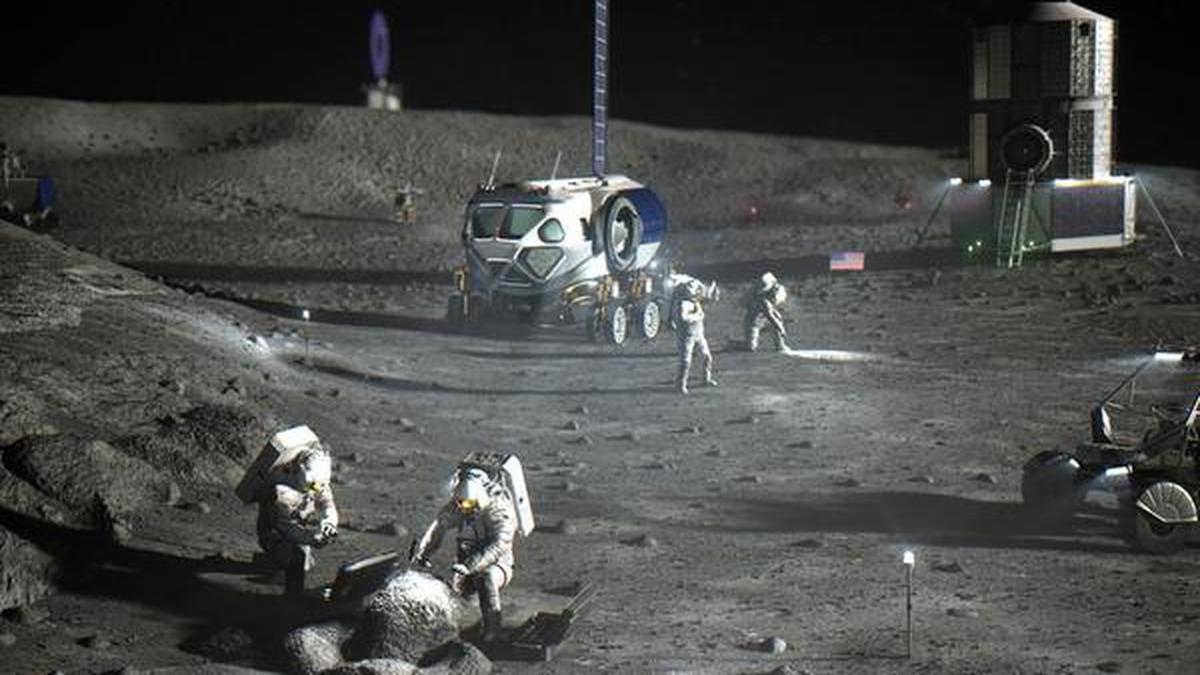
However, this presumes clear structural boundaries, stable installations, and nationally identifiable zones of activity. Permanently inhabited lunar or planetary bases may not operate in such conditions. Consider a lunar settlement extracting water ice near the moon’s south pole. One team operates autonomous drilling robots, another refines extraction algorithms using shared data, while life-support engineers adapt the process to local power and temperature constraints. The components can be built on the earth, the software updated remotely, and robots operate across multiple platforms. When such a system is incrementally refined by multinational teams on shared infrastructure, it’s not clear where the legally relevant act of invention occurs or which jurisdiction should govern it.
In these settings, the territorial anchors that patent law depends on become weaker. Identical technological activity may fall within patent jurisdiction or outside it entirely, depending solely on registration choices rather than on substantive contribution, operational control or the location of innovation. In such contexts, registration no longer reflects how innovation actually occurs.

Non-appropriation principle
These challenges intersect with the foundational principles of international space law. Article I of the Outer Space Treaty frames outer space as a domain to be explored and used for the benefit of all humankind. Article II reinforces this vision by prohibiting any form of national appropriation of celestial bodies, including the moon.
While patents don’t amount to territorial claims, they do confer exclusive control over technologies that may be essential for survival or exploration in space. In permanently inhabited environments, where access to water and energy could depend on patented technologies, such exclusivity carries real structural consequences.
This raises an unresolved question: at what point does patent-based exclusivity begin to operate as de facto exclusion in a domain that international law insists must remain accessible?
The concern is that fragmented enforcement driven solely by registration could indirectly constrain the freedom to explore and use space. If access to a patented life-support process or resource-extraction technique depends on the registry of a particular platform, operators on other platforms may be legally barred from using or modifying technologies essential to survival or mission continuity, even in non-competitive settings.
Article 5 of the Paris Convention for the Protection of Industrial Property is concerned with the doctrine of temporary presence. It limits patent enforcement in the public interest to ensure patented articles in transit are not treated as infringing. On the earth, this provision preserves freedom of transport across borders.
Whether this doctrine applies to space objects, however, remains unclear. Does temporary presence cover patented equipment launched through foreign territory, docked at multinational space stations or operated onboard platforms registered to another state? No treaty or authoritative interpretation provides an answer.

Flags of convenience
Registration-based jurisdiction also creates powerful incentives for strategic behaviour. Technologies can be developed in states with strong patent protection but deployed onboard space objects registered in jurisdictions with weaker enforcement, allowing innovation to slip beyond the reach of the legal system that enabled it.
This is not unlike the use of flags of convenience in maritime operations — and it risks hollowing out patent protection through regulatory arbitrage rather than genuine innovation.
Further, while more than 110 states are parties to the Outer Space Treaty, only a few shape how registration interacts with patent law, producing a system that is global in form but uneven in practice. Operational coordination mechanisms, such as those under the NASA Artemis Accords, could reduce interference. But coordination is also not jurisdiction, meaning they can’t resolve questions of ownership and enforcement in permanently inhabited space environments.
The challenge of patent protection in outer space is not a marginal legal puzzle. It reflects a structural mismatch between legal regimes designed for territorially bounded activity and environments defined by shared infrastructure and jurisdictional fragmentation.
International institutions have begun to acknowledge these tensions, and proposals for specialised space-related IP mechanisms are emerging. But coordination remains limited and uneven. Most states remain rule-takers rather than rule-makers in the evolving legal architecture of space innovation.
Shrawani Shagun is a researcher focusing on environmental sustainability and space governance.
Published – January 29, 2026 05:30 am IST