


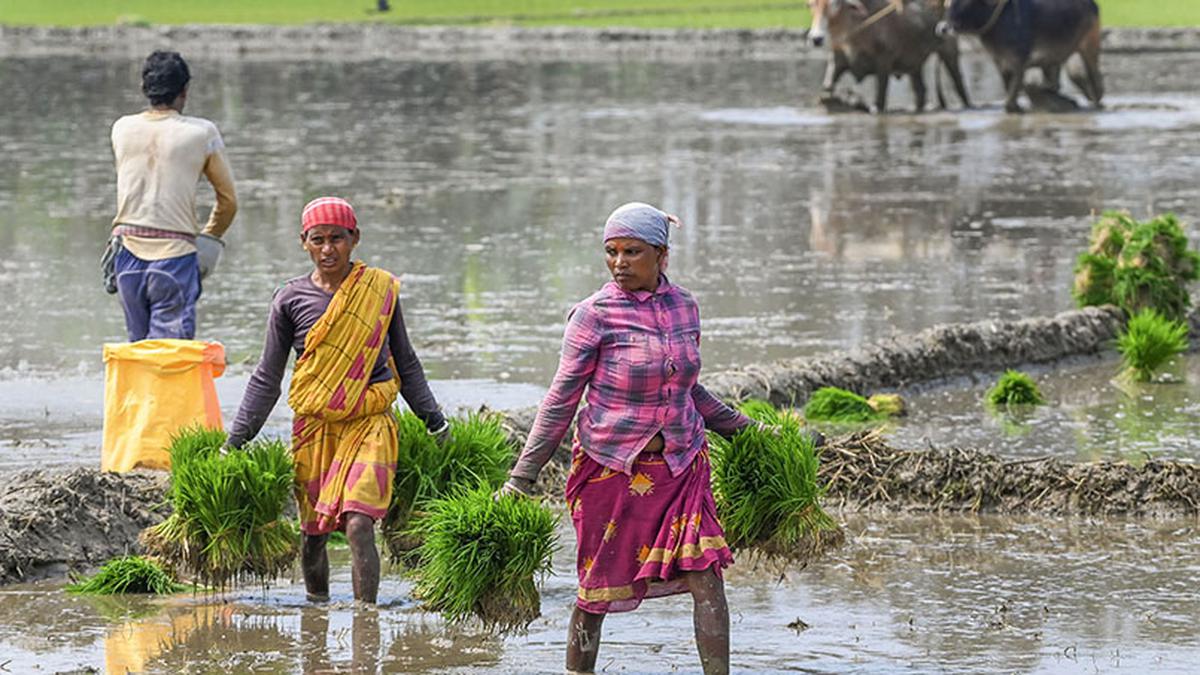
On February 13, groups of farmers began a march to New Delhi, to press for fulfilment of their demands, which include a legal guarantee for purchasing crops at Minimum Support Price (MSP) and India’s withdrawal from the World Trade Organization (WTO) which, they allege, places pressure on the Centre for drafting policies for procurement and MSP. While the Centre has fixed MSP for 23 farm commodities, it is implemented mostly for rice and wheat mainly because India has vast storage facilities for these grains and uses the produce for its public distribution system (PDS). The Union government has repeatedly asserted that a legal guarantee for MSP will not be possible. Should MSP be legalised? Siraj Hussain and Lakhwinder Singh discuss the question in a conversation moderated by A.M. Jigeesh. Edited excerpts:
Are the protests for a legalised MSP justified?
Lakhwinder Singh: These protests have been building up over time. In 2018 too, we saw tens of thousands of farmers from Maharashtra take to the streets. But their demands are perhaps not being listened to seriously, whether by State governments or the Central government.
Watch |What is Minimum Support Price?
There is a context to this. India introduced economic reforms in 1991 with a promise that we will soon become industrialised and the rural workforce will move from the agricultural to the industrial sector. More than 30 years later, agriculture has been squeezed in many ways but no one is talking about this agricultural crisis.
One of the most important demands of the farmers protesting this time is a legal guarantee for MSP. The public distribution system (PDS) gave support to farmers and ensured national food security. Now, India is expected to shift from food security to nutrition security. A legal guarantee for MSP for 23 crops is perhaps the way to do this. The farmers also want India to exit the WTO. We are in a phase of de-globalisation. When we have food shortages, for instance, the government imposes a ban on exports of food items (in defiance of the WTO). In a way, the demand of the farmers is in consonance with what the government does.
Also read | ‘MSP guarantee can nudge farmers to diversify beyond paddy and wheat, bolster incomes and consumption’
Siraj Hussain: The farmers are rightly concerned about the low prices of various crops. But their demands will not be accepted by any government in a hurry. We need a detailed, thorough review of agricultural trade policies and production and also what will happen to agriculture in the next 20-25 years.
After the 2020-21 protests, the government took seven months to set up a committee to look into this issue of MSP. More than a year and a half later, the committee has not even submitted an interim report.
Also read | Legal guarantee for MSP will make farmers drivers of GDP growth: Rahul Gandhi
Should MSP on all these crops be legalised? And will MSP survive without public procurement?
Siraj Hussain: The mandi system in the form of APMCs (agricultural produce market committees) is functional only in a few States. In most others, it is not functional. Less than one-third of the crop production in India is traded through mandis; the rest is sold by marginal farmers to village traders. So, even if MSP becomes legalised, it will be difficult to implement it because there is no record of who is buying and selling and at what rate. The government cannot be buying all the 23 crops – even for wheat and rice it faces lot of difficulties in procurement.
Lakhwinder Singh: Legalisation of MSP is in national interest. A large number of farmers sell commodities in informal markets. The government wants to make transactions digital and formal, so this is in consonance with the government’s aim. Also, the gross fixed capital formation in the agricultural sector after the 1991 reforms has gone down tremendously. Farmers are in distress. Legalising MSP is the answer. Let me add that the government is not expected to buy all the 23 crops. But if at least 5-10% of the produce is purchased, it would be a marginal intervention and stabilise the prices.
Editorial | Farming consensus: On the government and the farmers on protest
Is it possible to extend the MSP system to the entire country, especially for subsistence farmers, as the government claims?
Siraj Hussain: Yes. Madhya Pradesh, Chhattisgarh, and Odisha have shown that the procurement system can be expanded. Even in Bihar, West Bengal, and Tamil Nadu, procurement of rice has increased over the last few years. But that is not the question. The question is whether the government should be procuring so much. It has been procuring 50-60 million tonnes of rice. Is that a good policy regime? The root cause is PDS and now the government has made it free. That means that the government will continue to procure large quantities of wheat and rice.
Another concern is that legalised MSP will result in high prices affecting the consumers.
Siraj Hussain: I do not think it is possible for any government to procure all the commodities. It is not possible for the government to fix an MSP for everything. The basic question is how to ensure a remunerative price to farmers. My view is that it should be a State by State policy. Every State has a different regime. In Punjab, for instance, a price payment deficiency system is possible because the mandi system is well developed and the distance between two mandis is only 6 km, whereas at the all-India level it is 12 km. The States and the Centre should be talking to one another. Experts have to come up with a policy which will ensure that farmers receive a fair and remunerative price.
Where is the farmers’ protest heading? | In Focus podcast
Another question which you should be asking macroeconomists is on food inflation. The government must also look after the interests of consumers. They have to try and balance the policies of import, export, and domestic MSP.
Lakhwinder Singh: When the government is not interested in legalising MSP and intellectuals are not interested in discussing these issues, fear is created among consumers that they are going to be fleeced. And a binary is created of farmers and consumers. The government is an intermediary, which has to protect the rights of both consumers and producers.
In Frames |Farmers’ protests 2024
The most striking issue is food inflation. The local prices at which farmers are selling their produce are very low and do not cover the major costs involved (in production). On the other hand, consumers are facing huge price rise. Legalising MSP will reduce inflation, protect consumers, and give a relatively reasonable income to the farmers.
Also, regulating markets is important. The government has withdrawn from the regulatory mechanism and therefore in unorganised markets, intermediaries are active and creating inflationary pressures on the economy.
Farmers are also worried about input cost calculation methods such as A2+FL and C2+50%. What could be the best mechanism to calculate the input costs?
Lakhwinder Singh: The idea of C2+50% cost has come from industry. Agriculture requires remunerative prices. I think the C2 estimation of costs for agricultural crops is going to be almost comparable with other prices which we have in various sectors of the economy.
Siraj Hussain: There have been several suggestions, including a report by Dr. Ramesh Chand, about certain changes in the methodology of calculating the cost of cultivation. Those changes have not yet been decided. The problem is whatever price you fix, you are not able to ensure the A2+FL price. Sometimes, the price is so low that it is below the cost of cultivation.
Also read | Don’t consider our discipline and preference for dialogue as weakness: RSS farmers body tells government
The answer is not easy to find. The government cannot be deciding the prices of every agricultural commodity. Many farmers and organisations prefer selling to corporates because there used to be a lot of glut of at one point of time. Now, at least there are some large buyers. So, we can’t say that corporates should be completely prevented from purchasing and storing agricultural commodities.
Are cooperatives an alternative to help farmers?
Siraj Hussain: Cooperatives have been successful in certain sectors. For example, in the milk sector, they brought the White Revolution in Gujarat. It was due to the failure of cooperatives that the government came up with the idea of farmer-producer organisations (FPOs). Now, we are going back to cooperatives. Any form of aggregation which can help the farmers in realising better prices is welcome. But both cooperatives and FPOs have been captured by influential vested interests in rural areas. If cooperatives can create storage structures where the farmers can store their produce at reasonable prices to reap the benefits of higher prices in the off season, they are welcome.
Lakhwinder Singh: When we have to look for alternatives, we cannot rely on a single intervention. If you want to promote cooperatives, bring in a law and storage capacity. Government-supported cooperatives have failed because of corruption. This organisation has a future, but we need a legal framework within which they can flourish. And they need supportive infrastructure.
Listen to The Hindu Parley podcast
Lakhwinder Singh is Visting Professor, Institute for Human Development, New Delhi, and former Professor and head, Economics Department, Punjabi University, Patiala; Siraj Hussain is former Union Agriculture Secretary and adviser of FICCI