



Skip to content
  • Facebook
  • X
  • Linkedin
  • WhatsApp
  • Associate Journalism
  • About Us
  • Privacy Policy
  • 033-46046046
  • editor@artifex.news
Artifex.News

Artifex.News

Stay Connected. Stay Informed.

  • Breaking News
  • World
  • Nation
  • Sports
  • Business
  • Science
  • Entertainment
  • Lifestyle
  • Toggle search form
  • Access Denied
    Access Denied Nation
  • Sophie Devine to step down as New Zealand’s women’s T20 captain after World Cup
    Sophie Devine to step down as New Zealand’s women’s T20 captain after World Cup Sports
  • Rupee falls nine paise to 83.53 against U.S. dollar in early trade
    Rupee falls nine paise to 83.53 against U.S. dollar in early trade Business
  • Adidas Reports  Million Loss In 2023 As Kanye West Fallout Weighs
    Adidas Reports $82 Million Loss In 2023 As Kanye West Fallout Weighs World
  • Emma Raducanu Pulls Out Of French Open Qualifying To Train On Grass
    Emma Raducanu Pulls Out Of French Open Qualifying To Train On Grass Sports
  • Access Denied
    Access Denied Nation
  • Why India’s Constitution Is Key For Continuation Of Its Civilizational Ethos
    Why India’s Constitution Is Key For Continuation Of Its Civilizational Ethos Nation
  • Daily Quiz | On 9/11 attacks
    Daily Quiz | On 9/11 attacks World
Why participatory science is crucial to tackling coconut root wilt disease

Why participatory science is crucial to tackling coconut root wilt disease

Posted on January 16, 2026 By admin


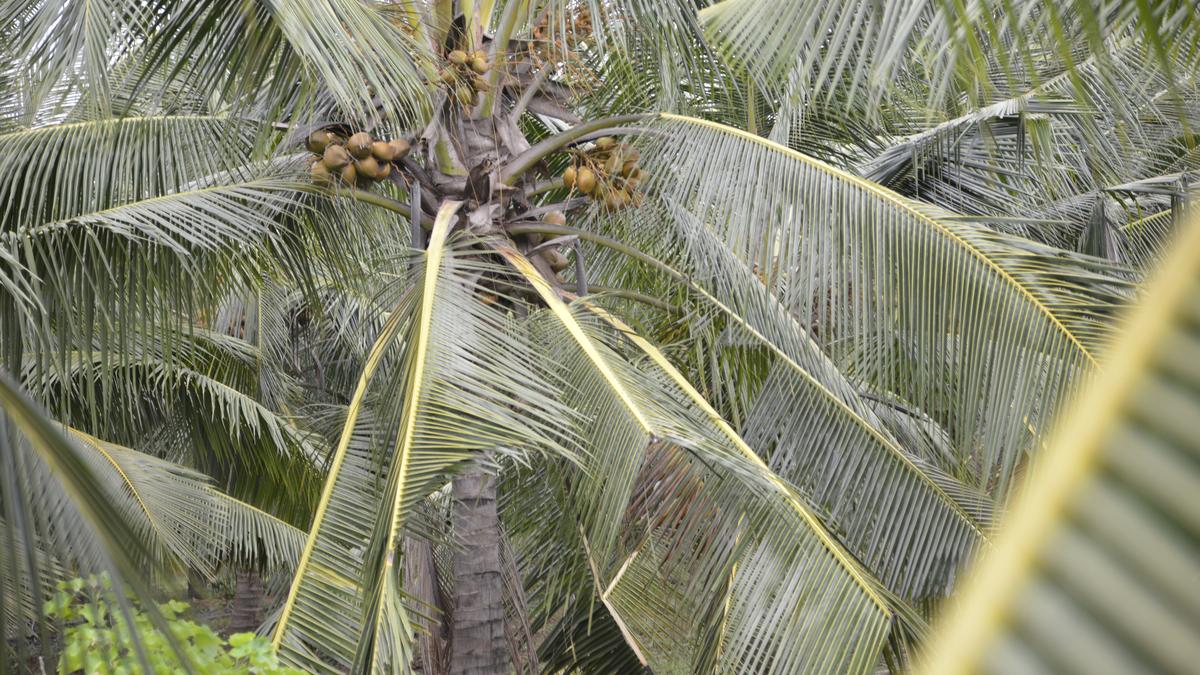
Coconut is one of the largest horticultural crops in peninsular India, and an increasing number of farmers are taking up coconut plantations due to a lack of labour availability and the intensive attention required to raise annual crops.

The three States of Karnataka, Tamil Nadu, and Kerala together account for about 82-83 % of India’s coconut production. Coconut is not only culturally interwoven but also defines the landscape of regions like Alappuzha and Pollachi, known for their pristine beauty.

Now, this carefully cultivated imagery is under threat from a microscopic adversary: phytoplasma. Specifically, phytoplasma-induced root wilt disease has destroyed large tracts of traditional coconut-growing areas in these three States.

Rapid expansion

Root wilt disease is a debilitating condition. It is classified as a non-fatal disease and was first identified more than a century and a half ago in Erattupetta in Kerala. More than 150 years of sustained scientific research at the Central Plantation Crops Research Institute (CPCRI), Kayamkulam, has yet to yield a definitive cure.

The disease spreads through insect vectors, aided by the movement of wind and uninterrupted stretches of coconut plantations. While the disease has existed for decades, its spread used to be limited. Today, its rapid expansion has caught many farmers unprepared.

In fact both farmers and the scientific community concur that erratic temperatures, especially extremes, and the rise of new sucking pests, particularly whiteflies, have significantly accelerated its spread. The combined effect of abiotic stress induced by climate change and biotic stress from emerging pests has rendered coconut palms increasingly susceptible to root wilt disease. Once a few palms are infected in a region, sufficient inoculum builds up to hasten further spread. Recent assessments indicate that more than 30 lakh coconut palms have already been affected across major coconut-growing regions.

In areas such as Pollachi, where farmers have prospered by adopting intercropping systems in coconut plantations with shade-loving permanent crops like cocoa and nutmeg, the situation has turned into a double disaster. Without the shade of the coconut canopy, cocoa and nutmeg trees simply succumb to thermal stress.

A successful tool

Research institutions have attempted to address this plight through two broad approaches: first by developing standardised integrated cultivation practices using a judicious mix of organic and inorganic inputs, and second by developing resistant and tolerant varieties. Farmers who have religiously followed the recommended practices contend that these measures have done little to prevent the spread of the disease. Once a tree is infested, symptoms appear only after a prolonged incubation period, and often vary, since they are superimposed with those of other diseases such as leaf decay.

The tree quickly becomes unproductive, sheds all its nuts, and assumes a distorted appearance. Even if the disease is not immediately fatal, the palm continues to act as a source of pathogen inoculum. The phytoplasma challenge is not confined to coconut alone. The spread of yellow leaf disease in arecanut across parts of Karnataka serves as a parallel reminder of how vector-borne palm diseases can silently expand when early, field-based interventions are inadequate.

CPCRI Kayamkulam has released one resistant and three tolerant varieties. Institutions such as the Tamil Nadu Agricultural University and the Coconut Development Board (CDB) multiply these varieties, but production has been limited to only a few thousand seedlings a year.

Breeding resistant and tolerant varieties remains one of the most successful tools for managing phytoplasma, as demonstrated by the high degree of success in addressing phytoplasma-related diseases in palms across the globe, from the Caribbean to Africa. Steps can be taken to import such varieties under strict quarantine protocols for field evaluation.

Participatory approach

However, a more prudent and sustainable approach would be to tap into the reservoir of genetic wealth already standing in farmers’ fields within highly infested endemic zones. Coconut palms that display tolerance under high inoculum pressure and intense vector load hold the key to combating phytoplasma.

A participatory approach to selection offers a credible pathway to addressing the central constraint in combating phytoplasma: identifying and breeding resistant and tolerant varieties. In highly infested regions, systematic participatory selection of coconut palms, combined with structured observation, can be undertaken with farmers playing a central role.

With appropriate training, farmers can be enabled to identify potentially tolerant palms and can be instructed on the importance of careful, long-term observation and record-keeping. This would significantly reduce the burden on scientific institutions while generating richer, field-relevant datasets.

Once tolerant or resistant palms are identified and validated, they can be inducted into decentralised breeding programmes, allowing multiple small, independent selection and evaluation efforts to proceed simultaneously under scientific supervision. Such an approach also enables the isolation of locally adapted varieties suited to specific agro-climatic conditions.

Institutional action

Given the rapid expansion of root wilt disease into new frontiers, mirroring the trajectory of whitefly, which was once confined to a few pockets in western Tamil Nadu but is now a pan-India pest, time is of the essence. Farmers whose palms are selected for breeding can also benefit through royalty mechanisms envisioned under the Protection of Plant Varieties and Farmers’ Rights Act while being encouraged to establish nurseries to multiply planting material at scale to replace the vast number of palms being felled.

The government and the scientific community must, therefore, place renewed faith in citizen science and ensure that participatory selection and participatory breeding are pursued in all earnestness to confront the phytoplasma menace threatening coconut cultivation.

Addressing root wilt at this scale requires coordinated institutional action. Central agencies such as CPCRI and the CDB must work closely with the agricultural universities of Kerala, Tamil Nadu, and Karnataka. Fragmented research efforts and parallel trials no longer suffice in the face of a fast-spreading phytoplasma threat. A shared framework for data, evaluation, and field validation is essential to translate participatory science into impact.

R. Ranjit Kumar is managing director, Pollachi Nutmeg Farmer Producer Company, and ICAR-IARI Innovative Farmer Awardee.

Published – January 16, 2026 12:56 pm IST



Source link

Science

Post navigation

Previous Post: India a key driver of global growth, says IMF spokesperson
Next Post: Access Denied

Related Posts

  • Strong geomagnetic storm hit earth – what causes them? | Explained
    Strong geomagnetic storm hit earth – what causes them? | Explained Science
  • Glacial lakes rise as glaciers retreat
    Glacial lakes rise as glaciers retreat Science
  • What is a supermoon?
    What is a supermoon? Science
  • For elephants, like people, greetings are a complicated affair
    For elephants, like people, greetings are a complicated affair Science
  • Cell sizes, clumping finally explain how animals form sharp patterns
    Cell sizes, clumping finally explain how animals form sharp patterns Science
  • IISc researchers develop sustainable method to remove heavy metal contaminants from groundwater
    IISc researchers develop sustainable method to remove heavy metal contaminants from groundwater Science

More Related Articles

WHO’s database on polio cases hides more than it reveals WHO’s database on polio cases hides more than it reveals Science
Watch: India’s renewables push is incomplete; here’s why: the storage challenge Watch: India’s renewables push is incomplete; here’s why: the storage challenge Science
Karnataka CM Siddaramaiah visits ISRO, felicitates Chairperson S. Somnath Karnataka CM Siddaramaiah visits ISRO, felicitates Chairperson S. Somnath Science
Earth’s oldest, tiniest creatures are poised to be climate change winners Earth’s oldest, tiniest creatures are poised to be climate change winners Science
Why planes don’t fly over the Tibetan Plateau Why planes don’t fly over the Tibetan Plateau Science
In breakthrough, scientists find pressure sensor in fat tissue In breakthrough, scientists find pressure sensor in fat tissue Science
SiteLock

Archives

  • January 2026
  • December 2025
  • November 2025
  • October 2025
  • September 2025
  • August 2025
  • July 2025
  • June 2025
  • May 2025
  • April 2025
  • March 2025
  • February 2025
  • January 2025
  • December 2024
  • November 2024
  • October 2024
  • September 2024
  • August 2024
  • July 2024
  • June 2024
  • May 2024
  • April 2024
  • March 2024
  • February 2024
  • January 2024
  • December 2023
  • November 2023
  • October 2023
  • September 2023
  • August 2023
  • July 2023
  • June 2023
  • May 2023
  • April 2023
  • March 2023
  • February 2023
  • January 2023
  • December 2022
  • November 2022
  • October 2022
  • September 2022
  • August 2022
  • July 2022
  • June 2022
  • May 2022

Categories

  • Business
  • Nation
  • Science
  • Sports
  • World

Recent Posts

  • Thailand orders 15-day construction suspension on 14 projects involving firm Italian-Thai after fatal accidents
  • Access Denied
  • Access Denied
  • Access Denied
  • Access Denied

Recent Comments

  1. YoungDic on UP Teacher Who Asked Students To Slap Muslim Classmate
  2. ManuelStome on UP Teacher Who Asked Students To Slap Muslim Classmate
  3. StevenBlist on UP Teacher Who Asked Students To Slap Muslim Classmate
  4. ThomasVaw on UP Teacher Who Asked Students To Slap Muslim Classmate
  5. RobertPaump on UP Teacher Who Asked Students To Slap Muslim Classmate
  • Byju’s Contests Shareholders’ Move To Oust Byju Raveendran As CEO
    Byju’s Contests Shareholders’ Move To Oust Byju Raveendran As CEO Nation
  • Singapore’s Indian-origin Leader of Opposition to go on trial in October for lying in Parliament
    Singapore’s Indian-origin Leader of Opposition to go on trial in October for lying in Parliament World
  • Access Denied
    Access Denied Nation
  • Trump Returns To New York Fraud Trial, Complains About Gag Order
    Trump Returns To New York Fraud Trial, Complains About Gag Order World
  • Buchi Babu semifinal | TNCA President’s XI’s final entry proves just a formality
    Buchi Babu semifinal | TNCA President’s XI’s final entry proves just a formality Sports
  • After 27 Years, Jharkhand Family Finds Lost Member As Monk In Maha Kumbh
    After 27 Years, Jharkhand Family Finds Lost Member As Monk In Maha Kumbh Nation
  • Benjamin Netanyahu’s Cabinet votes to permanently close Al Jazeera offices in Israel
    Benjamin Netanyahu’s Cabinet votes to permanently close Al Jazeera offices in Israel World
  • Larry the Downing Street cat in line for his sixth prime minister
    Larry the Downing Street cat in line for his sixth prime minister World

Editor-in-Chief:
Mohammad Ariff,
MSW, MAJMC, BSW, DTL, CTS, CNM, CCR, CAL, RSL, ASOC.
editor@artifex.news

Associate Editors:
1. Zenellis R. Tuba,
zenelis@artifex.news
2. Haris Daniyel
daniyel@artifex.news

Photograher:
Rohan Das
rohan@artifex.news

Artifex.News offers Online Paid Internships to college students from India and Abroad. Interns will get a PRESS CARD and other online offers.
Send your CV (Subjectline: Paid Internship) to internship@artifex.news

Links:
Associate Journalism
About Us
Privacy Policy

News Links:
Breaking News
World
Nation
Sports
Business
Entertainment
Lifestyle

Registered Office:
72/A, Elliot Road, Kolkata - 700016
Tel: 033-22277777, 033-22172217
Email: office@artifex.news

Editorial Office / News Desk:
No. 13, Mezzanine Floor, Esplanade Metro Rail Station,
12 J. L. Nehru Road, Kolkata - 700069.
(Entry from Gate No. 5)
Tel: 033-46011099, 033-46046046
Email: editor@artifex.news

Copyright © 2023 Artifex.News Newsportal designed by Artifex Infotech.