



Skip to content
  • Facebook
  • X
  • Linkedin
  • WhatsApp
  • YouTube
  • Associate Journalism
  • About Us
  • Privacy Policy
  • 033-46046046
  • editor@artifex.news
Artifex.News

Artifex.News

Stay Connected. Stay Informed.

  • Breaking News
  • World
  • Nation
  • Sports
  • Business
  • Science
  • Entertainment
  • Lifestyle
  • Toggle search form
  • Search for missing Malaysia Airlines Flight MH370 to resume on Dec. 30, over a decade after it disappeared
    Search for missing Malaysia Airlines Flight MH370 to resume on Dec. 30, over a decade after it disappeared World
  • Access Denied
    Access Denied Nation
  • Access Denied
    Access Denied Nation
  • Norwegian Envoy Completes 1 Year In India, Shares Post
    Norwegian Envoy Completes 1 Year In India, Shares Post Nation
  • Joe Biden Says He’d Still Be Able To “Deal” With Vladimir Putin, Xi Jinping In 3 Years
    Joe Biden Says He’d Still Be Able To “Deal” With Vladimir Putin, Xi Jinping In 3 Years World
  • High Court Puts On Hold UP’s Order To Suspend Sanjay Gandhi Hospital’s Licence
    High Court Puts On Hold UP’s Order To Suspend Sanjay Gandhi Hospital’s Licence Nation
  • Saim Ayub Century Helps Pakistan Crush Zimbabwe By 10 Wickets, Level Series
    Saim Ayub Century Helps Pakistan Crush Zimbabwe By 10 Wickets, Level Series Sports
  • Independent Candidate Enters Ladakh Polls, Makes It 3-Corner Fight
    Independent Candidate Enters Ladakh Polls, Makes It 3-Corner Fight Nation
Earth’s oldest, tiniest creatures are poised to be climate change winners

Earth’s oldest, tiniest creatures are poised to be climate change winners

Posted on August 14, 2024 By admin


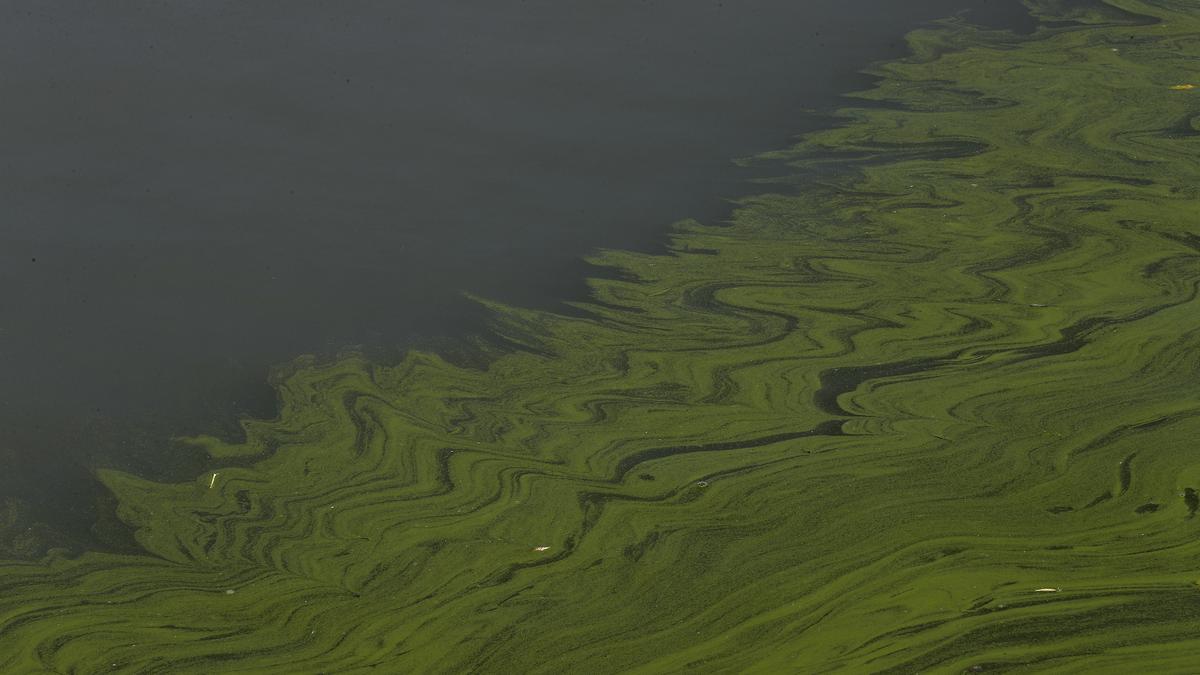
Algae floats on the surface of Lake Erie’s Maumee Bay in Oregon, Ohio, on Friday, September 15, 2017. Scientists found prokaryotes are remarkably resilient to climate change – and as a result, could increasingly dominate marine environments.
| Photo Credit: AP

The world’s oceans are home to microscopic organisms invisible to the human eye. The tiny creatures, known as “prokaryotes”, comprise 30% of life in the world’s oceans.

These organisms play an important role in keeping the oceans in balance. But new research by myself and colleagues shows this balance is at risk.

We found prokaryotes are remarkably resilient to climate change – and as a result, could increasingly dominate marine environments.

This could reduce the availability of fish humans rely on for food, and hamper the ocean’s ability to absorb carbon emissions.

A fine balance

Prokaryotes include both bacteria and “archaea”, another type of single-celled organism.

These organisms are thought to be the oldest cell-based lifeforms on Earth. They thrive across the entire planet – on land and in water, from the tropics to the poles.

What prokaryotes lack in size they make up in sheer abundance. Globally, about two tonnes of marine prokaryotes exist for every human on the planet.

They play a crucial role in the world’s food chains, helping support the nutrient needs of fish humans catch and eat.

Marine prokaryotes grow extremely fast – a process that emits a lot of carbon. In fact, prokaryotes to an ocean depth of 200 metres produce about 20 billion tonnes of carbon a year: double that of humans.

This massive carbon output is balanced by phytoplankton – another type of microscopic organism which turns sunlight and carbon dioxide into energy, through photosynthesis.

Phytoplankton and other ocean processes also absorb up to one-third of the carbon humans release into the atmosphere each year. This helps limit the pace of global warming.

How prokaryotes respond to warming is key to understanding how the fine balance of the world’s oceans may change in a warmer world. This was the focus of our research.

What we found

We wanted to predict how climate change would affect the “biomass”, or total global weight, of marine prokaryotes. We also wanted to examine how it would affect their carbon output.

To do this, we built computer models that integrated decades of observations from dozens of scientific surveys across the world’s oceans.

So what did we find? Prokaryotes are likely to be climate change winners, relative to other marine life.

For each degree of ocean warming, their biomass will decline by about 1.5%. This is less than half the projected 3–5% decline we predicted for larger plankton, fish and mammals.

It means future marine ecosystems will have lower overall biomass, and will increasingly be dominated by prokaryotes. This could divert a greater share of available nutrients and energy toward prokaryotes and away from fish, reducing the supply of fish humans eat.

We discovered another important change. For every degree of warming, we predict prokaryotes in the top 200 metres of the world’s oceans would produce an additional 800 million tonnes of carbon per year.

This is equivalent to the present-day emissions of the entire European Union (after converting CO₂ to carbon).

What does all this mean?

Due to human-caused climate change, Earth’s oceans are expected to warm by between 1°C and 3°C by the end of this century, unless humanity changes course.

If the amount of carbon produced by prokaryotes does increase as predicted, it could reduce the potential of oceans to absorb human emissions. This means achieving global net-zero emissions will become even more difficult.

What’s more, present projections of declines in global fish stocks under climate change generally do not consider how warming may restructure marine food webs by favouring prokaryotes. This means the predicted declines are likely to be underestimated.

Declines in fish populations present a major problem for global food supply, because the oceans are a major source of protein for about 3 billion people.

What should happen now

Our analysis is an important step in uncovering the changing role of marine prokaryotes. But significant uncertainties remain.

Our analysis is built with existing observations. Climate change is already changing conditions in marine ecosystems in ways our models may not have captured.

We also don’t know how quickly prokaryotes will adapt and evolve to new environments. But existing research shows that in a matter of weeks, bacteria can develop new traits that make it easier for them to survive.

Clearly, scientists must continue to improve their understanding of prokaryotes, and how they may be affected by climate change.

This article is republished from The Conversation under a Creative Commons license. Read the original article.


Source link

Science Tags:Climate change, climate change resilience, climate crisis, prokaryotes in the ocean

Post navigation

Previous Post: Thailand Prime Minister Srettha removed from office by court order over ethics violation
Next Post: Watch: PR Sreejesh: Like Rahul Dravid, I wanted to start coaching juniors

Related Posts

  • Significance of quantum dots in nanotechnology | Explained
    Significance of quantum dots in nanotechnology | Explained Science
  • Is global warming accelerating? – The Hindu
    Is global warming accelerating? – The Hindu Science
  • What is Point Nemo, the most isolated place on Earth?
    What is Point Nemo, the most isolated place on Earth? Science
  • Women biotech scientists await funds for research
    Women biotech scientists await funds for research Science
  • What the dismissal of Gino defamation lawsuit means for science
    What the dismissal of Gino defamation lawsuit means for science Science
  • Four new studies report progress towards long-awaited HIV vaccine
    Four new studies report progress towards long-awaited HIV vaccine Science

More Related Articles

ISRO celebrates National Space Day at MBU campus ISRO celebrates National Space Day at MBU campus Science
Dung test to detect early pregnancy in tigresses expanded to cattle Dung test to detect early pregnancy in tigresses expanded to cattle Science
Deep-learning helps classification of tumours during surgery Deep-learning helps classification of tumours during surgery Science
China’s Shenzhou-20 crew to return on November 14 after space debris delays mission China’s Shenzhou-20 crew to return on November 14 after space debris delays mission Science
NISAR satellite mounted on GSLV for launch on July 30, 2025 NISAR satellite mounted on GSLV for launch on July 30, 2025 Science
Crocodiles yield to flower power, study finds  Crocodiles yield to flower power, study finds  Science
SiteLock

Archives

  • May 2026
  • April 2026
  • March 2026
  • February 2026
  • January 2026
  • December 2025
  • November 2025
  • October 2025
  • September 2025
  • August 2025
  • July 2025
  • June 2025
  • May 2025
  • April 2025
  • March 2025
  • February 2025
  • January 2025
  • December 2024
  • November 2024
  • October 2024
  • September 2024
  • August 2024
  • July 2024
  • June 2024
  • May 2024
  • April 2024
  • March 2024
  • February 2024
  • January 2024
  • December 2023
  • November 2023
  • October 2023
  • September 2023
  • August 2023
  • July 2023
  • June 2023
  • May 2023
  • April 2023
  • March 2023
  • February 2023
  • January 2023
  • December 2022
  • November 2022
  • October 2022
  • September 2022
  • August 2022
  • July 2022
  • June 2022
  • May 2022

Categories

  • Business
  • Nation
  • Science
  • Sports
  • World

Recent Posts

  • ATS questions 57 in Maharashtra over alleged gangster network links
  • Nicobarese oppose proposal for three wildlife sanctuaries
  • Visakhapatnam Collector calls for inter-departmental synergy to boost investments
  • Kohli’s masterful knock powers Royal Challengers to the top
  • Senior IPS officer Asra Garg posted IGP Intelligence

Recent Comments

  1. RichardClage on UP Teacher Who Asked Students To Slap Muslim Classmate
  2. StevenLek on UP Teacher Who Asked Students To Slap Muslim Classmate
  3. Leonardren on UP Teacher Who Asked Students To Slap Muslim Classmate
  4. NathanQuins on UP Teacher Who Asked Students To Slap Muslim Classmate
  5. Davidgof on UP Teacher Who Asked Students To Slap Muslim Classmate
  • Brother Missing After Mumbai Boat Tragedy, Man Makes Rounds Of Hospitals
    Brother Missing After Mumbai Boat Tragedy, Man Makes Rounds Of Hospitals Nation
  • Aviation Body Raises IndiGo Engine Failure Issue With US Engine Maker
    Aviation Body Raises IndiGo Engine Failure Issue With US Engine Maker Nation
  • Shipping industry set for tougher times ahead due to Israel-Iran tensions: Experts
    Shipping industry set for tougher times ahead due to Israel-Iran tensions: Experts Business
  • Nepal panel to probe violence during anti-graft protests that killed 74
    Nepal panel to probe violence during anti-graft protests that killed 74 World
  • Access Denied World
  • Brazil becomes second BRICS country after India not to join China’s BRI
    Brazil becomes second BRICS country after India not to join China’s BRI World
  • Access Denied Sports
  • Iran-Israel war LIVE: Trump, Israel pressure Iran ahead of deadline as search continues for missing U.S. airman
    Iran-Israel war LIVE: Trump, Israel pressure Iran ahead of deadline as search continues for missing U.S. airman World

Editor-in-Chief:
Mohammad Ariff,
MSW, MAJMC, BSW, DTL, CTS, CNM, CCR, CAL, RSL, ASOC.
editor@artifex.news

Associate Editors:
1. Zenellis R. Tuba,
zenelis@artifex.news
2. Haris Daniyel
daniyel@artifex.news

Photograher:
Rohan Das
rohan@artifex.news

Artifex.News offers Online Paid Internships to college students from India and Abroad. Interns will get a PRESS CARD and other online offers.
Send your CV (Subjectline: Paid Internship) to internship@artifex.news

Links:
Associate Journalism
About Us
Privacy Policy

News Links:
Breaking News
World
Nation
Sports
Business
Entertainment
Lifestyle

Registered Office:
72/A, Elliot Road, Kolkata - 700016
Tel: 033-22277777, 033-22172217
Email: office@artifex.news

Editorial Office / News Desk:
No. 13, Mezzanine Floor, Esplanade Metro Rail Station,
12 J. L. Nehru Road, Kolkata - 700069.
(Entry from Gate No. 5)
Tel: 033-46011099, 033-46046046
Email: editor@artifex.news

Copyright © 2023 Artifex.News Newsportal designed by Artifex Infotech.