



For many decades now, scientists and biologists have been trying to understand how the mesmerising patterns in animal coats emerge from a group of underdeveloped cells.
The British mathematician Alan Turing proposed in the early 1950s that as cells and tissue develop, they produce certain molecules or chemical agents that diffuse into their surroundings, react with each other, and eventually enable the process of producing pigments for the patterns. Simultaneously other interactions could inhibit their diffusion, creating non-pigmented spaces between patterns and confining them to particular areas.
Thanks to this model, the resulting patterns are today called Turing patterns.
However, when scientists simulated this model on computers based on Turing’s formulae, they found that the patterns don’t develop the kind of sharp outlines seen on zebras, leopards, and snakes. Instead, the model only yielded blurry patterns, as if the diffusion wasn’t confined.
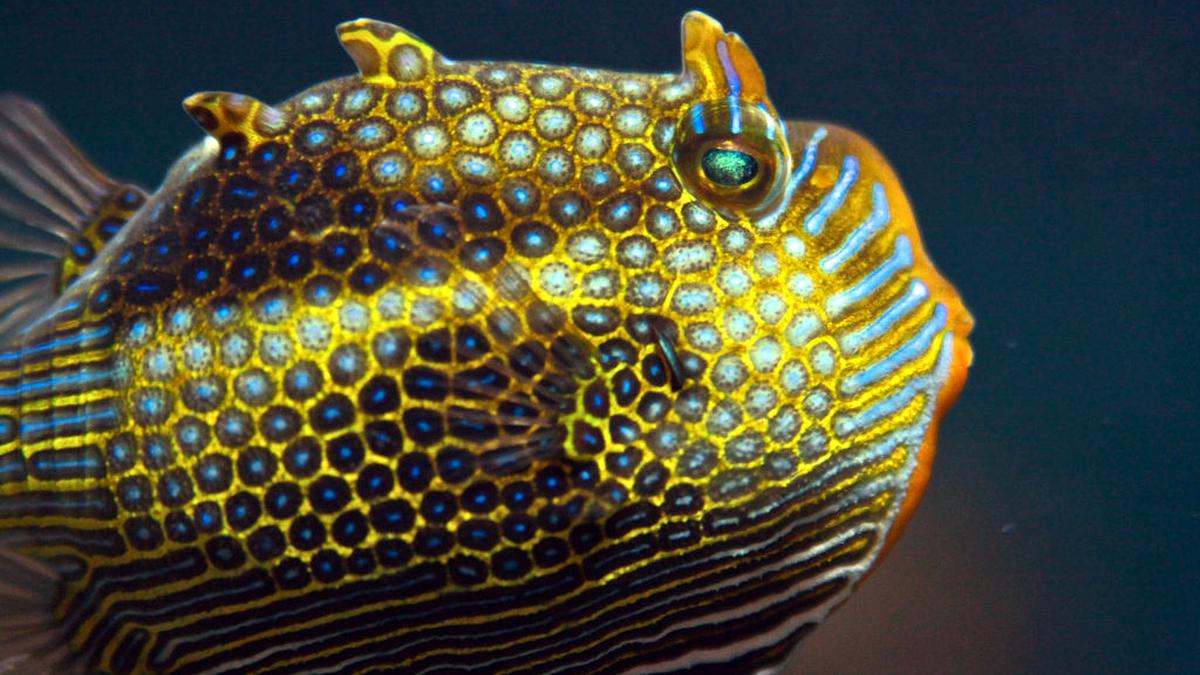
The ornate boxfish
Some scientists that have been trying to determine why as well as the ‘correct’ model are biophysicists working on the field of transport phenomena. One such line of inquiry led to the 1977 chemistry Nobel Prize, to the Belgian physical chemistry exponent Ilya Prigogine.
Now, a study from the University of Colorado-Boulder, published in the journal Matter on October 27, has reportedly figured out how animal coat patterns with sharp edges take shape.
“How are these animal patterns so beautiful yet imperfect? That’s the question we wanted to answer,” said Ankur Gupta, the study’s coauthor and assistant professor at the chemical and biological engineering department.
Pointing to an image of a male ornate boxfish (Aracana ornata), Dr. Gupta said his students were particularly mesmerised by its vivid purple-yellow gilding and wanted to understand how the yellow hexagonal lines on its body took shape.
“We almost started working on this by accident, because the patterns so closely resembled what my team was obtaining through simulations.”
Perfect imperfection
Dr. Gupta’s team had been working on Turing patterns. In 2023, they zeroed in on a phenomenon called diffusiophoresis: where colloidal particles suspended in a fluid or a dispersion medium could attract other particles like a magnet, clumping them together.
When they ran simulations, they found that diffusiophoresis could result in sharper patterns than the Turing model created. But on the flip side, these patterns were symmetrical — whereas in nature they have little imperfections.
In the new study, Dr. Gupta and his colleague Siamak Mirfendereski improved their own model by assigning specific sizes to different cells, then simulated the movement of these cells through tissues. And there they were: the imperfect Turing patterns much like those in the wild.
Diffusion and dispersion
When a molecule moves through a liquid medium, it isn’t just moving at constant speed in a straight line. For starters, because it’s so small, it will be affected by small temperature changes happening all around it. Seen from afar, the molecule will seem to be jittering around in random directions. This is Brownian motion — and the molecule’s journey through the medium in this way is called diffusion.
Dr. Gupta’s example of choice was dropping some ink into water: over time, the ink molecules spread out completely through the water, without clumping together in particular places. This is diffusion.
If the ink had been dropped in a river, its molecules would still diffuse through the water at small scales whereas. At a larger scale, however, the various currents would pull all the molecules downstream. This is called dispersion.
“All particles in a medium have some diffusion coefficient and some kind of tendency to diffuse around. But if they are also reacting with each other, and under the right conditions, you can get heterogeneity out of homogeneity,” Dr. Gupta.
Continuum model
In the course of its work, the team found that the patterns appeared blurry without proper boundaries if it used the classical Turing model, meaning when the pigments were only allowed to diffuse.
But if they were allowed to clump together, the team found that a group of three-dimensional spots would form in the medium, with particles aggregating and floating around each spot. This phenomenon is called diffusiophoresis.
When the researchers modeled the entire system with diffusiophoresis, they observed that patterns did occur and that they were much sharper than the classical Turing model. But because the cells all had the same size, they patterns were too perfect.
“Siamak brought in expertise from his PhD, which allowed us to model individual cells, and we did so for over 1,00,000 to 10,00,000 such cells,” Dr. Gupta said.
“This allowed us to create a computational algorithm for this modelling that we describe in detail in the paper. Now, we are moving away from a continuum model and trying to model each cell individually, and this results in a much more realistic pattern.”
Packing well
In the ink example, the updated model is akin to some particles in the water being attracted to the ink molecules while others are repelled.
The cells’ size matters in this scenario because it controls how well the cells can be packed around each other when they clump.
In the model, when the cells were very small compared to the pattern thickness, they could move freely and fit neatly into new patterns and the clumps they formed were smooth and well-organised. But as the cell got bigger, approaching the width of the chemical pattern, they started to bump into each other more and couldn’t all fit perfectly into the pattern’s ‘ideal’ spots, leading to imperfections. Some areas could be packed tightly while others were sparse or fragmented.
Since larger particles, or cells, also have more surface area, they could form broader patterns than those formed by smaller cells.
When they were even larger, the cells couldn’t form complete patterns at all. The clumps become irregular and coarse, like the uneven spots seen in real biological tissue.
Imperfect patterns
“When we simply modeled the cells with various sizes, our fish patterns suddenly became much more realistic,” Dr. Gupta said. “The imperfections in patterns are present and tightened, and something like the idea of discreteness is observed in this framework, and these patterns resemble more closely what we find in nature.”
The study isn’t without limitations. The new model doesn’t account for biological forces within a tissue or cell (e.g. adhesion), and it also simulated cells as hard spheres rather than as the permeable and squishy blobs they really are. According to Dr. Gupta, a future model that includes these factors could yield nuanced findings with respect to pattern formation.
For now, the new findings do come close to explaining natural patterns found in fish, lizards, mammals, and other animals, and could pave the way for better camouflage and textile design.
Sandhya Ramesh is a freelance science journalist.