


Skip to content
  • Facebook
  • X
  • Linkedin
  • WhatsApp
  • YouTube
  • Associate Journalism
  • About Us
  • Privacy Policy
  • 033-46046046
  • editor@artifex.news
Artifex.News

Artifex.News

Stay Connected. Stay Informed.

  • Breaking News
  • World
  • Nation
  • Sports
  • Business
  • Science
  • Entertainment
  • Lifestyle
  • Toggle search form
  • Access Denied Sports
  • Pakistan vs Bangladesh 2nd Test moved to Rawalpindi from Karachi
    Pakistan vs Bangladesh 2nd Test moved to Rawalpindi from Karachi Sports
  • Two persons arrested for throwing petrol bomb into house near Somangalam
    Two persons arrested for throwing petrol bomb into house near Somangalam Nation
  • Omar Abdullah Takes Oath, Congress Sits Out Of Jammu and Kashmir Government
    Omar Abdullah Takes Oath, Congress Sits Out Of Jammu and Kashmir Government Nation
  • Pakistan vs UAE, Women’s Asia Cup 2024 Highlights: Muneeba Ali, Gull Feroza Shine As Pakistan Beat UAE By 10 Wickets
    Pakistan vs UAE, Women’s Asia Cup 2024 Highlights: Muneeba Ali, Gull Feroza Shine As Pakistan Beat UAE By 10 Wickets Sports
  • Rupee falls 1 paisa to record low of 85.92 against U.S. dollar in early trade
    Rupee falls 1 paisa to record low of 85.92 against U.S. dollar in early trade Business
  • Prithvi Shaw’s ‘Lagaan Ke Bhaiyon’ Remark As DC Indians Take On Overseas Stars
    Prithvi Shaw’s ‘Lagaan Ke Bhaiyon’ Remark As DC Indians Take On Overseas Stars Sports
  • Girl, 3, Stuck In 700-Foot Borewell In Rajasthan For 20 Hours, Rescue Ops On
    Girl, 3, Stuck In 700-Foot Borewell In Rajasthan For 20 Hours, Rescue Ops On Nation
Scientists use ‘atomic stencils’ to make designer nanoparticles

Scientists use ‘atomic stencils’ to make designer nanoparticles

Posted on October 22, 2025 By admin


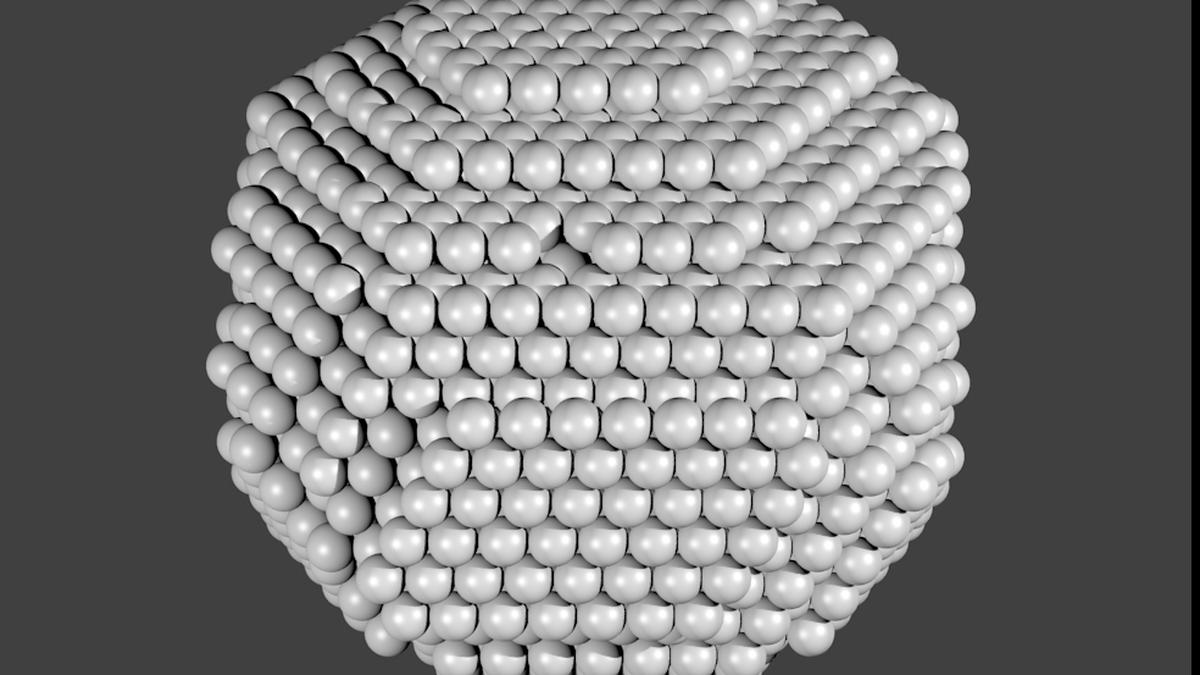
Idealised model of a platinum nanoparticle about 2 nm wide, showing individual atoms.
| Photo Credit: Vadim A. Volochaev

Inspired by an artist’s stencil, a team of scientists has developed a groundbreaking method to ‘paint’ microscopic gold particles with polymer patches, giving them new and exciting functions.

The technique, detailed in a paper published in Nature, could allow scientists to create intricate patterns on the surface of nanoparticles with atomic precision.

Imagine trying to build a complex machine using LEGO bricks that are all the same. It would be very difficult. Scientists face a similar challenge in nanotechnology.

Nanoparticles, which are particles thousands of times smaller than the width of a human hair, are the building blocks for revolutionary technologies in medicine, electronics, and energy. However, to create truly complex and functional materials, scientists need nanoparticles with different surface domains, or patches, that can guide how they connect together and organise in particular patterns. Creating these patchy nanoparticles with precision and in large quantities has been a major hurdle.

The breakthrough came from an unexpected place: an art class. Researchers, from the US and South Korea, realised they could adapt the simple concept of stenciling to the nanoscale. Their process, called “atomic stencilling,” works in two main steps. In the first step, iodide atoms are used as a microscopic stencil. These atoms stick selectively to certain flat faces of the small, gem-like gold nanoparticles, creating a mask that covers specific areas.

Next, they introduce long-chain molecules called polymers. These polymers act like paint, but they can only attach to the unmasked regions of the gold nanoparticle.

By carefully controlling the amount of the iodide ‘mask’, the scientists could precisely control the size, shape, and location of the polymer “paint” patches. This simple but elegant method allowed them to create a large variety of custom-made nanoparticles.

Using the same stencilling technique, the team successfully created more than 20 types of patchy nanoparticles with unique patterns, such as patches on their corners, faces, and even forming web-like designs.

Perhaps most remarkably, the patches were so uniform that the nanoparticles could spontaneously organise themselves into large, highly ordered 3D crystals known as superlattices. This process, called self-assembly, is a holy grail in nanomaterials science. For years, the creation of such complex, non-closely packed structures from patchy nanoparticles was largely theoretical. The new study has reportedly brought this theory to life, showing that by designing the patches correctly, scientists can direct the particles to build themselves into specific large-scale architectures.

This new level of control over nanoparticle design is a crucial step toward creating metamaterials, which are engineered materials with unique properties not found in nature, such as the ability to manipulate light and sound in new ways. The applications are vast, potentially leading to advances in targeted drug delivery, ultra-efficient catalysts, next-generation electronics, and new classes of smart materials.

The team’s technique “can extend to other nanoparticle systems, in which the tunability of core nanoparticle composition, shape, size as well as patch polymer chemistry is limitless,” the paper read. “For example, gold nanorods are promising candidates worth further study owing to their rich faceting behaviours determined by particle size and synthesis conditions.”

Published – October 22, 2025 04:01 pm IST



Source link

Science

Post navigation

Previous Post: Access Denied
Next Post: Access Denied

Related Posts

  • What are cosmic filaments? – The Hindu
    What are cosmic filaments? – The Hindu Science
  • Astronomers have spotted the biggest bangs since the Big Bang
    Astronomers have spotted the biggest bangs since the Big Bang Science
  • How do birds fly in a coordinated and seemingly effortless fashion?
    How do birds fly in a coordinated and seemingly effortless fashion? Science
  • Google’s new AI model offers new pathway in cancer drug research
    Google’s new AI model offers new pathway in cancer drug research Science
  • The impact of India-EU FTA on AI and semiconductor tech
    The impact of India-EU FTA on AI and semiconductor tech Science
  • Extreme heat threatens global food systems, UN agencies warn
    Extreme heat threatens global food systems, UN agencies warn Science

More Related Articles

Is groundwater contamination high in India? | Explained Is groundwater contamination high in India? | Explained Science
NIMHANS releases Pre-CURB, a digital learning resource on prevention of cannabis use NIMHANS releases Pre-CURB, a digital learning resource on prevention of cannabis use Science
What is the butterfly effect? What is the butterfly effect? Science
Dispersal out of Africa may have occurred during arid period Dispersal out of Africa may have occurred during arid period Science
In pictures: Lunar eclipse enthrals skywatchers across India and the globe In pictures: Lunar eclipse enthrals skywatchers across India and the globe Science
The cosmological constant problem is one of the biggest crises in physics The cosmological constant problem is one of the biggest crises in physics Science
SiteLock

Archives

  • September 2026
  • August 2026
  • July 2026
  • June 2026
  • May 2026
  • April 2026
  • March 2026
  • February 2026
  • January 2026
  • December 2025
  • November 2025
  • October 2025
  • September 2025
  • August 2025
  • July 2025
  • June 2025
  • May 2025
  • April 2025
  • March 2025
  • February 2025
  • January 2025
  • December 2024
  • November 2024
  • October 2024
  • September 2024
  • August 2024
  • July 2024
  • June 2024
  • May 2024
  • April 2024
  • March 2024
  • February 2024
  • January 2024
  • December 2023
  • November 2023
  • October 2023
  • September 2023
  • August 2023
  • July 2023
  • June 2023
  • May 2023
  • April 2023
  • March 2023
  • February 2023
  • January 2023
  • December 2022
  • November 2022
  • October 2022
  • September 2022
  • August 2022
  • July 2022
  • June 2022
  • May 2022

Categories

  • Business
  • Nation
  • Science
  • Sports
  • World

Recent Posts

  • The Netherlands is bracing for potentially devastating U.S. sanctions against ICC
  • Mega DSC recruits cannot be branded ‘fake’, says Atchannaidu
  • CSK names Zaheer Khan as head coach for IPL 2027
  • Persons with disabilities, residents oppose each other over use of community hall as service centre in Erode
  • Russia’s ruling pro-Putin party wins wartime election with over 57% of vote, near-complete results show

Recent Comments

  1. Jerrylaw on UP Teacher Who Asked Students To Slap Muslim Classmate
  2. BrandonDib on UP Teacher Who Asked Students To Slap Muslim Classmate
  3. RichardSpout on UP Teacher Who Asked Students To Slap Muslim Classmate
  4. Daviddrire on UP Teacher Who Asked Students To Slap Muslim Classmate
  5. RaphaelInart on UP Teacher Who Asked Students To Slap Muslim Classmate
  • PIA resumes operations in Europe after four-year suspension
    PIA resumes operations in Europe after four-year suspension World
  • “Amuses Me He’s Termed As All-Rounder From…”: Ex-Pakistan Coach’s Straight Talk On Hardik Pandya
    “Amuses Me He’s Termed As All-Rounder From…”: Ex-Pakistan Coach’s Straight Talk On Hardik Pandya Sports
  • Trump says he will resolve Pakistan-Afghanistan conflict ‘very quickly’
    Trump says he will resolve Pakistan-Afghanistan conflict ‘very quickly’ World
  • Why Players Flourish After Joining CSK? Navjot Sidhu’s Million-Dollar MS Dhoni Response
    Why Players Flourish After Joining CSK? Navjot Sidhu’s Million-Dollar MS Dhoni Response Sports
  • Temperature rising in chemical tank at risk of exploding in California
    Temperature rising in chemical tank at risk of exploding in California World
  • Donald Trump On H-1B Visa
    Donald Trump On H-1B Visa Nation
  • Access Denied
    Access Denied Nation
  • Archbishop of Canterbury Sarah Mullally meets with pope and prays at the Vatican
    Archbishop of Canterbury Sarah Mullally meets with pope and prays at the Vatican World

Editor-in-Chief:
Mohammad Ariff,
MSW, MAJMC, BSW, DTL, CTS, CNM, CCR, CAL, RSL, ASOC.
editor@artifex.news

Associate Editors:
1. Zenellis R. Tuba,
zenelis@artifex.news
2. Haris Daniyel
daniyel@artifex.news

Photograher:
Rohan Das
rohan@artifex.news

Artifex.News offers Online Paid Internships to college students from India and Abroad. Interns will get a PRESS CARD and other online offers.
Send your CV (Subjectline: Paid Internship) to internship@artifex.news

Links:
Associate Journalism
About Us
Privacy Policy

News Links:
Breaking News
World
Nation
Sports
Business
Entertainment
Lifestyle

Registered Office:
72/A, Elliot Road, Kolkata - 700016
Tel: 033-22277777, 033-22172217
Email: office@artifex.news

Editorial Office / News Desk:
No. 13, Mezzanine Floor, Esplanade Metro Rail Station,
12 J. L. Nehru Road, Kolkata - 700069.
(Entry from Gate No. 5)
Tel: 033-46011099, 033-46046046
Email: editor@artifex.news

Copyright © 2023 Artifex.News Newsportal designed by Artifex Infotech.