


Why isn’t your body transparent? Some animals such as jellyfish, zebra fish and some glass frogs have see-through bodies. But most mammals, including humans, aren’t transparent.
While the idea of a transparent body might seem odd or even a bit creepy, it could actually be really helpful for doctors. If our bodies were transparent, doctors could easily see inside to diagnose diseases in organs such as the liver, spleen and brain. They wouldn’t need invasive procedures such as biopsies or expensive machines such as CT scanners and MRIs.
I’m a materials scientist, and my team and I work on how new materials can aid biomedicine. My colleagues and I have wondered whether it’s possible to make living tissue transparent temporarily to aid in medical treatments and other uses.
We discovered that by dissolving certain dye molecules, including a food dye commonly used in snacks called FD&C Yellow 5, into water, we can change the way light travels through the water. We used this phenomenon to make organic tissue – specifically the thin skin of mice – transparent in our study, published in September 2024 in Science.
Refractive indices
Our bodies, like those of most mammals, aren’t transparent mainly because of how light interacts with our tissues. Normally, light travels in a straight line through the air. But when light hits the human body, it doesn’t go very far before its path gets scattered. The light bounces around in different directions instead of traveling straight through. If light passed through us without scattering, our tissue would be transparent.
This scattering happens because human tissues are made up of many different components, including water, fats and proteins. Each of these components slows down light differently, a property known as the refractive index.
For example, water has a refractive index of about 1.33, while fats and proteins have a higher refractive index of around 1.45 in the visible spectrum. So, light travels more slowly in lipids than in water.
The key to making living tissue transparent would be to reduce the differences in how light moves through different parts of the tissue – specifically between water and fats and proteins.
Kramers-Kronig relations
A principle in physics known as the Kramers-Kronig relations explains how if a material absorbs more light of one colour, such as blue, this increased absorption will change how light of a different colour, such as red, moves through it. Kramers-Kronig relations say that the colours of light are not independent of each other but connected.
FD&C Yellow 5 absorbs blue light strongly, which yields its characteristic orange-to-red colour when dissolved in water. This happens because the blue part of the light is absorbed, leaving only the orange-to-red part visible. As a result of the Kramers-Kronig relations, this absorption of blue light increases the refractive index of water for red light. The water’s refractive index increases from 1.33 and matches that of fats and proteins, around 1.45.
When the refractive indices match, red light no longer scatters as much. It travels in water the same way that it does in fats in the tissue. So, the whole tissue appears as a single, uniform material. This process can make the tissue look transparent, even though it’s normally opaque.
Turning tissue transparent
My research team applied this idea in an experiment using a scattering phantom, which is a material designed to mimic the opaqueness of human skin. As we added more FD&C Yellow 5 dye to the phantom, it became more orange-red in colour, just as we expected.
However, something else happened. It became more transparent to red light. This increased transparency allowed us to see the grid pattern on the table underneath the phantom.
The more yellow dye we added, the more transparent a scattering phantom became.Guosong Hong
We then decided to test this idea on a piece of chicken breast from the grocery store. Unless it’s sliced very thin, chicken meat usually looks opaque.
When we soaked the chicken breast in a solution containing FD&C Yellow 5 dye, something amazing happened. It became more transparent, allowing us to clearly see a Stanford sign placed underneath.
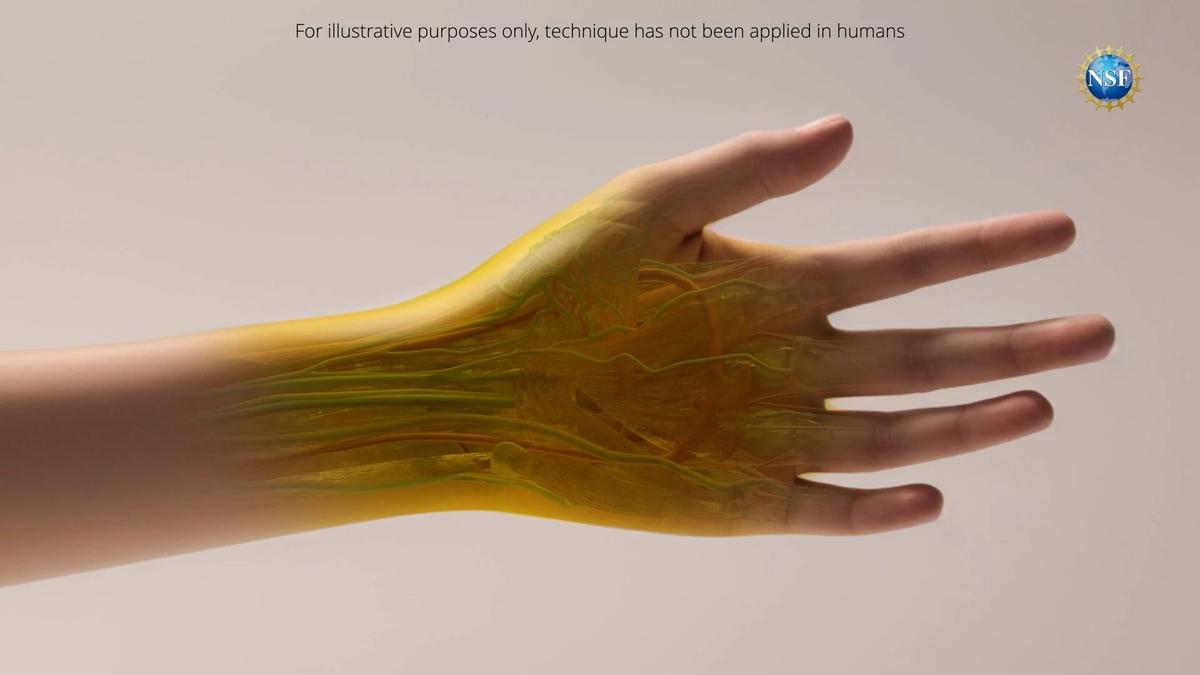
Finally, we used this idea to make the skin of a mouse optically transparent. We applied the FD&C Yellow 5 dye to different parts of the mouse’s body. When we added it to the mouse’s scalp, we could see the blood vessels in its brain. When we added it to the mouse’s belly, we could see its gut. When we added it to the mouse’s limbs, we could see its muscle fibers.
All this experiment took was gently massaging a solution of the dye into the mouse’s skin and a bit of patience.
This process is noninvasive because it doesn’t require tissue removal or surgery, and the skin returns to its normal opacity once you rinse off the dye with water. Although it’s a fascinating technique, we strongly advise against trying this on yourself.
While the use of Yellow 5 is approved by the FDA, some people have raised concerns about its potential health risks. These include allergic reactions – particularly in people with asthma – hyperactivity in children and potential links to cancer. But researchers will need to conduct more tests to determine whether there are any dangers.
Future uses
So what could this approach be used for? Right now, it works best on very thin layers of skin, like that of a mouse.
Unfortunately, human skin is much thicker, so this method isn’t quite ready for practical use on people yet. Also, the red colour of the dye means that the colour balance isn’t quite right and the transparency isn’t perfect across the entire visible spectrum. The dye still blocks blue light.
My colleagues and I are working on improving this technique to make it more effective for human tissues. We’re also trying to shift the dye’s absorption toward the ultraviolet spectrum, which would create a more balanced transparency effect across all visible colours.

Looking ahead, this technology one day could make veins more visible, making it easier to perform venipuncture – the process of drawing blood or injecting fluids through a needle – especially in elderly patients with hard-to-see veins.
It could also aid in the early detection of skin cancer, enhance light delivery into deep tissues for photodynamic and photothermal therapies and simplify laser-based tattoo removal.
In photodynamic and photothermal therapies, doctors use a laser to kill cancerous and precancerous cells. But light from the laser penetrates only so far into the tissue, so these therapies aren’t suitable for organs deeper in the body – yet.
All of these applications could benefit from a reversible, on-demand transparency window into the body.
Guosong Hong is assistant professor of materials science and engineering, Stanford University. This article is republished from The Conversation.

Published – September 06, 2024 01:25 pm IST