


Skip to content
  • Facebook
  • X
  • Linkedin
  • WhatsApp
  • YouTube
  • Associate Journalism
  • About Us
  • Privacy Policy
  • 033-46046046
  • editor@artifex.news
Artifex.News

Artifex.News

Stay Connected. Stay Informed.

  • Breaking News
  • World
  • Nation
  • Sports
  • Business
  • Science
  • Entertainment
  • Lifestyle
  • Toggle search form
  • Shootout Linked To Drug Trafficking Injures Five In France
    Shootout Linked To Drug Trafficking Injures Five In France World
  • Delhi Doctors Report Rise In Hand, Foot, Mouth Disease In Children
    Delhi Doctors Report Rise In Hand, Foot, Mouth Disease In Children Nation
  • Access Denied Sports
  • Access Denied Sports
  • Denied Accreditation, India’s Korean Archery Coach Says He Won’t Continue After Contract Expiry
    Denied Accreditation, India’s Korean Archery Coach Says He Won’t Continue After Contract Expiry Sports
  • Indian national arrested in U.S. over multi-million-dollar fraud targeting elderly
    Indian national arrested in U.S. over multi-million-dollar fraud targeting elderly World
  • 160 Percent Increase: Border-Gavaskar Trophy 2024/25 Shatters More Cricket Viewership Records
    160 Percent Increase: Border-Gavaskar Trophy 2024/25 Shatters More Cricket Viewership Records Sports
  • Arvind Kejriwal’s Post With Inked Finger
    Arvind Kejriwal’s Post With Inked Finger Nation
For elephants, like people, greetings are a complicated affair

For elephants, like people, greetings are a complicated affair

Posted on May 14, 2024 By admin


The male savannah elephant Doma and the male savannah elephant Mainos engage in greeting behaviour at Jafuta Reserve in Zimbabwe, in this undated handout picture.
| Photo Credit: Reuters

People greet each other in a variety of ways. They might say “hello,” “guten tag,” “hola,” “konnichiwa” or “g’day.” They might shake hands, bump fists, make a fist-and-palm gesture or press their hands together with a gentle head bow. They might kiss on the cheek or hand. And they might give a nice big hug.

For elephants, greetings appear to be a similarly complex affair. A study based on observations of African savannah elephants in the Jafuta Reserve in Zimbabwe provides new insight into the visual, acoustic and tactile gestures they employ in greetings, including how greetings differ depending on factors such as their sex and whether they are looking at each other.

“Elephants live in a so-called ‘fission-fusion’ society, where they often separate and reunite, meeting after hours, days or months apart,” said cognitive and behavioural biologist Vesta Eleuteri of the University of Vienna in Austria, lead author of the study published this month in the journal Communications Biology.

Elephants, Earth’s largest land animals, are highly intelligent, with keen memory and problem-solving skills and sophisticated communication.

Female elephants of different family groups might have strong social bonds with each other, forming “bond groups.” Previous studies in the wild reported that when these groups meet, the elephants engage in elaborate greeting ceremonies to advertise and strengthen their social bond, Eleuteri said.

Male elephants have weaker social bonds, and their greetings may function more to ease possible “risky reunions” – a hostile interaction. They greet mainly by smelling each other, reaching with their trunks, Eleuteri added.

The study detailed around 20 gesture types displayed during greetings, showing that elephants combine these in specific ways with call types such as rumbles, roars and trumpets. It also revealed how smell plays an important role in greetings, often involving urination, defecation and secretions from a unique elephant gland.

Elephants may greet by making gestures intended to be seen, like spreading the ears or showing their rump, or with gestures producing distinct sounds like flapping the ears forward, or with tactile gestures involving touching the other elephant.
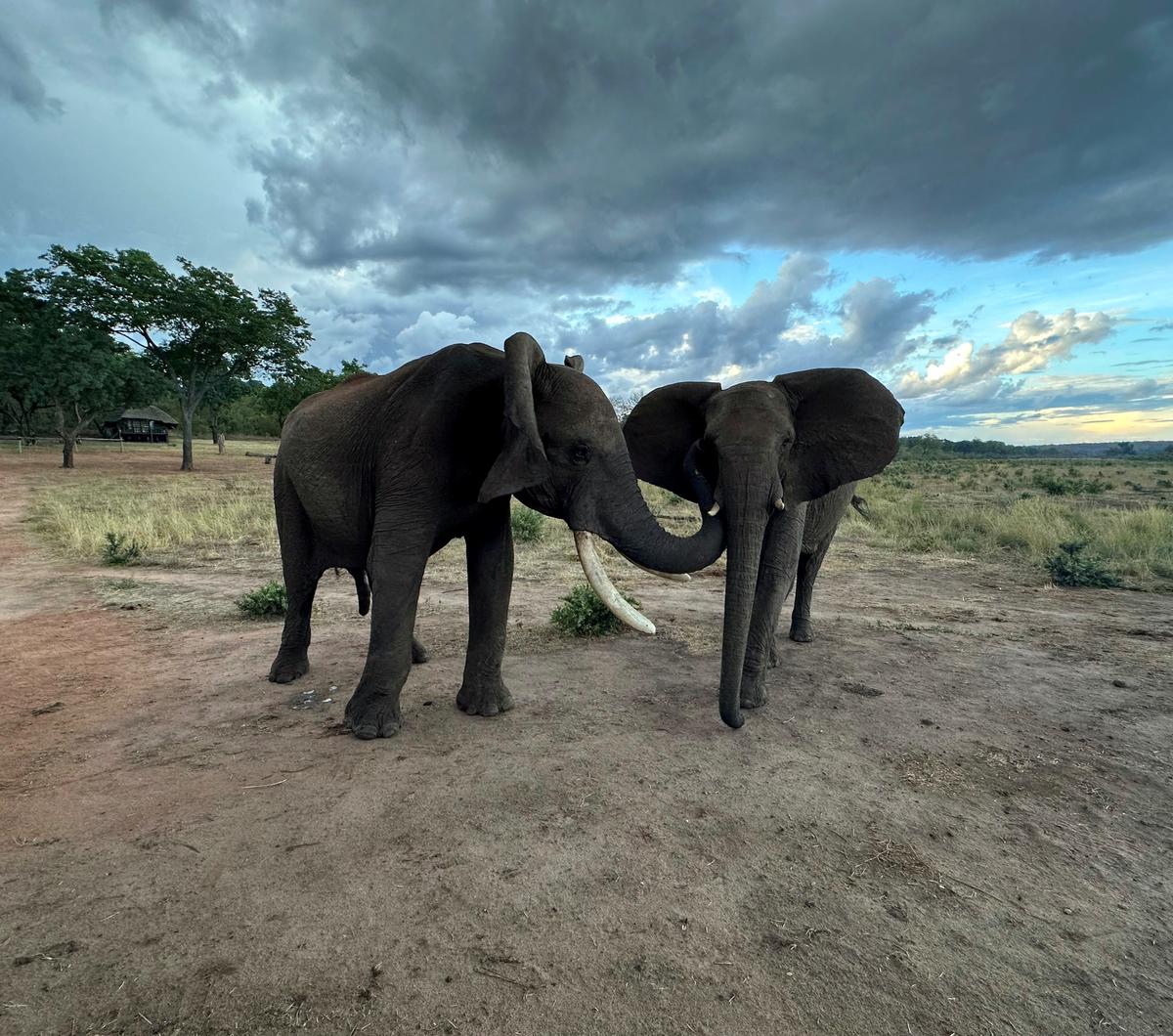
The male savannah elephant Doma and the female savannah elephant Kariba engage in greeting behaviour at Jafuta Reserve in Zimbabwe in this undated handout picture.

The male savannah elephant Doma and the female savannah elephant Kariba engage in greeting behaviour at Jafuta Reserve in Zimbabwe in this undated handout picture.
| Photo Credit:
Reuters

“We found that they select these visual, acoustic and tactile gestures by taking into account whether their greeting partner was looking at them or not, suggesting they’re aware of others’ visual perspectives. They preferred using visual gestures when their partner was looking at them, while tactile ones when they were not,” Eleuteri said.

Greeting behaviour has been studied in various animals.

“Many other species greet, including different primates, hyenas and dogs,” Eleuteri said. “Animal greetings help mediate social interactions by, for example, reducing tension and avoiding conflict, by reaffirming existing social bonds, and by establishing dominance status using different behaviors.”

The new research built on previous studies of elephant greeting behavior. The nine observed elephants – four females and five males – were “semi-captive,” freely roaming their natural environment during daytime and kept in stables at night.

Greetings used by the female elephants closely matched the behavior of wild elephants. The greeting behavior of the male elephants appeared to differ from their wild counterparts. Wild male elephants tend to be solitary, forming loose associations with other elephants.

The temporal gland, midway between the eye and the ear, secretes a substance called temporin containing chemical information about an elephant’s identity or emotional and sexual state. Elephants often use their trunks to check out the temporal glands of others.

“The urine and feces of elephants also contain chemical information important for elephants, like the identity of the individual, their reproductive state or even their emotional state,” Eleuteri said.

“Elephants might defecate or urinate during greetings to release this important information. Another option is that they do this due to the excitement of seeing each other. But the fact that the elephants often moved their tails to the side or waggled their tails when urinating and defecating suggests they may be inviting the recipients to smell them. Maybe they don’t need to tell each other how they’re doing, as they can smell it,” Eleuteri added.

Source link

Science Tags:African savannah elephants, animal news, animal science, Elephant behaviour, Elephant greetings, elephants

Post navigation

Previous Post: Blinken visits Ukraine to tout U.S. support for Kyiv’s fight against Russia’s advances
Next Post: “It Has Made A Big Difference”: Ravi Shastri Backs Impact Player Rule

Related Posts

  • Photobiology: speeding up enzyme reactions in microbes using light
    Photobiology: speeding up enzyme reactions in microbes using light Science
  • Science Quiz: Unusual sources of energy
    Science Quiz: Unusual sources of energy Science
  • If anxiety is in my brain, why is my heart pounding? A psychiatrist explains the neuroscience and physiology of fear
    If anxiety is in my brain, why is my heart pounding? A psychiatrist explains the neuroscience and physiology of fear Science
  • Frigid alien planet may offer a glimpse at Earth’s distant future
    Frigid alien planet may offer a glimpse at Earth’s distant future Science
  • Why is it colder at higher altitudes?
    Why is it colder at higher altitudes? Science
  • More solar storms brewing after last week’s aurorae as Sun ‘wakes up’
    More solar storms brewing after last week’s aurorae as Sun ‘wakes up’ Science

More Related Articles

Rapid, diagnostic test for UTIs may help stem super bug crisis Rapid, diagnostic test for UTIs may help stem super bug crisis Science
In Pictures | Artemis II’s voyage to the moon and back In Pictures | Artemis II’s voyage to the moon and back Science
A new genetic analysis of animals in the Wuhan market in 2019 may help find COVID-19’s origin A new genetic analysis of animals in the Wuhan market in 2019 may help find COVID-19’s origin Science
Scientists find gene that keeps rice from breaking during milling Scientists find gene that keeps rice from breaking during milling Science
China launches 3-member crew to its space station as it seeks to put astronauts on the moon by 2030 China launches 3-member crew to its space station as it seeks to put astronauts on the moon by 2030 Science
Is the Gangotri glacier losing snow earlier than usual? Is the Gangotri glacier losing snow earlier than usual? Science
SiteLock

Archives

  • September 2026
  • August 2026
  • July 2026
  • June 2026
  • May 2026
  • April 2026
  • March 2026
  • February 2026
  • January 2026
  • December 2025
  • November 2025
  • October 2025
  • September 2025
  • August 2025
  • July 2025
  • June 2025
  • May 2025
  • April 2025
  • March 2025
  • February 2025
  • January 2025
  • December 2024
  • November 2024
  • October 2024
  • September 2024
  • August 2024
  • July 2024
  • June 2024
  • May 2024
  • April 2024
  • March 2024
  • February 2024
  • January 2024
  • December 2023
  • November 2023
  • October 2023
  • September 2023
  • August 2023
  • July 2023
  • June 2023
  • May 2023
  • April 2023
  • March 2023
  • February 2023
  • January 2023
  • December 2022
  • November 2022
  • October 2022
  • September 2022
  • August 2022
  • July 2022
  • June 2022
  • May 2022

Categories

  • Business
  • Nation
  • Science
  • Sports
  • World

Recent Posts

  • FSDA cancels 16 pharmacy licences, suspends 8, including Pfizer depot
  • I approach Vaishali whenever I have a doubt: Savitha Shri
  • Apartments, gated communities reel under water crisis; Dependency on tankers increases
  • Russia reports mass cyberattacks targeting elections
  • Israeli settler killed in West Bank, suspect arrested

Recent Comments

  1. Jasonnekly on UP Teacher Who Asked Students To Slap Muslim Classmate
  2. Frankenrib on UP Teacher Who Asked Students To Slap Muslim Classmate
  3. Frankenrib on UP Teacher Who Asked Students To Slap Muslim Classmate
  4. Anthonylop on UP Teacher Who Asked Students To Slap Muslim Classmate
  5. Anthonylop on UP Teacher Who Asked Students To Slap Muslim Classmate
  • Access Denied
    Access Denied Nation
  • Doctors Reply To Mamata Banerjee’s “Final” Talks Invite With 3 Options
    Doctors Reply To Mamata Banerjee’s “Final” Talks Invite With 3 Options Nation
  • Access Denied
    Access Denied Nation
  • India’s ‘heat trap’ cities make summers worse, says government official
    India’s ‘heat trap’ cities make summers worse, says government official Science
  • Supreme Court Puts On Hold Centre’s Notification On Its Fact-Check Unit
    Supreme Court Puts On Hold Centre’s Notification On Its Fact-Check Unit Nation
  • Access Denied World
  • Do mRNA tumour vaccines herald a new revolution in cancer treatment?
    Do mRNA tumour vaccines herald a new revolution in cancer treatment? Science
  • BJP Leader’s Offensive Remark About Congress’ Balasaheb Thorat’s Daughter Jayashree Thorat Sparks Row
    BJP Leader’s Offensive Remark About Congress’ Balasaheb Thorat’s Daughter Jayashree Thorat Sparks Row Nation

Editor-in-Chief:
Mohammad Ariff,
MSW, MAJMC, BSW, DTL, CTS, CNM, CCR, CAL, RSL, ASOC.
editor@artifex.news

Associate Editors:
1. Zenellis R. Tuba,
zenelis@artifex.news
2. Haris Daniyel
daniyel@artifex.news

Photograher:
Rohan Das
rohan@artifex.news

Artifex.News offers Online Paid Internships to college students from India and Abroad. Interns will get a PRESS CARD and other online offers.
Send your CV (Subjectline: Paid Internship) to internship@artifex.news

Links:
Associate Journalism
About Us
Privacy Policy

News Links:
Breaking News
World
Nation
Sports
Business
Entertainment
Lifestyle

Registered Office:
72/A, Elliot Road, Kolkata - 700016
Tel: 033-22277777, 033-22172217
Email: office@artifex.news

Editorial Office / News Desk:
No. 13, Mezzanine Floor, Esplanade Metro Rail Station,
12 J. L. Nehru Road, Kolkata - 700069.
(Entry from Gate No. 5)
Tel: 033-46011099, 033-46046046
Email: editor@artifex.news

Copyright © 2023 Artifex.News Newsportal designed by Artifex Infotech.