



Skip to content
  • Facebook
  • X
  • Linkedin
  • WhatsApp
  • YouTube
  • Associate Journalism
  • About Us
  • Privacy Policy
  • 033-46046046
  • editor@artifex.news
Artifex.News

Artifex.News

Stay Connected. Stay Informed.

  • Breaking News
  • World
  • Nation
  • Sports
  • Business
  • Science
  • Entertainment
  • Lifestyle
  • Toggle search form
  • Maharashtra Government Vs Opposition Over Shooting Of Badlapur Rape Accused
    Maharashtra Government Vs Opposition Over Shooting Of Badlapur Rape Accused Nation
  • Congress Complains To Poll Body On Haryana Results
    Congress Complains To Poll Body On Haryana Results Nation
  • U.S. indictment will squeeze Adani in its negotiation with Bangladesh
    U.S. indictment will squeeze Adani in its negotiation with Bangladesh World
  • Access Denied
    Access Denied Nation
  • Paris Olympics 2024: Where India’s Medals Could Be Won Or Lost
    Paris Olympics 2024: Where India’s Medals Could Be Won Or Lost Sports
  • Access Denied Business
  • Access Denied
    Access Denied Nation
  • Access Denied
    Access Denied Nation
Can we make black holes reveal themselves in echoes of light?

Can we make black holes reveal themselves in echoes of light?

Posted on December 16, 2024 By admin


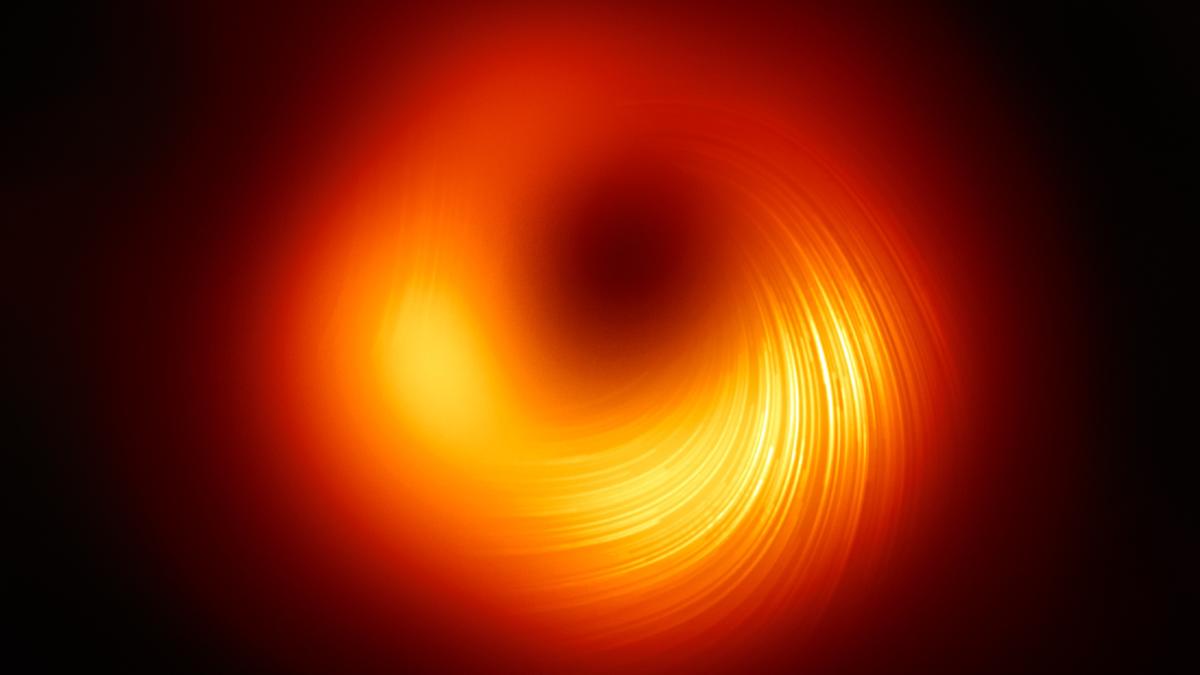
A view of the M87 supermassive black hole in polarised light as captured by the Event Horizon Telescope and released in 2021.
| Photo Credit: EHT Collaboration (CC BY 4.0)

When it comes to making sense of our universe, the importance of black holes is hard to understate. Scientists know that a black hole exerts a strong gravitational pull, so much so that any object that gets closer to its centre beyond a point can never get back out. The effects of black holes on their surroundings include the release of a tremendous amount of energy. These effects are crucial to determine the structures of the galaxies they occupy and how the stars around them evolved over time.

A study published in the Astrophysical Journal Letters on November 7 is notable in this wider context. It was carried out by astrophysicists from the Institute for Advanced Study in Princeton, New Jersey, led by George Wong of the School of Natural Sciences at Princeton University. In their study, the researchers presented a new method to measure the properties of black holes by using the effects they have on light flowing around them.

Signatures in the light

When light passes around a very heavy object, like a black hole, its path bends. As a result some parts of the light may take a direct route to the viewer while others may pass around the black hole a few times before getting back on its original path. In this way, light emitted by a distant source in the cosmos may reach the earth at different instances, depending on its interactions with black holes on the way. When two beams of light emitted by the same source reach the earth at different points, the beam to arrive second will be an echo of the beam that arrived first. This phenomenon is thus called a light echo.

The manner and extent to which light circles around a black hole depends on the black hole’s mass and radius. If the black hole is spinning (a.k.a. a Kerr black hole), it will also depend on the object’s angular momentum. Thus, according to the study, scientists can use light echoes as a new and independent way to the masses and spins of black holes.

In general, the task of measuring a black hole’s mass and spin is quite tedious because all the matter, hot gases, and the radiation swirling around the object complicate observations and make signals harder to extract from the noise. Light, fortunately, is affected differently and light echoes could offer a better signal-to-noise ratio.

Lenses and rings

An object that bends light is called a lens. Black holes do this by the sheer strength of their gravity, thus the phenomenon is called gravitational lensing. Scientists theorised long ago that gravitational lensing could create light echoes but they have not been directly measured so far. To get around this issue, the new study proposes the use of a technique called long-baseline interferometry. The principle here is that the non-simultaneous arrival of two signals — like two light beams — could interfere with each other to create a new, unique signal.

To spot light echoes created by a black hole, one telescope could be placed on the earth and the other in space. While the number of instruments may seem modest, they will have to operate with supreme technical rigour.

The main motivation for the new study was the fact that some of the supermassive black holes in the centre of the Milky Way and the nearby M87 galaxies have been found to have bright rings of light at a frequency of 230 GHz around them. The structure of these rings is influenced by astrophysical forces and the spacetime geometry of black holes, and scientists have been keen to study them in detail using very long baseline interferometry techniques. One particular aspiration is to trace the black hole’s shadow on these rings to understand spacetime around the black holes.

Independent of colour

The analysis in the new study essentially focused on a black hole at the centre of the M87 galaxy — an appealing object of study for light echoes since it’s quite large in the sky. But the results are also applicable to other black holes. The baseline in ‘long baseline interferometry’ refers to the distance between the two telescopes that receive the light. According to the study, it should be at least 40 Gλ, where Gλ is a unit of measurement that refers to the telescopes’ ability to collect signals at a specific frequency.

The Princeton team also carried out preliminary high-resolution simulations to test the credibility of their technique. For this, team members collected several thousand instantaneous images of light travelling around the M87 black hole, located nearly 55 million lightyears away, using the Event Horizon Telescope. Then they estimated the time beams of light took to travel from the near end of the black hole to its far end, which, according to their idea, would depend on the black hole’s mass and angular momentum, after adjusting for the angle at which the telescope was viewing it. From this simulated data, the team inferred the echo delay.

Albert Einstein’s general theory of relativity also anticipated the phenomenon of light echoes. In particular the theory predicts the echoes will be achromatic, meaning light of all frequencies should be able to form echoes. (Since Gλ is inversely proportional to the frequency, building a telescope to detect the echoes is a separate headache.) Thus any approach to detect light echoes at multiple frequencies at the same time could provide a good test of the new technique. A positive result will also be yet another confirmation that the general theory of relativity provides an accurate description of black holes.

Qudsia Gani is an assistant professor in the Department of Physics, Government Degree College Pattan, Baramulla.

Published – December 16, 2024 05:30 am IST



Source link

Science

Post navigation

Previous Post: U.S. agencies should use advanced technology to identify mysterious drones, Schumer says
Next Post: India, Bangladesh 1971 war veterans’ exchange visit to mark Vijay Diwas

Related Posts

  • The Science Quiz | The world of fungi
    The Science Quiz | The world of fungi Science
  • Trump administration fires entire National Science Board
    Trump administration fires entire National Science Board Science
  • Lancet paper provides proof for undeniable link between high glycaemic index and diabetes
    Lancet paper provides proof for undeniable link between high glycaemic index and diabetes Science
  • UV camera snaps treetops glowing as thunderstorm passed overhead
    UV camera snaps treetops glowing as thunderstorm passed overhead Science
  • 2023 Nobel Prize in Physics: Seeing electrons through brief pulses of light | Explained
    2023 Nobel Prize in Physics: Seeing electrons through brief pulses of light | Explained Science
  • Scientists use ‘atomic stencils’ to make designer nanoparticles
    Scientists use ‘atomic stencils’ to make designer nanoparticles Science

More Related Articles

Why is environmental surveillance important? | Explained Why is environmental surveillance important? | Explained Science
How do SIM cards work? | Explained How do SIM cards work? | Explained Science
What is India’s first orbital data centre satellite? What is India’s first orbital data centre satellite? Science
The science, technology, and pitfalls of using nuclear power in space The science, technology, and pitfalls of using nuclear power in space Science
If tardigrades crowd-sourced their remarkable genes, can humans? If tardigrades crowd-sourced their remarkable genes, can humans? Science
World’s cleanest pigs raised to grow kidneys, hearts for humans World’s cleanest pigs raised to grow kidneys, hearts for humans Science
SiteLock

Archives

  • May 2026
  • April 2026
  • March 2026
  • February 2026
  • January 2026
  • December 2025
  • November 2025
  • October 2025
  • September 2025
  • August 2025
  • July 2025
  • June 2025
  • May 2025
  • April 2025
  • March 2025
  • February 2025
  • January 2025
  • December 2024
  • November 2024
  • October 2024
  • September 2024
  • August 2024
  • July 2024
  • June 2024
  • May 2024
  • April 2024
  • March 2024
  • February 2024
  • January 2024
  • December 2023
  • November 2023
  • October 2023
  • September 2023
  • August 2023
  • July 2023
  • June 2023
  • May 2023
  • April 2023
  • March 2023
  • February 2023
  • January 2023
  • December 2022
  • November 2022
  • October 2022
  • September 2022
  • August 2022
  • July 2022
  • June 2022
  • May 2022

Categories

  • Business
  • Nation
  • Science
  • Sports
  • World

Recent Posts

  • ATS questions 57 in Maharashtra over alleged gangster network links
  • Nicobarese oppose proposal for three wildlife sanctuaries
  • Visakhapatnam Collector calls for inter-departmental synergy to boost investments
  • Kohli’s masterful knock powers Royal Challengers to the top
  • Senior IPS officer Asra Garg posted IGP Intelligence

Recent Comments

  1. RichardClage on UP Teacher Who Asked Students To Slap Muslim Classmate
  2. StevenLek on UP Teacher Who Asked Students To Slap Muslim Classmate
  3. Leonardren on UP Teacher Who Asked Students To Slap Muslim Classmate
  4. NathanQuins on UP Teacher Who Asked Students To Slap Muslim Classmate
  5. Davidgof on UP Teacher Who Asked Students To Slap Muslim Classmate
  • Ranji Trophy: Vidarbha Defeat Madhya Pradesh By 62 Runs, Set Up Date With Mumbai In Final
    Ranji Trophy: Vidarbha Defeat Madhya Pradesh By 62 Runs, Set Up Date With Mumbai In Final Sports
  • Akhilesh Yadav’s official Facebook account suspended: Samajwadi Party
    Akhilesh Yadav’s official Facebook account suspended: Samajwadi Party Nation
  • Access Denied Business
  • Access Denied World
  • Biden Congratulates President-Elect Trump At White House
    Biden Congratulates President-Elect Trump At White House World
  • Access Denied Business
  • Access Denied World
  • BJP Targets Priyanka Gandhi On Poll Affidavit, Husband Robert Vadra Replies
    BJP Targets Priyanka Gandhi On Poll Affidavit, Husband Robert Vadra Replies Nation

Editor-in-Chief:
Mohammad Ariff,
MSW, MAJMC, BSW, DTL, CTS, CNM, CCR, CAL, RSL, ASOC.
editor@artifex.news

Associate Editors:
1. Zenellis R. Tuba,
zenelis@artifex.news
2. Haris Daniyel
daniyel@artifex.news

Photograher:
Rohan Das
rohan@artifex.news

Artifex.News offers Online Paid Internships to college students from India and Abroad. Interns will get a PRESS CARD and other online offers.
Send your CV (Subjectline: Paid Internship) to internship@artifex.news

Links:
Associate Journalism
About Us
Privacy Policy

News Links:
Breaking News
World
Nation
Sports
Business
Entertainment
Lifestyle

Registered Office:
72/A, Elliot Road, Kolkata - 700016
Tel: 033-22277777, 033-22172217
Email: office@artifex.news

Editorial Office / News Desk:
No. 13, Mezzanine Floor, Esplanade Metro Rail Station,
12 J. L. Nehru Road, Kolkata - 700069.
(Entry from Gate No. 5)
Tel: 033-46011099, 033-46046046
Email: editor@artifex.news

Copyright © 2023 Artifex.News Newsportal designed by Artifex Infotech.