



Skip to content
  • Facebook
  • X
  • Linkedin
  • WhatsApp
  • YouTube
  • Associate Journalism
  • About Us
  • Privacy Policy
  • 033-46046046
  • editor@artifex.news
Artifex.News

Artifex.News

Stay Connected. Stay Informed.

  • Breaking News
  • World
  • Nation
  • Sports
  • Business
  • Science
  • Entertainment
  • Lifestyle
  • Toggle search form
  • Max Verstappen Wins Japanese GP, Red Bull Clinch Constructors’ Championship
    Max Verstappen Wins Japanese GP, Red Bull Clinch Constructors’ Championship Sports
  • Vimal stakes claim for opener’s slot in TN Ranji squad
    Vimal stakes claim for opener’s slot in TN Ranji squad Sports
  • Firefighters battle devastating Los Angeles wildfires as winds calm somewhat
    Firefighters battle devastating Los Angeles wildfires as winds calm somewhat World
  • Elon Musk took part in Trump-Zelensky call: Ukrainian official
    Elon Musk took part in Trump-Zelensky call: Ukrainian official World
  • Ahead Of Boxing Day Test, Virat Kohli Takes Internet By Storm With New Haircut Video. Watch
    Ahead Of Boxing Day Test, Virat Kohli Takes Internet By Storm With New Haircut Video. Watch Sports
  • Access Denied
    Access Denied Nation
  • Israeli strike kills one in Gaza as sides trade blame for truce violations
    Israeli strike kills one in Gaza as sides trade blame for truce violations World
  • Frightened residents say Rwanda-backed rebels are advancing on a third city in eastern Congo
    Frightened residents say Rwanda-backed rebels are advancing on a third city in eastern Congo World
Why is environmental surveillance important? | Explained

Why is environmental surveillance important? | Explained

Posted on October 1, 2025 By admin


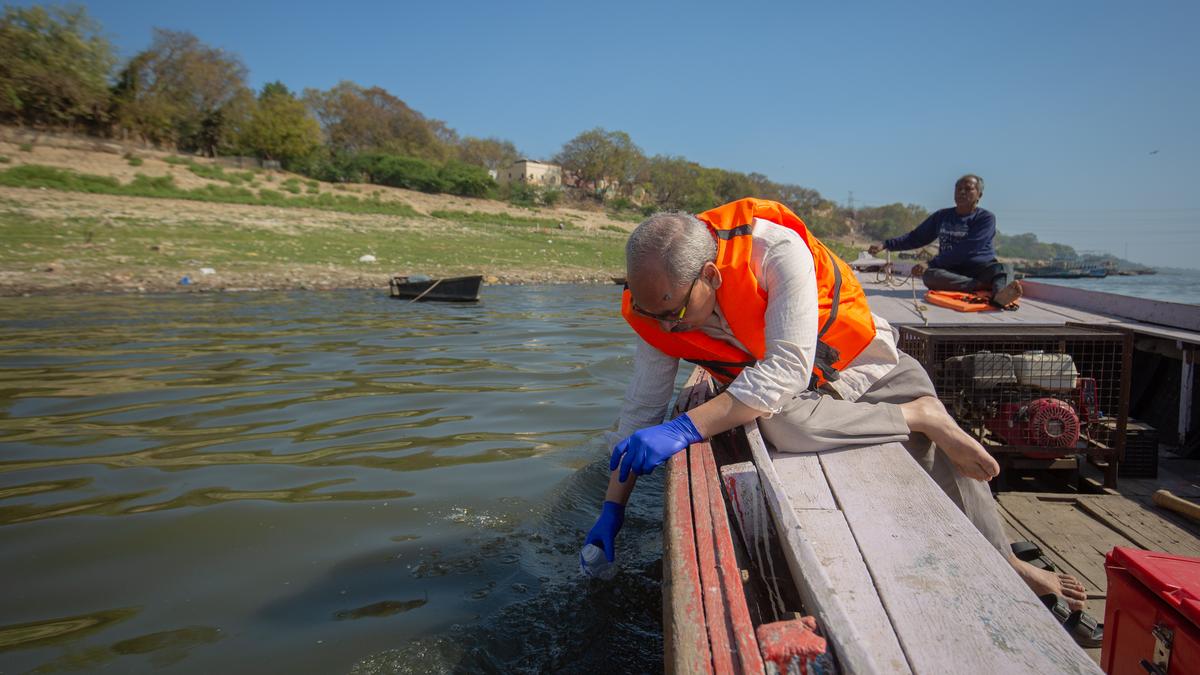
A laboratory technician collects river water samples to test for faecal coliform bacteria from the Ganges river in Varanasi on March 5.
| Photo Credit: Getty Images

The story so far: Pathogens (usually bacteria and viruses) that cause diseases in humans and animals, can be tracked in samples taken from the environment, for example, by sampling sewage through wastewater surveillance. This can provide early warnings for potential disease outbreaks.

How does this work?

Samples taken from sewage treatment plants, effluents from hospitals and from public spaces such as railway stations and toilets in airplanes, can be studied to see how the pathogens they contain change from day-to-day. It works because pathogens of interest are shed in the stools or urine of infected individuals. Diseases transmitted by parasitic worms such as roundworms and hookworms can also be monitored through wastewater and soil samples, providing information about the burden of the disease and the effectiveness of control measures.

Rigorous protocols inform the collection of samples. These protocols detail how samples must be collected and processed, and how pathogens are detected and analysed. By following these protocols, comparisons of pathogen load become possible, and whole-genome sequencing enables the identification of variants of the same pathogen.

Why is this important?

Traditionally, the only way to figure out levels of infection in a community was to detect infections in patients, called clinical case detection. However, not all infected people might show symptoms, or might not choose to be tested if symptoms are mild. The number of people who are tested might not reflect the true numbers of those infected.

Environmental surveillance can thus provide important early warning signals of an impending outbreak. It is now known that the levels of pathogen in wastewater can precede, often by more than a week, a rise in infections.

Why do early-warning signals matter?

Understanding how many infected people there are is important for public health planning. The more the amounts of pathogen that circulate, the more likely it is that people will be infected. Preparing for a disease outbreak becomes much easier if there’s more notice.

Wastewater-based epidemiology has been used for over 40 years to track several diseases such as measles, cholera and polio. Such disease surveillance in India, through wastewater, was first initiated in Mumbai for polio in 2001. During the COVID-19 pandemic, similar surveillance programs for COVID-19 were started in five cities, and they continue to this day.

What is India doing?

The Indian Council of Medical Research (ICMR) has recently said that it will initiate wastewater surveillance for 10 viruses across 50 cities. This will enable public health surveillance to pick up any increase in viral load within community settings. This extends ICMR’s involvement in establishing environmental surveillance for viruses, including avian influenza virus, particularly in areas with outbreaks. However, there is scope for improvement. The sharing of data and protocols across institutions and reaching common agreements on templates for surveillance frameworks that are disease-specific is important. Programmatic approaches, rather than project-driven approaches, must be developed that integrate waste-water and other environmental surveillance with routine disease surveillance. Developing a national wastewater surveillance system for India is important.

Moreover, new methodologies are emerging — audio samples of people coughing in public places can be used to examine the prevalence of respiratory conditions, through refined machine learning methods. Thus, the possibilities of environmental surveillance are ever-increasing.

Gautam Menon is Dean, Research and Professor of Physics and Biology, Ashoka University. Views expressed are personal and not of his institution.

Published – October 01, 2025 08:30 am IST



Source link

Science

Post navigation

Previous Post: Access Denied
Next Post: Why are Indian broadcasters owed payments? | Explained

Related Posts

  • Why is it colder at higher altitudes?
    Why is it colder at higher altitudes? Science
  • Science Snapshots: April 19, 2026
    Science Snapshots: April 19, 2026 Science
  • Reclaiming India’s fragrance heritage — why a name matters
    Reclaiming India’s fragrance heritage — why a name matters Science
  • What does the India-Brazil critical minerals MoU mean for the two countries?
    What does the India-Brazil critical minerals MoU mean for the two countries? Science
  • West Asia war: how finding oil changed the Persian Gulf’s ecology
    West Asia war: how finding oil changed the Persian Gulf’s ecology Science
  • Odisha tribal healer’s remedies for chronic diseases to undergo scientific validation under Ministry of Ayush initiative
    Odisha tribal healer’s remedies for chronic diseases to undergo scientific validation under Ministry of Ayush initiative Science

More Related Articles

Send robots into space rather than people, says Britain’s Astronomer Royal Send robots into space rather than people, says Britain’s Astronomer Royal Science
Why don’t left-handed persons make up half the population? Why don’t left-handed persons make up half the population? Science
How does glue work: the physics of what makes glue so sticky How does glue work: the physics of what makes glue so sticky Science
Efforts to restore mangroves can turn the tide on India’s coastal security Efforts to restore mangroves can turn the tide on India’s coastal security Science
Why are some people mosquito magnets? Why are some people mosquito magnets? Science
NZ treaty may allow people to sue on ‘behalf of whales’ NZ treaty may allow people to sue on ‘behalf of whales’ Science
SiteLock

Archives

  • May 2026
  • April 2026
  • March 2026
  • February 2026
  • January 2026
  • December 2025
  • November 2025
  • October 2025
  • September 2025
  • August 2025
  • July 2025
  • June 2025
  • May 2025
  • April 2025
  • March 2025
  • February 2025
  • January 2025
  • December 2024
  • November 2024
  • October 2024
  • September 2024
  • August 2024
  • July 2024
  • June 2024
  • May 2024
  • April 2024
  • March 2024
  • February 2024
  • January 2024
  • December 2023
  • November 2023
  • October 2023
  • September 2023
  • August 2023
  • July 2023
  • June 2023
  • May 2023
  • April 2023
  • March 2023
  • February 2023
  • January 2023
  • December 2022
  • November 2022
  • October 2022
  • September 2022
  • August 2022
  • July 2022
  • June 2022
  • May 2022

Categories

  • Business
  • Nation
  • Science
  • Sports
  • World

Recent Posts

  • PM Modi’s ‘warning’ on economy | What it means | Talking Politics
  • Trump-Xi meeting was ‘good’, says White House
  • Farooq Abdullah backs RSS leader Dattatreya Hosabale’s call for dialogue with Pakistan
  • As Puducherry orders closure of Smart City Development Limited, experts urge its repurposing
  • Drug ban low, WTC high, now IPL blitz: Rabada reflects on roller-coaster 12 months

Recent Comments

  1. JamesHeR on UP Teacher Who Asked Students To Slap Muslim Classmate
  2. RafaelNar on UP Teacher Who Asked Students To Slap Muslim Classmate
  3. CarlosExorb on UP Teacher Who Asked Students To Slap Muslim Classmate
  4. Robertfloup on UP Teacher Who Asked Students To Slap Muslim Classmate
  5. Davidcag on UP Teacher Who Asked Students To Slap Muslim Classmate
  • UP School Teacher Beats Class 2 Student For Not Reciting Table Of 7, Arrested
    UP School Teacher Beats Class 2 Student For Not Reciting Table Of 7, Arrested Nation
  • Access Denied
    Access Denied Nation
  • Access Denied
    Access Denied Nation
  • Stock markets rally after RBI keeps repo rate unchanged
    Stock markets rally after RBI keeps repo rate unchanged Business
  • Netanyahu says U.S. an ‘extraordinary friend’ during Rubio visit
    Netanyahu says U.S. an ‘extraordinary friend’ during Rubio visit World
  • Rahul Gandhi Slams Mohan Bhagwat
    Rahul Gandhi Slams Mohan Bhagwat Nation
  • ArcelorMittal net income rises 31% in Sepember quarter
    ArcelorMittal net income rises 31% in Sepember quarter Business
  • Access Denied
    Access Denied Nation

Editor-in-Chief:
Mohammad Ariff,
MSW, MAJMC, BSW, DTL, CTS, CNM, CCR, CAL, RSL, ASOC.
editor@artifex.news

Associate Editors:
1. Zenellis R. Tuba,
zenelis@artifex.news
2. Haris Daniyel
daniyel@artifex.news

Photograher:
Rohan Das
rohan@artifex.news

Artifex.News offers Online Paid Internships to college students from India and Abroad. Interns will get a PRESS CARD and other online offers.
Send your CV (Subjectline: Paid Internship) to internship@artifex.news

Links:
Associate Journalism
About Us
Privacy Policy

News Links:
Breaking News
World
Nation
Sports
Business
Entertainment
Lifestyle

Registered Office:
72/A, Elliot Road, Kolkata - 700016
Tel: 033-22277777, 033-22172217
Email: office@artifex.news

Editorial Office / News Desk:
No. 13, Mezzanine Floor, Esplanade Metro Rail Station,
12 J. L. Nehru Road, Kolkata - 700069.
(Entry from Gate No. 5)
Tel: 033-46011099, 033-46046046
Email: editor@artifex.news

Copyright © 2023 Artifex.News Newsportal designed by Artifex Infotech.