

Skip to content
  • Facebook
  • X
  • Linkedin
  • WhatsApp
  • YouTube
  • Associate Journalism
  • About Us
  • Privacy Policy
  • 033-46046046
  • editor@artifex.news
Artifex.News

Artifex.News

Stay Connected. Stay Informed.

  • Breaking News
  • World
  • Nation
  • Sports
  • Business
  • Science
  • Entertainment
  • Lifestyle
  • Toggle search form
  • Access Denied
    Access Denied Nation
  • Girl, 9, Complains Of Pinch. Then Mother Discovers Spider Bite That Quickly Spread
    Girl, 9, Complains Of Pinch. Then Mother Discovers Spider Bite That Quickly Spread World
  • Access Denied Sports
  • With Ball In Hand, Obsession In Heart, Mohammed Shami Gears Up For Comeback
    With Ball In Hand, Obsession In Heart, Mohammed Shami Gears Up For Comeback Sports
  • Indian Diplomats In Canada Under Surveillance, Centre Tells Parliament
    Indian Diplomats In Canada Under Surveillance, Centre Tells Parliament Nation
  • Access Denied Sports
  • “I Saw Her Again After…”: Mohammed Shami’s Post For ‘Bebo’ Is Emotional
    “I Saw Her Again After…”: Mohammed Shami’s Post For ‘Bebo’ Is Emotional Sports
  • Access Denied Sports
Scientists report trees absorb methane as well

Scientists report trees absorb methane as well

Posted on July 26, 2024 By admin


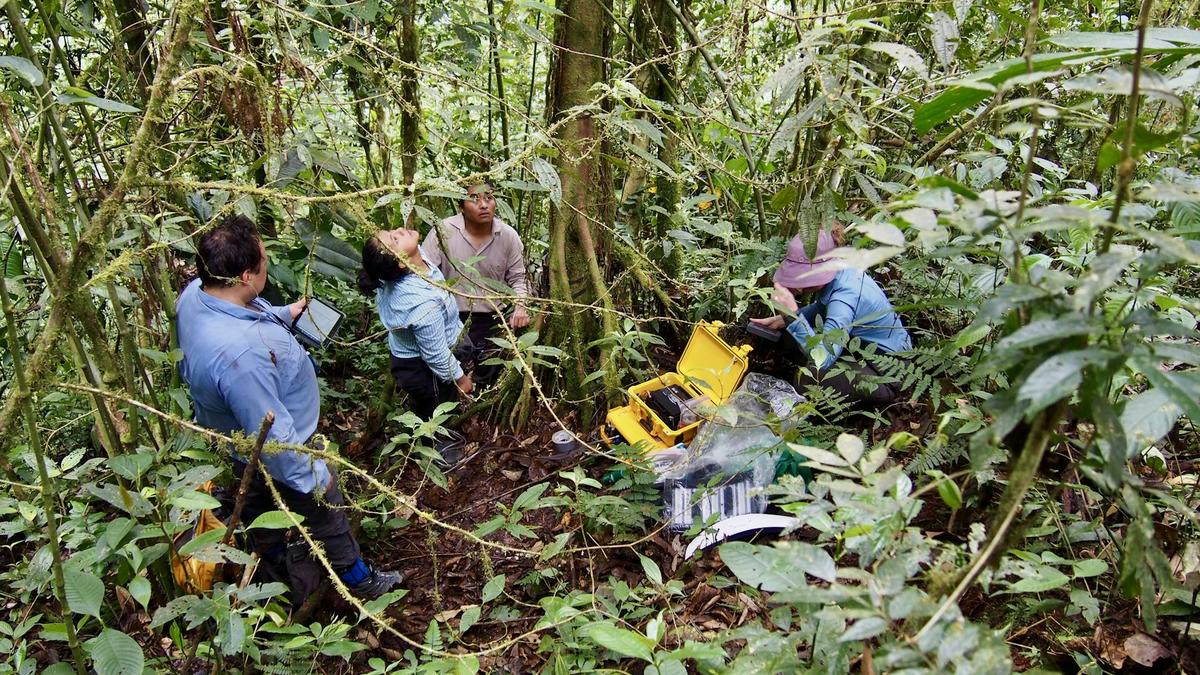
Researchers measure methane exchange on upland trees in Peru.
| Photo Credit: Vincent Gauci (CC BY-ND)

Tree bark in the world’s forests absorbs the greenhouse gas methane, my colleagues and I have demonstrated for the first time on a global scale – a discovery that could have big implications for tackling climate change.

As trees photosynthesise, their leaves take up carbon dioxide (CO₂) and lock it away as biomass in their trunks and branches providing a long-term store of carbon. But now, our large-scale study proves that there’s another way that trees absorb greenhouse gases – so forests can provide even more climate benefits than previously thought.

Methane has contributed about a third of the observed climate warming since preindustrial times. Concentrations of methane in the atmosphere have been rising rapidly for the best part of two decades.

That’s a real problem for Earth’s climate because methane traps much more heat in the atmosphere than the equivalent amount of CO₂. But while CO₂ can last in the atmosphere for hundreds of years, methane has a lifetime of around ten years.

This short atmospheric lifetime means that any changes to sources of methane or processes that remove methane from the atmosphere (known as methane sinks) can have rapid effects. If removal is enhanced, this can be a quick climate win helping to mitigate escalating climate change.

That’s why researchers are so interested in understanding how methane gets into the atmosphere and how different processes remove it. It’s why my team of ecologists and climate scientists have been studying the exchange of methane between tree bark, a surface that had previously been overlooked for its climate contribution, and the atmosphere.

Wetlands are known to be the primary natural source of methane – trees in swamps and floodplains can emit methane from the lower portions of their trunks. But methane exchange in trees growing on free-draining soils that don’t flood – that includes most of the world’s forests – has not been well-studied, until now.

We measured methane exchange on hundreds of tree stems in forests along a climate gradient spanning the Amazon and Panama, through to Sweden and forests near Oxford in the U.K. We used a simple plastic chamber that wrapped around the tree trunk which was then connected to a laser-based methane analyser.

At first, we looked for methane emissions from trees, and some do emit a small amount from their trunk base. But the surprise happened when we measured higher up the trunks: trees were taking up methane from the atmosphere and this methane removal grew stronger the higher up we went, with methane removal from the atmosphere dominating overall exchange.

Next, we investigated whether this was a globally important process. To do this we needed to calculate the global area of tree bark. Using a technique called terrestrial laser scanning, we mapped tree woody surfaces down to the finest twig.

We discovered that, if the bark from all the world’s trees were laid flat, it would cover all of Earth’s land surface. Potentially, this represents a vast area for gas exchange between tree bark and the atmosphere but this mechanism is still poorly understood.

An untapped sink

In total, our cautious first estimate is that trees take up between about 25 and 50 million tonnes of atmospheric methane each year, with most taken up by tropical forests.

This is similar to the only other land-based methane sink – soils – and it makes temperate and tropical trees 7%-12% better for climate than they are currently credited for.

But unlike soil, which isn’t changing in area, forests are contracting and expanding through deforestation and reforestation – these changes can influence atmospheric methane. If we reforest and plant trees in the right place, more methane could be drawn down from the atmosphere.

Clearly, decarbonisation of the global economy and energy system is the key way to address climate change. But, this capacity for tree bark to absorb methane offers another angle of attack as a nature-based climate solution.

There may be new ways to improve methane uptake in plantation forestry, by selecting trees that are particularly good at atmospheric methane removal or modifying tree bark microbial communities.

Nations could be given greater incentives to preserve existing natural forest and avoid further deforestation. Expensive reforestation projects may become more economically viable under reputable carbon offset schemes that consider methane.

This new evidence reinforces the importance of trees and forests for our climate system while demonstrating there is still much to learn about these valuable ecosystems.

Vincent Gauci is Professorial Fellow, School of Geography, Earth and Environmental Science, University of Birmingham. This article is republished from The Conversation.


The Conversation


Source link

Science Tags:methane capture, Methane emissions, methane formula, methane gas, trees absorb methane

Post navigation

Previous Post: Smriti Mandhana, Renuka Thakur Shine As India Beat Bangladesh, Enter Women’s Asia Cup Final
Next Post: Tax Body Clarifies Acquisition Cost Of Real Estate Bought Before 2001 For LTCG

Related Posts

  • Meghalaya yields new burrowing reed snake
    Meghalaya yields new burrowing reed snake Science
  • Jagan Mohan Reddy congratulates ISRO on its 100th launch
    Jagan Mohan Reddy congratulates ISRO on its 100th launch Science
  • No immediate need to collaborate with China on space, says ISRO
    No immediate need to collaborate with China on space, says ISRO Science
  • Rotavirus vaccine: tortured data analyses raise false safety alarm
    Rotavirus vaccine: tortured data analyses raise false safety alarm Science
  • Chandrayaan vs. Chang’e: How different are India’s and China’s lunar missions?
    Chandrayaan vs. Chang’e: How different are India’s and China’s lunar missions? Science
  • Lok Sabha Speaker urges ethical adoption of AI to bridge the digital divide
    Lok Sabha Speaker urges ethical adoption of AI to bridge the digital divide Science

More Related Articles

Spare live animals, move to biological models Spare live animals, move to biological models Science
Aditya-L1, first space-based Indian observatory to check the solar, to be introduced on Sept. 2 Aditya-L1, first space-based Indian observatory to check the solar, to be introduced on Sept. 2 Science
Wasps are excellent predators of pests and can play a big role in controlling them: IISc professor Wasps are excellent predators of pests and can play a big role in controlling them: IISc professor Science
IIT Roorkee uses bacterial enzymes to degrade plasticizers IIT Roorkee uses bacterial enzymes to degrade plasticizers Science
Quiz | Easy like Sunday morning: Space and beyond Quiz | Easy like Sunday morning: Space and beyond Science
Explained | After Chandrayaan-3, what has ISRO planned? Explained | After Chandrayaan-3, what has ISRO planned? Science
SiteLock

Archives

  • May 2026
  • April 2026
  • March 2026
  • February 2026
  • January 2026
  • December 2025
  • November 2025
  • October 2025
  • September 2025
  • August 2025
  • July 2025
  • June 2025
  • May 2025
  • April 2025
  • March 2025
  • February 2025
  • January 2025
  • December 2024
  • November 2024
  • October 2024
  • September 2024
  • August 2024
  • July 2024
  • June 2024
  • May 2024
  • April 2024
  • March 2024
  • February 2024
  • January 2024
  • December 2023
  • November 2023
  • October 2023
  • September 2023
  • August 2023
  • July 2023
  • June 2023
  • May 2023
  • April 2023
  • March 2023
  • February 2023
  • January 2023
  • December 2022
  • November 2022
  • October 2022
  • September 2022
  • August 2022
  • July 2022
  • June 2022
  • May 2022

Categories

  • Business
  • Nation
  • Science
  • Sports
  • World

Recent Posts

  • Nicobarese oppose proposal for three wildlife sanctuaries
  • Visakhapatnam Collector calls for inter-departmental synergy to boost investments
  • Kohli’s masterful knock powers Royal Challengers to the top
  • Senior IPS officer Asra Garg posted IGP Intelligence
  • Vijay Narayan earns rare distinction of being Advocate General under two different governments

Recent Comments

  1. StevenLek on UP Teacher Who Asked Students To Slap Muslim Classmate
  2. Leonardren on UP Teacher Who Asked Students To Slap Muslim Classmate
  3. NathanQuins on UP Teacher Who Asked Students To Slap Muslim Classmate
  4. Davidgof on UP Teacher Who Asked Students To Slap Muslim Classmate
  5. NathanJobre on UP Teacher Who Asked Students To Slap Muslim Classmate
  • Access Denied Sports
  • National Cricket League: Los Angeles Waves Seal Top Two Spot, Mumbai Indians Star Tim David Shines
    National Cricket League: Los Angeles Waves Seal Top Two Spot, Mumbai Indians Star Tim David Shines Sports
  • India Have ‘Lost In Big Match Situations’, Sourav Ganguly’s Concerns Ahead Of World Cup 2023
    India Have ‘Lost In Big Match Situations’, Sourav Ganguly’s Concerns Ahead Of World Cup 2023 Sports
  • Access Denied
    Access Denied Nation
  • Actor Nimrat Kaur Inaugurates War Memorial Dedicated To Her Father In Rajasthan
    Actor Nimrat Kaur Inaugurates War Memorial Dedicated To Her Father In Rajasthan Nation
  • 2 Judges Shot Dead, 1 Injured Outside Iran’s Supreme Court In Tehran
    2 Judges Shot Dead, 1 Injured Outside Iran’s Supreme Court In Tehran World
  • Sharad Pawar’s Dig At Eknath Shinde On Maratha Quota
    Sharad Pawar’s Dig At Eknath Shinde On Maratha Quota Nation
  • Rural, urban consumption inequality dips during August 2023-July 2024: Government Survey
    Rural, urban consumption inequality dips during August 2023-July 2024: Government Survey Business

Editor-in-Chief:
Mohammad Ariff,
MSW, MAJMC, BSW, DTL, CTS, CNM, CCR, CAL, RSL, ASOC.
editor@artifex.news

Associate Editors:
1. Zenellis R. Tuba,
zenelis@artifex.news
2. Haris Daniyel
daniyel@artifex.news

Photograher:
Rohan Das
rohan@artifex.news

Artifex.News offers Online Paid Internships to college students from India and Abroad. Interns will get a PRESS CARD and other online offers.
Send your CV (Subjectline: Paid Internship) to internship@artifex.news

Links:
Associate Journalism
About Us
Privacy Policy

News Links:
Breaking News
World
Nation
Sports
Business
Entertainment
Lifestyle

Registered Office:
72/A, Elliot Road, Kolkata - 700016
Tel: 033-22277777, 033-22172217
Email: office@artifex.news

Editorial Office / News Desk:
No. 13, Mezzanine Floor, Esplanade Metro Rail Station,
12 J. L. Nehru Road, Kolkata - 700069.
(Entry from Gate No. 5)
Tel: 033-46011099, 033-46046046
Email: editor@artifex.news

Copyright © 2023 Artifex.News Newsportal designed by Artifex Infotech.