




Skip to content
  • Facebook
  • X
  • Linkedin
  • WhatsApp
  • YouTube
  • Associate Journalism
  • About Us
  • Privacy Policy
  • 033-46046046
  • editor@artifex.news
Artifex.News

Artifex.News

Stay Connected. Stay Informed.

  • Breaking News
  • World
  • Nation
  • Sports
  • Business
  • Science
  • Entertainment
  • Lifestyle
  • Toggle search form
  • Access Denied
    Access Denied Nation
  • Louise Glück, Nobel-winning poet of terse and candid lyricism, dies at 80
    Louise Glück, Nobel-winning poet of terse and candid lyricism, dies at 80 World
  • Access Denied Sports
  • U.S. lawmakers express concern over total ban of Bangladesh’s Awami League party
    U.S. lawmakers express concern over total ban of Bangladesh’s Awami League party World
  • In Bengaluru, a garbage crisis deepens
    In Bengaluru, a garbage crisis deepens Nation
  • Moon was formed around 4.51 billion years ago: study
    Moon was formed around 4.51 billion years ago: study Science
  • Assembly election in Jammu and Kashmir should be held soon after Lok Sabha polls: Azad
    Assembly election in Jammu and Kashmir should be held soon after Lok Sabha polls: Azad Business
  • Spouses Of G20 Leaders Treated to Special Lunch, Street Food
    Spouses Of G20 Leaders Treated to Special Lunch, Street Food Nation
Chandrayaan vs. Chang’e: How different are India’s and China’s lunar missions?

Chandrayaan vs. Chang’e: How different are India’s and China’s lunar missions?

Posted on September 12, 2023 By admin


The story so far: Scripting history, the Chandrayaan-3 lander landed in the south polar region of the moon on August 23 at 6:03 pm IST, making India the first country to successfully soft-land in that area. The Vikram lander along with the Pragyan rover have since completed a small suite of surface tests. China’s Yutu-2 rover is the only other such instrument currently active on the moon.

Chandrayaan-3 is India’s second attempt to land on the moon. The first was Chandrayaan-2, whose lander module crashed on the moon in 2019.

China had landed a lander-rover module in the South Pole-Aitken Basin (this is not as close to the south polar region as Chandrayaan) in 2018. Both are operational as of date.

Here’s a look at China’s missions to the moon.

Chang’e

Since 2007, China has been launching lunar missions comprising orbiters, landers, rovers, and sample-return spacecraft. While Chang’e-1 and 2 launched lunar orbiters, Chang’e-3 launched the Yutu rover, which conducted a series of experiments on the lunar surface.

Planned initially as a back-up for Chang’e 3, the Chang’e 4 mission launched Yutu-2 on December 8, 2018, and it became the first rover to successfully soft-land on the moon’s far side.

After its launch, Chang’e 4 entered lunar orbit on December 12, 2018 and later completed three weeks of orbital manoeuvres before the spacecraft made a controlled landing in the Von Karman crater in the South Pole-Aitkin Basin on January 3, 2019.

The rover, on the far side of the moon, hibernates in the lunar night and functions during the day. The lander that transported it, Chang’e 4, is still operational and is a communication relay between the rover and control stations on the earth together with the orbiter, Queqiao. Details of data collected by the rover and the experiments conducted by it have not been made public by the Chinese National Space Agency (CNSA).

Chang’e 5 was launched on November 23, 2020, with two lunar orbiters, a lander, and an ascent vehicle. The primary mission objective was to collect surface samples from the Mons Rumker region of Oceanus Procellarum on the moon. After the launch, Chang’e 5 completed a lunar orbit before the descender spacecraft separated on November 29, 2020. Lowering into a circular orbit, the descender along with the lander landed on Mons Rumker, a vast volcanic plain.

The lander was equipped with a robotic arm with a scoop, a coring drill, and a chamber with a regolith storing capacity of up to 4 kg. (Regolith is the layer of soil, composed of loose rocks, dust, and other debris that covers the moon’s surface).

The lander also had the Panoramic Camera (PCAM), Lunar Regolith Penetrating Radar (LRPR), and a visible and near-infrared Lunar Mineralogical Spectrometer (LMS). With a life of one lunar day (two weeks), the lander did most of the drilling and sampling within 48 hours of landing. From a depth of 1 metre, the lander collected and stored 1.731 kg of lunar regolith and later transferred it to the ascender module.

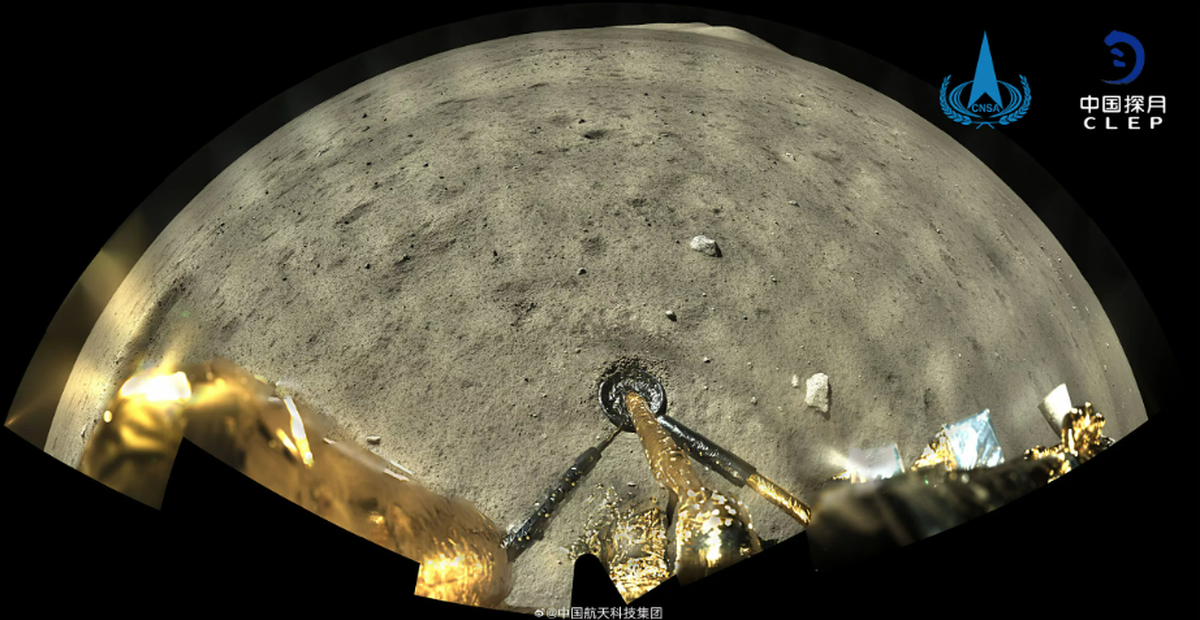
China’s Chang’e-5 spacecraft captured this image of the lunar surface shortly after landing in the Ocean of Storms on 1 December 2020

This module then travelled to the orbiter and transferred the sample container to the return capsule, which fired its rockets and entered the earth-moon orbit before landing in Inner Mongolia in northern China on December 17, 2020. Before returning to the earth, the orbiter separated from the return capsule, fired its rockets and headed for the earth-sun Lagrange point L1 to observe the sun. (This is the same location in space to which India’s Aditya L-1 satellite is currently headed.)

China has more moon missions planned — Chang’e 6,7 and 8 in 2024, 2026 and 2027— before finally sending a crewed mission to the moon by 2030. Continuing its sample return mission, Chang’e 6, a back up to Chang’e 5, will also have a lander with a scooping arm, return container, and ascender. This mission will also land on the far side of the moon, in the South Pole-Aitken Basin.

In 2026, Chang’e 7 is scheduled to expand on lunar south pole exploration by conducting detailed surveys, analysing the terrain, and studying the geological composition, locations of water ice, and the space environment. The mission will focus on detecting water ice in parts of the moon’s permanently shadowed craters.

In 2027, Chang’e 8 will test technologies necessary to construct a lunar science base in the south pole, carrying a lander, a rover, a flying detector, and a 3D-printing module.

Watch | Indians are buying land on the moon… but can one ‘own’ lunar land?

Chang’e mission aims

The Chang’e lunar exploration missions have seen evolving phases of the Chinese space programme since they began in 2007. Initial missions Chang’e 1 and 2 were designed to launch an orbiter and capture high resolution photos of the lunar surface. Chang’e 3 launched in 2013 comprised of a rover (Yutu) which explored 3 sq. km of the moon for 90 earth days collecting data to understand the moon’s elemental composition and the lunar subsurface. This mission demonstrated China’s capability to soft land on the moon.

Researchers work around Chang'e-5 lunar return capsule carrying moon samples next to a Chinese national flag, after it landed in northern China's Inner Mongolia Autonomous Region, December 17, 2020.

Researchers work around Chang’e-5 lunar return capsule carrying moon samples next to a Chinese national flag, after it landed in northern China’s Inner Mongolia Autonomous Region, December 17, 2020.
| Photo Credit:
Reuters

However, the programme’s aims changed with Chang’e 4, turning its focus towards the southern shadowed areas of the moon. Launching yet another lander-rover in 2018, Chang’e 4 was tasked with performing a controlled landing in the Von Karman crater in the South Pole-Aitken Basin and capture humankind’s first photos of the far side of the moon taken from the surface. Armed with spectrometers and radars, the rover studied the composition of the lunar surface there.

China then changed Chang’e mission’s aim to returning samples of lunar regolith to the earth with Chang’e 5, which brought 1.731 kg of lunar regolith back.
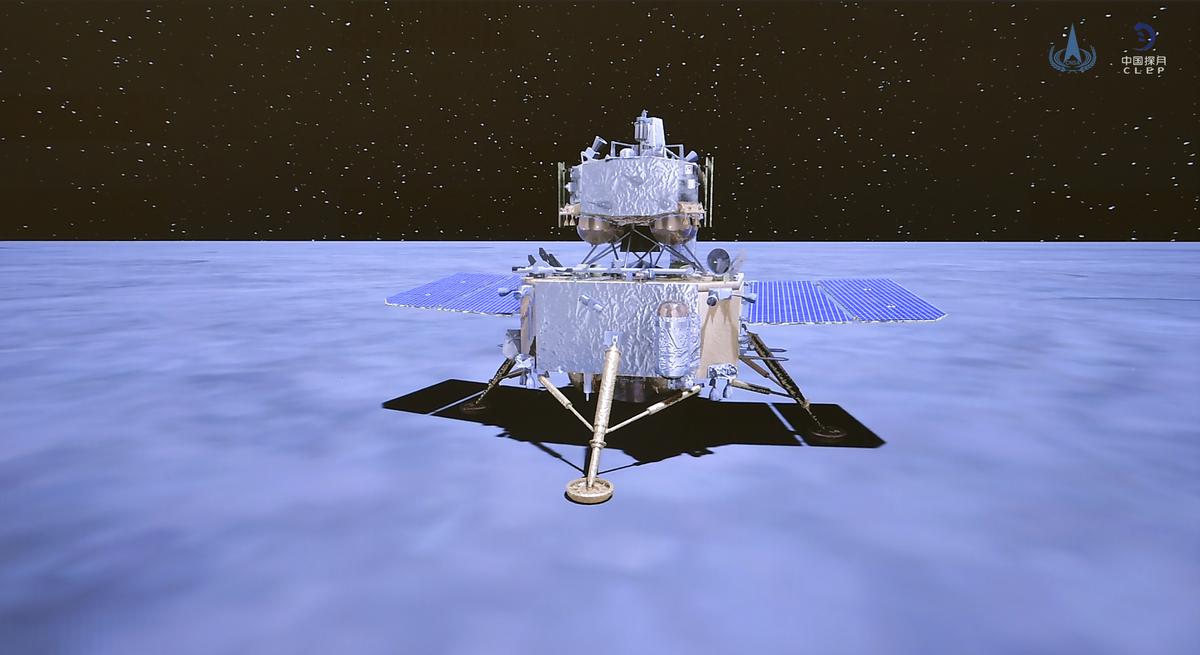
A representation of Chang’e 5 lander on the lunar surface

A representation of Chang’e 5 lander on the lunar surface

Chang’e 4’s lander and Yutu-2 rover were supposed to last for two months, but they are still functional, and have been sending data and high-resolution photos of the far side of the moon. Both the lander and rover use radioisotopic heat sources to maintain their temperatures through lunar nights.

Chang’e 5 had a specific lifetime of 23 days from launch on November 23, 2020, to return on December 16, 2020. After lunar orbit capture on November 28, the lander and descender/ascent vehicle separated and landed on the lunar surface on December 1. As the lander was capable of collecting samples for only 1 lunar day ), it lifted off via the ascender on December 3 and transferred the samples to the return capsule, before crashing to the moon’s surface on December 7.
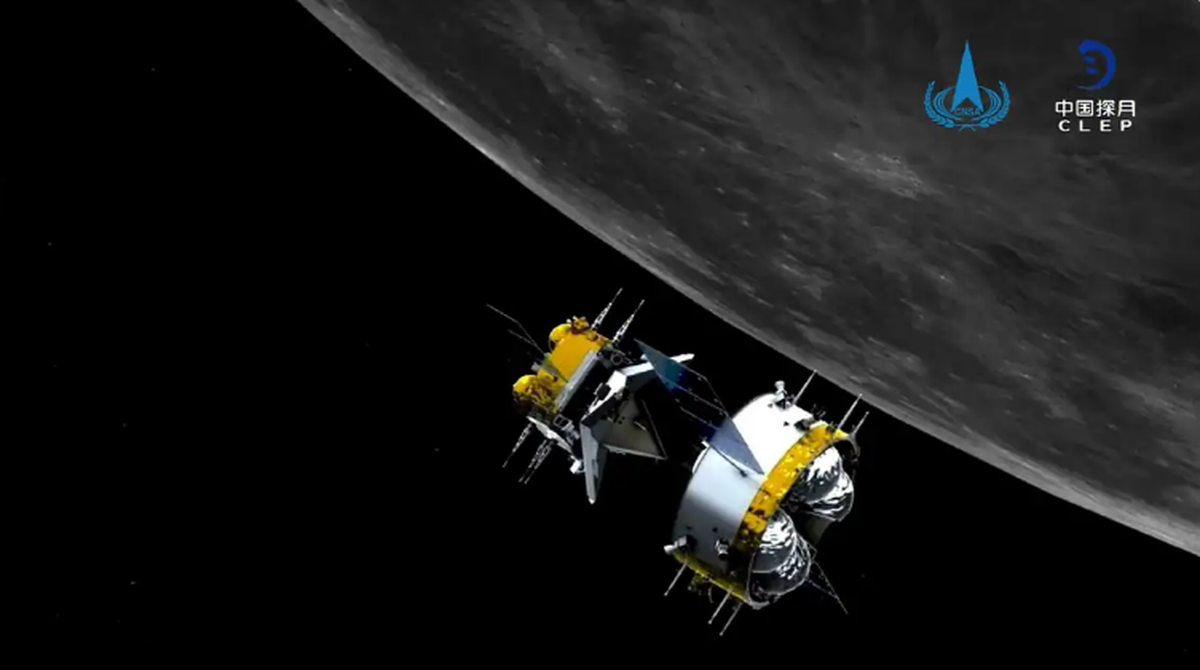
Representation of the orbiter and returner of China’s Chang’e 5 probe after its separation from the ascender

Representation of the orbiter and returner of China’s Chang’e 5 probe after its separation from the ascender

The return capsule landed with parachutes on December 16 in northern China. Before entering earth orbit, the orbiter headed to the earth-sun L1 Lagrange point for a mission to study the sun.

As of 2021, the orbiter observed the earth and the sun, and was on its way to the moon. Some reports suggest that the Chang’e 5 orbiter may have performed a lunar flyby before heading to asteroid 469219 Kamoʻoalewa— a part of China’s asteroid sample-return mission scheduled for 2025.


Source link

Science Tags:chandrayaan, Chandrayaan 3, chang’e, China, india, lander, luna 25, moon, pragyan, rover, south pole, vikram

Post navigation

Previous Post: India vs Sri Lanka Live Score Ball by Ball, Asia Cup 2023 Live Cricket Score Of Today's Match on NDTV Sports
Next Post: Marilyn Monroe’s Home Saved From Demolition After Widespread Outrage In US

Related Posts

  • Lost in space? You might need just two stars to find your way
    Lost in space? You might need just two stars to find your way Science
  • What does spaceflight do to the human body? | Explained
    What does spaceflight do to the human body? | Explained Science
  • Europe ‘back in space’ despite Ariane 6 debut glitch
    Europe ‘back in space’ despite Ariane 6 debut glitch Science
  • ‘Strange’ particle found to have mass when moving in one direction, not another
    ‘Strange’ particle found to have mass when moving in one direction, not another Science
  • What are cosmic filaments? – The Hindu
    What are cosmic filaments? – The Hindu Science
  • A decade among the stars: India’s first space observatory AstroSat completes 10 years
    A decade among the stars: India’s first space observatory AstroSat completes 10 years Science

More Related Articles

Hypoxia rewires membrane lipids, drives pancreatic cells to move: IIT-Bombay study Hypoxia rewires membrane lipids, drives pancreatic cells to move: IIT-Bombay study Science
Pragyan rover confirms sulphur at moon’s south pole, searching for hydrogen Pragyan rover confirms sulphur at moon’s south pole, searching for hydrogen Science
science newsletter New study links loneliness to cardiovascular diseases, stroke and mortality  science newsletter New study links loneliness to cardiovascular diseases, stroke and mortality  Science
Is it possible to remove microplastics from water? Is it possible to remove microplastics from water? Science
NISAR mission launch highlights: GSLV-F 16 successfully places NISAR satellite in orbit NISAR mission launch highlights: GSLV-F 16 successfully places NISAR satellite in orbit Science
Geroscience: the science related to aging Geroscience: the science related to aging Science
SiteLock

Archives

  • September 2026
  • August 2026
  • July 2026
  • June 2026
  • May 2026
  • April 2026
  • March 2026
  • February 2026
  • January 2026
  • December 2025
  • November 2025
  • October 2025
  • September 2025
  • August 2025
  • July 2025
  • June 2025
  • May 2025
  • April 2025
  • March 2025
  • February 2025
  • January 2025
  • December 2024
  • November 2024
  • October 2024
  • September 2024
  • August 2024
  • July 2024
  • June 2024
  • May 2024
  • April 2024
  • March 2024
  • February 2024
  • January 2024
  • December 2023
  • November 2023
  • October 2023
  • September 2023
  • August 2023
  • July 2023
  • June 2023
  • May 2023
  • April 2023
  • March 2023
  • February 2023
  • January 2023
  • December 2022
  • November 2022
  • October 2022
  • September 2022
  • August 2022
  • July 2022
  • June 2022
  • May 2022

Categories

  • Business
  • Nation
  • Science
  • Sports
  • World

Recent Posts

  • Mourinho fumes at referee, Simeone urges respect after fiery Madrid derby
  • Early returns in Russia’s parliamentary election show main Kremlin party leading
  • ICE agent shoots, wounds man in Austin
  • Australia completes cricket series sweep with 1-wicket win against Zimbabwe in third ODI
  • Heavy rains, squally wind likely in West Bengal from September 22

Recent Comments

  1. LarryKef on UP Teacher Who Asked Students To Slap Muslim Classmate
  2. Josephjab on UP Teacher Who Asked Students To Slap Muslim Classmate
  3. LarryKef on UP Teacher Who Asked Students To Slap Muslim Classmate
  4. Jasonnekly on UP Teacher Who Asked Students To Slap Muslim Classmate
  5. Jasonnekly on UP Teacher Who Asked Students To Slap Muslim Classmate
  • Diljit Dosanjh Faces Legal Action Over Alcohol Songs After Ludhiana Concert
    Diljit Dosanjh Faces Legal Action Over Alcohol Songs After Ludhiana Concert Nation
  • GST, SBI Credit Card And Other Changes From Next Month
    GST, SBI Credit Card And Other Changes From Next Month Nation
  • Sonia Gandhi To Campaign For Daughter Priyanka Gandhi’s Electoral Debut In Wayanad Bypoll
    Sonia Gandhi To Campaign For Daughter Priyanka Gandhi’s Electoral Debut In Wayanad Bypoll Nation
  • Ukraine withdraws from eastern town of Vugledar
    Ukraine withdraws from eastern town of Vugledar World
  • RBI raises WMA limits of States/UTs by 28% to ₹60,118 crore
    RBI raises WMA limits of States/UTs by 28% to ₹60,118 crore Business
  • Cricket World Cup – PCB Chief Discusses India Visa Delays For Pakistan Media And Fans With Foreign Secretary: Report
    Cricket World Cup – PCB Chief Discusses India Visa Delays For Pakistan Media And Fans With Foreign Secretary: Report Sports
  • Car drives into group of people at Christmas market in Germany
    Car drives into group of people at Christmas market in Germany World
  • 7 Killed, 3 Injured As Taxi Falls Into Roadside Well In Maharashtra: Report
    7 Killed, 3 Injured As Taxi Falls Into Roadside Well In Maharashtra: Report Nation

Editor-in-Chief:
Mohammad Ariff,
MSW, MAJMC, BSW, DTL, CTS, CNM, CCR, CAL, RSL, ASOC.
editor@artifex.news

Associate Editors:
1. Zenellis R. Tuba,
zenelis@artifex.news
2. Haris Daniyel
daniyel@artifex.news

Photograher:
Rohan Das
rohan@artifex.news

Artifex.News offers Online Paid Internships to college students from India and Abroad. Interns will get a PRESS CARD and other online offers.
Send your CV (Subjectline: Paid Internship) to internship@artifex.news

Links:
Associate Journalism
About Us
Privacy Policy

News Links:
Breaking News
World
Nation
Sports
Business
Entertainment
Lifestyle

Registered Office:
72/A, Elliot Road, Kolkata - 700016
Tel: 033-22277777, 033-22172217
Email: office@artifex.news

Editorial Office / News Desk:
No. 13, Mezzanine Floor, Esplanade Metro Rail Station,
12 J. L. Nehru Road, Kolkata - 700069.
(Entry from Gate No. 5)
Tel: 033-46011099, 033-46046046
Email: editor@artifex.news

Copyright © 2023 Artifex.News Newsportal designed by Artifex Infotech.