

Skip to content
  • Facebook
  • X
  • Linkedin
  • WhatsApp
  • YouTube
  • Associate Journalism
  • About Us
  • Privacy Policy
  • 033-46046046
  • editor@artifex.news
Artifex.News

Artifex.News

Stay Connected. Stay Informed.

  • Breaking News
  • World
  • Nation
  • Sports
  • Business
  • Science
  • Entertainment
  • Lifestyle
  • Toggle search form
  • Access Denied
    Access Denied Nation
  • Access Denied
    Access Denied Nation
  • In last major speeches, leaders of BNP, Jamaat claim legacies of Liberation war of 1971, uprising of 2024
    In last major speeches, leaders of BNP, Jamaat claim legacies of Liberation war of 1971, uprising of 2024 World
  • British air force pilot dies after Spitfire crashes in eastern England
    British air force pilot dies after Spitfire crashes in eastern England World
  • Adani Portfolio’s earnings before interest, taxes, depreciation and amortization rises 10% YoY to ₹90,572 crore
    Adani Portfolio’s earnings before interest, taxes, depreciation and amortization rises 10% YoY to ₹90,572 crore Business
  • Jannik Sinner Surges Into Aus Open Last 16 On ‘Great Day’ For Happy Couple
    Jannik Sinner Surges Into Aus Open Last 16 On ‘Great Day’ For Happy Couple Sports
  • Access Denied Sports
  • WHO reports sharp rise in newborn deaths in Gaza
    WHO reports sharp rise in newborn deaths in Gaza World
Hope for pancreatic cancer as new drug, daraxonrasib, shows promise

Hope for pancreatic cancer as new drug, daraxonrasib, shows promise

Posted on May 5, 2026 By admin


In 1988, a landmark paper appeared in the journal Cell. It showed that in around 95% of pancreatic cancers, a gene called KRAS carried mutations at a particular location. The paper was a watershed moment in cancer research since it was one of the first demonstrations of a mutation with near-universal frequency identified in a cancer.

Simply put, cancer is nothing but uncontrolled cell division. In a healthy individual, cells grow and divide in a tightly controlled cycle. Specific signals exist that tell the cell when to divide and when to not. If during this process something goes amiss and there is any kind of damage to the cells, they can repair themselves or undergo a process called programmed cell death. This balance maintains normal tissue structure.

In cancer, this balance is disturbed, causing unregulated cell division. As a result, mistakes tend to accumulate in the DNA, and that in turn leads to the formation of tumours that can invade surrounding tissues and spread to other organs, ultimately disrupting normal body function and threatening life.

The 1988 Cell paper was important because the KRAS gene acts as a switch, regulating whether a cell divides or not. The KRAS protein — the product of the KRAS gene — exists in two states, an ‘off’ state that suppresses cell division and an ‘on’ state that promotes it. The mutations reported in the study locked KRAS in its ‘on’ state, driving continuous and uncontrolled cell division, leading to several types of cancers, including pancreatic, colorectal, and lung cancers.

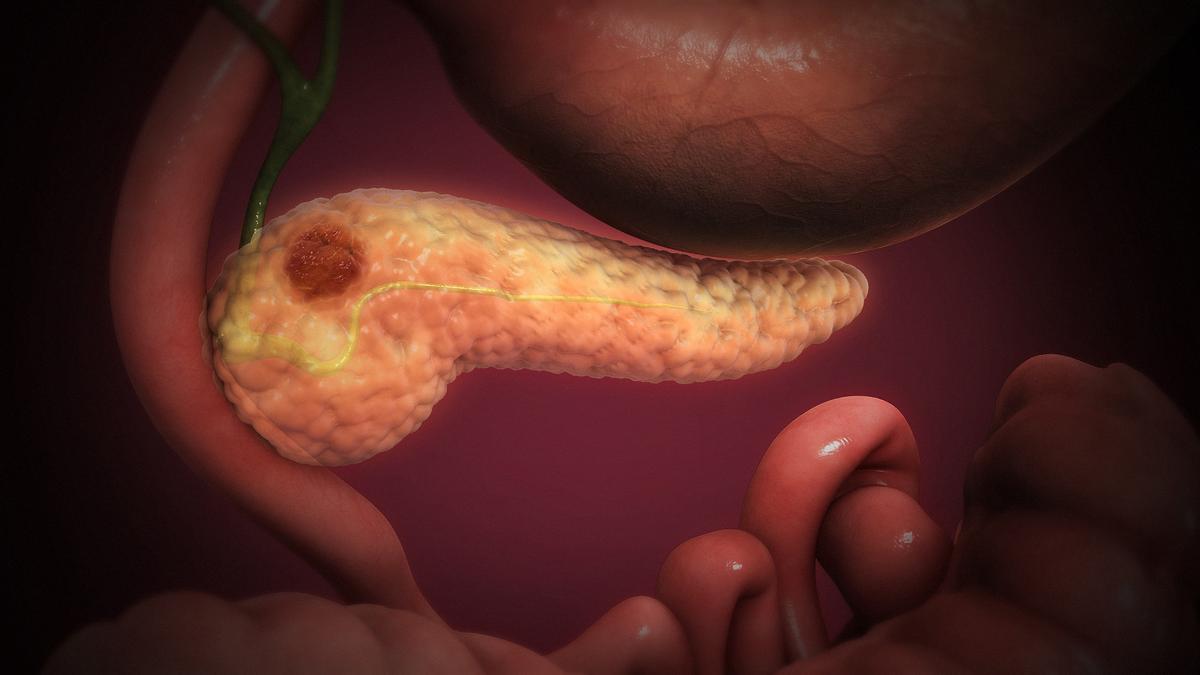
Pancreatic cancer is one of the deadlier forms of cancer because it is usually detected late, when the symptoms are vague and the disease has already spread to neighbouring tissues. There are very few surgical options as well. And even after surgery, recurrence is common. Standard chemotherapy is also not very effective while targeted therapies are scarce, contributing to the low survival rates of the disease.

Targeting RAS proteins

For decades, the medical fraternity considered KRAS to be an attractive drug target because of its central role in driving cancer. However, it proved exceptionally difficult to inhibit because most small-molecule drugs work by fitting into well-defined pockets or grooves on a protein’s surface and blocking its activity. KRAS, on the other hand, has a relatively smooth, compact surface with few such binding sites, making selective targeting challenging.

Despite this difficulty, several research groups attempted to target the KRAS gene — but nearly all of them fared poorly in clinical trials. As a result, KRAS was long labelled “undruggable” despite its importance in cancer biology.

In June 2024, a California-based company called Revolution Medicines reported a new molecule called RMC-6236, later renamed daraxonrasib. The molecule works by targeting a wide range of the RAS family of proteins, including KRAS, when they are in their ‘on’ state, signalling the cell to divide. Daraxonrasib binds to this active form indirectly by first binding another protein called cyclophilin-A and locking this protein with KRAS in a nonfunctional state. This prevents it from having any further interactions, thus shutting off the uncontrolled cell division.

Unlike previous drugs like sotorasib and adagrasib, which worked on single mutations, daraxonrasib inhibits multiple RAS variants, making it useful to treat a wide variety of cancers.

Far more effective

In a phase 1/2 clinical trial, medical researchers evaluated daraxonrasib for its safety and its ability to shrink tumours in patients with advanced cancers driven by RAS mutations, such as pancreatic, colorectal, and lung cancers. Results from these initial phases were encouraging enough for the drug to move forward into a phase 3 clinical trial, where the investigators tested daraxonrasib’s actual effectiveness in a larger group of patients.

The results from the phase 3 trial were recently presented at the annual meeting of the American Association for Cancer Research, held in San Diego from April 17 to 22. The findings suggested that daraxonrasib may be far more effective than previous treatments for pancreatic cancer. In 51% of the patients, the drug reduced the size of tumours, and in 97% of patients the drug brought the disease under control, meaning that their cancers either shrunk or remained stable without growing further.

However, daraxonrasib also had many side effects. Nearly all the patients experienced mild to moderate effects, including skin rash, diarrhoea, mouth sores, nausea, and fatigue. However, importantly, no life-threatening side-effects were reported in any patients.

Ray of hope

While the peer-reviewed data are still awaited, the early results have generated considerable excitement in the cancer research community. Many researchers are already calling daraxonrasib a potential “game changer”, particularly for cancers like pancreatic cancer, where the treatment options are limited.

The strong clinical results have also led the U.S. Food and Drug Administration (FDA) to include Revolution Medicines’s daraxonrasib among eight other therapies in the first-ever group of drugs to receive “National Priority Voucher” status. The FDA created this designation for highly promising drug candidates that address urgent national health needs. The voucher also allows the FDA to accelerate its review timeline, shortening what would typically be a year-long process to just one or two months. The results of the FDA review are awaited as well, and there is growing optimism that it will be positive. In the meantime, the FDA has given Revolution Medicines ‘expanded access’ to use daraxonrasib with patients who lack other treatment options.

For many decades, pancreatic cancer has stood as one of medicine’s most unforgiving challenges, often offering little time, few options, and even less hope. Today, that narrative may finally be beginning to change. For a scientist, daraxonrasib is not a cure in the real sense of the word, at least not yet — but for patients and their families around the world, it is a long-awaited ray of hope.

Arun Panchapakesan is an assistant professor at the Y.R. Gaitonde Centre for AIDS Research and Education, Chennai.

Published – May 08, 2026 07:15 am IST


Source link

Science

Post navigation

Previous Post: Apple holds talks with Intel, Samsung for US chipmaking: Report
Next Post: India most resilient emerging market economy; better placed to manage future shocks: Moody’s

Related Posts

  • In a first, RNA is recovered from extinct Tasmanian tiger
    In a first, RNA is recovered from extinct Tasmanian tiger Science
  • Evolution can change how an ecosystem collapses, study finds
    Evolution can change how an ecosystem collapses, study finds Science
  • Study uncovers surprising new ‘spatial grammar’ of gene expression
    Study uncovers surprising new ‘spatial grammar’ of gene expression Science
  • World’s oldest termite mounds found in South Africa, storing carbon for millennia
    World’s oldest termite mounds found in South Africa, storing carbon for millennia Science
  • Latest muon data narrows gap but leaves physics mysteries unresolved
    Latest muon data narrows gap but leaves physics mysteries unresolved Science
  • The Science Quiz: Nuclear non-proliferation
    The Science Quiz: Nuclear non-proliferation Science

More Related Articles

Noted physicist Rohini Godbole passes away Noted physicist Rohini Godbole passes away Science
Entrepreneur and pilot, Gopichand Thotakura is aiming for a place in Indian space history Entrepreneur and pilot, Gopichand Thotakura is aiming for a place in Indian space history Science
Rocks’ carbon storage capacity vastly overestimated: study Rocks’ carbon storage capacity vastly overestimated: study Science
As West Asia war threatens gas supply, remembering a gas grid India never built As West Asia war threatens gas supply, remembering a gas grid India never built Science
How neuroscience reshapes marketing strategies in India How neuroscience reshapes marketing strategies in India Science
Joel Mokyr’s story of how science becomes technology is incomplete Joel Mokyr’s story of how science becomes technology is incomplete Science
SiteLock

Archives

  • May 2026
  • April 2026
  • March 2026
  • February 2026
  • January 2026
  • December 2025
  • November 2025
  • October 2025
  • September 2025
  • August 2025
  • July 2025
  • June 2025
  • May 2025
  • April 2025
  • March 2025
  • February 2025
  • January 2025
  • December 2024
  • November 2024
  • October 2024
  • September 2024
  • August 2024
  • July 2024
  • June 2024
  • May 2024
  • April 2024
  • March 2024
  • February 2024
  • January 2024
  • December 2023
  • November 2023
  • October 2023
  • September 2023
  • August 2023
  • July 2023
  • June 2023
  • May 2023
  • April 2023
  • March 2023
  • February 2023
  • January 2023
  • December 2022
  • November 2022
  • October 2022
  • September 2022
  • August 2022
  • July 2022
  • June 2022
  • May 2022

Categories

  • Business
  • Nation
  • Science
  • Sports
  • World

Recent Posts

  • Union Minister Sanjay Kumar’s son booked under POCSO; files extortion counter-complaint
  • Pakistan security forces kill 5 terrorists in Khyber Pakhtunkhwa
  • Fadnavis asks officials to fast-track water conservation works amid El Niño concerns
  • Labour reforms: Government fully operationalises four new codes by publishing rules
  • 65-foot trident inaugurated at Kailasagiri; MP outlines vision for Global Tourism Hub

Recent Comments

  1. JasonCobby on UP Teacher Who Asked Students To Slap Muslim Classmate
  2. Jamesnep on UP Teacher Who Asked Students To Slap Muslim Classmate
  3. CalebKar on UP Teacher Who Asked Students To Slap Muslim Classmate
  4. Alvinadubs on UP Teacher Who Asked Students To Slap Muslim Classmate
  5. CharlesVOX on UP Teacher Who Asked Students To Slap Muslim Classmate
  • Why is there a drop in school enrolments? | Explained
    Why is there a drop in school enrolments? | Explained Nation
  • Access Denied
    Access Denied Nation
  • Access Denied Sports
  • “Sabki Soch Alag Hoti”: Ashish Nehra On His Decision To Not Apply For India Coach Job
    “Sabki Soch Alag Hoti”: Ashish Nehra On His Decision To Not Apply For India Coach Job Sports
  • Companies’ appetite for cheap carbon offsets stokes fears of greenwashing
    Companies’ appetite for cheap carbon offsets stokes fears of greenwashing Science
  • Tamil Nadu Governor RN Ravi On Dravidian, Aryan Divide
    Tamil Nadu Governor RN Ravi On Dravidian, Aryan Divide Nation
  • Access Denied Business
  • Access Denied
    Access Denied Nation

Editor-in-Chief:
Mohammad Ariff,
MSW, MAJMC, BSW, DTL, CTS, CNM, CCR, CAL, RSL, ASOC.
editor@artifex.news

Associate Editors:
1. Zenellis R. Tuba,
zenelis@artifex.news
2. Haris Daniyel
daniyel@artifex.news

Photograher:
Rohan Das
rohan@artifex.news

Artifex.News offers Online Paid Internships to college students from India and Abroad. Interns will get a PRESS CARD and other online offers.
Send your CV (Subjectline: Paid Internship) to internship@artifex.news

Links:
Associate Journalism
About Us
Privacy Policy

News Links:
Breaking News
World
Nation
Sports
Business
Entertainment
Lifestyle

Registered Office:
72/A, Elliot Road, Kolkata - 700016
Tel: 033-22277777, 033-22172217
Email: office@artifex.news

Editorial Office / News Desk:
No. 13, Mezzanine Floor, Esplanade Metro Rail Station,
12 J. L. Nehru Road, Kolkata - 700069.
(Entry from Gate No. 5)
Tel: 033-46011099, 033-46046046
Email: editor@artifex.news

Copyright © 2023 Artifex.News Newsportal designed by Artifex Infotech.