



Skip to content
  • Facebook
  • X
  • Linkedin
  • WhatsApp
  • YouTube
  • Associate Journalism
  • About Us
  • Privacy Policy
  • 033-46046046
  • editor@artifex.news
Artifex.News

Artifex.News

Stay Connected. Stay Informed.

  • Breaking News
  • World
  • Nation
  • Sports
  • Business
  • Science
  • Entertainment
  • Lifestyle
  • Toggle search form
  • Access Denied Business
  • Gautam Gambhir Drops Big Jasprit Bumrah Workload Statement Ahead Of 2nd Test Against New Zealand
    Gautam Gambhir Drops Big Jasprit Bumrah Workload Statement Ahead Of 2nd Test Against New Zealand Sports
  • Access Denied Sports
  • Rain Wipes Out England’s Final T20I Against West Indies
    Rain Wipes Out England’s Final T20I Against West Indies Sports
  • One Israeli killed, three wounded in West Bank attack as UN approves Trump’s Gaza plan
    One Israeli killed, three wounded in West Bank attack as UN approves Trump’s Gaza plan World
  • Tropical storm causes seven deaths in Philippines; more than 22,000 people evacuated
    Tropical storm causes seven deaths in Philippines; more than 22,000 people evacuated World
  • Access Denied
    Access Denied Nation
  • Indians largest non-EU group immigrating to and emigrating from U.K.
    Indians largest non-EU group immigrating to and emigrating from U.K. World
Latest muon data narrows gap but leaves physics mysteries unresolved

Latest muon data narrows gap but leaves physics mysteries unresolved

Posted on August 13, 2025 By admin


Can you weigh an elephant before and after it picks up a one-rupee coin, and tell the difference?  You can if the measurement is precise. To detect a 4-gram coin on a 4-tonne creature, the scales must come with a resolution of at least 1 part per million (ppm). Precise measurements such as these routinely lead to startling discoveries in fundamental physics. This is what the physicist Albert Michelson meant by “The future truths of physical science are to be looked for in the sixth place of decimals”.

This June, the Muon g-2 (pronounced “gee minus two”) Experiment at Fermilab in the US presented its highly anticipated final results. With data collected over three years and with the involvement of more than 170 physicists, the collaboration had measured a unique property of a subatomic particle called a muon with an unprecedented precision of 0.127 ppm, outdoing its stated goal of 0.140 ppm.

Usually, physicists check such measurements against the prediction of the Standard Model, the theory of subatomic particles that predicts their properties. If they don’t match, the measured value would hint at the presence of unseen forces. But in this instance, there are two ways to make theoretical predictions about this property of the muon. One of them is consistent with the Fermilab experiment and the other is far off. Nobody knows which really is right, and an intriguing drama has been unfolding over the last few years with no clear resolution in sight.

g minus 2

The muon is an elementary particle that mimics the electron in every trait except for being 207-times heavier. Discovered in 1936 in cosmic rays, its place in the pattern of the Standard Model was, and still is, something of a mystery, prompting physicist Isidor Rabi to remark: “Who ordered that?”

The muon carries non-zero quantum spin, which means it functions like a petite magnet. The strength of this magnet, called the magnetic moment, is captured by a quantity called the g factor. In a high-school calculation, g would be exactly 2, but in advanced theory its value drifts a tiny bit from 2 due to quantum field effects. It is this so-called anomalous magnetic moment that the Muon g -2 Experiment painstakingly ascertained.

Measurements of the g-2 of the muon were first made at CERN in Europe and the results were published in 1961 with a definition of 4000 ppm. Over the next two decades at CERN, the precision was improved to 7 ppm. Matters took an interesting trans-Atlantic turn when the Muon E821 experiment at the Brookhaven National Lab in the US took data between 1997 and 2001 and achieved a precision of 0.540 ppm, which was similar to the uncertainty in the theoretical prediction. In other words, the two numbers — the theoretical calculation and the observed value — could be meaningfully compared.

And lo and behold, they significantly disagreed.

Contrast with theory

Nothing seemed to have been amiss in the experiment, so many physicists wagered that the disagreement was a hint of ‘new physics’. Numerous explanations involving theories beyond the Standard Model poured into the literature over the next two decades. At the same time, the theoretical physicists themselves got down to refining the Standard Model prediction itself, which was no mean task.

So stood affairs until Fermilab started measuring g-2 in 2017. When it had collected just 6% of the total intended data by 2021, it had already reached a precision of 0.460 ppm, comparable to E821. This first result was in such excellent agreement with E821 data that when the two results were combined, the discrepancy with theory deepened to worrying levels.

But the spectacle didn’t end there. On the very day that Fermilab announced this result to much fanfare, there quietly appeared in Nature a new paper in which a group of physicists, called the Budapest-Marseille-Wuppertal (BMW) Lattice collaboration, argued there may be no gap between theory and experiment values after all.

Theorists compute the muon g-2 using either (i) Feynman diagrams, a tool that has served calculations in quantum field theory for three quarters of a century, or (ii) the so-called lattice, a supercomputer simulation of spacetime as a discretised grid that represents quantum fields. Both approaches are technically very challenging in this context.

The final results at Fermilab from June are less confusing. They are consistent with their past announcements; it’s their contrast with theory that is unsettled.

An old friend

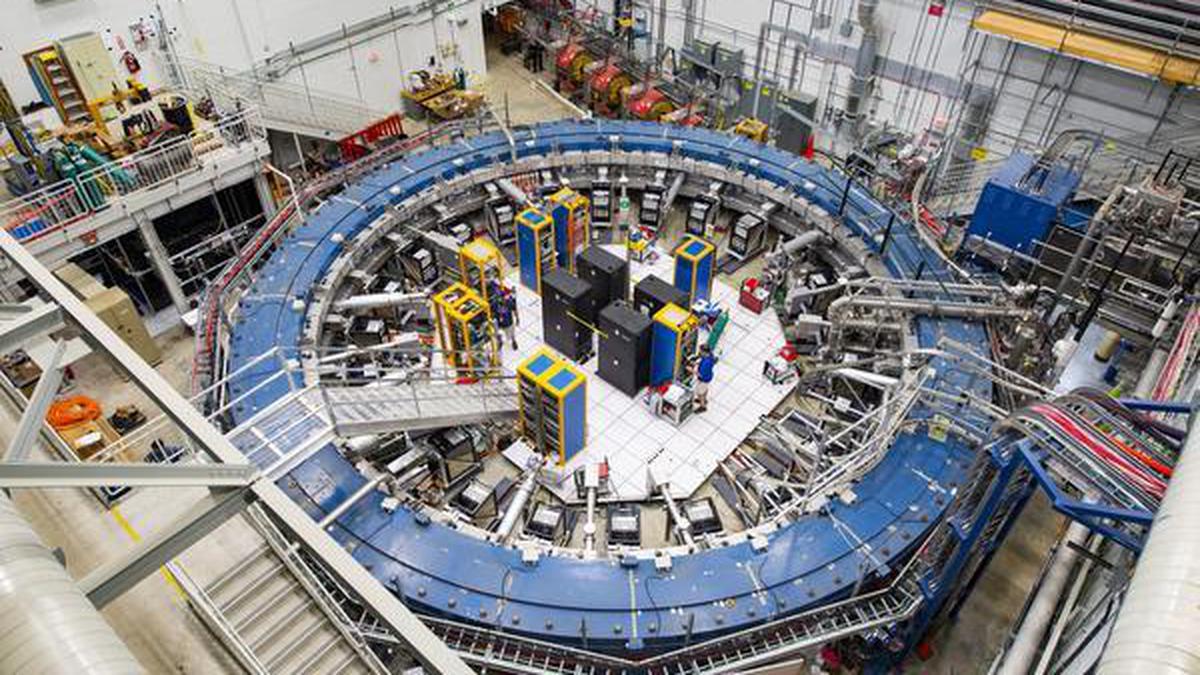
The experimental setup itself was ingenious. A beam of anti-muons is injected into a 15-m-wise ring with a uniform magnetic field. There the antiparticles make circular orbits with a characteristic frequency. Meanwhile, the antiparticles’ spin vectors — a fundamental property of theirs — rotate in the magnetic field and they resemble spinning tops, spinning with a certain spin frequency. The central conceit is to measure the difference between the frequency of the circular orbits and the spin frequencies. This difference carries direct information on the muon’s g-2 value.

Both E821 and Fermilab operated on this principle. This is not impossible. Fermilab reused part of the E821 equipment and thus some unknown defects may have made their presence felt in the Fermilab data as well. This is why it is crucial to have a completely independent measurement by a different experimental approach. An upcoming effort at the Japan Proton Accelerator Research Complex will do just this.

Uncertainty is an old friend of fundamental physics. It has always borne the promise of an imminent disclosure of a deep secret of nature. We wait now for the next word from theorists and hope that the jury will soon be in.

Nirmal Raj is an assistant professor of theoretical physics at the Centre for High Energy Physics in the Indian Institute of Science, Bengaluru.

Published – August 13, 2025 05:30 am IST


Source link

Science

Post navigation

Previous Post: Mali junta arrests former Prime Minister Choguel Kokalla Maiga
Next Post: Why does bread become stale even if it doesn’t go mouldy?

Related Posts

  • Revealed: how humans evolved in the last 10,000 years alone
    Revealed: how humans evolved in the last 10,000 years alone Science
  • New study finds how calcium and pH regulate ovarian cancer spheroids
    New study finds how calcium and pH regulate ovarian cancer spheroids Science
  • What is cheaper to cook with, LPG or induction?
    What is cheaper to cook with, LPG or induction? Science
  • Why does water stay cool in a claypot even in peak summers?
    Why does water stay cool in a claypot even in peak summers? Science
  • Health sector can’t ignore telemedicine’s green gains, study shows
    Health sector can’t ignore telemedicine’s green gains, study shows Science
  • Shubhanshu Shukla to pilot Axiom-4 Mission: My journey to space will be the journey of 1.4 billion fellow Indians
    Shubhanshu Shukla to pilot Axiom-4 Mission: My journey to space will be the journey of 1.4 billion fellow Indians Science

More Related Articles

The Science Quiz | Spacetime continuum The Science Quiz | Spacetime continuum Science
Trump’s Golden Dome looks for alternatives to Elon Musk’s SpaceX Trump’s Golden Dome looks for alternatives to Elon Musk’s SpaceX Science
The Science Quiz | Words that begin ‘cell-’ The Science Quiz | Words that begin ‘cell-’ Science
Calories and kilojoules: how do we know the energy content of food, and how accurate are the labels? Calories and kilojoules: how do we know the energy content of food, and how accurate are the labels? Science
How do astronauts return from space and survive re-entry? How do astronauts return from space and survive re-entry? Science
New cat species identified in Bolivia, first in over a century New cat species identified in Bolivia, first in over a century Science
SiteLock

Archives

  • September 2026
  • August 2026
  • July 2026
  • June 2026
  • May 2026
  • April 2026
  • March 2026
  • February 2026
  • January 2026
  • December 2025
  • November 2025
  • October 2025
  • September 2025
  • August 2025
  • July 2025
  • June 2025
  • May 2025
  • April 2025
  • March 2025
  • February 2025
  • January 2025
  • December 2024
  • November 2024
  • October 2024
  • September 2024
  • August 2024
  • July 2024
  • June 2024
  • May 2024
  • April 2024
  • March 2024
  • February 2024
  • January 2024
  • December 2023
  • November 2023
  • October 2023
  • September 2023
  • August 2023
  • July 2023
  • June 2023
  • May 2023
  • April 2023
  • March 2023
  • February 2023
  • January 2023
  • December 2022
  • November 2022
  • October 2022
  • September 2022
  • August 2022
  • July 2022
  • June 2022
  • May 2022

Categories

  • Business
  • Nation
  • Science
  • Sports
  • World

Recent Posts

  • 172 candidates receive appointment letters at Visakhapatnam Rozgar Mela
  • Flawed AI-linked intel almost led U.S. to board China ship: report
  • IIT Bombay faculty member booked for caste abuse, suicide abetment
  • Arjun finds form as India beats Spain; Savitha stars for women
  • CWC chief flags ‘malpractices’ in phytosanitary certification, pitches integrated logistics to boost agri-exports

Recent Comments

  1. AlvinNet on UP Teacher Who Asked Students To Slap Muslim Classmate
  2. AlvinNet on UP Teacher Who Asked Students To Slap Muslim Classmate
  3. Jamesslits on UP Teacher Who Asked Students To Slap Muslim Classmate
  4. MichaelClear on UP Teacher Who Asked Students To Slap Muslim Classmate
  5. Jamesslits on UP Teacher Who Asked Students To Slap Muslim Classmate
  • US House Passes Bill Banning Transgender Athletes From Women’s Sports
    US House Passes Bill Banning Transgender Athletes From Women’s Sports World
  • Access Denied Sports
  • Marcus Stoinis Enters History Books, Surpasses Ex-PBKS Star For Huge IPL Record
    Marcus Stoinis Enters History Books, Surpasses Ex-PBKS Star For Huge IPL Record Sports
  • On CCTV, Cops Seen Planting Drugs On Man In Mumbai, Suspended After Probe Khar Police Station
    On CCTV, Cops Seen Planting Drugs On Man In Mumbai, Suspended After Probe Khar Police Station Nation
  • Rupee rises 12 paise to 88.04 against U.S. dollar in early trade
    Rupee rises 12 paise to 88.04 against U.S. dollar in early trade Business
  • Declare Kumbh Mela area restricted zone for non-Hindus before 2027 Ardh Kumbh: Shri Ganga Sabha
    Declare Kumbh Mela area restricted zone for non-Hindus before 2027 Ardh Kumbh: Shri Ganga Sabha Nation
  • Inflation in Mexico eases below forecast
    Inflation in Mexico eases below forecast World
  • Access Denied
    Access Denied Nation

Editor-in-Chief:
Mohammad Ariff,
MSW, MAJMC, BSW, DTL, CTS, CNM, CCR, CAL, RSL, ASOC.
editor@artifex.news

Associate Editors:
1. Zenellis R. Tuba,
zenelis@artifex.news
2. Haris Daniyel
daniyel@artifex.news

Photograher:
Rohan Das
rohan@artifex.news

Artifex.News offers Online Paid Internships to college students from India and Abroad. Interns will get a PRESS CARD and other online offers.
Send your CV (Subjectline: Paid Internship) to internship@artifex.news

Links:
Associate Journalism
About Us
Privacy Policy

News Links:
Breaking News
World
Nation
Sports
Business
Entertainment
Lifestyle

Registered Office:
72/A, Elliot Road, Kolkata - 700016
Tel: 033-22277777, 033-22172217
Email: office@artifex.news

Editorial Office / News Desk:
No. 13, Mezzanine Floor, Esplanade Metro Rail Station,
12 J. L. Nehru Road, Kolkata - 700069.
(Entry from Gate No. 5)
Tel: 033-46011099, 033-46046046
Email: editor@artifex.news

Copyright © 2023 Artifex.News Newsportal designed by Artifex Infotech.