


Skip to content
  • Facebook
  • X
  • Linkedin
  • WhatsApp
  • YouTube
  • Associate Journalism
  • About Us
  • Privacy Policy
  • 033-46046046
  • editor@artifex.news
Artifex.News

Artifex.News

Stay Connected. Stay Informed.

  • Breaking News
  • World
  • Nation
  • Sports
  • Business
  • Science
  • Entertainment
  • Lifestyle
  • Toggle search form
  • “No One Was Agreeing…”: Shreyas Iyer Takes Aim At BCCI Over Back Injury
    “No One Was Agreeing…”: Shreyas Iyer Takes Aim At BCCI Over Back Injury Sports
  • 10 Dead In Explosion At Fireworks Unit In Tamil Nadu’s Ariyalur District
    10 Dead In Explosion At Fireworks Unit In Tamil Nadu’s Ariyalur District Nation
  • Access Denied
    Access Denied Nation
  • Drugs Worth Rs 8600 Crore Destroyed In Record Operation At Madhya Pradesh Cement Factory
    Drugs Worth Rs 8600 Crore Destroyed In Record Operation At Madhya Pradesh Cement Factory Nation
  • From Yashasvi Jaiswal To Nitish Reddy, 10 Emerging International Cricketers Who Enjoyed A Breakout 2024
    From Yashasvi Jaiswal To Nitish Reddy, 10 Emerging International Cricketers Who Enjoyed A Breakout 2024 Sports
  • Access Denied Sports
  • Interio by Godrej unveils new brand identity, eyes ₹10,000 crore revenue in 3 years
    Interio by Godrej unveils new brand identity, eyes ₹10,000 crore revenue in 3 years Business
  • Access Denied Sports
Blue: the colour that moved kings before poets

Blue: the colour that moved kings before poets

Posted on February 24, 2026 By admin


When Isaac Newton wrote Opticks, published in 1704, he divided the colour spectrum into the now famous VIBGYOR, a set of seven colours (the decision was not, as such, scientific because Newton’s choice was dictated by ‘7’ being a significant number in alchemy.) What Newton observed was a series of hues merging into one another, rather than discrete parcels. The Irish chemist Robert Boyle, who inspired Newton through his experiments, had observed the same spectrum when he pinched refined quicksilver in a “syrup of violets”, but spoke of only five colours. Many of Newton’s readers were not really sure if they could tell indigo from blue or violet at all. And yet Newton insisted that there were seven. The number was alchemically significant. It echoed the musical scale, the number of (visible) planets, and other harmonies of yore based on which Newton intended to structure what we now see as early modern thought.

Colour was being ordered, and this ordering was optical and administrative. Newton, who later served the British crown as Warden and Lord of Mint, stabilised colour into a sequence that could be taught, reproduced, and enforced.

A journey of the blues

Long before this abstraction, blue appeared in the Rig Veda, one of the earliest surviving bodies of liturgy, through Varuna, the god of cosmic order, oath, and surveillance. Varuna is described as syama and kṛṣṇa (meaning dusk-coloured and dark), terms that signal depth and enclosure rather than surface hue. The Indologist Michael Witzel has described Varuṇa as a figure of an early vedic kingship, a “nocturnal sovereign” whose power lies in distance, binding, and the night sky.

What is striking is that this chromatic marker of sovereignty co-evolves with a profound religious transformation. In the Mahābhārata and Itihasic-Purāṇic traditions, śyāma and kṛṣṇa become the most common names of Vāsudeva Kṛṣṇa, who emerges not merely as a heroic figure but as the lord of the cosmos itself. Across this shift, from ritual order of the vedas to the bhakti of Puranas, blue remains a sign of totality and command.

The Greek world, by contrast, hesitated before blue. Karissa St. Clair, in her book Secret Lives of Colours, notes that in Homer’s Iliad and Odyssey, blue is conspicuously absent. The sea is “wine-dark,” and the colour of the skies is unmentioned. Nineteenth-century thinker and politician William Gladstone famously remarked that Greeks could not see blue. And of course, this is not true. Colour theorists and historians have pointed out that in Homer’s epics, colour was organised around brightness, texture, and emotional force rather than hue.

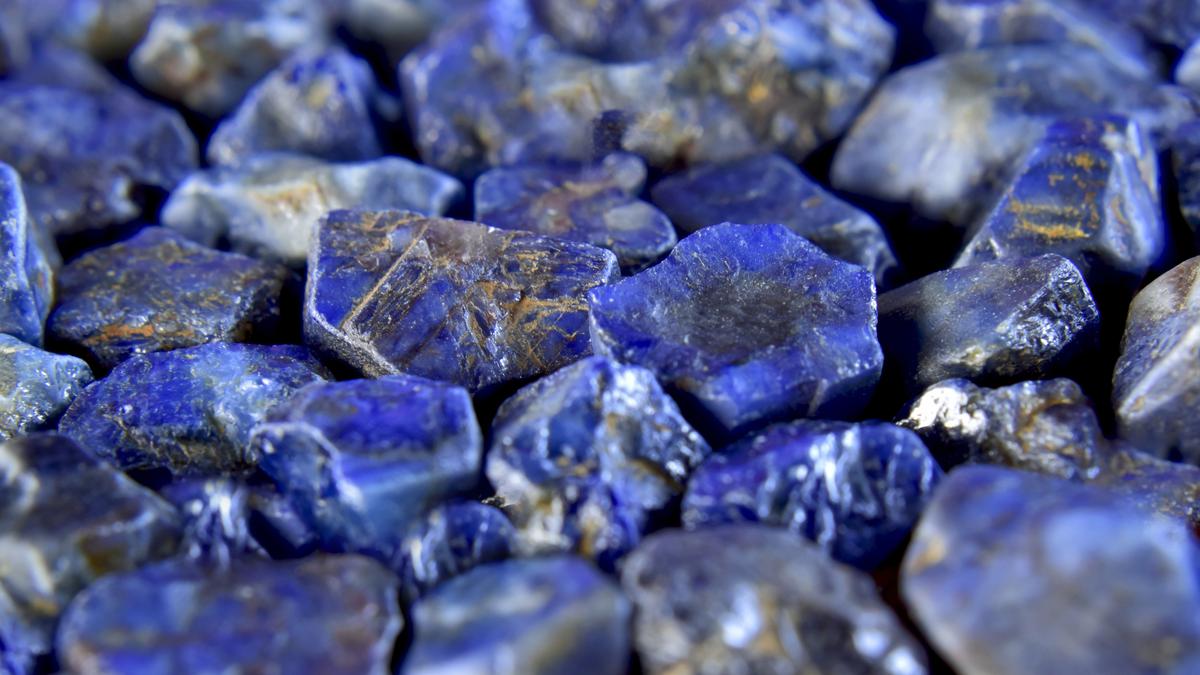
But a few thousand years before ancient Greece, the value of blue was negotiated materially through stone, right from the earliest stages of the Bronze Age. Lapis lazuli, deep blue and flecked with gold, travelled thousands of kilometres from the mines of Badakhshan in present-day Afghanistan to connect Mesopotamia, Egypt, the Indus Valley and China in trans-continental trade. Archaeological finds at the earliest agricultural sites such as Mehrgarh and Bhirrana (6th Millennium BCE) include lapis beads imported through these long-distance trade routes. In ancient Sumer, lapis was sacred to Inanna and in Egypt, it adorned divine brows and funerary masks apart from featuring in statuettes and seals. Lapis Lazuli marked divinity because it was rare, costly, and difficult to command.

Visibility co-evolves with value, but the tension which separates the two has always been observable. Even by the early Bronze Age, Egypt was successful in locally producing their own synthetic colour pigments, Ceruleum, from copper, limestone and silica to reproduce the colour of lapis marking the earliest known instances of synthetic colour production on an industrial scale under government regulation. By the axial age, Mesopotamians were importing Indigo from distant India to colour their royal robes in the colour of Lapis while China created its own synthetic blue, from barium, copper, and silicon to colour its terracotta army in Lapis so the army could serve its emperor in the afterlife.

‘Stimulation of nothingness’

Seen this way, Newton’s spectrum marks not the beginning of colour, but the final abstraction of a long process. When blue became a wavelength, something older was lost: its connection to effort, danger, devotion, and power. In an effort to preserve the values associated with the colour value, Goethe, in his Theory of Colours (1804) wrote, “The blue colour is a kind of contradiction between excitement and repose. It is a stimulation of nothingness. Hence we feel a certain pleasure in gazing at blue, because it draws us after it.”

Satwik Gade is a Chennai-based writer and illustrator. This article is part of a series on the history and development of colours.

Published – February 25, 2026 08:30 am IST


Source link

Science

Post navigation

Previous Post: Access Denied
Next Post: Access Denied

Related Posts

  • Global warming’s patterns are more important than its levels | Explained
    Global warming’s patterns are more important than its levels | Explained Science
  • Qdenga: a vaccine for dengue but not a silver bullet
    Qdenga: a vaccine for dengue but not a silver bullet Science
  • South American lungfish has largest genome of any animal
    South American lungfish has largest genome of any animal Science
  • How does potassium cyanide cause sudden death?
    How does potassium cyanide cause sudden death? Science
  • Sci-Five | The Hindu Science Quiz: On Colossal Squid
    Sci-Five | The Hindu Science Quiz: On Colossal Squid Science
  • What is Google’s ‘quantum advantage’ leap? | Explained
    What is Google’s ‘quantum advantage’ leap? | Explained Science

More Related Articles

Sci-Five | The Hindu Science Quiz: On Asteroids Sci-Five | The Hindu Science Quiz: On Asteroids Science
Why is rice such a water-intensive crop? Why is rice such a water-intensive crop? Science
Goa scientists find 50,000-year-old magnetic fossils in Bay of Bengal Goa scientists find 50,000-year-old magnetic fossils in Bay of Bengal Science
Plankton balloon to six times their size to reach ocean surface Plankton balloon to six times their size to reach ocean surface Science
Deep-brain stimulation: nudging neurons – The Hindu Deep-brain stimulation: nudging neurons – The Hindu Science
Europe is the fastest-warming continent, at nearly twice global average: report Europe is the fastest-warming continent, at nearly twice global average: report Science
SiteLock

Archives

  • May 2026
  • April 2026
  • March 2026
  • February 2026
  • January 2026
  • December 2025
  • November 2025
  • October 2025
  • September 2025
  • August 2025
  • July 2025
  • June 2025
  • May 2025
  • April 2025
  • March 2025
  • February 2025
  • January 2025
  • December 2024
  • November 2024
  • October 2024
  • September 2024
  • August 2024
  • July 2024
  • June 2024
  • May 2024
  • April 2024
  • March 2024
  • February 2024
  • January 2024
  • December 2023
  • November 2023
  • October 2023
  • September 2023
  • August 2023
  • July 2023
  • June 2023
  • May 2023
  • April 2023
  • March 2023
  • February 2023
  • January 2023
  • December 2022
  • November 2022
  • October 2022
  • September 2022
  • August 2022
  • July 2022
  • June 2022
  • May 2022

Categories

  • Business
  • Nation
  • Science
  • Sports
  • World

Recent Posts

  • Shrimp feed manufacturers put on hold price hike following govt.’s intervention
  • Refurbished Bharat Scouts and Guides Training Centre inaugurated at Papanasam
  • King’s Speech outlines U.K. govt. agenda as Starmer’s future hangs in the balance
  • Shots heard at Philippine Senate as lawmaker wanted by ICC holds out; no casualties reported
  • Pawan Khera appears before Assam police Crime Branch

Recent Comments

  1. DavidNup on UP Teacher Who Asked Students To Slap Muslim Classmate
  2. JeffryFok on UP Teacher Who Asked Students To Slap Muslim Classmate
  3. Jesusetexy on UP Teacher Who Asked Students To Slap Muslim Classmate
  4. WilliamGoT on UP Teacher Who Asked Students To Slap Muslim Classmate
  5. StanleyPeapy on UP Teacher Who Asked Students To Slap Muslim Classmate
  • Access Denied
    Access Denied Nation
  • “Raheem Sterling, Bernardo Silva, Riyad Mahrez Paid My Legal Fees”: Disgraced Ex-Manchester City Footballer Benjamin Mendy Makes Shocking Revelation
    “Raheem Sterling, Bernardo Silva, Riyad Mahrez Paid My Legal Fees”: Disgraced Ex-Manchester City Footballer Benjamin Mendy Makes Shocking Revelation Sports
  • Pakistan Test Skipper Shan Masood Praises Babar Azam, Calls Him “One Of The Best Batsmen In The World”
    Pakistan Test Skipper Shan Masood Praises Babar Azam, Calls Him “One Of The Best Batsmen In The World” Sports
  • Access Denied World
  • Girl Rescued From Car Stuck In Flood Waters Amid Rain In Uttarakhand
    Girl Rescued From Car Stuck In Flood Waters Amid Rain In Uttarakhand Nation
  • Uttar Pradesh government sacks five doctors; orders action against 16 health officials for negligence
    Uttar Pradesh government sacks five doctors; orders action against 16 health officials for negligence Nation
  • Access Denied
    Access Denied Nation
  • Why is there a row over climate finance?
    Why is there a row over climate finance? World

Editor-in-Chief:
Mohammad Ariff,
MSW, MAJMC, BSW, DTL, CTS, CNM, CCR, CAL, RSL, ASOC.
editor@artifex.news

Associate Editors:
1. Zenellis R. Tuba,
zenelis@artifex.news
2. Haris Daniyel
daniyel@artifex.news

Photograher:
Rohan Das
rohan@artifex.news

Artifex.News offers Online Paid Internships to college students from India and Abroad. Interns will get a PRESS CARD and other online offers.
Send your CV (Subjectline: Paid Internship) to internship@artifex.news

Links:
Associate Journalism
About Us
Privacy Policy

News Links:
Breaking News
World
Nation
Sports
Business
Entertainment
Lifestyle

Registered Office:
72/A, Elliot Road, Kolkata - 700016
Tel: 033-22277777, 033-22172217
Email: office@artifex.news

Editorial Office / News Desk:
No. 13, Mezzanine Floor, Esplanade Metro Rail Station,
12 J. L. Nehru Road, Kolkata - 700069.
(Entry from Gate No. 5)
Tel: 033-46011099, 033-46046046
Email: editor@artifex.news

Copyright © 2023 Artifex.News Newsportal designed by Artifex Infotech.