


Skip to content
  • Facebook
  • X
  • Linkedin
  • WhatsApp
  • YouTube
  • Associate Journalism
  • About Us
  • Privacy Policy
  • 033-46046046
  • editor@artifex.news
Artifex.News

Artifex.News

Stay Connected. Stay Informed.

  • Breaking News
  • World
  • Nation
  • Sports
  • Business
  • Science
  • Entertainment
  • Lifestyle
  • Toggle search form
  • Access Denied
    Access Denied Nation
  • Supreme Court Stays Opening Of Road Outside Punjab Chief Minister’s Home In Chandigarh
    Supreme Court Stays Opening Of Road Outside Punjab Chief Minister’s Home In Chandigarh Nation
  • Access Denied Sports
  • CJI agrees to consider listing plea by Vodafone-Idea to correct computational errors in Adjusted Gross Revenue dues
    CJI agrees to consider listing plea by Vodafone-Idea to correct computational errors in Adjusted Gross Revenue dues Business
  • Access Denied
    Access Denied Nation
  • Elon Musk Backs Trump Over Slamming Zelensky
    Elon Musk Backs Trump Over Slamming Zelensky World
  • After Backlash On Bail ‘Celebrations’, Allu Arjun’s Post For Boy Injured In ‘Pushpa 2’ Stampede Case
    After Backlash On Bail ‘Celebrations’, Allu Arjun’s Post For Boy Injured In ‘Pushpa 2’ Stampede Case Nation
  • Woman jumps before moving metro at Delhi’s Pitampura station, loses right hand
    Woman jumps before moving metro at Delhi’s Pitampura station, loses right hand Nation
Goa scientists find 50,000-year-old magnetic fossils in Bay of Bengal

Goa scientists find 50,000-year-old magnetic fossils in Bay of Bengal

Posted on March 26, 2024 By admin


Needle, spindle, bullet and spearhead shape-magnetofossils.
| Photo Credit: Kadam, N et al/Nature

In the depths of the Bay of Bengal, scientists have discovered a 50,000-year-old sediment — a giant magnetofossil and one of the youngest to be found yet. 

What are magentofossils?

Magnetofossils are the fossilised remains of magnetic particles created by magnetotactic bacteria, also known as magnetobacteria, and found preserved within the geological records.

Magnetotactic bacteria are mostly prokaryotic organisms that arrange themselves along the earth’s magnetic field. These unique creatures were first described fairly recently, in 1963, by Salvatore Bellini, an Italian doctor and then again in 1975 by Richard Blakemore of the Woods Hole Oceanographic Institution, Woods Hole, Massachusetts.

These organisms were believed to follow the magnetic field to reach places that had optimal oxygen concentration. Using an electron microscope, Blakemore found the bacteria contained “novel structured particles, rich in iron” in small sacs that essentially worked as a compass.

These magnetotactic bacteria create tiny crystals made of the iron-rich minerals magnetite or greigite. The crystals help them navigate the changing oxygen levels in the water body they reside in.

The fossils left behind by the crystal-creating bacteria help scientists glean conditions that prevailed millions of years ago and which contributed to “the sediment magnetic signal”.

What makes the Bay of Bengal sediment special?

In previous studies on magnetofossils often ascertained their origins to be hyperthermal vents, comet impacts, changes in oceanic ventilation, weathering or the presence of oxygen-poor regions.
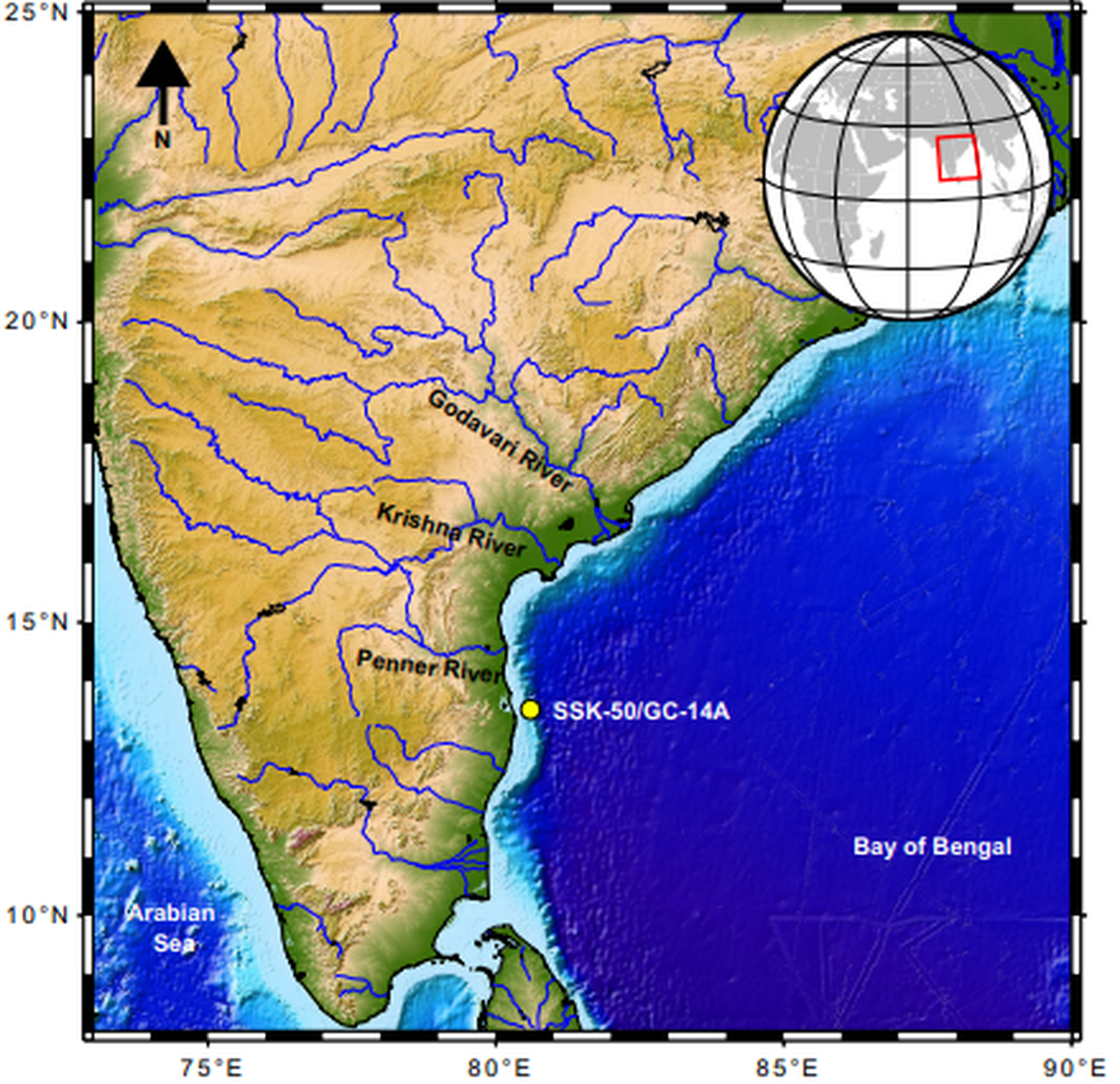
Sediments deposited at the core site originate predominantly from the Godavari, Krishna, and Penner Rivers, highlighted on the map.

Sediments deposited at the core site originate predominantly from the Godavari, Krishna, and Penner Rivers, highlighted on the map.
| Photo Credit:
Kadam, N et al/Nature

In fact, the origin of giant magnetofossils has stayed a mystery. Most giant magnetofossils have been found in sediments dating to the late Palaeocene period, some 56 million years ago, suggesting they formed only during periods of extreme warming.

But in the new study, published in the journal Nature in February, the scientists found the sediment in the Bay of Bengal to be from the late Quaternary period, or about 50,000 years ago, making it the youngest giant magnetofossil to have been found found yet.

What did the study find?

In the study, scientists at the CSIR-National Institute of Oceanography, Goa, combined magnetic analyses and electron microscopy to study the sediment sample.

The three-metre-long sediment core from the southwestern Bay of Bengal consisted mainly of “pale green silty clays,” they wrote in their paper. They also reported finding abundant benthic and planktic foraminifera — single-celled organisms with shells found near the sea bed and free-floating in water.

High-resolution transmission electron microscopy revealed the fossil to be in the shape of needles, spindles, bullets, and spearheads. The microscopy also confirmed the presence of ‘conventional’ magnetofossils along with giant ones. 

At a depth of around 1,000-1,500 m, the Bay of Bengal has a distinctively low oxygen concentration.

Earlier, studies of sediments suggested that nearly 29,000 to 11,700 years ago, during the last Glacial Maximum-Halocene period, the northeast and southwest monsoon strengthened and resulted in significant weathering and sedimentation.

Analysis of the sediment sample confirmed fluctuations in the monsoon took place as the scientists found particles of magnetic minerals from the two distinct geological periods.

The scientists also suggested the rivers Godavari, Mahanadi, Ganga-Brahmaputra, Cauvery, and Penner, which empty into the Bay of Bengal, played a crucial role in the formation of the magnetofossils.

The nutrient-rich sediment carried in by these rivers provided a sufficient supply of reactive iron, which combined with the available organic carbon in the suboxic conditions of the Bay of Bengal to create a favourable environment for the growth of magnetotatic bacteria.

The freshwater discharge from these rivers along with the other oceanographic processes, like eddy formation, rendered the oxygen content in these waters that isn’t usually found in other low-oxygen zones.

The scientists also said the presence of the magnetofossils showed that the suboxic conditions of the Bay of Bengal persisted for a long time, allowing the bacteria to thrive.
Source link

Science Tags:Bay of Bengal, history of monsoons, India summer monsoons, magnetic bacteria, Magnetofossils, Magnetofossils in the Bay of Bengal, science news

Post navigation

Previous Post: 50,000-year-old magnetic fossils found in the Bay of Bengal
Next Post: As Birth Rates Drop, Japanese Diaper Makers Move To Adult Market

Related Posts

  • DoPT denies service allocation to scientist with muscular dystrophy who cleared UPSC exam four times
    DoPT denies service allocation to scientist with muscular dystrophy who cleared UPSC exam four times Science
  • ISRO chief Somnath says space agency prefers woman fighter test pilots for its crewed mission, possible in future
    ISRO chief Somnath says space agency prefers woman fighter test pilots for its crewed mission, possible in future Science
  • Wastewater data revealed hidden COVID surges in Bengaluru after testing declined
    Wastewater data revealed hidden COVID surges in Bengaluru after testing declined Science
  • Scientists propose sweeping new law of nature, expanding on evolution
    Scientists propose sweeping new law of nature, expanding on evolution Science
  • Chandrayaan-3 | Centre asks universities to organise special assemblies to watch Moon landing
    Chandrayaan-3 | Centre asks universities to organise special assemblies to watch Moon landing Science
  • Italy to host main control centre for EU satellite constellation
    Italy to host main control centre for EU satellite constellation Science

More Related Articles

Science for all newsletter how do lidocaine ointments work?  Science for all newsletter how do lidocaine ointments work?  Science
Firefly Sparkle galaxy offers a taste of the infant Milky Way Firefly Sparkle galaxy offers a taste of the infant Milky Way Science
Charles Richet and his Nobel-winning work on severe allergic reactions Charles Richet and his Nobel-winning work on severe allergic reactions Science
Can GLP-1 generics fix India’s obesity epidemic, which goes beyond body size? Can GLP-1 generics fix India’s obesity epidemic, which goes beyond body size? Science
New research rescues the dodo’s reputation from confusion and myth New research rescues the dodo’s reputation from confusion and myth Science
Chandrayaan-3 live updates | Vikram lander successfully lands on Moon; India becomes 4th country to make soft landing on lunar surface Chandrayaan-3 live updates | Vikram lander successfully lands on Moon; India becomes 4th country to make soft landing on lunar surface Science
SiteLock

Archives

  • May 2026
  • April 2026
  • March 2026
  • February 2026
  • January 2026
  • December 2025
  • November 2025
  • October 2025
  • September 2025
  • August 2025
  • July 2025
  • June 2025
  • May 2025
  • April 2025
  • March 2025
  • February 2025
  • January 2025
  • December 2024
  • November 2024
  • October 2024
  • September 2024
  • August 2024
  • July 2024
  • June 2024
  • May 2024
  • April 2024
  • March 2024
  • February 2024
  • January 2024
  • December 2023
  • November 2023
  • October 2023
  • September 2023
  • August 2023
  • July 2023
  • June 2023
  • May 2023
  • April 2023
  • March 2023
  • February 2023
  • January 2023
  • December 2022
  • November 2022
  • October 2022
  • September 2022
  • August 2022
  • July 2022
  • June 2022
  • May 2022

Categories

  • Business
  • Nation
  • Science
  • Sports
  • World

Recent Posts

  • Prosthetic foot centre set up in Trinidad; Jaishankar terms it gift of mobility
  • Last evacuation flights from hantavirus ship land in Netherlands
  • Hantavirus: Confirmed cases by nationality
  • Will hear Trinamool pleas on victory margins being less than deleted votes in SIR, says Supreme Court
  • PM’s Telangana visit: Did BJP internal wranglings upset Modi?

Recent Comments

  1. RonaldLam on UP Teacher Who Asked Students To Slap Muslim Classmate
  2. Robertsheds on UP Teacher Who Asked Students To Slap Muslim Classmate
  3. Jamescax on UP Teacher Who Asked Students To Slap Muslim Classmate
  4. Jameszoppy on UP Teacher Who Asked Students To Slap Muslim Classmate
  5. MatthewTub on UP Teacher Who Asked Students To Slap Muslim Classmate
  • With Hockey Bronze, PR Sreejesh Poses In Traditional Costume In Front Of Eifel Tower
    With Hockey Bronze, PR Sreejesh Poses In Traditional Costume In Front Of Eifel Tower Sports
  • Access Denied World
  • Access Denied Sports
  • Seven children among 49 people drowned across Russia on July 6
    Seven children among 49 people drowned across Russia on July 6 World
  • Rupee falls 4 paise to 83.95 against U.S. dollar
    Rupee falls 4 paise to 83.95 against U.S. dollar Business
  • Access Denied
    Access Denied Nation
  • IPL-17, KKR vs DC | No ‘safe’ total as KKR and DC will look to out-bat each other
    IPL-17, KKR vs DC | No ‘safe’ total as KKR and DC will look to out-bat each other Sports
  • Rupee falls 1 paisa to all-time low of 84.92 against U.S. dollar
    Rupee falls 1 paisa to all-time low of 84.92 against U.S. dollar Business

Editor-in-Chief:
Mohammad Ariff,
MSW, MAJMC, BSW, DTL, CTS, CNM, CCR, CAL, RSL, ASOC.
editor@artifex.news

Associate Editors:
1. Zenellis R. Tuba,
zenelis@artifex.news
2. Haris Daniyel
daniyel@artifex.news

Photograher:
Rohan Das
rohan@artifex.news

Artifex.News offers Online Paid Internships to college students from India and Abroad. Interns will get a PRESS CARD and other online offers.
Send your CV (Subjectline: Paid Internship) to internship@artifex.news

Links:
Associate Journalism
About Us
Privacy Policy

News Links:
Breaking News
World
Nation
Sports
Business
Entertainment
Lifestyle

Registered Office:
72/A, Elliot Road, Kolkata - 700016
Tel: 033-22277777, 033-22172217
Email: office@artifex.news

Editorial Office / News Desk:
No. 13, Mezzanine Floor, Esplanade Metro Rail Station,
12 J. L. Nehru Road, Kolkata - 700069.
(Entry from Gate No. 5)
Tel: 033-46011099, 033-46046046
Email: editor@artifex.news

Copyright © 2023 Artifex.News Newsportal designed by Artifex Infotech.