


Skip to content
  • Facebook
  • X
  • Linkedin
  • WhatsApp
  • YouTube
  • Associate Journalism
  • About Us
  • Privacy Policy
  • 033-46046046
  • editor@artifex.news
Artifex.News

Artifex.News

Stay Connected. Stay Informed.

  • Breaking News
  • World
  • Nation
  • Sports
  • Business
  • Science
  • Entertainment
  • Lifestyle
  • Toggle search form
  • Air India ‘bullish’ on long-haul travel
    Air India ‘bullish’ on long-haul travel Business
  • Government Pushing Poor To Send Kids To Private Schools: Karnataka High Court
    Government Pushing Poor To Send Kids To Private Schools: Karnataka High Court Nation
  • "No One Can Stop Babri Masjid In Bengal": Humayun Kabir To NDTV
    "No One Can Stop Babri Masjid In Bengal": Humayun Kabir To NDTV Nation
  • How 1,000 Ukraine Troops Entered 30 Km Into Russia, What They Plan Next
    How 1,000 Ukraine Troops Entered 30 Km Into Russia, What They Plan Next World
  • Landslip in Bangladesh kill at least eight Rohingya refugees
    Landslip in Bangladesh kill at least eight Rohingya refugees World
  • Access Denied World
  • Larijani’s killing won’t destabilise Iran, says Foreign Minister Araghchi; IRGC vows ‘revenge’
    Larijani’s killing won’t destabilise Iran, says Foreign Minister Araghchi; IRGC vows ‘revenge’ World
  • 7 militants killed in northwestern Pakistan in military operation: Army
    7 militants killed in northwestern Pakistan in military operation: Army World
Charles Richet and his Nobel-winning work on severe allergic reactions

Charles Richet and his Nobel-winning work on severe allergic reactions

Posted on May 10, 2026 By admin


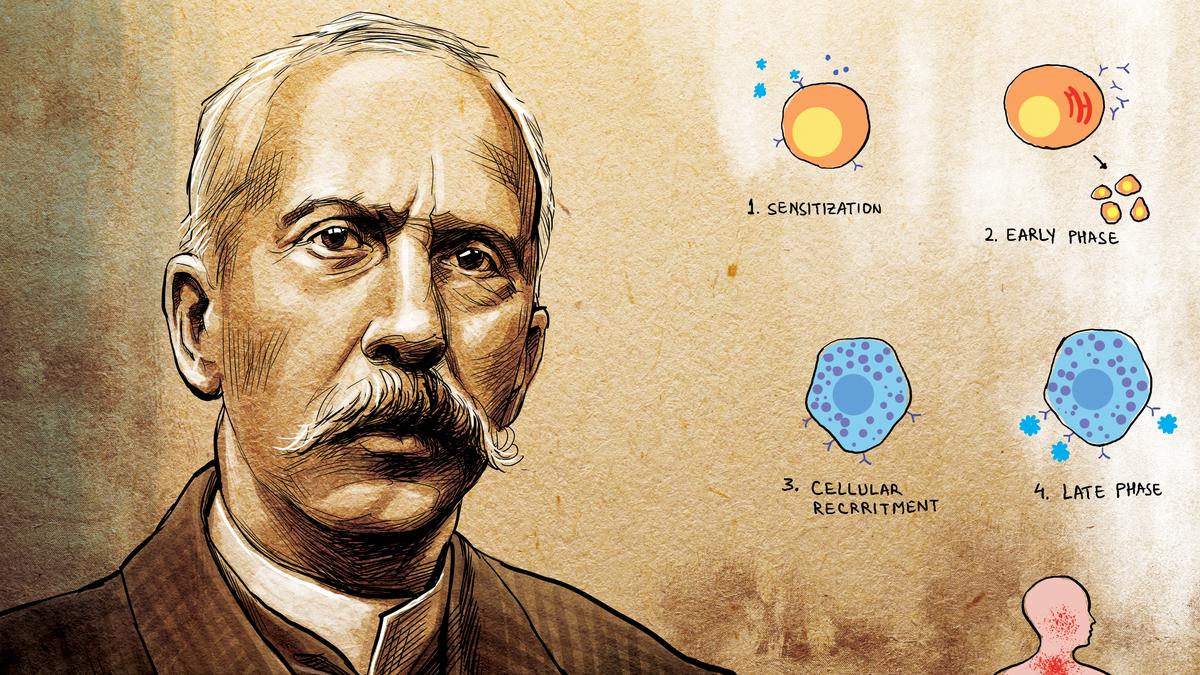
The 1913 Nobel Prize in Physiology or Medicine was awarded to Charles Richet “in recognition of his work on anaphylaxis.”His research uncovered a paradoxical reaction in which the body’s defenses, instead of protecting it, could overreact with severe consequences. This discovery became a cornerstone of immunology and the study of allergic diseases.

In the late nineteenth and early twentieth centuries, medicine was advancing rapidly in understanding infections and immunity, but certain reactions remained mysterious. Doctors and researchers observed that both people and animals could suddenly develop difficulty breathing, collapse, or even fatal reactions after exposure to substances that had previously caused little harm. These responses were unpredictable and could not be explained by the existing understanding of how the immune system worked. Without understanding these reactions, treatments for toxins, vaccines, and other medical interventions carried significant risk, and there was no framework to prevent or manage severe allergic responses.

Early life

Charles Robert Richet was born on August 26, 1850, in Paris, France. He came from a medical family –his father, Alfred Richet, was a surgeon and professor. Besides immunology, he also studied subjects including physiology, psychology, and neuroscience. He studied medicine at the University of Paris, where he developed a fascination with physiology, toxins, and the body’s defensive mechanisms. Early in his career, Richet focused on understanding how animals responded to poisons and venoms, often observing that repeated exposure sometimes caused reactions far more severe than the first encounter.

These observations sparked his interest in systematically studying what he would later define as anaphylaxis. Richet spent years performing controlled experiments to uncover the principles behind these dangerous immune responses.

Richet’s major contribution

Richet’s breakthrough came in 1902 through experiments with marine toxins, in collaboration with French physiologist, Paul Portier. They exposed dogs to jellyfish and sea anemone venoms. While an initial dose often produced mild effects, subsequent exposures sometimes provoked violent reactions, including shock and death.

Richet documented these outcomes and recognised a distinct physiological phenomenon: anaphylaxis. He named it from the Greek “ana-” (opposite of) and “phylaxis” (protection), emphasising that the immune system could react in a harmful, rather than protective, way.

This discovery explained previously puzzling severe allergic reactions and became the first systematic description of hypersensitivity. Richet’s work showed that the immune system could overreact, providing the basis for understanding allergies, severe drug reactions, and other immune-mediated conditions. When Richet first described anaphylaxis in 1902, scientists largely believed the immune system only protected the body. His experiments revealed the opposite could also happen –the body’s own defenses could trigger sudden, deadly reactions after a second exposure to a substance.

Research contributions

Beyond describing anaphylaxis, Richet’s research laid the groundwork for safer medical practices. His findings informed the development of allergy testing, immunotherapy, and emergency interventions such as epinephrine treatment for life-threatening reactions. He also influenced the broader field of immunology, helping scientists understand that immune responses can be both protective and pathological.

Richet continued to study physiological reactions and toxins throughout his career, contributing to general knowledge of the nervous and circulatory systems. However, his work on anaphylaxis remained his best recognised achievement.

Impact on medicine

Charles Richet’s discovery fundamentally changed the understanding of the immune system. Today, anaphylaxis is recognised as a medical emergency, and protocols for its management directly reflect Richet’s insights. Treatments, preventive measures, and patient education in allergy care all trace back to his work.

His research also influenced the study of autoimmune diseases and other conditions in which the immune system causes harm. By revealing that the body’s defenses can sometimes overreact, Richet opened the door to safer therapies, vaccines, and clinical practices that anticipate and prevent harmful immune responses.

Charles Richet passed away on December 4, 1935, but his legacy endures. His experiments and documentation provided a framework for modern immunology, saving lives through a deeper understanding of allergic and hypersensitivity reactions.

Published – May 10, 2026 08:10 am IST


Source link

Science Tags:allergic reactions, anaphylaxis, immunity, severe allergic reactions

Post navigation

Previous Post: Archery World Cup Stage 2 in Shanghai: Deepika leads women’s recurve team to gold; India finish with two medals
Next Post: Non-binary Indian migrant elected member of Scottish Parliament

Related Posts

  • The bacteria that write new genes to cope with infections
    The bacteria that write new genes to cope with infections Science
  • Argentine biotech firm breeds gene-edited polo super ponies
    Argentine biotech firm breeds gene-edited polo super ponies Science
  • Agnikul eyes satellite launches by 2025: start-up CEO Ravichandran
    Agnikul eyes satellite launches by 2025: start-up CEO Ravichandran Science
  • Getting a closer look at Pluto
    Getting a closer look at Pluto Science
  • Chimps imbibe two cocktails’ worth of ethanol daily from ripe fruits
    Chimps imbibe two cocktails’ worth of ethanol daily from ripe fruits Science
  • Spacewalking is the new domain of the rich as billionaire attempts first private spacewalk
    Spacewalking is the new domain of the rich as billionaire attempts first private spacewalk Science

More Related Articles

The story of dapsone: from dye to drug The story of dapsone: from dye to drug Science
Sci-Five | The Hindu Science Quiz: On Sea Wolves Sci-Five | The Hindu Science Quiz: On Sea Wolves Science
What the ‘moral distress’ of doctors tells us about eroding trust in health care What the ‘moral distress’ of doctors tells us about eroding trust in health care Science
SpaceX’s Starship launches 6th Flight; first ever payload was a stuffed banana SpaceX’s Starship launches 6th Flight; first ever payload was a stuffed banana Science
Elon Musk says that SpaceX has shifted focus from Mars to Moon Elon Musk says that SpaceX has shifted focus from Mars to Moon Science
Earth’s magnetic flips can last 70,000 years, new study finds Earth’s magnetic flips can last 70,000 years, new study finds Science
SiteLock

Archives

  • September 2026
  • August 2026
  • July 2026
  • June 2026
  • May 2026
  • April 2026
  • March 2026
  • February 2026
  • January 2026
  • December 2025
  • November 2025
  • October 2025
  • September 2025
  • August 2025
  • July 2025
  • June 2025
  • May 2025
  • April 2025
  • March 2025
  • February 2025
  • January 2025
  • December 2024
  • November 2024
  • October 2024
  • September 2024
  • August 2024
  • July 2024
  • June 2024
  • May 2024
  • April 2024
  • March 2024
  • February 2024
  • January 2024
  • December 2023
  • November 2023
  • October 2023
  • September 2023
  • August 2023
  • July 2023
  • June 2023
  • May 2023
  • April 2023
  • March 2023
  • February 2023
  • January 2023
  • December 2022
  • November 2022
  • October 2022
  • September 2022
  • August 2022
  • July 2022
  • June 2022
  • May 2022

Categories

  • Business
  • Nation
  • Science
  • Sports
  • World

Recent Posts

  • Raphinha hat-trick maintains Barcelona’s perfect LaLiga start
  • Saudi Arabia confirms Yemen’s Houthi rebels tried to attack its capital with ballistic missile
  • Martin recovers from early setback to win Austrian sprint and retake championship lead
  • Arsenal thrashed by Brighton, sorry Spurs lose again
  • Shamli Police book six over alleged ‘misleading’ social media posts on Ayush Malik High Court proceedings

Recent Comments

  1. AlvinNet on UP Teacher Who Asked Students To Slap Muslim Classmate
  2. AlvinNet on UP Teacher Who Asked Students To Slap Muslim Classmate
  3. Jamesslits on UP Teacher Who Asked Students To Slap Muslim Classmate
  4. MichaelClear on UP Teacher Who Asked Students To Slap Muslim Classmate
  5. Jamesslits on UP Teacher Who Asked Students To Slap Muslim Classmate
  • PM Modi Launches Railway Projects Worth Rs 2,871 Crore In Odisha
    PM Modi Launches Railway Projects Worth Rs 2,871 Crore In Odisha Nation
  • Access Denied
    Access Denied Nation
  • Ranji Trophy | Powerful Tamil Nadu holds all the aces against Assam
    Ranji Trophy | Powerful Tamil Nadu holds all the aces against Assam Sports
  • Explosion, ‘suspected bomb’ in Philippine capital before Marcos speech
    Explosion, ‘suspected bomb’ in Philippine capital before Marcos speech World
  • Israeli forces kill 2 Palestinians at West Bank hospital: director
    Israeli forces kill 2 Palestinians at West Bank hospital: director World
  • The price of AI is falling; why are enterprises still spending more? Explained
    The price of AI is falling; why are enterprises still spending more? Explained Business
  • Man With Explosives Tries To Enter Brazil Supreme Court, Dies In Blast
    Man With Explosives Tries To Enter Brazil Supreme Court, Dies In Blast World
  • Access Denied World

Editor-in-Chief:
Mohammad Ariff,
MSW, MAJMC, BSW, DTL, CTS, CNM, CCR, CAL, RSL, ASOC.
editor@artifex.news

Associate Editors:
1. Zenellis R. Tuba,
zenelis@artifex.news
2. Haris Daniyel
daniyel@artifex.news

Photograher:
Rohan Das
rohan@artifex.news

Artifex.News offers Online Paid Internships to college students from India and Abroad. Interns will get a PRESS CARD and other online offers.
Send your CV (Subjectline: Paid Internship) to internship@artifex.news

Links:
Associate Journalism
About Us
Privacy Policy

News Links:
Breaking News
World
Nation
Sports
Business
Entertainment
Lifestyle

Registered Office:
72/A, Elliot Road, Kolkata - 700016
Tel: 033-22277777, 033-22172217
Email: office@artifex.news

Editorial Office / News Desk:
No. 13, Mezzanine Floor, Esplanade Metro Rail Station,
12 J. L. Nehru Road, Kolkata - 700069.
(Entry from Gate No. 5)
Tel: 033-46011099, 033-46046046
Email: editor@artifex.news

Copyright © 2023 Artifex.News Newsportal designed by Artifex Infotech.