
Skip to content
  • Facebook
  • X
  • Linkedin
  • WhatsApp
  • Associate Journalism
  • About Us
  • Privacy Policy
  • 033-46046046
  • editor@artifex.news
Artifex.News

Artifex.News

Stay Connected. Stay Informed.

  • Breaking News
  • World
  • Nation
  • Sports
  • Business
  • Science
  • Entertainment
  • Lifestyle
  • Toggle search form
  • Harbhajan Singh’s Fiery Reply To PCB’s ‘Threat’, Says “Tournament Will Happen Without Pakistan”
    Harbhajan Singh’s Fiery Reply To PCB’s ‘Threat’, Says “Tournament Will Happen Without Pakistan” Sports
  • Poland’s Foreign Minister says it should not exclude the possibility of sending troops to Ukraine
    Poland’s Foreign Minister says it should not exclude the possibility of sending troops to Ukraine World
  • Access Denied Sports
  • 2 Missing Children Found Dead Inside Water Tank In Rajasthan: Police
    2 Missing Children Found Dead Inside Water Tank In Rajasthan: Police Nation
  • White House pressing Ukraine to draft 18-year-olds so it has enough troops to battle Russia
    White House pressing Ukraine to draft 18-year-olds so it has enough troops to battle Russia World
  • Vice Admiral Dinesh Tripathi Appointed As Next Indian Navy Chief
    Vice Admiral Dinesh Tripathi Appointed As Next Indian Navy Chief Nation
  • Greenland limits foreigners’ right to property
    Greenland limits foreigners’ right to property World
  • Judges Must Act With Dignity, Shouldn’t Dent Image Of Judiciary: High Court
    Judges Must Act With Dignity, Shouldn’t Dent Image Of Judiciary: High Court Nation
Steve Smith’s eye-blacks and the slippery slope of cricket’s tool rules

Steve Smith’s eye-blacks and the slippery slope of cricket’s tool rules

Posted on December 1, 2025 By admin


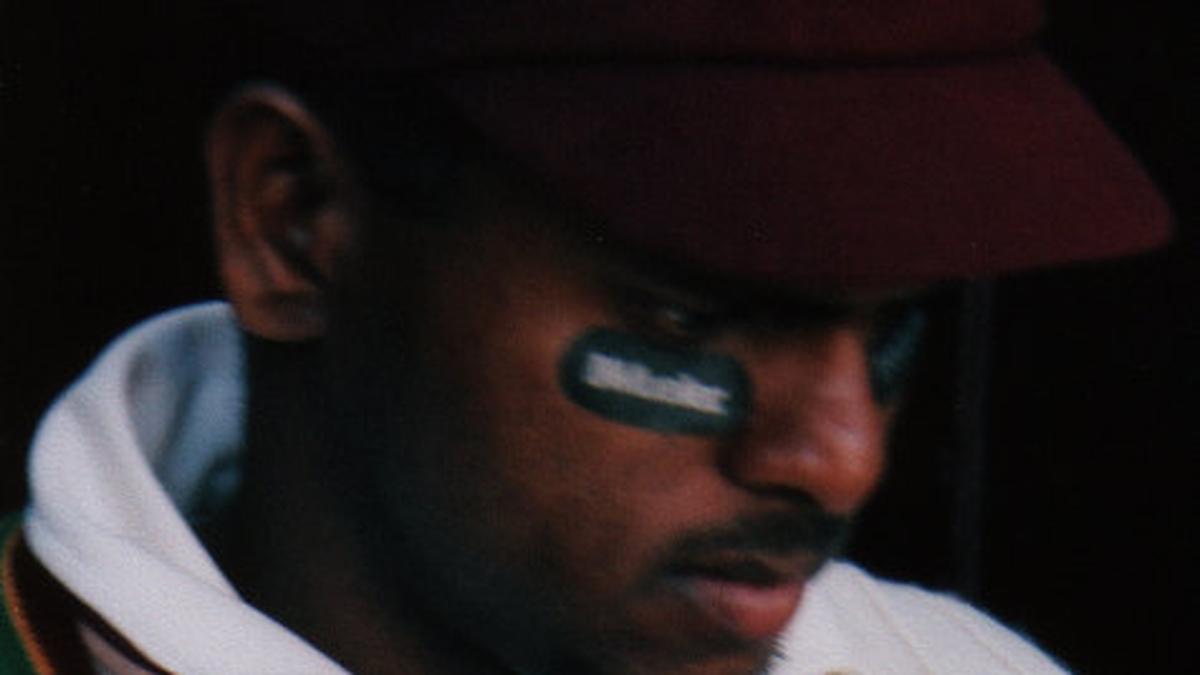
West Indian cricketer Shivnarine Chanderpaul sporting eye-blacks in 2006.
| Photo Credit: Ashlar (CC BY-SA)

On November 30, Australian cricketer Steven Smith was spotted wearing eye-black strips while training for the forthcoming pink-ball Ashes Test match in Brisbane. These strips are pasted over the cheekbone and reduce the glare created by light reflected off the skin by more than half. They were popularised in the previous decade by West Indies cricketer Shivnarine Chanderpaul. It’s a simple solution to a problem posed by the pink ball, which has a black seam that ‘extra’ light could make difficult to pick under floodlights.

The strips are also a reminder that modern sport is full of unobtrusive technologies that help athletes cope with difficult environments without turning them into different kinds of athletes. These tools are often aimed at restoring something that environmental conditions take away, including clear vision under bright lights, stable joints under heavy load or basic safety in high-speed collisions – but some of them also sit in a grey area between ordinary equipment and performance enhancement, raising questions about where sport should draw the line.

Restorative logic

In American football and baseball, eye-blacks and tinted helmet visors help players keep track of the ball under floodlights while also protecting their eyes. Basketball and football players use compression sleeves and kinesiology tape to support muscles and joints when they have a packed match schedule. Long-distance runners and footballers wear custom orthotic insoles to correct gait and reduce contact forces, seemingly without changing what their legs can do in principle. Swimmers bank on specialised goggles to see clearly and maintain direction in turbulent water. Tennis players have long moved away from wooden and towards composite racquets that are standardised but still vary in subtle ways that can enhance control or mitigate strain.

In each case, sport has accepted equipment that offsets some nuisance while usually resisting technologies that would add new capacities. Cricket has its own bevy of such ‘prosthetic’ aids. Aside from anti-glare strips, they include prescription contact lenses or goggles to correct vision, polarised or tinted sunglasses for fielders and wicketkeepers; batting helmets with redesigned grilles and visors; batting gloves with extra padding and consistent grip; arm, thigh, chest, and rib guards; custom orthotic insoles in cricket shoes for better gait; knee, elbow and ankle braces or supports; compression sleeves, socks, and base layers for circulation and recovery; and dental mouthguards to protect the teeth and reduce concussion risk.

Most of these technologies are uncontroversial because they fit a restorative logic, meaning they protect the body in a high-risk environment or restore ordinary human capacities in conditions that would otherwise degrade them. Eye-blacks and sunglasses reduce glare so a batter can track the ball as a person with normal vision would under less intense lighting. Contact lenses or sports goggles allow a short-sighted player to approximate the sight of a player with no refractive error. Helmets and guards reduce injury risk from forces that are intrinsic to contemporary cricket. Insoles and compression garments help players keep joints and muscles functioning within normal ranges over long playing seasons.

A fine line

The main regulatory and ethical questions arise where the line between restoring and enhancing becomes less clear. For example, polarised sunglasses and tinted contact lenses do more than simply restore vision that myopia has taken away. In some lighting conditions they can improve contrast, reduce background noise, and make it easier to pick the ball’s seam or shape than with the naked eye. That’s still a modest advantage compared to non-users but it’s also an advantage tied to access to equipment and to knowledge about how to tune lenses to specific conditions, such as pink-ball cricket played under lights.

If such tuning becomes very precise, regulators could be pushed to decide whether certain tints or coatings remain allowable as ‘normal’ protective eyewear or if they cross into a category of performance aids that need to be standardised or even restricted.

A similar issue exists with braces, insoles, and compression gear. At present they’re justified as tools to prevent injuries and manage physical loads. However, a brace that stores and releases elastic energy in a joint or a compression garment that measurably improves sprint or endurance performance in real-time, rather than just aiding recovery, would be tantamount to mechanical doping. Cricket doesn’t yet have the kind of detailed equipment regulations that cycling or track and field sports have developed around such questions but the direction of sports science suggests these issues may not always remain hypothetical.

High stakes

Cost and access add an ethical layer even when the technology itself is considered okay. Custom orthotics and high-end contact lenses are more accessible to players in well-resourced systems than to those in poorer domestic structures. If such equipment meaningfully reduces injury risk or marginally improves performance, there’s a question of distributive fairness in competitions that mix players from very different backgrounds. Recall that these competitions are also becoming more competitive and more lucrative.

Thus far, cricket’s solution has largely been informal: governing bodies specify minimum safety standards for items like helmets and gloves and then leave the finer technological differences to the market. That may be adequate when the performance effects remain small, but there’s still the question of whether marginal gains could build up into systematic advantages.

Eye-blacks have very low stakes in this spectrum of technologies. It’s also cheap and easy to use and its effect is to help batters cope with glare partly introduced by a shift in the sport driven by commercial interests and the importance of broadcast revenue. The ethical concern here is minimal and any competitive effect can be offset by universal availability. The more challenging cases lie however in  more subtle advances in materials science and sports engineering that can be built into gear that looks otherwise familiar, changing what it does without obviously changing what it is. That’s where cricket administrators may eventually need better criteria for differentiating harmless prosthetic support from technologies that enhance performance.

Published – December 01, 2025 01:23 pm IST


Source link

Science

Post navigation

Previous Post: Access Denied
Next Post: Access Denied

Related Posts

  • Did the world’s best-preserved dinosaurs really die in ‘Pompeii-type’ events?
    Did the world’s best-preserved dinosaurs really die in ‘Pompeii-type’ events? Science
  • Sci-Five | The Hindu Science Quiz: On Drones
    Sci-Five | The Hindu Science Quiz: On Drones Science
  • New Zealand to loosen gene editing regulation, make commercialisation easier
    New Zealand to loosen gene editing regulation, make commercialisation easier Science
  • Academics warn new science papers are being generated with AI chatbots
    Academics warn new science papers are being generated with AI chatbots Science
  • What are weights in AI?
    What are weights in AI? Science
  • Limestone, iron reveal puzzling extreme rain in Australia 100,000 years ago
    Limestone, iron reveal puzzling extreme rain in Australia 100,000 years ago Science

More Related Articles

Using science to address India’s dog crisis Using science to address India’s dog crisis Science
Sci-Five | The Hindu Science Quiz: On Whale Sharks Sci-Five | The Hindu Science Quiz: On Whale Sharks Science
Researchers identify key genetic factors causing oral cancer early among Indian tobacco chewers Researchers identify key genetic factors causing oral cancer early among Indian tobacco chewers Science
Science for all newsletter The cost of giving birth Science for all newsletter The cost of giving birth Science
DoPT denies service allocation to scientist with muscular dystrophy who cleared UPSC exam four times DoPT denies service allocation to scientist with muscular dystrophy who cleared UPSC exam four times Science
Severe solar storm triggers rare auroral arc in Ladakh sky Severe solar storm triggers rare auroral arc in Ladakh sky Science
SiteLock

Archives

  • December 2025
  • November 2025
  • October 2025
  • September 2025
  • August 2025
  • July 2025
  • June 2025
  • May 2025
  • April 2025
  • March 2025
  • February 2025
  • January 2025
  • December 2024
  • November 2024
  • October 2024
  • September 2024
  • August 2024
  • July 2024
  • June 2024
  • May 2024
  • April 2024
  • March 2024
  • February 2024
  • January 2024
  • December 2023
  • November 2023
  • October 2023
  • September 2023
  • August 2023
  • July 2023
  • June 2023
  • May 2023
  • April 2023
  • March 2023
  • February 2023
  • January 2023
  • December 2022
  • November 2022
  • October 2022
  • September 2022
  • August 2022
  • July 2022
  • June 2022
  • May 2022

Categories

  • Business
  • Nation
  • Science
  • Sports
  • World

Recent Posts

  • Access Denied
  • Access Denied
  • U.K. medical team to arrive in Bangladesh as Zia remains critical
  • Access Denied
  • Man charged in National Guard shooting pleads not guilty during court appearance from hospital

Recent Comments

  1. dfb{{98991*97996}}xca on UP Teacher Who Asked Students To Slap Muslim Classmate
  2. "dfbzzzzzzzzbbbccccdddeeexca".replace("z","o") on UP Teacher Who Asked Students To Slap Muslim Classmate
  3. 1}}"}}'}}1%>"%>'%> on UP Teacher Who Asked Students To Slap Muslim Classmate
  4. bfg6520<s1﹥s2ʺs3ʹhjl6520 on UP Teacher Who Asked Students To Slap Muslim Classmate
  5. pHqghUme9356321 on UP Teacher Who Asked Students To Slap Muslim Classmate
  • U.S. Federal Reserve makes half-point cut in first rate reduction since 2020
    U.S. Federal Reserve makes half-point cut in first rate reduction since 2020 World
  • “Could Not Even Brush My Teeth For Two Months…”: Rishabh Pant Recalls Struggling With Injuries After Car Accident
    “Could Not Even Brush My Teeth For Two Months…”: Rishabh Pant Recalls Struggling With Injuries After Car Accident Sports
  • “They Are Irreplaceable”: Ex-India Captain’s Blockbuster Praise For Rohit Sharma, Virat Kohli
    “They Are Irreplaceable”: Ex-India Captain’s Blockbuster Praise For Rohit Sharma, Virat Kohli Sports
  • Access Denied
    Access Denied Nation
  • Iran loosens import restrictions on foreign cars and iPhones, trying to mask its economic woes
    Iran loosens import restrictions on foreign cars and iPhones, trying to mask its economic woes World
  • ‘Cheteshwar Pujara And Ajinkya Rahane Have No Place…”: Sunil Gavaskar Blasts India’s Batting Tactics
    ‘Cheteshwar Pujara And Ajinkya Rahane Have No Place…”: Sunil Gavaskar Blasts India’s Batting Tactics Sports
  • India vs New Zealand third Test in Mumbai on Day 2: November 2, 2024. Ashwin’s post-match press conference
    India vs New Zealand third Test in Mumbai on Day 2: November 2, 2024. Ashwin’s post-match press conference Sports
  • Unemployment rate is now the U.S. Fed’s undisputed lodestar
    Unemployment rate is now the U.S. Fed’s undisputed lodestar Business

Editor-in-Chief:
Mohammad Ariff,
MSW, MAJMC, BSW, DTL, CTS, CNM, CCR, CAL, RSL, ASOC.
editor@artifex.news

Associate Editors:
1. Zenellis R. Tuba,
zenelis@artifex.news
2. Haris Daniyel
daniyel@artifex.news

Photograher:
Rohan Das
rohan@artifex.news

Artifex.News offers Online Paid Internships to college students from India and Abroad. Interns will get a PRESS CARD and other online offers.
Send your CV (Subjectline: Paid Internship) to internship@artifex.news

Links:
Associate Journalism
About Us
Privacy Policy

News Links:
Breaking News
World
Nation
Sports
Business
Entertainment
Lifestyle

Registered Office:
72/A, Elliot Road, Kolkata - 700016
Tel: 033-22277777, 033-22172217
Email: office@artifex.news

Editorial Office / News Desk:
No. 13, Mezzanine Floor, Esplanade Metro Rail Station,
12 J. L. Nehru Road, Kolkata - 700069.
(Entry from Gate No. 5)
Tel: 033-46011099, 033-46046046
Email: editor@artifex.news

Copyright © 2023 Artifex.News Newsportal designed by Artifex Infotech.