






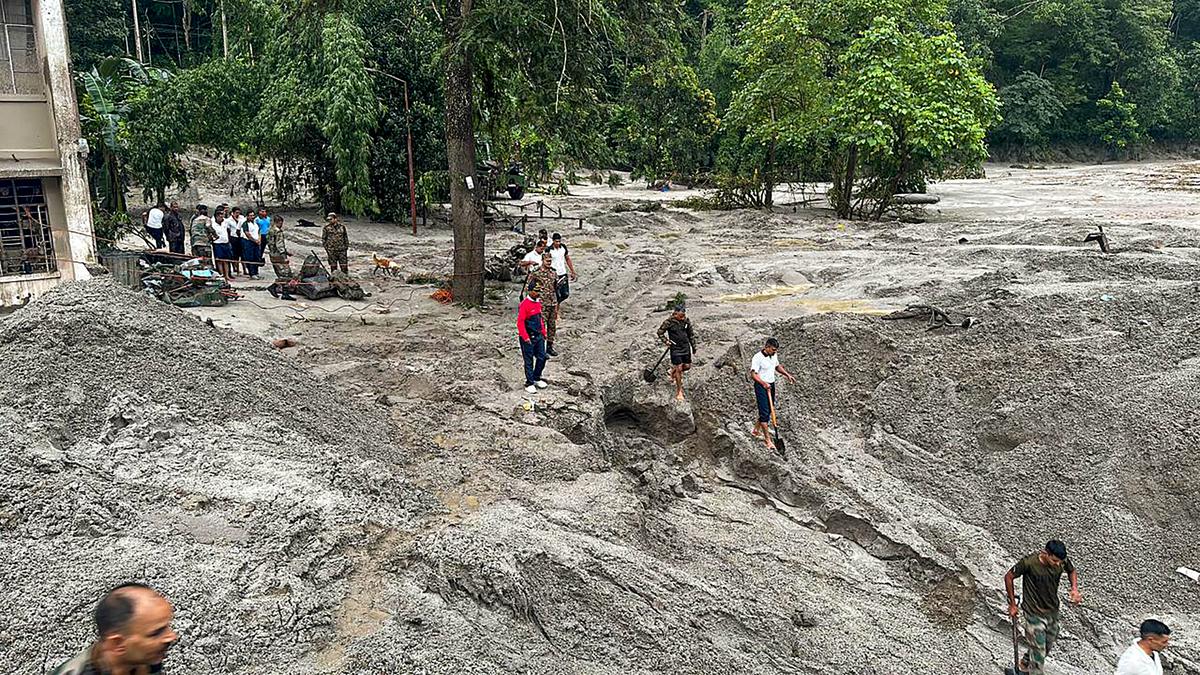
The Teesta basin in the Sikkim Himalaya is home to several glacial lakes in the high-altitude, glacier-covered terrain. Among them, South Lhonak Lake stands out as one of the largest and fastest-growing.
Although these lakes are primarily situated in remote and uninhabited mountain valleys, the consequences of glacial lake outburst floods (GLOFs) can extend over tens of kilometres downstream, resulting in loss of human life and significant damage to property and infrastructure. A GLOF occurs when the weak, unstable natural moraine that holds a glacial lake fails can no longer hold the water in the glacial lake. Events like earthquakes, cloudbursts, and avalanches can trigger a GLOF by breaking the moraine.
A recent cloudburst above South Lhonak Lake caused it to breach its embankment, dumping the water into a channel that caused the water in the Chungthang dam reservoir to overflow as well as the reservoir itself to suffer damage. All this then triggered abrupt and devastating flash floods in different parts of the hilly state of Sikkim.
Not just extreme weather
Meteorologists have stressed that while existing weather conditions were indeed favourable for heavy to extremely heavy rainfall, since a low-pressure atmospheric system was nearby, the flash floods can’t be solely attributed to the singular instance of extreme weather. Climate change has played a big part in altering the frequency and amplifying the intensity of such weather phenomena – and human activities on unstable terrain have made their effects more devastating.
“We all know that in a warming world, the potential for cloudbursts, extreme rains, and GLOF has gone up,” Roxy Mathew Koll, a climate scientist at the Indian Institute of Tropical Meteorology, Pune. “Ocean warming has already increased moisture levels over the region. The low-pressure area near the region further increased the moisture, [providing] a conducive environment for torrential rains.”
An expected disaster
As it happens, scientists had anticipated the Sikkim disaster as early as 2021, when, in a study published in the journal Geomorphology, they highlighted the expanding dimensions of the Lhonak glacial lake, which rendered a GLOF more likely due to cloudbursts.
“There has been a substantial increase in the number of glacial lakes as the glaciers are melting due to global warming,” Farooq Azam, a glaciologist at the Indian Institute of Technology, Indore, said. “When the glaciers advance, they erode the river bed, leading to the deepening of the river. Also, climate change has resulted in erratic precipitation, including events like cloudbursts, as we saw in Sikkim, leading to the partial breach of the moraine dam.”
Dr. Azam added that eroding glaciers apply pressure on the bedrock, which then produces more silt: “Whenever there is a flash flood, you will witness more silt and debris flowing downhill, aggravating the destruction caused by floods and landslides.”
‘Critical’ lakes
Glaciers in the area are melting and retreating, which has led to the accelerated growth in the number and size of proglacial lakes (i.e. lakes growing in front of the glaciers). And as the glaciers continue to recede, the expansion of these lakes is also linked to the topography of the exposed bed. For example, if the bed contains a depression that becomes exposed, water can collect there and ‘expand’ the lake.
As the lakes become bigger, the chances of a GLOF increase as well.
The 2021 study also singled 12 lakes out as ‘critical’ and 93 as ‘potentially critical’, out of 251 glacial lakes larger than 0.01 sq. km. The criticality referred to the probability of a lake developing an outburst followed by “potential downstream exposure”.
In another similar study, published in May 2022, researchers from the National Institute of Technology, Rourkela, evaluated the potential downstream impact of 329 lakes across the Indian Himalaya, and found that 36 were exposed to potential avalanche-impact zones. This study also identified South Lhonak Lake as potentially dangerous, with a high outburst probability. In the last 29 years, the length of the glacier next to which the lake is growing reduced from 6.4 km to 5.1 km even as the water-body grew from 0.42 sq. km in 1990 to 1.35 sq. kmin 2019.
Rainfall and earthquakes
“Eastern Himalayas are dominated by the monsoon, which has over the period become more erratic and unpredictable,” Dr. Azam said. “Snowfall is food for glaciers, but it is now replaced by rainfall, that too erratic. There are more days of heavy rain and [the number of] dry periods is also increasing. Rise in global warming has led to rise in glacial melt.”
Geologists have found that as glaciers recede, they deposit large quantities of sediment – composed of an unstable combination of soil and rocks – in the upper regions of the Himalaya. In these circumstances, even a small amount of rainfall can dislodge boulders and debris and leave them to flow downstream. As a result, scientists deemed in the May 2022 paper the upper Himalayan region to be highly unsuitable for the construction of dams and tunnels.
Another threat like rain is seismic activity: earthquakes can deteriorate the structural stability of the moraines. They may not necessarily result in outburst floods but they could nonetheless trigger significant ice and/or rock avalanches. And this threat is worth paying attention to because South Lhonak Lake is located in an area characterised by a high level of seismic activity. According to the National Institute of Disaster Management, Sikkim straddles land classified as seismic zones IV and V – i.e. having the highest level of seismicity.
Several earthquakes in the past have also had their epicentres close to the lake.
Landscape of uncertainties
“[We] don’t have high-resolution monitoring systems that could tell us what happened, how it happened, and to what extent climate change aggravated the scenario,” Dr. Koll said about the Sikkim GLOF. “We know the Himalayan region is prone to cloudbursts, but we cannot identify a hotspot. Thus, a proper monitoring network is the need of the hour.”
Scientists have also articulated the need for more research to better understand the area’s climate sensitivity. There are more than 54,000 glaciers across the Hindu Kush Himalaya but only a few are actually monitored – 1-5%, according to Anjal Prakash, director of the Bharti Institute of Public Policy, Indian School of Business, Hyderabad, and a coauthor of assessment reports prepared by the Intergovernmental Panel on Climate Change.
On the other hand, construction activities in the Himalayan region – especially hydroelectric power generation facilities – need to be moderated against the uncertainty over how the mountainous system will respond.
“The location, size, and scale of these projects, the knowledge and experience of the developers, the capability of project-regulating agencies, and the way projects have been designed, and the technology used have been questioned all across the fragile Himalayan ecology,” development economist Mahendra Lama said.
“Unfortunately, in many cases, these issues come up for public discussion only in the aftermath of disasters.”