

Skip to content
  • Facebook
  • X
  • Linkedin
  • WhatsApp
  • YouTube
  • Associate Journalism
  • About Us
  • Privacy Policy
  • 033-46046046
  • editor@artifex.news
Artifex.News

Artifex.News

Stay Connected. Stay Informed.

  • Breaking News
  • World
  • Nation
  • Sports
  • Business
  • Science
  • Entertainment
  • Lifestyle
  • Toggle search form
  • TRAI emphasises use of 160 number series to make service, transactional calls
    TRAI emphasises use of 160 number series to make service, transactional calls Business
  • Access Denied Sports
  • Riyan Parag Stuns Reporters With “Not In My Best Form” Remark Despite 49-Ball 77
    Riyan Parag Stuns Reporters With “Not In My Best Form” Remark Despite 49-Ball 77 Sports
  • Trump orders U.S. military to ‘shoot and kill’ Iranian small boats choking Strait of Hormuz
    Trump orders U.S. military to ‘shoot and kill’ Iranian small boats choking Strait of Hormuz World
  • PM Modi Arrives In Ukraine By Train, 8-Hour Journey With S Jaishankar
    PM Modi Arrives In Ukraine By Train, 8-Hour Journey With S Jaishankar Nation
  • April core sector output rises 6.2% as electricity, steel buoy
    April core sector output rises 6.2% as electricity, steel buoy Business
  • Industrial Output Growth Slows To 3-Month Low Of 3.2% In December
    Industrial Output Growth Slows To 3-Month Low Of 3.2% In December Nation
  • Access Denied
    Access Denied Nation
Why some rivers refuse to mix

Why some rivers refuse to mix

Posted on January 30, 2026 By admin


Two rivers meet, and yet, they do not become one.

They run side by side, different in colour and texture, divided by a sharp, visible line that seems to defy everything we know about water.

After all, place two droplets together and they merge instantly. So how can two massive, fast-moving rivers touch, and still refuse to blend?

What looks like pure magic is, in fact, fascinating science at work.

Where it happens: Famous real-world examples

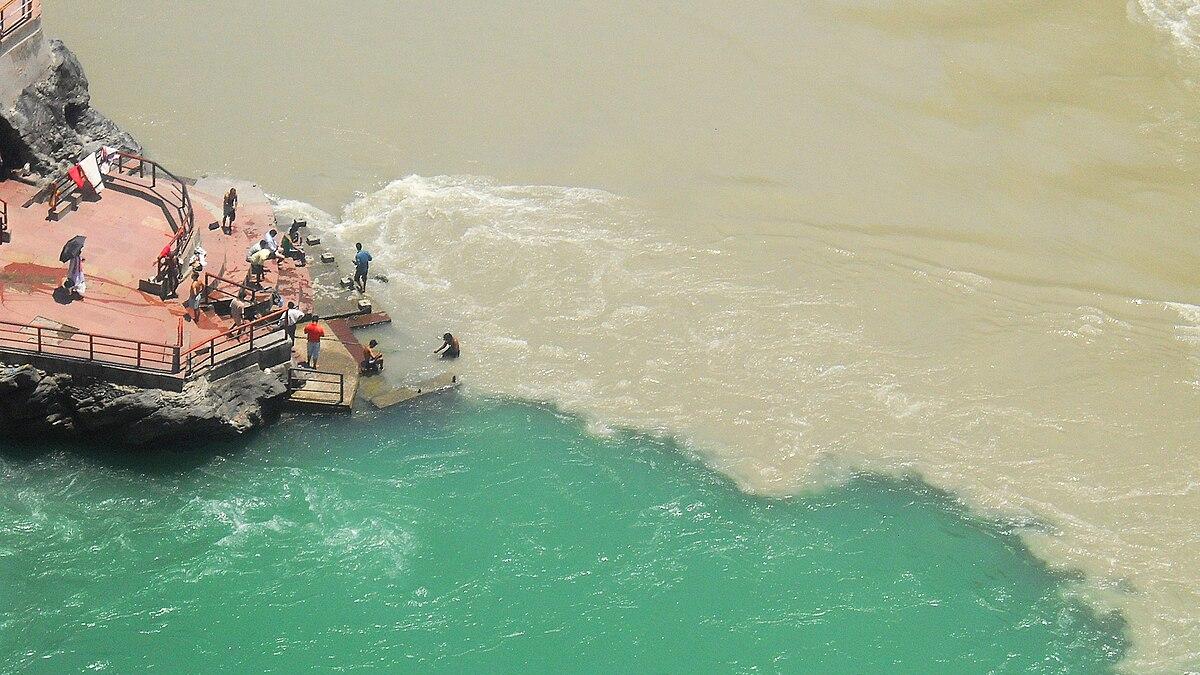
In India, one of the most striking examples appears at Devprayag in Uttarakhand. Here, the Alaknanda and the Bhagirathi rivers meet to form the Ganga —yet for a short stretch, they flow side by side without fully mixing. One runs clearer, the other darker, creating a visible seam where two identities briefly remain separate before becoming one.

This phenomenon isn’t unique to India. Halfway across the world, in the Amazon rainforest, the Rio Negro and the Solimões rivers travel together for nearly six kilometres without blending. The contrast is dramatic: the inky-black waters of the Rio Negro alongside the muddy brown Solimões, divided by a line so sharp it looks almost drawn.

The Rio Negro and the Solimões rivers in Amazon rainforest
| Photo Credit:
Photo: Wikimedia Commons

A similar sight unfolds in Europe, where Switzerland’s Rhone River meets the Arve in Geneva. The glacier-fed Arve, heavy with silt, flows alongside the clearer Rhone, forming a striking two-toned river that has become a favourite for photographers and curious onlookers alike.

From the Himalayas to the Amazon and the Alps, these rivers show that even in constant motion, water can hold its boundaries—at least for a while.

First instinct vs reality

Our first instinct is simple: water should mix instantly. After all, pour a glass of water into another and the boundary disappears in seconds. We grow up learning that liquids flow, spread, and merge without resistance—so when two rivers meet, we expect the same seamless union.

But rivers are not just water in motion. They are complex systems, carrying heat, sediment, speed, and history from the landscapes they pass through. When two such systems collide, nature doesn’t always follow our everyday expectations. Instead of instant blending, the rivers may move alongside each other, maintaining their differences—at least for a while—revealing that in the natural world, mixing is not automatic, but conditional.

The core science: What keeps rivers apart

The line between two rivers is not imaginary, it is shaped by measurable physical differences. When rivers meet, several factors decide whether they blend smoothly or hold their distance.

Temperature differences play a key role. Warmer water is lighter, while colder water is heavier. When rivers with different temperatures collide, they can flow alongside each other instead of mixing immediately, much like warm air rising above cold air.

Density and sediment load add another layer. Rivers carrying heavy sediment—silt, sand, or clay—are denser than clearer rivers. This difference makes mixing slower, allowing each river to maintain its colour and character over long stretches.

Speed and volume of flow matter as well. If one river is faster or carries more water, it can push past the other rather than blend with it. The stronger current creates a moving boundary where the two flows meet but do not easily merge.

Finally, chemical composition influences how waters interact. Variations in dissolved minerals, organic matter, or salinity can subtly alter water behaviour, reinforcing separation.

Together, these differences create temporary yet visible boundaries—natural lines drawn not by magic, but by physics patiently at work.

The invisible physics at work

What we see on the surface is only part of the story. Beneath it, invisible forces decide how and when rivers will finally mix.

When two rivers meet, their waters may flow in relatively smooth, parallel layers, a pattern known as laminar flow. With limited turbulence to stir them together, the boundary between the rivers remains sharp. Only when the flow becomes rough and chaotic does turbulence begin to break that line, pulling the waters into each other.

Another process at play is stratification. Differences in temperature, density, or sediment can cause one river to flow slightly above or below the other, reducing contact and slowing down mixing even further.

This is where mixing timescales come in. Mixing is not instantaneous, it takes time, distance, and energy. In many cases, the rivers do blend completely, but only kilometres downstream, long after the dramatic visual boundary has disappeared from view.

In other words, the rivers are not refusing to mix. They are simply mixing on nature’s schedule, not ours.

Nature’s slow handshake

Given enough distance, time, and turbulence, the boundary between rivers slowly fades. Currents stir, sediments settle, temperatures equalise, and the waters finally become one. What looks like refusal is really patience. The rivers do mix, just on nature’s timeline, not ours.

Why it matters

This slow mixing shapes river ecology, influencing where fish, plants, and microorganisms thrive. Scientists also use these boundaries to track pollution, seeing how contaminants spread downstream. In a warming world, such river behaviour helps researchers study glacial melt and climate change. To scientists, rivers are not just channels of water, but living systems that carry information about the land they flow through.

A broader pattern in nature

These invisible boundaries aren’t limited to rivers. They appear in oceans where currents meet, in the atmosphere where air masses collide, and in ecosystems where habitats overlap. Nature often allows separation and interaction to exist side by side.


Source link

Science

Post navigation

Previous Post: Access Denied
Next Post: Access Denied

Related Posts

  • Chip that steers terahertz beams sets stage for 6G internet
    Chip that steers terahertz beams sets stage for 6G internet Science
  • Scientists discover new fungus species in Thrissur
    Scientists discover new fungus species in Thrissur Science
  • Lot of interest about Gaganyaan world over: Shubhanshu Shukla tells PM Modi
    Lot of interest about Gaganyaan world over: Shubhanshu Shukla tells PM Modi Science
  • Archaeologists, Sanskrit scholars tie up to decipher Rigveda text
    Archaeologists, Sanskrit scholars tie up to decipher Rigveda text Science
  • Watch: Did you know 40 per cent of Australia’s energy comes from solar power?
    Watch: Did you know 40 per cent of Australia’s energy comes from solar power? Science
  • Taking away Fukushima’s melted nuclear gas will likely be tougher than the reduce of plant’s wastewater
    Taking away Fukushima’s melted nuclear gas will likely be tougher than the reduce of plant’s wastewater Science

More Related Articles

7 researchers of KLE Technological University among top 2% of scientists: Stanford University 7 researchers of KLE Technological University among top 2% of scientists: Stanford University Science
NASA touts space research in anti-cancer fight NASA touts space research in anti-cancer fight Science
Understanding the Impact on Elephants and Tigers in India Understanding the Impact on Elephants and Tigers in India Science
AI can make drug-testing more precise, relevant to human biology AI can make drug-testing more precise, relevant to human biology Science
Study finds distinct blood markers for early detection of gallbladder cancer Study finds distinct blood markers for early detection of gallbladder cancer Science
Deep tech investments in India doubling every three years, crossed  billion between 2021-23: Report Deep tech investments in India doubling every three years, crossed $1 billion between 2021-23: Report Science
SiteLock

Archives

  • May 2026
  • April 2026
  • March 2026
  • February 2026
  • January 2026
  • December 2025
  • November 2025
  • October 2025
  • September 2025
  • August 2025
  • July 2025
  • June 2025
  • May 2025
  • April 2025
  • March 2025
  • February 2025
  • January 2025
  • December 2024
  • November 2024
  • October 2024
  • September 2024
  • August 2024
  • July 2024
  • June 2024
  • May 2024
  • April 2024
  • March 2024
  • February 2024
  • January 2024
  • December 2023
  • November 2023
  • October 2023
  • September 2023
  • August 2023
  • July 2023
  • June 2023
  • May 2023
  • April 2023
  • March 2023
  • February 2023
  • January 2023
  • December 2022
  • November 2022
  • October 2022
  • September 2022
  • August 2022
  • July 2022
  • June 2022
  • May 2022

Categories

  • Business
  • Nation
  • Science
  • Sports
  • World

Recent Posts

  • 65-foot trident inaugurated at Kailasagiri; MP outlines vision for Global Tourism Hub
  • IPL 2026: Delhi Capitals’ batters have failed to take responsibility, says Venugopala Rao
  • ‘Jhalmuri’ turns victory flavour at BJP government’s maiden oath ceremony in West Bengal
  • Labour loses power in Wales for first time since 1999 devolution
  • RBI officers seek Governor’s intervention to correct promotion policy

Recent Comments

  1. Jamesnep on UP Teacher Who Asked Students To Slap Muslim Classmate
  2. CalebKar on UP Teacher Who Asked Students To Slap Muslim Classmate
  3. Alvinadubs on UP Teacher Who Asked Students To Slap Muslim Classmate
  4. CharlesVOX on UP Teacher Who Asked Students To Slap Muslim Classmate
  5. Robertgop on UP Teacher Who Asked Students To Slap Muslim Classmate
  • Access Denied Business
  • Indian-origin Cincinnati Mayor Aftab Pureval wins second term, defeats V-P J.D. Vance’s half-brother Cory Bowman
    Indian-origin Cincinnati Mayor Aftab Pureval wins second term, defeats V-P J.D. Vance’s half-brother Cory Bowman World
  • Access Denied Sports
  • India Thrash Malaysia 4-0 In Women’s Asian Champions Trophy Hockey Opener
    India Thrash Malaysia 4-0 In Women’s Asian Champions Trophy Hockey Opener Sports
  • Anushka Sharma’s Reaction After Virat Kohli Almost Falls For First-Ball Duck Goes Viral – Watch
    Anushka Sharma’s Reaction After Virat Kohli Almost Falls For First-Ball Duck Goes Viral – Watch Sports
  • Kotak Mahindra’s Shares Fall After Ban On Cards And New Online Clients
    Kotak Mahindra’s Shares Fall After Ban On Cards And New Online Clients Nation
  • Access Denied
    Access Denied Nation
  • Access Denied World

Editor-in-Chief:
Mohammad Ariff,
MSW, MAJMC, BSW, DTL, CTS, CNM, CCR, CAL, RSL, ASOC.
editor@artifex.news

Associate Editors:
1. Zenellis R. Tuba,
zenelis@artifex.news
2. Haris Daniyel
daniyel@artifex.news

Photograher:
Rohan Das
rohan@artifex.news

Artifex.News offers Online Paid Internships to college students from India and Abroad. Interns will get a PRESS CARD and other online offers.
Send your CV (Subjectline: Paid Internship) to internship@artifex.news

Links:
Associate Journalism
About Us
Privacy Policy

News Links:
Breaking News
World
Nation
Sports
Business
Entertainment
Lifestyle

Registered Office:
72/A, Elliot Road, Kolkata - 700016
Tel: 033-22277777, 033-22172217
Email: office@artifex.news

Editorial Office / News Desk:
No. 13, Mezzanine Floor, Esplanade Metro Rail Station,
12 J. L. Nehru Road, Kolkata - 700069.
(Entry from Gate No. 5)
Tel: 033-46011099, 033-46046046
Email: editor@artifex.news

Copyright © 2023 Artifex.News Newsportal designed by Artifex Infotech.