



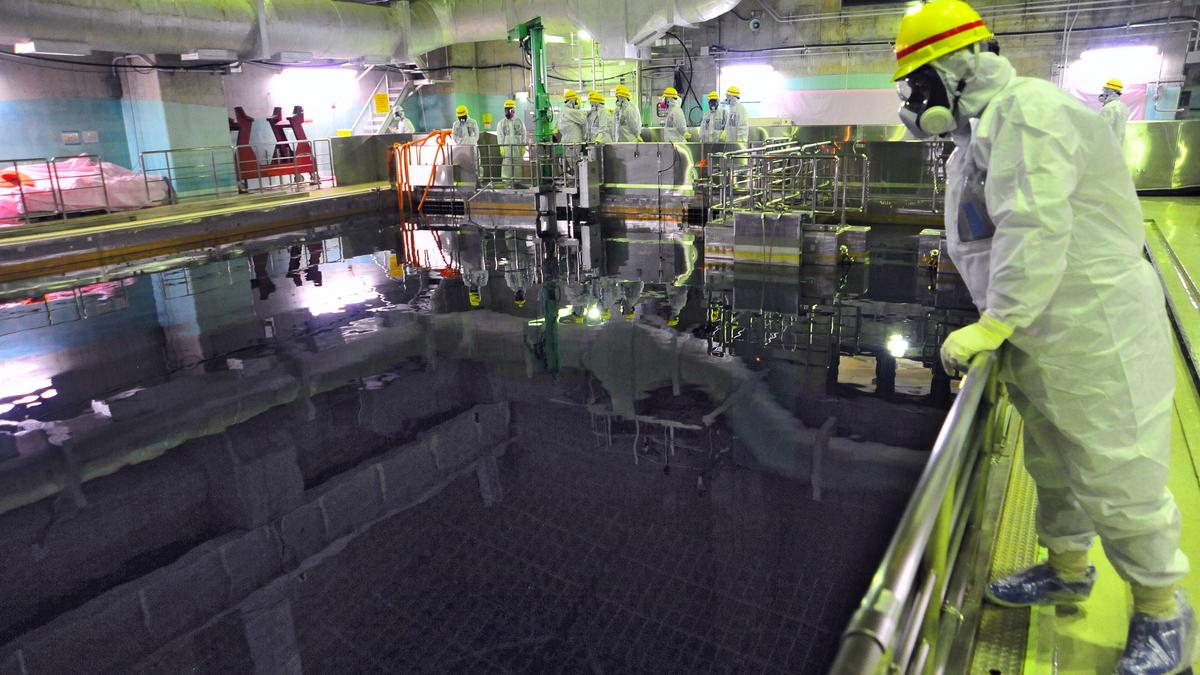
A member of the Canadian Nuclear Safety Commission looks over ths spent fuel pool at the Fukushima nuclear power plant, 2013.
| Photo Credit: IAEA Imagebank (CC BY-SA)
In the high-stakes world of preventing governments from secretly developing atom bombs, the ability of inspectors to check what happens inside a reactor core — without stepping foot inside the highly radioactive structure — is a holy grail.
For many decades, International Atomic Energy Agency inspectors have used cameras and close inspections to ensure operators are not diverting spent nuclear fuel for illicit uses.
A new study in Physical Review Letters by researchers of the ‘Double Chooz’ Collaboration in France has reported a breakthrough in this domain. The team has reported the first measurement of the signature of particles emitted by spent nuclear fuel, which a detector can detect even from a distance.

Remotely verify
These particles are called neutrinos. They are subatomic particles and are very, very light. They interact so weakly with matter that around 100 billion neutrinos pass through each one of your fingers every second and your body doesn’t even notice.
The nuclear fuel inside a reactor produces antimatter neutrinos in similarly staggering quantities. But while scientists have studied these emissions from active reactors for six decades, the low-intensity stream of neutrinos that persists after a reactor has shut down has remained elusive. This stream is produced by isotopes such as Pr-144 and Rh-106, which continue to decay in the partially burnt fuel within the core and in nearby spent fuel cooling pools for a long time.
Using a detector located 400 m from the Chooz B nuclear power plant in France, the Double Chooz team analysed 2.5 weeks of data. In this window, when both of the plant’s reactor cores were simultaneously offline, the detector recorded around 106 neutrino candidate events.
The researchers used statistical methods to confirm the signal was not a fluke. The data showed that 56% of the signal originated from the reactor cores and 44% came from the cooling pools.
The ability to measure the residual flux allows monitors to remotely verify the spent fuel inventory. If a rogue state clandestinely removes fuel assemblies from a cooling pool to extract plutonium — a key ingredient of nuclear weapons — the neutrino glow from that pool would diminish.

Future detectors
Soviet scientists pioneered this way of using neutrinos in 1978. Now, the Double Chooz team has become the first to describe the energy levels of the neutrinos emitted by spent fuel at high precision. The unique pattern of these energy levels is the signature.
Scientists have also worked out a way to use neutrino detectors to estimate the plutonium content in a reactor core in real-time. This information can be used to check if operators are swapping fuel out prematurely — a common tactic to harvest weapons-grade plutonium.
In a 2019 study in Nature Communications, researchers in the U.S. also reasoned that compact and portable detectors of the future could help authorities discover small, undeclared facilities used to produce fissile materials. However, building such machines is still a significant challenge. Current detectors are large and stationary because they need to filter out cosmic rays, which are constantly streaming in from space.
One of the Double Chooz detectors itself weighed over 500 tonnes, with 300 tonnes of shielding alone.
Published – August 05, 2026 09:30 am IST